
An endorsement deal can look simple until money gets involved. A brand may pay crores for one campaign alone. Yet the real value goes beyond the agreed payment amount. Content rights, exclusivity, and reputation can shape that value. Even campaign timing can create costly issues for both sides.
A verbal deal cannot define these details with enough care. A basic influencer brief cannot protect either party fully. That makes brand endorsement contracts vital for serious campaigns. They spell out what each side must deliver clearly. They also set limits on what each side receives.
This matters more when celebrities or athletes join campaigns. High-reach creators can also bring greater brand and legal risks. One unclear clause can create disputes months after launch. A strong contract helps both sides avoid such costly gaps.
India’s creator economy also makes these deals more important. EY estimates India’s influencer marketing industry could reach ₹3,375 crore. The report also points toward steady growth through 2026. That growth means more brands now enter creator deals. It also means more brand endorsement contracts need clear terms from day one.
So, what should a strong endorsement contract cover today? I’ll break down key clauses, risks, and negotiation points. We’ll also look at payment, rights, exclusivity, and termination. Finally, we’ll cover smart ways both sides can negotiate. That approach can help turn complex deals into clear partnerships.
What are brand endorsement contracts?
A brand endorsement contract sets clear terms for an endorsement deal. It forms a legal agreement between a brand and an endorser. The contract defines what each side must deliver. It also states how and when the brand pays. Both sides can set the campaign start and end dates. They can define where and how content may appear. The deal can also limit work with rival brands. It can set approval rights for posts, ads, and scripts. Disclosure rules can also protect audiences and both parties. The contract can state when either side may exit.
Unlike general advertising agreements, brand endorsement contracts involve personal influence. The endorser’s image can directly shape brand trust. An employment contract instead governs an ongoing work relationship. An endorsement deal usually covers a specific campaign period. It can also cover one or several campaign deliverables.
A clear contract protects both sides from unclear demands. It gives brands control over agreed campaign outcomes. It also gives endorsers clear limits around brand demands. These terms matter across different types of brand endorsements. They also support clear rules around endorsement in advertising. In short, a strong contract makes expectations clear early.
Know these 8 key clauses in brand endorsement contracts
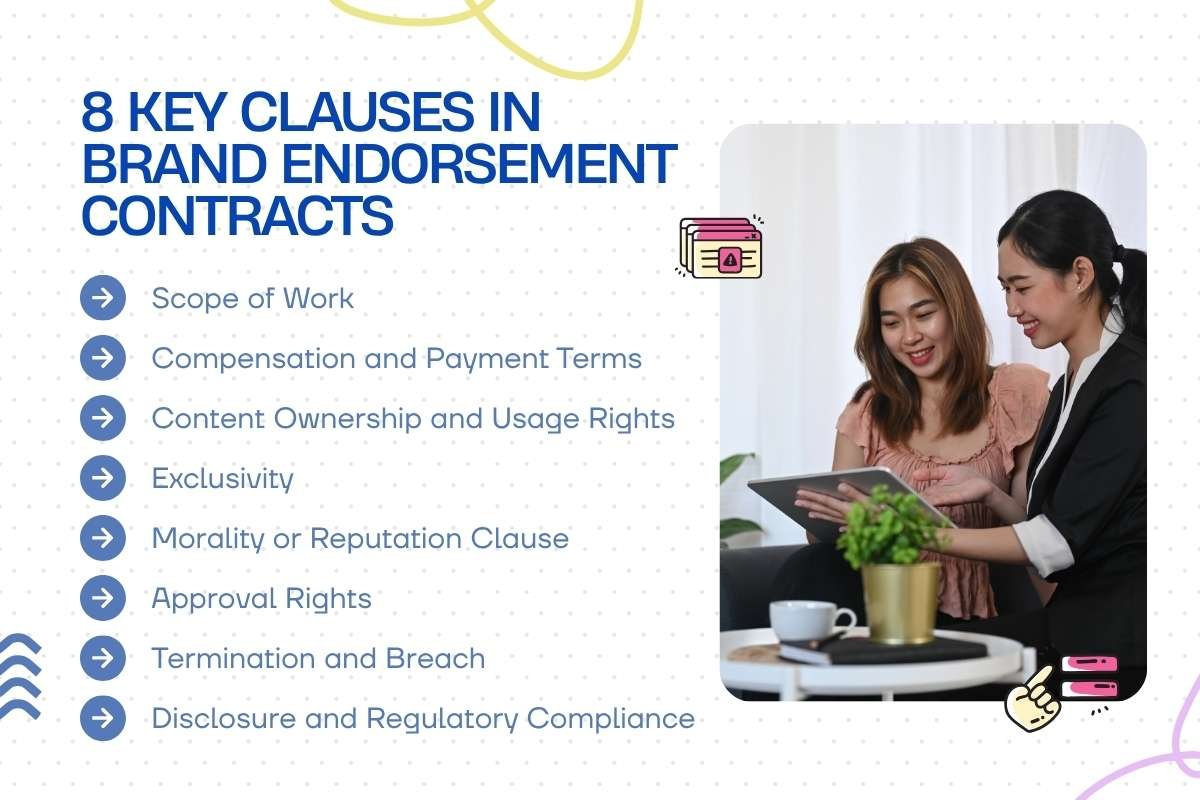
A strong endorsement deal needs more than a name and fee. Each clause should answer one clear question for both sides. That clarity can prevent disputes before they ever start. Here are the clauses that deserve the most care.
1. Scope of work
The scope should state every promised deliverable in detail. It should list posts, videos, events, interviews, and appearances. It should also state dates, formats, and posting channels. Brands should avoid phrases like “reasonable promotional support” here. Such vague wording can create very different expectations later.
2. Compensation and payment terms
The contract should state the full fee and payment dates. Some deals use fixed fees for agreed campaign work. Others add bonuses when campaigns reach set performance goals. Performance-linked payments need clear metrics and tracking rules. The contract should also cover taxes and approved expenses. Both sides should know who pays each cost beforehand.
3. Content ownership and usage rights
Usage rights often create the biggest value gap in deals. The contract should state who owns each piece of content. It should also list every platform where brands can use it. These platforms might include Instagram, YouTube, websites, and TV. The agreement should define the exact territory and usage period.
Perpetual rights can raise the value of all brand endorsement contracts. They let brands reuse content long after campaigns end. That extended use can justify a much higher endorsement fee. A creator should never accept “all media” without clear limits. Both sides should define duration, territory, format, and purpose.
4. Exclusivity
Exclusivity stops endorsers from promoting certain rival brands. The contract should define which brands count as competitors. It should also define the restricted period with exact dates. Broad terms can unfairly limit future deals for endorsers. Brands should link exclusivity to real market competition needs.
5. Morality or reputation clauses
Morality clauses protect both sides when reputations face harm. They can cover misconduct, scandals, fraud, or serious public claims. The contract should explain what triggers these rights clearly. It should also state who can end the deal. Payment outcomes should also follow clear rules after termination.
6. Approval rights
Approval rights decide who controls campaign content before publication. Brands may need approval over claims and brand messaging. Endorsers may need approval over edits using their image. The contract should cover scripts, captions, edits, and final creative. Clear timelines can also stop approval delays from hurting campaigns.
7. Termination and breach
Every contract should explain when either side can exit. It should cover missed work, late delivery, and non-performance. It should also address major breaches and reputation events. The contract should state notice periods and cure periods. It should explain refunds, damages, and unused content rights too.
8. Disclosure and regulatory compliance
Paid endorsements need clear disclosure when audiences could face confusion. Indian brands should follow the ASCI Guidelines for Influencer Advertising. The Consumer Protection Act also supports honest advertising practices. Creators should clearly mark paid partnerships where required. Brands should include these duties directly within brand endorsement contracts.
One clause many people misunderstand
Advertising lawyer advice can add real value here. A common mistake involves treating usage rights like simple permission. In practice, usage rights can change the deal’s value greatly. A contract specialist should review these rights before signing. That review can protect both money and creative control.
How do brand endorsement contracts differ by endorser?
Not every endorser brings the same value or risk. So, brands should not use one contract for everyone. A celebrity deal needs different terms from creator deals. The right contract should match the endorser’s role.
| Endorser | Contract priority |
| Celebrity | Exclusivity, reputation, usage rights |
| Influencer | Deliverables, platforms, analytics, disclosure |
| Athlete | Category exclusivity, appearances, image rights |
| Micro-influencer | Content needs, usage rights, payment |
Why should the contract match the endorser?
Celebrity deals often focus on image and long-term value. Brands may also seek broad rights across many media. Exclusivity can also limit future work with rival brands. That makes clear terms vital before either side signs.
Influencer deals often focus more on content and reach. The contract should list each post, reel, story, or video. It should also name platforms and expected campaign metrics. Disclosure rules should also form part of every creator deal.
Athletes bring another set of contract needs altogether. Their brand endorsement contracts often involve events, appearances, and image rights. Category exclusivity can also carry major value for brands. A sportswear deal may limit rival sportswear partnerships, for example.
Micro-influencers often need simpler but precise contract terms. Brands should still define content needs, rights, and payment. Small audience size does not remove contract risk completely. A creator’s content can still gain wide reach later.
This difference matters when choosing celebrities for endorsements. It also helps when comparing micro-influencers and mega-celebrities. The same logic applies to celebrity endorsement vs influencer marketing. The best contract always reflects the deal’s real value.
What should brands negotiate?

A good deal starts with clear terms, not just a lower fee. Brands should negotiate each term based on campaign needs. Small changes can also shift the deal’s total value. Here are the terms worth reviewing before signing.
Campaign duration
Set exact start and end dates for every campaign. A longer term can limit the endorser’s future work. It can also keep brand rights active for longer. So, brands should pay only for needed campaign time.
Number of deliverables
List every post, video, event, and appearance clearly. This keeps both sides aligned on the expected workload. It also prevents extra work from appearing without warning. Brands should link each deliverable to a clear payment term.
- Content Revisions
Set a clear number of revision rounds beforehand. Too many edits can delay campaigns and increase creator workload. Brands should reserve revisions for key factual or brand issues. Endorsers should also protect their time from endless changes.
Usage period
Brand endorsement contracts must define how long the brand can reuse content. A thirty-day social campaign differs from lifetime media use. Longer rights usually create greater value for the brand. That wider value should be reflected in the negotiated fee.
Geographic rights
State exactly where the brand can use content. Rights across India differ from global rights in value. Brands should avoid paying for regions they never target. Endorsers should also protect future deals outside agreed markets.
Exclusivity period
Exclusivity can block other income for the endorser. Brands should limit it to a useful campaign period. Endorsers should seek fair value for every restriction. Both sides should also define exact competing categories.
Competitor definition
Never leave the word “competitor” open to interpretation. List specific brands or clearly defined market categories instead. This prevents disputes when new partnerships appear later. Clear definitions also protect the endorser’s future earning power.
Event appearances
State how many events the endorser must attend. Include event length, location, dates, and appearance duties. This avoids disputes over extra appearances during campaigns. Brands should also define reasonable notice for event requests.
Travel expenses
Travel costs can add up during national campaigns. The contract should state who pays travel and lodging. It should also cover local transport and approved meals. Clear expense rules prevent small costs from causing conflict.
Cancellation terms
Every deal needs clear rules for early cancellation. The contract should explain notice periods and payment outcomes. It should also address cancellations caused by either party. This protects both sides when campaign plans change suddenly.
Performance bonuses
Brands can reward results through clear bonus structures. These bonuses should use measurable targets and agreed tracking. Sales, views, leads, or conversions can support such payments. Both sides should define data sources before campaign launch.
Renewal terms
A strong campaign may lead to a renewed partnership. The contract should explain how renewal talks will work. It can set notice periods, pricing rules, or first rights. This gives brands planning value without locking future prices.
A simple example: why usage rights change value?
Imagine a brand hires an actor for social content. The original deal covers Instagram and Facebook for three months. Now, the brand wants TV, OTT, and outdoor ads. That change greatly expands the content’s commercial reach and lifespan.
The brand now gains far more value from one shoot. So, the original fee may no longer fit fairly. The endorser can negotiate extra payment for wider usage. The brand gains broader rights while keeping costs transparent.
This approach makes brand endorsement contracts fairer for everyone.
Common contract risks and red flags

A contract can look complete while hiding costly gaps. Most problems start with terms that sound too broad. A quick review can help spot these risks early.
Here are the red flags worth checking before signing.
1. Vague deliverables
Avoid terms like “regular promotion” or “social support.” Such phrases leave room for different views on workload. Every post, video, event, and appearance needs clear details. Dates, formats, platforms, and quantities should appear in writing.
2. Unlimited content usage
Unlimited usage rights can greatly increase campaign value. A brand might reuse content across many media channels. That could include TV, OTT, websites, and outdoor ads. The contract should set clear limits on usage rights.
3. Overly broad exclusivity
Broad exclusivity can block valuable future work for endorsers. A vague “competing brands” clause creates even greater risk. The contract should name categories, brands, and restricted periods. That keeps restrictions fair and easier to enforce.
4. No cancellation clause
Campaign plans can change because markets and strategies shift. Without cancellation terms, both sides face costly uncertainty. The contract should explain notice, refunds, and remaining payments. It should also cover cancellation caused by either side.
5. No disclosure requirements
Paid endorsements need clear disclosure for Indian audiences. ASCI’s influencer rules require clear labels for paid promotions. Brands should include these duties directly within campaign contracts. Creators should also know which disclosure labels they need.
6. Unclear payment milestones
Payment terms should never rely on vague promises. The contract should state dates and payment conditions clearly. It should also define taxes, expenses, and delayed payment rules. Clear milestones help both sides manage cash flow better.
7. No approval process
Content disputes often start when approval rights remain unclear. The contract should define who reviews scripts and final edits. It should also set response times for each approval stage. That keeps campaign timelines from slipping without reason.
8. Weak reputation protection
Both sides face reputation risks during public campaigns. A morality clause should define serious conduct and response rights. It should also explain termination and payment outcomes clearly. This protects both parties when public trust changes suddenly.
9. No content ownership terms
Never assume content ownership transfers automatically after payment. The contract should define ownership and licensing rights separately. It should also cover edits, reposts, and future campaigns. This prevents disputes when content gains value later.
10. Missing dispute-resolution terms
Disputes can become expensive when contracts lack clear procedures. The agreement should state how both sides resolve conflicts. It can define negotiation, mediation, arbitration, or court processes. It should also specify governing law and legal jurisdiction.
These risks show why careful review matters before signing. Indian advertisers should also follow applicable consumer protection rules. ASCI’s guidelines help set clear standards for influencer disclosures.
Clear brand endorsement contracts cannot remove every endorsement risk from campaigns. It can, however, make those risks easier to manage.
How to structure a strong contract?
A strong contract should make every key duty clear. Before signing, I would check these points first:
- Define every deliverable: List posts, videos, events, and appearances.
- Specify payment and deadlines: Add fees, milestones, taxes, and dates.
- Set clear usage rights: Name platforms, regions, formats, and time limits.
- Define competitors: List brands or categories covered by exclusivity.
- Include disclosure requirements: Follow applicable Indian advertising disclosure rules.
- Add termination conditions: Explain breach, cancellation, notice, and payment outcomes.
- Establish approval processes: Set reviewers, deadlines, revisions, and final sign-off.
- Seek legal review: Ask qualified counsel to review the agreement.
Example contract structure:
Simple brand endorsement contracts might follow this order:
1. Parties
This Endorsement Agreement (“Agreement”) is entered into on [Date] by and between:
Brand: [Legal name], a company incorporated under the laws of [Jurisdiction], with its registered office at [Address] (“Brand”); and
Endorser: [Full legal name], residing at [Address], professionally known as [Public name] (“Endorser”).
The Brand and Endorser are each a “Party” and together the “Parties.”
2. Campaign
The Brand appoints the Endorser to promote [Product or Service] under the campaign titled “[Campaign Name]” (“Campaign”).
The Campaign will run from [Start Date] through [End Date], unless terminated earlier under this Agreement. The intended audience is [Description of target audience], and the Campaign will be conducted through the channels described below.
3. Deliverables
The Endorser will provide the following deliverables:
a. [Number] original [posts/reels/videos/stories] on [Platform];
b. [Number] appearances at [Event or location] on [Dates];
c. [Number] product photographs or other approved promotional materials; and
d. Reasonable cooperation with the Brand’s Campaign brief, provided that requests remain consistent with the Endorser’s public image and applicable law.
The Endorser will create the deliverables personally and will not delegate material performance obligations without the Brand’s prior written consent. All content must be original, accurate, and compliant with applicable law and platform rules.
4. Payment
In consideration of the services, the Brand will pay the Endorser a total fee of ₹[Amount] plus applicable taxes, subject to receipt of valid invoices and legally required tax documentation.
Payment will be made as follows:
a. [Percentage or amount] within [Number] business days after signing;
b. [Percentage or amount] upon approval of the first deliverable; and
c. The remaining balance within [Number] business days after completion and acceptance of all deliverables.
The Brand will reimburse reasonable, pre-approved expenses supported by receipts. The Endorser is responsible for all personal taxes arising from payments under this Agreement, except taxes the Brand is required by law to withhold.
5. Usage Rights
The Endorser grants the Brand a non-exclusive, worldwide, royalty-free license to use, reproduce, publish, display, distribute, and communicate the approved deliverables and the Endorser’s name, image, voice, and approved likeness solely in connection with the Campaign.
This license will remain effective for [Number] months after the Campaign ends and will apply to [specified platforms, media, and formats]. The Brand may make reasonable technical edits, including resizing, formatting, captioning, and cropping, but may not materially alter the Endorser’s statements or create a misleading impression.
The Brand may not use the Endorser’s materials for unrelated campaigns, political advertising, or product claims not approved by the Endorser without separate written consent.
6. Exclusivity
During the Term and for [Number] months afterward, the Endorser will not provide substantially similar promotional services for the following competing brands or categories: [List competitors or categories].
This restriction applies only to [Territory] and does not prevent the Endorser from accepting engagements that were disclosed to and approved by the Brand in writing before this Agreement was signed.
7. Approvals
The Brand will provide a written brief, required claims, brand guidelines, and deadlines. The Endorser will submit drafts at least [Number] business days before the scheduled publication date.
The Brand will provide consolidated comments within [Number] business days after receiving a draft. The Endorser will make up to [Number] reasonable rounds of revisions at no additional charge. Any material change in scope requires written agreement on additional fees and deadlines.
No deliverable may be published using the Brand’s trademarks or Campaign materials until the Brand gives written approval. Approval does not relieve either Party of responsibility for its own legal obligations.
8. Disclosure and Compliance
The Endorser will clearly disclose the commercial relationship in each applicable communication using wording and placement required by applicable law, advertising guidelines, and platform rules, including a prominent “#Ad” or other legally appropriate disclosure where required.
The Endorser will not make false, misleading, unsubstantiated, or unauthorized claims about the Brand or its products. The Brand will provide substantiation for claims it requires the Endorser to make and will be responsible for claims supplied by the Brand, except to the extent the Endorser knowingly modifies or misrepresents them.
9. Termination
Either Party may terminate this Agreement for a material breach if the breaching Party fails to cure the breach within [Number] days after receiving written notice.
The Brand may terminate immediately if the Endorser engages in conduct that reasonably causes substantial reputational harm to the Brand or makes performance unlawful. The Endorser may terminate immediately if the Brand fails to pay an undisputed amount within [Number] days after written notice.
If the Brand terminates without cause, it will pay for accepted deliverables completed before termination and any non-cancellable, pre-approved expenses. If the Endorser materially breaches this Agreement, the Brand may withhold payment for rejected deliverables and seek repayment of amounts paid for undelivered services, subject to applicable law.
Upon termination, the Brand will stop new use of the Endorser’s materials, except that it may retain existing lawful publications for [Number] days to complete an orderly takedown.
10. Disputes and general terms
This Agreement is governed by the laws of India. The Parties will first attempt in good faith to resolve any dispute through discussions between authorized representatives. If the dispute is not resolved within [Number] days, it will be submitted to mediation in [City]. If mediation fails, the courts of [City, State] will have exclusive jurisdiction.
The Endorser is an independent contractor and is not an employee, partner, or agent of the Brand. Neither Party may assign this Agreement without the other Party’s prior written consent, except that the Brand may assign it to an affiliate or successor in connection with a merger or sale of substantially all relevant assets.
This Agreement, including its schedules, is the entire agreement between the Parties regarding the Campaign. Any amendment must be in writing and signed by both Parties. If any provision is held invalid, the remaining provisions will continue in effect.
Signatures
For the Brand:
Name: ____________________
Title: _____________________
Signature: _________________
Date: _____________________
For the Endorser:
Name: ____________________
Signature: _________________
Date: _____________________
This sample is for illustration only and should be reviewed and adapted by qualified legal counsel before use.
This structure gives both sides a clear deal map. It also helps legal counsel spot gaps before signing. Use this as a framework, not as legal advice. Each deal needs terms that fit its actual risks.
Conclusion:
Good brand endorsement contracts do much more than record payment terms. It protects brand trust, creator rights, and campaign value. It also sets clear rules for content ownership and usage.
I would never judge a deal by fame alone. A popular endorser does not always need wider contract rights. Brands should instead match terms with campaign goals and scope. That means paying for value, reach, rights, and real work.
Clear contracts also make endorsement strategies stronger from day one. They help both sides plan, create, measure, and respond better. In the end, strong terms support stronger brand endorsement [Pillar Article] partnerships. That makes brand endorsement contracts part of smart campaign planning.
FAQs
1. What is included in a brand endorsement contract?
A brand endorsement contract usually covers deliverables, payment, duration, and usage rights. It can also include exclusivity, approvals, disclosures, and termination terms. Strong agreements should define ownership, expenses, disputes, and performance bonuses. Clear terms help both sides avoid costly misunderstandings later.
2. How long do brand endorsement contracts usually last?
Most endorsement deals last for a defined campaign period. Short campaigns may run for several weeks or months. Longer deals can cover six months or several years. The contract should also define rights after the campaign ends.
3. What should brands negotiate in an endorsement contract?
Brands should negotiate deliverables, payment, usage rights, and campaign duration. They should also define exclusivity, competitors, approvals, and cancellation terms. Performance bonuses can reward results without raising upfront campaign costs. Legal review can also help identify unclear or risky terms.
4. What is an exclusivity clause in an endorsement contract?
An exclusivity clause limits an endorser’s work with competing brands. It should define competitors, categories, locations, and restricted periods clearly. Broad exclusivity can limit future income for endorsers. Brands should therefore request only restrictions that serve campaign goals.
5. Who owns content created under brand endorsement contracts?
Content ownership depends on the contract’s exact terms and rights. Some agreements transfer ownership to the brand after payment. Others give brands limited licenses for specific uses and periods. Both sides should clearly define ownership, edits, platforms, and future use.