
Some brand endorsements become part of how we recall brands. Think of Cadbury with Amitabh Bachchan. Think of Hyundai with Shah Rukh Khan. These pairings feel almost natural to Indian consumers today. Yet fame alone never makes an endorsement work well. The strongest campaigns join celebrity fit, audience trust, brand position, and repeat exposure. Recent research also shows why this match matters. A 2025 Journal of Marketing Analytics study examined how celebrity endorsements perform across media types. Another study found consumer-brand fit can matter more than celebrity-brand fit.
Today, I’ll break down memorable brand endorsement examples from India and abroad. I’ll look beyond famous faces and catchy ads. Instead, I’ll ask what made each pairing stick, what results followed, and what marketers can still learn today.
What makes a brand endorsement memorable? 6 things for a memorable campaign
A famous face can grab attention, but that alone cannot carry campaigns. There are six factors to consider when judging the examples below. Together, these factors show why some pairings stay strong for years.
1. Strong celebrity-brand fit
The celebrity should make sense for the brand and its core promise. Their public image should support what the brand wants people to feel. A poor fit can make the ad feel forced or even confusing.
Research backs this point with strong evidence. A meta-analysis studied 46 studies with 10,357 participants. It found stronger effects when celebrities matched the endorsed product well.
2. High audience recognition
Familiar faces can help people notice ads more quickly. They can also help viewers recall the message and brand. Yet recognition does not mean people will buy the product.
I would separate “I remember this ad” from “I chose this brand.” That gap matters when marketers judge campaign success. A celebrity can win attention without winning sales.
3. Clear brand association
Memorable brand endorsement examples make the celebrity and brand feel linked. Repeated exposure can strengthen that link over time. This matters because one ad rarely creates lasting brand memory.
Research suggests repeated celebrity pairings can increase endorsement effectiveness. The meta-analysis found effects can grow with greater exposure.
That helps explain why long partnerships often beat random celebrity appearances.
4. Cultural relevance
A campaign must fit the culture around its audience and moment. This matters even more across India’s many regions and languages.
A cricket star may work well for sportswear and fitness. A film star may carry more weight for mass brands. Festivals, cricket seasons, weddings, and local trends can also shape recall.
The best campaigns often feel timely without chasing every trend.
5. Creative execution
A celebrity cannot rescue a weak advertising idea for long. The concept still needs a clear story, line, hook, or joke.
Think about ads people quote years after they first aired. They remember the idea, not only the person. Strong creative work gives the celebrity something worth remembering.
This also prevents the so-called vampire effect, where the celebrity overshadows the brand. Research has examined how celebrity presence can affect brand recall itself.
6. Long-term consistency
The best part about famous people endorsements is that one appearance can create buzz, but repetition builds stronger links. Long partnerships let audiences see the same pairing across many campaigns.
This consistency can turn a celebrity into part of brand memory. Cadbury and Amitabh Bachchan show how that can work in India. The pairing feels familiar because audiences have seen it repeatedly.
So, do not judge an endorsement by fame alone. Instead, ask whether the person, brand, message, culture, and timing reinforce each other.
That gives us a better lens for the examples that follow.
7. Memorable brand endorsement examples everyone remembers
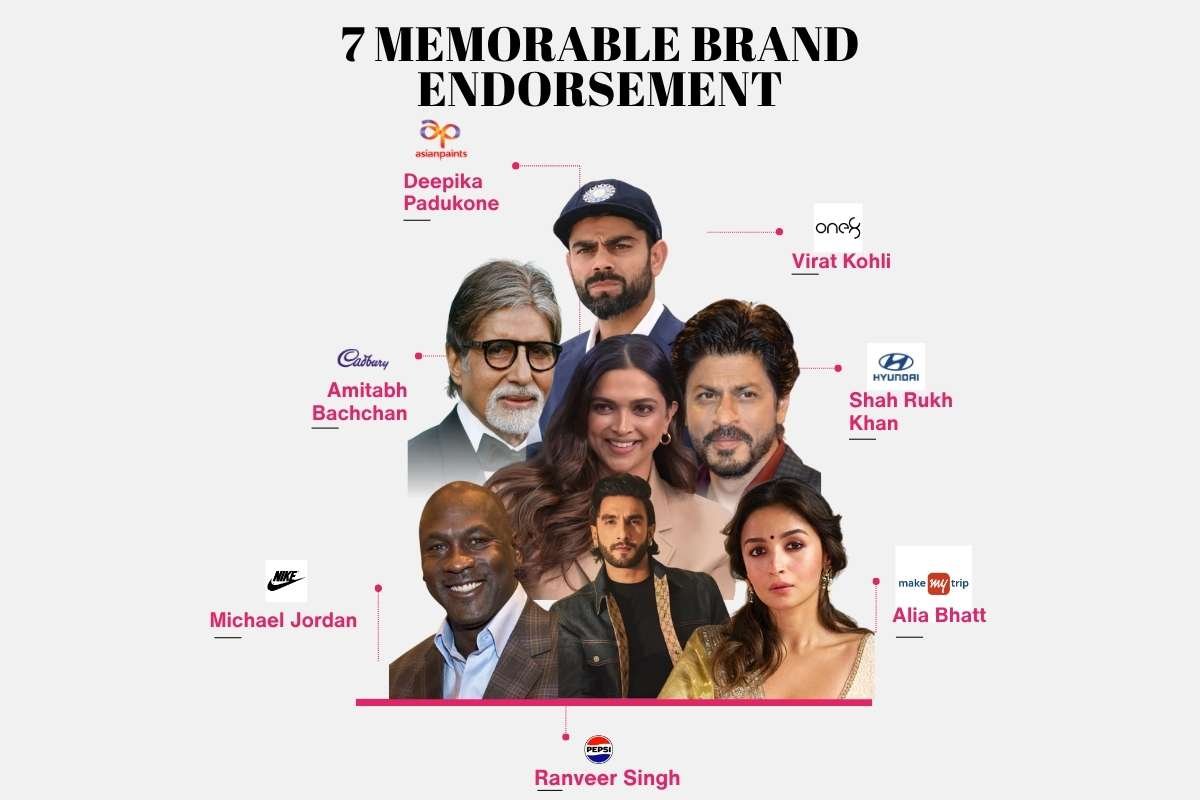
The best campaigns do more than put stars beside products. They make the pairing feel useful, natural, and worth recalling. The examples below show different ways brands create that effect. Some rely on trust, while others use humour or culture. One even blurs the line between endorsement and ownership.
Example 1: One8 by Virat Kohli
One8 offers a different model for celebrity-led brand building. Virat Kohli helped create the brand through his Puma partnership. The brand launched in 2016 with sportswear and lifestyle products.
Kohli’s image fits One8’s active, driven identity well. His cricket career gives the brand instant sports credibility. Yet One8 goes beyond simply placing Kohli inside ads. His name helps shape the product identity itself.
That distinction makes these memorable brand endorsement examples more useful. A celebrity can become part of the product story itself. That approach gives brands more room for deeper audience links.
The partnership also produced measurable commercial value for Puma India. One8 contributed about 10% of Puma India’s sales in 2019. Puma reported ₹1,413 crore in revenue that year.
The bigger lesson goes beyond follower counts or fame. Athletes can build brands when products match their personal worlds. Kohli’s later move also makes this lesson even stronger.
In 2025, Agilitas acquired One8 from Kohli’s earlier Puma setup. Kohli invested ₹40 crore and joined Agilitas as an investor.
What marketers can learn: Build around the person’s real expertise. Don’t just rent their fame for one campaign.
Example 2: Amitabh Bachchan and Cadbury
Few Indian pairings show long-term trust like Amitabh Bachchan and Cadbury. Cadbury brought Bachchan into its Dairy Milk advertising in 2004.
The timing mattered because Cadbury faced a major trust crisis. The brand faced backlash after worms appeared in some chocolates. Cadbury then worked to rebuild trust through new campaigns and communication.
Bachchan brought huge familiarity and credibility to that task. His image also carried strong family and cultural recognition across India. The pairing therefore felt bigger than another celebrity chocolate ad.
Cadbury also kept the partnership active across different campaign ideas. One later campaign used the familiar “Kuch Meetha Ho Jaye” platform. Bachchan appeared again in the 2007 television campaign.
That consistency helped connect Bachchan with Cadbury over time. Consumers could recognize the relationship without needing much explanation.
This example also shows an important marketing truth. Trust often matters more than short-term celebrity excitement.
What marketers can learn: Long partnerships can turn familiarity into brand memory. The right celebrity can support recovery after serious brand problems.
Example 3: Shah Rukh Khan and Hyundai
Shah Rukh Khan’s Hyundai relationship shows another route toward memorable brand endorsement examples. Khan first appeared for Hyundai’s Santro campaign in 1998. The relationship later continued across several Hyundai models.
Hyundai used Khan’s broad appeal to reach mass Indian audiences. His image also helped the brand present itself as modern and aspirational. That mix suited India’s fast-growing car market during that period.
The partnership gained strength through repeated exposure across many years. Hyundai itself once said Khan’s association strengthened brand recall.
That long run matters more than one viral television commercial. Consumers repeatedly saw Khan beside the Hyundai name. The celebrity therefore became part of the brand’s public memory.
The partnership also shows why reach can matter for mass products. Hyundai sells cars across many age groups and Indian regions. A widely known celebrity can help maintain broad attention.
Still, reach alone cannot create a strong brand association. Hyundai kept the relationship useful by connecting Khan with specific products.
What marketers can learn: Mass brands need broad appeal without losing brand meaning. A long partnership can make familiarity work harder.
Example 4: Deepika Padukone and Asian Paints
Deepika Padukone offers a different form of celebrity-brand fit. Asian Paints used her for its Royale Play campaigns. The brand linked her image with style, creativity, and personal taste.
One campaign even featured Padukone alongside her father, Prakash Padukone. That creative choice added warmth beyond the usual luxury appeal.
Asian Paints positioned Royale Play around personal home expression. Padukone’s public image supported that idea through style and visual appeal.
This is where memorable brand endorsement examples show an important pattern. Popularity matters, but congruence often matters even more. The celebrity should strengthen the feeling that the brand wants.
Asian Paints continued using Padukone for later luxury campaigns. Its 2025 Royale Glitz campaign again connected her with luxury décor. The campaign positioned walls as expressive parts of Indian homes.
The creative idea also matched Padukone’s polished visual identity. The result felt closer to lifestyle storytelling than product promotion.
What marketers can learn: Choose celebrities who embody your desired brand personality. Don’t choose stars only because audiences already know them.
Example 5: Ranveer Singh and Pepsi
Ranveer Singh brings a very different energy to Pepsi campaigns. His loud style and playful persona give brands strong creative material. Pepsi could use that energy for humour, music, and fast-moving stories.
That approach makes the celebrity part of the creative idea itself. Ranveer does not simply stand beside the Pepsi bottle. His exaggerated persona becomes part of the entertainment.
This matters because memorable advertising needs more than celebrity visibility. People often remember the joke, song, scene, or character first. The brand then benefits when that memory connects back to Pepsi.
Ranveer’s broader celebrity value also supports this approach. Kroll valued his brand at $162.9 million in 2025. That ranking placed him second among Indian celebrities.
However, brand value does not prove Pepsi campaign success. It only shows the scale of his public influence. Marketers should avoid treating celebrity value as campaign ROI.
The better lesson concerns creative fit. Ranveer works best when campaigns use his natural personality.
What marketers can learn: Let the celebrity’s real persona shape creative ideas. Forced scripts can waste even strong celebrity appeal.
Example 6: Alia Bhatt and MakeMyTrip
MakeMyTrip used Alia Bhatt and Ranveer Singh together. The brand built recurring characters around their on-screen chemistry. Those characters helped explain real travel problems through humour.
One campaign promoted MakeMyTrip’s “Book With Zero Payment” feature. The films showed a small-town couple discussing hotel booking choices. That setting helped the brand address users beyond major Indian cities.
The campaign also ran across television, social media, and outdoor media. It appeared during IPL coverage, news, music, and other channels.
MakeMyTrip had a clear reason for choosing this celebrity pairing. The company wanted an aspirational image with younger consumer appeal. It also wanted to keep its value-for-money positioning.
That balance makes the campaign particularly useful for marketers. Alia brings youth appeal, while the characters keep situations relatable.
The brand later brought the pair back for more campaigns. This consistency helped turn separate ads into one wider campaign world.
What marketers can learn: Use recurring characters when your product needs explanation. Familiar faces can make useful information easier to remember.
Example 7: Michael Jordan and Nike
For a global example, few partnerships beat Michael Jordan and Nike. Nike signed Jordan in 1984 for a signature basketball shoe. The deal created what became the Air Jordan line.
The partnership worked because Jordan represented elite sports performance. Nike could therefore connect athletic skill with product identity. The shoe also carried Jordan’s name, not merely his appearance.
The numbers show how far that strategy went. Air Jordan generated $126 million during its first year. Nike had expected only $3 million across three years.
That gap shows why ownership and product design can matter. Nike did not simply pay Jordan to appear inside advertisements. It built a product universe around him.
The partnership also kept expanding through new shoe models. That helped maintain the celebrity-brand link across decades.
This remains one of the strongest memorable brand endorsement examples because Jordan became part of Nike’s product architecture.
It also offers a useful contrast with traditional Indian endorsements. Most celebrity ads borrow attention from famous people. Nike helped turn the celebrity into a lasting product identity.
What marketers can learn: The strongest endorsements can create assets beyond advertising. Product design, naming, and ownership can deepen celebrity-brand links.
These seven campaigns show that fame rarely works alone. Each partnership gives the celebrity a clear role inside the brand story. That role might involve trust, aspiration, humour, culture, or product ownership.
The key lesson remains simple: Famous people endorsement works best when fame serves strategy. Brands should start with the message and audience, then choose the face. Not the other way around.
Sources & references:
- Economic Times. “Tie-up with Virat Kohli’s One8 contributes 10% of Puma India sales.” https://economictimes.indiatimes.com/industry/services/advertising/tie-up-with-virat-kohlis-one8-contributes-10-of-puma-india-sales/articleshow/74290143.cms
- Economic Times. “Virat Kohli to sell One8 to Agilitas Sports, invests Rs 40 crore for minority stake.” https://m.economictimes.com/industry/cons-products/garments-/-textiles/virat-kohli-to-sell-one8-to-agilitas-sports-invests-rs-40-crore-for-minority-stake/amp_articleshow/125837053.cms
- Exchange4media. “Big B’s ‘meetha’ urge finds way in new Cadbury Dairy Milk TVC.” https://www.exchange4media.com/advertising-news/big-b%27s-%27meetha%27-urge-finds-way-in-new-cadbury-dairy-milk-tvc-26565.html
- CarDekho. “Shahrukh Khan Onboard as Hyundai Xcent’s Brand Ambassador.” https://www.cardekho.com/india-car-news/shahrukh-khan-onboard-as-hyundai-xcents-brand-ambassador-14061.htm
- Times of India. “Deepika Padukone launches Asian Paints Royale Play’s new campaign.” https://timesofindia.indiatimes.com/entertainment/events/mumbai/deepika-padukone-launches-asian-paints-royale-plays-new-campaign-in-mumbai/articleshow/49216289.cms
- Impact. “Asian Paints’ new campaign highlights self-expression in home décor with Deepika Padukone.” https://www.impactonnet.com/more-from-impact/asian-paints-new-campaign-highlights-self-expression-in-home-dcor-with-deepika-padukone-11771.html
- Financial Express. “MakeMyTrip launches new campaign with Ranveer Singh and Alia Bhatt for its Book With Zero Payment feature.” https://www.financialexpress.com/business/brandwagon-makemytrip-launches-new-campaign-with-ranveer-singh-and-alia-bhatt-for-its-book-with-zero-payment-feature-3042272/
- Business Standard. “MakeMyTrip aims for the stars to boost hotel chain.” https://www.business-standard.com/article/management/makemytrip-aims-for-the-stars-to-boost-hotel-chain-116032101225_1.html
- Brand Equity. “Ranveer Singh and Alia Bhatt charm in MakeMyTrip ad.” https://brandequity.economictimes.indiatimes.com/news/research/advertising/ranveer-singh-and-alia-bhatt-charm-in-makemytrip-ad/105057740
- Guinness World Records. “Largest sneaker endorsement.” https://www.guinnessworldrecords.com/world-records/776613-largest-sneaker-endorsement
What these memorable brand endorsement examples have in common?

These campaigns look quite different on the surface. Yet they share a few strong traits beneath that surface. Those traits help explain why some celebrity partnerships last for years.
1. Celebrity-brand fit beats celebrity popularity.
A famous person can still make a poor brand choice. Fame may bring attention, but attention alone cannot create relevance. The celebrity should strengthen the feeling that your brand wants.
Researchers call this idea celebrity-brand congruence. It describes how well the celebrity matches the brand. A large meta-analysis reviewed 46 studies with 10,357 participants. It found stronger celebrity-brand endorsement effects when celebrity-product fit improved.
This explains why marketers should start with brand meaning. Then they should find a celebrity who fits that meaning.
2. Familiarity creates stronger associations.
People often need repeated exposure before brands stick. One campaign can gain attention for a short time. Repeated campaigns can build a much stronger mental link.
Long partnerships therefore offer an important advantage. Audiences start to expect the same face with the same brand. That link can then become part of everyday brand memory.
This pattern also explains why one-off celebrity ads can struggle. The star may remain memorable while the brand fades. Marketers should therefore track brand recall, not celebrity recall alone.
3. The campaign needs its own idea.
Celebrity attention gets people to notice an advertisement. A strong creative idea gives them something worth remembering.
That idea might involve humour, a story, music, or emotion. The celebrity then helps deliver that idea with greater impact. Without that creative hook, the celebrity can overshadow the brand.
I would therefore judge the ad before judging its star. Ask what viewers should remember after watching it. Then ask whether that memory points clearly back to your brand.
4. Audience fit matters
A celebrity can have millions of followers without reaching buyers. Brands need to study audience overlap before signing any deal. Age, location, income, interests, and purchase habits all matter.
A mass celebrity can suit products with broad national appeal. A smaller creator may suit a narrow product much better. This makes the audience fit a strategic choice, not just a rich choice.
That distinction matters when comparing celebrity and creator campaigns. Famous people endorsements can deliver scale, while creators can offer sharper targeting.
5. Authenticity affects credibility
People respond better when the celebrity feels believable. Their lifestyle, work, skills, or public image should support the product. A mismatch can make the endorsement feel like paid promotion.
Research on source credibility supports this broader point. Expertise and trustworthiness can shape how audiences respond to endorsed products. Source attractiveness can also influence attitudes toward advertising and brands.
That does not mean celebrities must use every product personally. Instead, the connection should make sense to the audience.
A cricketer promoting sportswear feels easy to understand. A film star promoting a niche technical product needs more proof. The stronger the fit, the less explanation the endorsement needs.
6. The real pattern is strategic consistency.
The most memorable brand endorsement examples connect person, audience, idea, and brand. Remove one piece, and the partnership can weaken quickly.
That gives marketers a better test than celebrity fame alone. Ask whether the person makes sense for the brand. Then test whether audiences overlap with the target buyers.
Finally, ask whether the creative idea deserves attention itself. When those pieces align, celebrity endorsement becomes more than borrowed fame. It becomes a repeatable part of brand strategy.
What marketers can learn from these endorsements?
The examples show what worked, but marketers need usable steps. You can turn those lessons into five clear decisions.
1. Start with the brand objective
Start by asking what the campaign must achieve first. Different goals need different celebrity strategies and success measures.
- Awareness: Choose someone who can build broad attention.
- Repositioning: Choose someone who reflects your desired image.
- Product launch: Choose someone who can create quick interest.
- Trust: Choose someone audiences already view as credible.
- Sales: Choose someone whose audience matches likely buyers.
A celebrity can support several goals at once. Still, one main goal should guide campaign planning.
2. Select the celebrity based on fit
Do not start with the biggest name you can afford. Start with the audience you need to reach first. Then check whether that person’s image supports your brand. Dr. Madhu Viswanathan, associate professor of marketing at the Indian School of Business, notes that creators are now “an increasingly important route to market for businesses and a trusted source of information for consumers.”
I would assess five areas before signing any deal:
- Audience: Does their audience match your buyers?
- Values: Do their values support your brand promise?
- Personality: Does their image fit your desired brand tone?
- Geography: Can they reach your key Indian markets?
- Reputation: Could their public actions harm your brand?
This process can save money before negotiations even begin. It also helps prevent fame from becoming the main selection rule.
3. Build a campaign around the person
Do not simply place a celebrity inside your old advertisement. Build an idea that uses what makes that person distinctive.
A cricketer can bring real sports insight to campaigns. A comic actor can make product demos feel more fun. A fashion star can help shape visual stories around style.
The best creative work gives the celebrity a clear role. Their presence should improve the idea, not merely decorate it.
This approach also helps brands avoid forgettable celebrity ads. Audiences should remember both the person and the brand message.
4. Plan for repetition
One advertisement can create buzz for several weeks. A planned partnership can build stronger associations over several years.
That does not mean repeating the same ad again and again. Instead, create new stories around the same brand-celebrity connection.
Use new products, moments, formats, and cultural events over time. Keep the core brand meaning steady while the creative work changes.
This strategy helped several campaigns in our earlier examples. Repetition gave audiences more chances to link celebrity and brand.
5. Measure outcomes
Do not judge an endorsement by views or likes alone. Match each metric with the campaign objective from the start.
Track metrics across several stages:
| Goal | Useful metrics |
| Awareness | Reach, impressions, brand awareness |
| Recall | Ad recall, brand recall, search growth |
| Engagement | Comments, shares, saves, video completion |
| Consideration | Traffic, product views, enquiries |
| Leads | Sign-ups, forms, qualified leads |
| Sales | Revenue, conversions, repeat purchases |
| Brand impact | Brand lift, preference, purchase intent |
The key is to connect these numbers with campaign cost. High reach can still produce weak returns if buyers do not act.
It can help you connect campaign spend with measurable business ROI.
The best endorsement strategy therefore starts before casting. Define the goal, find the right fit, build the right idea, repeat it well, and measure the result. That process turns celebrity fame into a marketing asset.
Famous people endorsement vs. Influencer-led campaigns
Celebrity and influencer campaigns can both drive strong results. The better choice depends on what your campaign needs most.
Famous people endorsements usually offer broad public recognition. A major film star, athlete, or public figure can reach audiences across cities and age groups. That reach can help brands build mass awareness faster.
Influencers usually offer tighter audience targeting and stronger niche relevance. Their followers often gather around shared interests, such as fitness, beauty, gaming, or food. Smaller creators can also build closer community ties through regular interaction.
Cost can also differ sharply between both options. Major celebrities often require larger budgets and longer planning cycles. Influencers can offer more flexible deals across several audience segments.
Choose celebrities when scale and awareness matter most. Consider creators when targeting and community engagement matter more.
The choice also depends on campaign length and product type. A national launch may favour a major celebrity. A niche product may gain more from several trusted creators.
The key point remains simple: Choose the audience strategy before choosing the face to create memorable brand endorsement examples.
When can memorable brand endorsement examples still fail?

A memorable advertisement does not always mean a successful campaign. People may remember the celebrity, joke, or slogan but forget the brand itself. Worse, they may remember the ad without ever buying the product.
Celebrity endorsements produced very different results across situations. Stronger effects appeared when the celebrity matched the endorsed product.
That means marketers should also study where endorsements can fail.
1. Celebrity controversy
A celebrity’s public actions can quickly affect brand perception. Scandals, legal issues, or offensive remarks can create unwanted brand links.
The risk becomes greater when audiences strongly connect the person with your brand. The same association that once helped you can then hurt you.
Brands should therefore check past conduct, current risks, and reputation. They should also prepare clear exit terms before signing major deals.
2. Poor celebrity-brand fit
A famous face cannot fix a weak celebrity-brand match. In fact, the wrong pairing can create negative reactions. Matching the celebrity with the product plays a major role.
This makes fit more important than fame alone. Your audience should understand why this person represents your brand.
3. The celebrity overshadows the product
Sometimes people remember the star but forget the brand. This problem can waste much of your advertising spend.
A great celebrity may attract attention without transferring that attention. The campaign then becomes entertainment rather than effective brand communication.
Test brand recall alongside ad recall for this reason. Both numbers can tell very different stories.
4. Celebrity overexposure
Audiences can see the same celebrity promoting many brands. That can weaken the sense that any partnership feels special.
Too many endorsements can also reduce perceived credibility. Consumers may start seeing the celebrity as a paid spokesperson everywhere.
This creates another reason to study endorsement clutter before signing. Your brand needs enough attention to stand apart to be part of memorable brand endorsement examples.
5. Audience mismatch
A celebrity can have enormous reach but weak buyer overlap. That creates wasted impressions and weaker commercial results.
A national film star may reach millions of people. Yet only a small share may need your product. A smaller creator may reach fewer people but attract better prospects.
So, judge audience quality before audience size.
6. High campaign costs
Major celebrity deals can require large budgets beyond appearance fees. Production, media, travel, exclusivity, and usage rights can add more costs.
A campaign can therefore look impressive while producing poor returns. Marketers need to compare total investment against measurable outcomes.
This matters most when brands chase fame without clear goals. High visibility cannot justify high costs by itself.
7. Weak measurement
Some brands stop measuring after reach and engagement. Those numbers can show attention, but they cannot prove business impact.
Track recall, traffic, leads, conversions, sales, and brand lift. Match each metric with the campaign goal you set earlier.
A strong measurement plan can expose weak campaigns early. It can also show which parts deserve more investment.
8. Short-term attention without conversion
This may be the biggest trap of all. A campaign can become famous without changing buying behaviour.
Celebrity effects varied greatly across different outcomes. Average results also did not show one universal effect across studies.
That finding should change how marketers judge success. A viral ad deserves praise for attention, not automatic credit for sales.
The better question is simple: Did the endorsement move people closer to buying?
Memorability matters because it helps brands stay mentally available. But memorability alone cannot prove commercial success. The strongest campaigns connect attention with brand recall, trust, action, and measurable business results; that’s what makes them memorable brand endorsement examples.
How to choose the right celebrity for your brand?
Choosing a celebrity should start with strategy, not fame. You could use this simple path before signing any deal:
Goal → Audience → Celebrity Fit → Campaign Concept → Budget → Risk → Measurement
Then check each point below.
1. Check audience overlap
Start by finding your ideal buyers and their habits. Then compare that group with the celebrity’s audience.
Look beyond follower counts and total reach. Check age, location, interests, income, and buying behaviour.
2. Check brand values
Ask whether the celebrity reflects your brand’s core values. Their public image should support the message you want.
A mismatch can confuse audiences or weaken your positioning.
3. Test celebrity credibility
Consider why audiences trust this particular person. Their expertise, career, or experience should support your product.
A cricket star can support sports gear with clear relevance. A technical product may need stronger subject expertise.
4. Review public reputation
Study past controversies before making your choice. Check recent conduct, major partnerships, and public statements.
You should also consider risks that could grow later. Reputation checks should happen before negotiations begin.
5. Consider geographic relevance
India has many regions, languages, and cultural groups. A celebrity with national fame may not fit every market.
Regional brands may gain more from strong local recognition. National brands can still use regional stars for targeted campaigns.
6. Match the content style
Study how the celebrity communicates with audiences online. Look at their tone, humour, visuals, and usual content themes.
Your campaign should feel natural within that style. Forced content can weaken both credibility and engagement.
7. Decide the campaign duration
A short campaign may need fast attention and strong reach. A longer deal can build deeper celebrity-brand associations.
Set the expected duration before you discuss fees. Your contract should match that planned relationship.
8. Set the budget
Calculate the full campaign cost before choosing names. Include fees, production, media, travel, usage, and exclusivity.
The biggest celebrity may not deliver the best return. Spend should follow the campaign goal, not celebrity status.
9. Check exclusivity requirements
Some celebrities cannot promote competing brands during contracts. Those restrictions can affect your total campaign cost.
Review category limits, time periods, platforms, and territories carefully. Strong contract terms can prevent costly conflicts later.
10. Map potential reputation risks
Think beyond today’s reputation before signing any celebrity. Ask what could damage your brand during the partnership.
Build clear exit clauses and response plans before launch.
The right choice should pass every major test. Fame may open the door, but fit should close the deal.
And that’s how you create memorable brand endorsement examples.
Conclusion:
Memorable brand endorsements need much more than famous faces. The strongest campaigns combine fit, creative ideas, audience relevance, and consistency. Marketers should define their business goal before choosing any celebrity. That goal should guide every choice that follows.
I also would not confuse memorability with commercial success. People can remember an ad without buying anything. Strong campaigns connect attention with recall, action, and measurable returns.
That is why these memorable brand endorsement examples offer more than inspiration. Study the choices behind each campaign, not only its celebrity. Ask why the person fit, why the idea worked, and how brands measured results. Then apply those principles to your own campaign strategy.
Frequently asked questions
1. What is a memorable brand endorsement?
A memorable brand endorsement links a famous person with strong creative work. It also needs clear brand fit and repeated exposure over time. The best campaigns make audiences remember both the celebrity and brand. That connection helps turn short-term attention into lasting brand memory.
2. What are some of the most memorable brand endorsement examples?
Strong examples include One8 by Virat Kohli and Puma. Amitabh Bachchan’s Cadbury partnership also stands out strongly. Shah Rukh Khan and Hyundai offer another long-term example. Deepika Padukone with Asian Paints and Michael Jordan with Nike also show different successful approaches.
3. Why do famous people endorse brands?
Brands gain attention, reach, credibility, and useful public associations. Celebrities gain income, visibility, and potential business opportunities. Some partnerships can also help celebrities build products or brands. One8 shows how an endorsement can eventually become part of wider business ownership.