


India’s green shift creates huge space for direct profit beyond generation. We extract green tech insights from Business Viewpoint leaders to see how companies grow cleanly. Richa Varshney shows how firms secure energy storage, form tech ties, and ensure project readiness.
Santosh Sahu integrates solar panels, green buildings, and digital tech into rural logistics networks. Commercial energy storage projects hit $2.05 billion recently, proving market scale. These green tech insights from Business Viewpoint leaders prove sustainability powers operational models.
What Richa Varshney say about making green technology commercial?
Richa Varshney emphasizes that green initiatives scale only when they prove financially viable. We gain actionable green tech insights from Business Viewpoint leaders by studying her model, which turns sustainability into an economic advantage.
Commercial & industrial renewable procurement in India surpassed 3.2 GW in recent auctions, proving that corporate buyers seek lower energy costs rather than moral labels. Evaluating green energy solutions and technology requires assessing real operational yields before committing capital.
Furthermore, managing investment in green energy business demands total alignment across legal, financial, and grid connection pipelines.
| Insight | Business implication |
|---|---|
| Sustainability must make economic sense | Green solutions need a clear customer value proposition. |
| Project readiness matters | Capital alone cannot solve infrastructure and execution gaps. |
| Technology needs validation | Adoption should follow evidence, not hype. |
Varshney highlights that technology integration must avoid fear-driven trends. Projects require rigorous evaluation across degradation rates, lifecycle economics, and battery safety before full deployment.
What Santosh Sahu reveals about sustainable infrastructure?

Santosh Sahu demonstrates how green technology transforms existing infrastructure without acting as the primary product. He redefines agricultural logistics by embedding renewable power and digital tools directly into rural supply chains. We gather practical green tech insights from Business Viewpoint leaders by observing how Gogreen Warehouses integrate solar-powered facilities, energy-efficient designs, scientific storage, digital ERPs, and IoT monitoring to protect produce.
NABARD studies indicate that India suffers roughly ₹1.53 trillion in annual post-harvest losses due to inadequate storage and transport gaps. Sahu solves this through an integrated framework:
- Problem: Severe rural supply-chain gaps and crop spillage.
- Technology: IoT monitoring, scientific storage, and solar-powered facilities.
- Business value: Enhanced visibility, improved storage quality, and lower operating expenses.
Understanding the benefits of green energy for businesses helps operators cut grid dependency and reduce operating overhead. Sahu’s warehouse-to-finance model links physical storage with financial services, giving farmers liquidity via warehouse receipts. Gogreen reports managing over 1,600 warehouses across 25 states with 35 lakh MT capacity, proving that eco-friendly infrastructure yields strong commercial performance.
Two green-tech models, two business problems
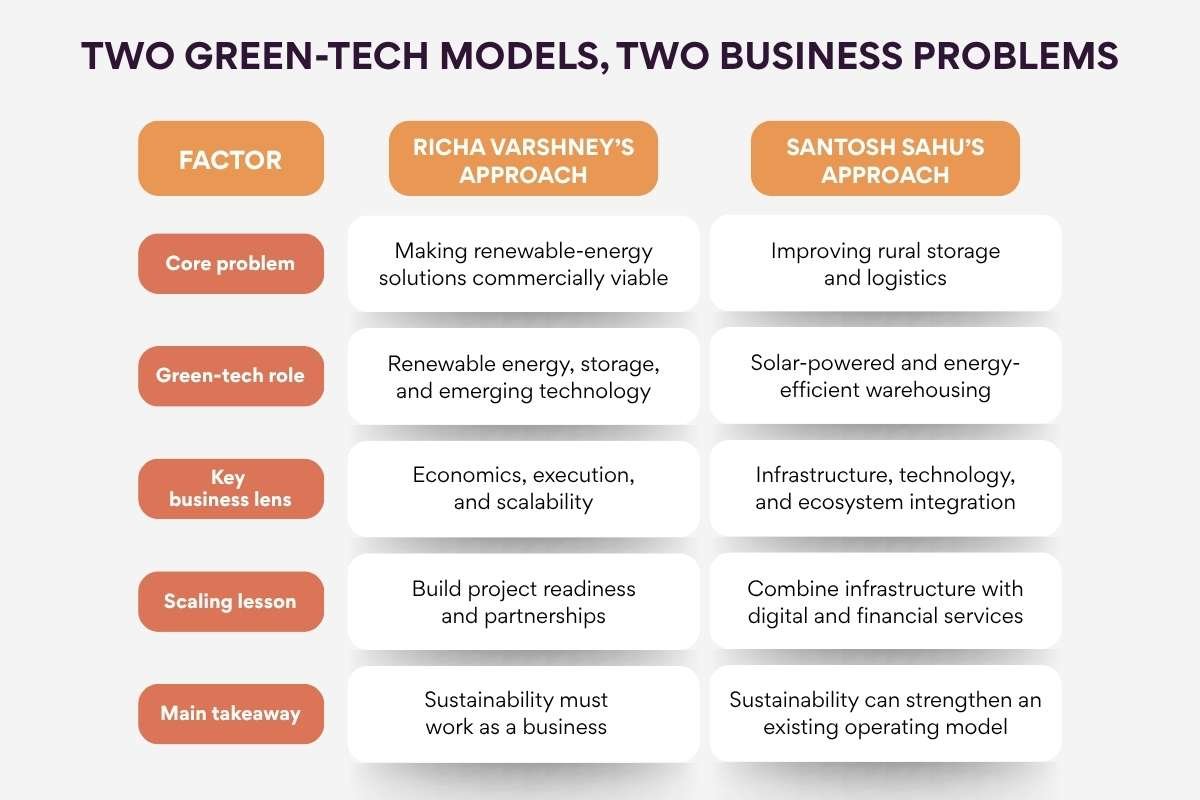
Analyzing both approaches highlights two distinct ways to build sustainable organizations. We gain actionable green tech insights from Business Viewpoint leaders by evaluating how clean technology solves core operational problems.
| Factor | Richa Varshney’s approach | Santosh Sahu’s approach |
|---|---|---|
| Core problem | Making renewable-energy solutions commercially viable | Improving rural storage and logistics |
| Green-tech role | Renewable energy, storage, and emerging technology | Solar-powered and energy-efficient warehousing |
| Key business lens | Economics, execution, and scalability | Infrastructure, technology, and ecosystem integration |
| Scaling lesson | Build project readiness and partnerships | Combine infrastructure with digital and financial services |
| Main takeaway | Sustainability must work as a business | Sustainability can strengthen an existing operating model |
These models reveal two green business models that scale across different markets. Varshney targets direct power generation and grid readiness, while Sahu embeds sustainability straight into agricultural supply chains. Accelerating corporate adoption of renewable energy requires aligning clean power investments with real financial returns.
What entrepreneurs can actually take from these models?

Indian entrepreneurs can extract a concrete execution framework from these two cases:
- Solve real problems: Pinpoint a measurable operational pain point first.
- Define clear unit economics: Ensure the green model lowers baseline expenses.
- Validate technology early: Test hardware thoroughly before investing major capital.
- Build project readiness: Secure regulatory, financial, and grid access early.
- Leverage strategic alliances: Partner with institutions to bridge skill gaps.
- Integrate operations: Treat eco-friendly features as operational engines, not marketing tactics.
- Track operational metrics: Measure cost reductions alongside environmental impact.
Applying these green tech insights from Business Viewpoint leaders keeps green ventures cash-flow positive.
Conclusion:
Sustainable growth occurs when green technology solves concrete operational challenges. Studying these green tech insights from Business Viewpoint leaders shows how companies build profitable enterprise models.
Richa Varshney secures success through commercial viability, project readiness, technology validation, and strategic partnerships. Santosh Sahu drives scale through sustainable infrastructure, digital systems, and rural supply-chain integration. Both models prove that clean technology powers strong financial performance.
FAQs
1: What can businesses learn from Richa Varshney’s approach to green technology?
Green technology must balance sustainability with commercial viability, technology readiness, and strategic partnerships.
2: How does Santosh Sahu connect sustainability with logistics?
He combines solar warehouses, efficient designs, IoT, and scientific storage to build more sustainable supply chains.
3: What makes a green technology business model scalable?
Clear unit economics, customer value, repeatable operations, and strong partnerships support scalable growth.
4: Can green technology create opportunities outside renewable power generation?
Yes. Green logistics, energy-efficient storage, battery integration, and digital monitoring offer strong commercial opportunities. This is a key green energy insight.