


India’s energy story now creates a bigger question for investors. Investment in green energy business can no longer mean buying solar projects alone. The real opportunity now spans the wider energy system.
India may need over ₹30 lakh crore in renewable-energy investment by 2030. IREDA made this estimate in its FY25 annual report. This need creates room for both large and smaller investors.
Think beyond power plants for a moment. Capital can support batteries, EV charging, and energy-saving tools. It can also enter green hydrogen, waste-to-energy, and carbon-management firms. Software, equipment, and energy services offer more routes.
That makes green energy a broad investment category. Each model has different capital needs and cash-flow patterns. Each also carries a different mix of risk and growth.
A solar project may need heavy upfront capital and patient returns. An energy-management platform may need less capital and scale much faster. Neither option suits every investor.
So, the smart approach starts with the business model itself. The better question is not whether green energy is investable. It is which green-energy business model fits the investor.
What does investment in green energy business mean, and how is it different from investment in green energy assets?
Investment in green energy business means putting capital into firms, projects, or infrastructure that support cleaner energy. The investor may seek income, growth, or both from that capital.
The route can vary based on the investor’s goals. You could buy equity in an operating company or fund a green-energy startup. You could also lend money to an energy project and earn interest. Project-level deals let investors fund one solar, storage, or charging asset.
Public markets offer another route through listed clean-energy firms. Large firms can also make strategic investments through partnerships or direct stakes.
But one key difference matters here.
An energy asset and an energy business do not create returns alike.
A solar plant earns from power sales and project terms. A solar-services firm relies on customers, pricing, costs, and growth. The asset has its own cash flow, while the business depends on execution.
That difference should shape every investment choice. The next step means looking at where this capital can flow.
Where investors can put money in green energy? 6 investment opportunities you must know about
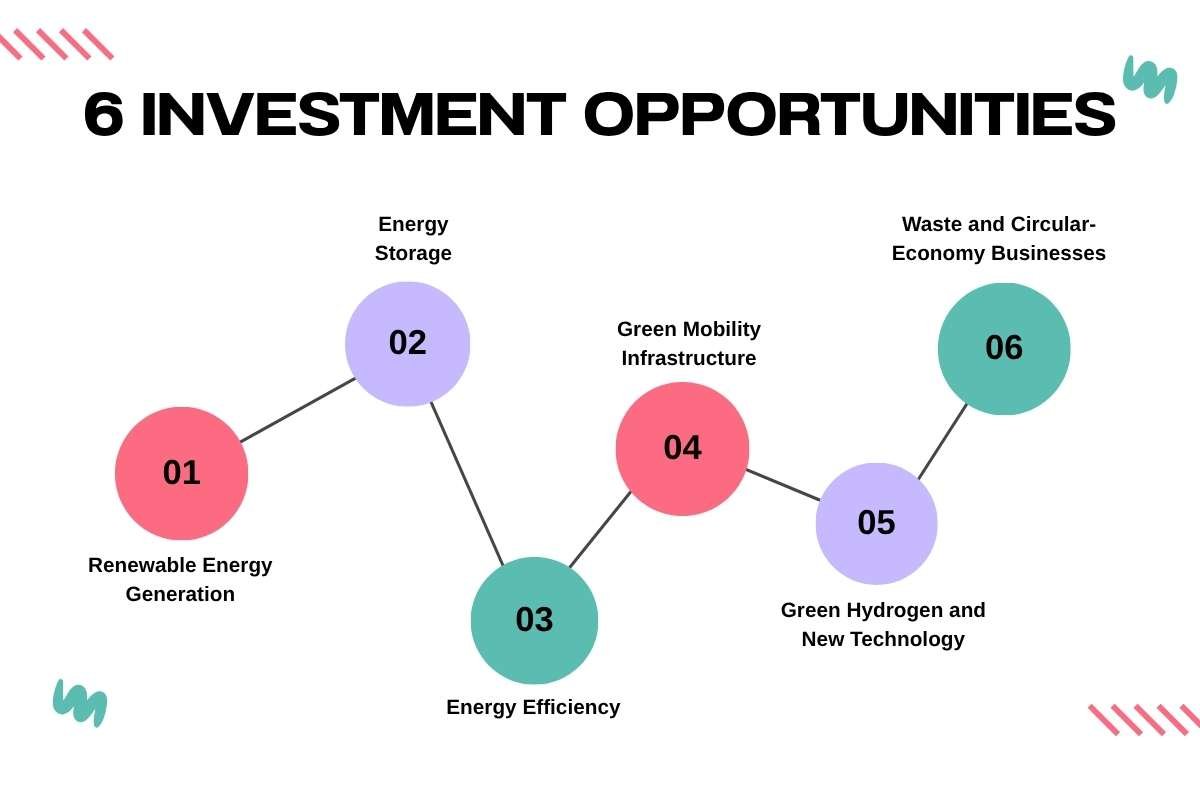
The green-energy market now offers far more than power plants. Each segment has a different revenue path, capital need, and risk level. That makes sector choice a key part of investment in green energy business.
1. Renewable energy generation
Solar, wind, and hybrid projects remain major investment routes. India had 168.04 GW of solar capacity by August 2026.
Projects can earn through power sales and long-term agreements. Larger projects can spread fixed costs across more generation. C&I projects can also serve factories, offices, and large buyers directly.
2. Energy storage
Battery storage can earn from several grid and power needs. It can store cheap power and release it when demand rises. CEA projects 34.72 GWh of battery storage needs for 2026-27.
That makes storage a useful growth layer beside renewable power.
3. Energy efficiency
Investors need not own any power assets at all. Energy audits, smart controls, and factory optimisation offer another route. Firms can also use performance-based contracts and share client energy savings.
This model can require less capital than generation projects.
4. Green mobility infrastructure
EV charging creates another infrastructure play for investors. Options include fleet charging, battery swapping, and charging software. The stronger models may combine hardware with recurring software or service fees.
5. Green hydrogen and new technology
Green hydrogen offers high growth but carries higher execution risk. Investors can target electrolysers, hydrogen hubs, storage, and industrial uses. The National Green Hydrogen Mission has a ₹17,490 crore initial incentive outlay.
Still, technology costs and demand can change quickly.
6. Waste and circular-economy businesses
Waste-to-energy, biomass, recycling, and resource recovery add another path. These businesses can earn from waste handling, recovered materials, energy sales, or several streams together.
So, the best opportunity may not be the biggest project. It may be the model with stronger cash flow, lower fixed costs, and clear demand.
5 green energy business models investors should understand
Before investing, I would first ask one simple question: How does this business make money? The answer often matters more than the green label itself.
1. Asset ownership
Here, investors fund solar plants, batteries, or other assets. The asset then earns through power sales or fixed contracts. These models need high upfront capital and patient capital. Returns depend on tariffs, use, debt costs, and upkeep.
2. Project development
Developers find sites, secure permits, and arrange funding. They then build, run, or sell the project. Their returns can come from development fees or project sales. This model needs strong local links and sound project skills.
3. Energy-as-a-service
The provider pays for and runs the energy system. The customer then avoids a high upfront cost. The provider earns through regular fees or shared energy savings. This can create steady income without selling the asset.
4. Technology and SaaS
Energy software can track use and cut waste. Firms may sell smart-meter tools, AI energy systems, or carbon software. Investors often value these models for their scale and repeat income.
5. Equipment manufacturing
Companies can make panels, inverters, batteries, chargers, and control gear. Demand can grow fast, but plants need high capital and supply chains.
So, compare each green energy business model across five points:
Capital need | Recurring income | Scale | Execution | Risk
That lens makes investment in green energy businesses far easier to assess.
How much capital does a green energy business need?
There is no single number for investment in green energy businesses. Capital needs change with the model, scale, and assets involved. A better way to judge them starts with three broad bands.
Lower-capital models include energy audits, consulting, and green software. Sustainability services and small energy-management firms also fit here. These models rely more on skills, sales, and tools than heavy assets.
Mid-capital models include EV charging and rooftop solar services. Energy-as-a-service and small commercial projects also need more working capital. Equipment distribution can fall into this band too.
High-capital models include solar parks, wind projects, and battery storage. Green hydrogen and manufacturing plants need even deeper funding. These models also bring longer project cycles and more complex risks.
But here is the part many guides miss: Capital need does not equal investment appeal.
A capital-light firm may scale faster with lower fixed costs. An infrastructure project may offer steadier contracted income instead. Yet that stability can come with debt, land, and policy risks.
So, investors should match capital size with their risk, time, and return goals.
What returns can investors expect?

Returns from investment in green energy businesses can vary a lot. No green-energy model can promise one fixed return. The outcome depends on the business, funding, demand, and exit path.
Several factors shape that outcome. Initial capital sets the starting point for the investment. Debt cost can then change cash flow and profit. Project use, power tariffs, and contract length also matter.
Operating costs can lower margins over time. Equipment life can affect long-term asset value. New technology can also create extra risk. For service firms, customer costs and churn can shape growth. Policy shifts can affect both demand and project economics.
For private businesses, exit value can matter as much as yearly profit. Public companies add another layer through market price changes.
A simple comparison helps investors see these differences:
| Business type | Capital intensity | Revenue pattern | Main return driver |
|---|---|---|---|
| Solar project | High | Contracted/project-based | Power generation |
| Energy services | Medium | Recurring/project | Customer contracts |
| Green SaaS | Lower | Subscription | Customer growth |
| EV charging | Medium | Usage-based | Station utilisation |
| Green-tech manufacturing | High | Product sales | Scale and margins |
For a real analysis, I would check annual reports first. Look at revenue growth, margins, debt, and cash flow. Then compare those figures with the company’s growth plans.
The key lesson stays simple: Green does not mean profitable by default.
Understanding key risks in green energy investment
Every investment in green energy business carries some risk. The risk changes with the business model, project stage, and funding mix. So, investors should never treat the whole sector as one risk class.
Policy changes can affect project income and demand. Grid delays can push back project timelines. Land, permits, and local approvals can also slow progress. Higher interest rates can raise debt costs and cut project returns.
Power prices create another risk for firms without fixed contracts. New technology can also make older systems less useful. Supply chains may face delays or price shocks. Equipment can degrade faster than planned.
Business models bring their own risks too. A startup may burn cash before finding steady demand. A charging firm may depend on high station use. A services firm may rely on a few large clients. Long payback periods can also test investor patience.
This creates one important rule: Different models need different risk tests.
A contracted solar project and a green-hydrogen startup need different lenses. The first may face financing and execution risk. The second may face deeper technology and market risk.
I would assess five layers before investing:
Business risk + technology risk + financing risk + regulatory risk + market risk
That wider view can reveal risks hidden behind strong growth claims.
How to evaluate a green energy business before investing
Before making an investment in a green energy business, I would test the business from six angles. This keeps the decision tied to facts, not hype.
1. Understand the revenue model
Start by asking who pays the business. Then check how often they pay. Review contract terms and payment periods. Recurring revenue can also make future income easier to judge.
2. Check unit economics
Look at customer acquisition cost and gross margin first. Then review operating costs and payback periods. For assets, check how often they generate income.
3. Review the project pipeline
Infrastructure firms need a strong project pipeline for growth. Check projects under development and those under construction. Also review operational and contracted capacity.
4. Assess financing
Review the debt-equity ratio and cost of debt. Check upcoming refinancing needs and current cash flow. High debt can strain even strong energy projects.
5. Check regulatory exposure
Review licences, approvals, incentives, and grid access. Then ask how much revenue depends on policy support. This can reveal risks that basic financial checks miss.
6. Test scalability
Ask what growth demands from the business next. Does growth need more assets, staff, or capital? Or can the firm grow mainly through more customers?
This checklist can make investment in green energy business more disciplined. It shifts focus from a green label toward real business strength.
Which green energy investment model fits different investors?
Not every investor needs the same path into green energy. Investment in green energy business should match capital, risk appetite, and time horizon.
Small investors can consider listed clean-energy companies or suitable green bonds. Small business opportunities may also offer direct exposure. Crowdfunding needs extra care and should follow Indian rules.
Entrepreneurs can target models with lower asset needs. Energy services, solar EPC, and energy management offer several entry points. EV infrastructure and green software can also support growth.
HNIs and private investors can look at private firms and project finance. They may also assess infrastructure deals and growth-stage green-tech companies. These routes often need more capital and deeper due diligence.
Institutional investors can handle larger, longer-term opportunities. Utility-scale projects, infrastructure funds, storage, and manufacturing can fit well. Contracted assets may also suit their long investment horizons.
The key point remains simple: investor profile should determine business model. Capital, risk, skills, and time should guide the choice. The green label should come second.
India-specific factors shaping green energy investment in 2026
India’s policy path now shapes how investors price green-energy opportunities. The country targets 500 GW of non-fossil capacity by 2030. It also targets 5 million tonnes of green hydrogen each year.
This creates demand across generation, storage, hydrogen, and clean mobility. Yet policy support matters most when it lowers project risk. Better rules can improve financing terms and strengthen investment cases.
Storage is gaining more weight as renewable power grows. MNRE notes that storage can support grid stability, peak shifting, and wider renewable use.
C&I buyers also create a growing market for clean power. The draft National Electricity Policy 2026 backs easier renewable procurement through open access. It also supports renewable projects linked with storage.
Domestic manufacturing adds another investment layer. Current MNRE notices cover solar supply chains, storage, hydrogen, and clean-energy research.
Investment in green energy business: a practical decision framework

Before putting money into any green business, ask five clear questions.
- What problem does the business solve?
- Who pays for the solution, and how often?
- Does revenue recur, or does each project reset?
- How much capital does growth need over time?
- What could break the investment thesis later?
These questions reveal more than a green label ever can. They show demand, cash flow, funding needs, and key risks.
High capital plus predictable contracts does not mean better. Low capital plus rapid growth does not mean safer. Investment in green energy businesses needs a wider view than that.
The right choice depends on risk tolerance, time horizon, capital, and economics. That means investors should compare the business first. The sector name should come later.
So, investment in green energy business now depends on policy direction too. Investors should track targets, rules, grid access, and market demand together. A strong policy tailwind can lower risk, but it cannot replace sound business economics.
Conclusion
Green energy now forms a broad investment ecosystem in India. The opportunity spans power assets, storage, EVs, software, and services. Each model needs a different amount of capital. Each model also creates income in a different way.
That makes investment in green energy business less about picking a hot sector. It means judging the business behind the green label.
Market growth matters, but revenue quality matters just as much. Strong contracts can support steady cash flow. Scalable models can support faster growth with less fixed cost. Policy support can lower risk, but it cannot fix weak business economics.
Before investing, check cash flow, contracts, technology, and growth needs. Also assess debt, regulation, customer demand, and execution risk.
The strongest green-energy business opportunities may not sit in the fastest-growing sector. It may sit in a business with a clear customer, durable economics, manageable risk, and a real path to scale.
Frequently Asked Questions
1. Is investment in green energy business profitable?
It can be, but returns depend on the business model, capital structure, revenue visibility, and execution.
2. What is the best green energy business to invest in India?
There is no universal best option, as infrastructure, services, technology, and manufacturing offer different risk and return profiles.
3. How much money is needed to invest in a green energy business?
Capital needs range from low-cost service businesses to highly capital-intensive infrastructure and manufacturing projects.
4. Which green energy businesses have recurring revenue?
Energy-as-a-service, monitoring subscriptions, energy-management software, O&M contracts, and long-term commercial contracts can provide recurring revenue.
5. What are the biggest risks of green energy investment?
Key risks include policy changes, financing costs, technology shifts, project delays, supply issues, and uncertain market demand.
6. Can small investors invest in green energy businesses?
Yes, small investors can use public-market and regulated investment routes, while direct private funding usually requires deeper capital and due diligence.