


Two companies complete an acquisition, yet their teams still clash over daily work. One expects quick approvals, while the other follows strict reporting rules. These cultural integration challenges can slow decisions and weaken trust.
They can also drive skilled employees away and block knowledge sharing. As a result, companies may struggle to achieve the gains they expected.
In this article, we examine common cultural conflicts and practical ways Indian companies can address them after a deal closes.
What causes cultural integration challenges after an M&A deal?
Workplace culture shapes how people make choices, share ideas, and handle conflict. It also guides how teams judge performance and reward success. After a deal closes, these unwritten rules can clash. Employees may disagree over authority, feedback, budgets, or promotions. Such differences can turn routine tasks into long disputes.
| Cultural difference | Possible integration problem |
| Centralised vs. delegated decisions | Delayed approvals or unclear authority |
| Individual vs. team rewards | Disputes over incentives and credit |
| Formal vs. informal communication | Misunderstood instructions and feedback |
| Risk-taking vs. strict controls | Conflicts over budgets and new plans |
| Tenure vs. performance-based advancement | Perceived unfairness in promotions |
Neither approach is always better. Conflict grows when employees lack clarity about which practices will stay.
McKinsey’s 2019 research found that 95% of executives viewed cultural fit as critical. Yet 25% cited poor cultural alignment as the main reason integrations failed. These findings reflect surveyed executives, not all M&A deals.
Five cultural integration challenges that can disrupt an M&A deal
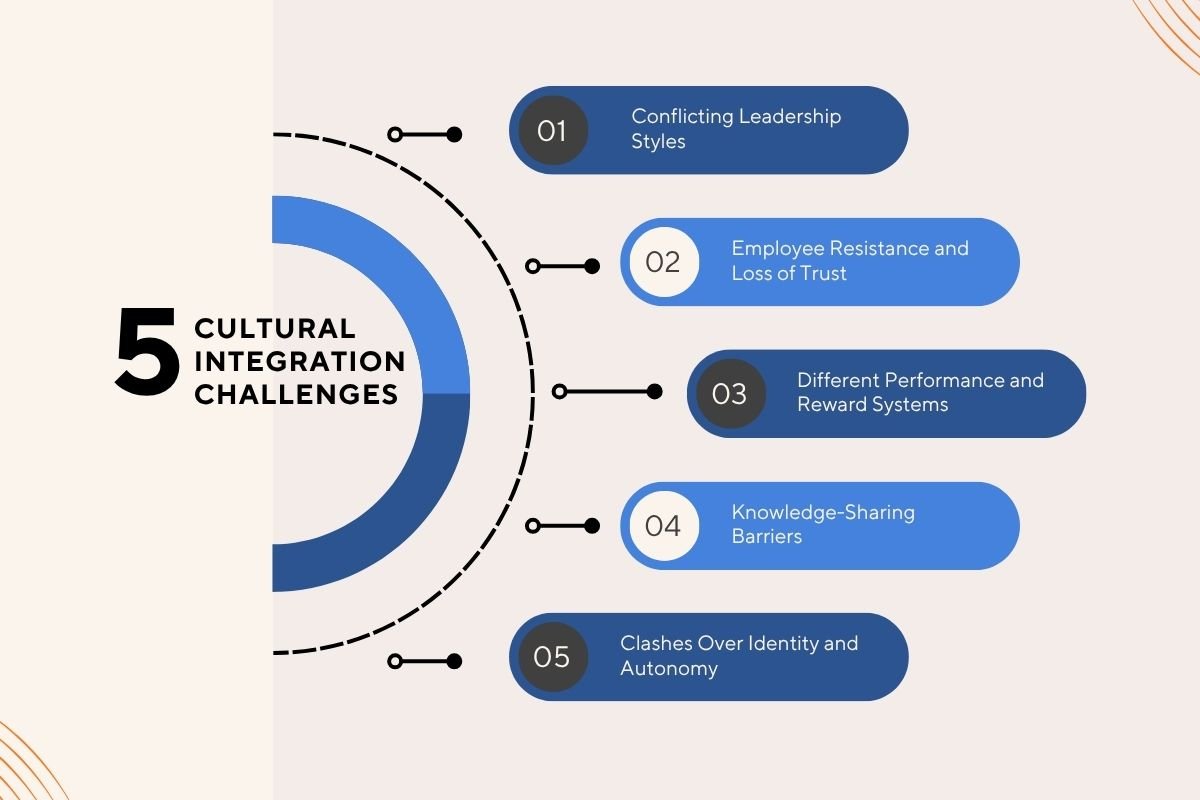
1. Conflicting leadership styles
A large buyer may require board approval for major spending. The acquired firm’s founder may have approved such costs within hours. Now, teams face delays even when both sides agree on priorities. Unclear decision rights can also leave managers unsure who answers for results.
2. Employee resistance and loss of trust
After an acquisition, staff may hear rumours about job cuts or team closures. If leaders delay answers, employees may stop sharing concerns or seek other jobs. This can drain key skills just when the combined business needs them most. It can also deepen the impact of the merger on employees.
3. Different performance and reward systems
One company may reward sales staff for individual targets. The other may tie bonuses to team results and client retention. After the deal, staff may argue over credit for shared wins. If leaders keep both reward systems without clear rules, employees may see the new system as unfair.
4. Knowledge-sharing barriers
An acquired firm’s engineers may hold back product details from the buyer’s team. They may fear that sharing their know-how will make their roles less vital. The buyer then struggles to combine tools, train staff, or improve products. This can weaken the deal’s core value.
5. Clashes over identity and autonomy
A buyer may ask a small firm to use its global product approval process. Yet the acquired team may rely on quick tests and fast client feedback. Extra checks can slow new releases and frustrate skilled staff. Leaders must know which controls protect the business and which limit its edge.
A 2023 study in Accounting, Organizations and Society examined cultural differences and acquisition outcomes. Its findings support careful analysis, not the claim that every culture clash causes failure.
How can Indian companies manage cultural integration after a merger?

1. Assess culture before closing
During due diligence, compare decision rights, rewards, leadership styles, and knowledge sharing. Start culture reviews before closing, so leaders can address risks early.
2. Choose what to keep and change
Not every practice needs a common rule. An Indian company buying a founder-led tech business could centralise finance controls. Yet it could retain the product team’s freedom to test new ideas. This protects innovation while keeping clear financial oversight.
3. Give leaders clear ownership
Name senior leaders who can settle disputes across both teams. HR can guide the process, but business heads must own key choices. PwC India’s 2017 survey highlighted senior management involvement and dedicated integration teams among reported integration practices.
4. Set clear communication rules
Tell employees what leaders have decided and what remains open. Name the decision-maker and give a date for the next update. PwC’s 2026 M&A Integration Survey found that 52% of respondents cited culture alignment and people-related change as key cultural integration challenges.
5. Track changes in employee behaviour
Check staff exits, survey scores, decision times, and unresolved role disputes. Track knowledge transfers too, especially when key experts hold vital skills. These measures show whether cultural integration challenges are easing or hurting performance.
Should companies adopt one culture or preserve both?
Cultural integration does not mean both companies must work alike. The right approach depends on the deal’s goals and business needs.
| Approach | When it fits |
| Full integration | When shared controls and common work rules matter most |
| Selective integration | When core practices must align, but specialist teams need freedom |
| Cultural preservation | When the acquired business’s identity, skills, or model create value |
For example, an Indian buyer may align finance and compliance rules while preserving a founder-led team’s product choices. This protects innovation without weakening control.
Leaders should base this choice on the deal’s purpose, business model, and risks found during assessment. For customer-facing changes, brand integration after a merger may also need careful planning.
What can failed mergers teach Indian companies about culture?

The Larsen & Toubro acquisition of Mindtree offers a useful Indian case. The 2019 takeover raised concerns about Mindtree’s identity and leadership continuity. However, those concerns alone do not prove cultural failure. The wider lesson is that ownership changes can unsettle employees when leaders leave key questions unanswered.
Dealmakers should assess cultural risks early, define decision rights, and track retention and business results after closing. These steps help turn the lessons from failed mergers in India into better integration plans.
A stronger example is L&T’s 2019 takeover of Mindtree. Reports highlighted fears about Mindtree’s open culture under L&T’s more top-down approach. An academic case study also examined the takeover and its people-related challenges.
These concerns do not prove cultural failure, but they show why trust matters. Indian dealmakers should assess cultural risks early, set clear decision rights, and track staff retention and business results.
Conclusion:
Cultural integration challenges can affect deal value, staff retention, and daily work. Leaders must assess differences early and decide which practices need alignment. They should also track whether teams share knowledge and meet goals. Clear owners, milestones, and measures turn culture plans into real progress. Strong integration makes it easier to achieve the aims of mergers and acquisitions.
Frequently asked questions about cultural integration challenges
1. How long does cultural integration take after a merger?
Cultural integration can take months or years, depending on trust, leadership choices, and changes to daily work.
2. Who should lead cultural integration after an acquisition?
Senior business leaders should own cultural integration, with HR and integration teams guiding employee engagement and change.
3. How can companies spot cultural risks before an acquisition?
Companies can use employee interviews, leadership discussions, staff surveys, and reviews of workplace policies to identify likely cultural conflicts.