



What if a profitable company hides a costly problem? It may owe taxes, face ownership disputes, or risk losing key customers. Due diligence in M&A helps buyers verify these risks before committing.
In India, buyers check company records, GST compliance, statutory filings, and required permits. These findings can change the price, deal terms, or decision to proceed. The key is to test the evidence, not just trust the seller’s claims.
What does due diligence in M&A actually check?
Due diligence checks whether a business matches the seller’s claims. Buyers compare management statements with source records, outside evidence, and actual results. The scope depends on the target’s industry, size, deal structure, and risks.
The review also looks beyond past performance to future threats. A company may show steady sales and hold valid customer contracts. Yet one contract may let a key client leave after a takeover. The document is genuine, but the deal may weaken customer ties. This is why buyers must assess both facts and their impact.
Historical records show what happened; risk checks show what could change.
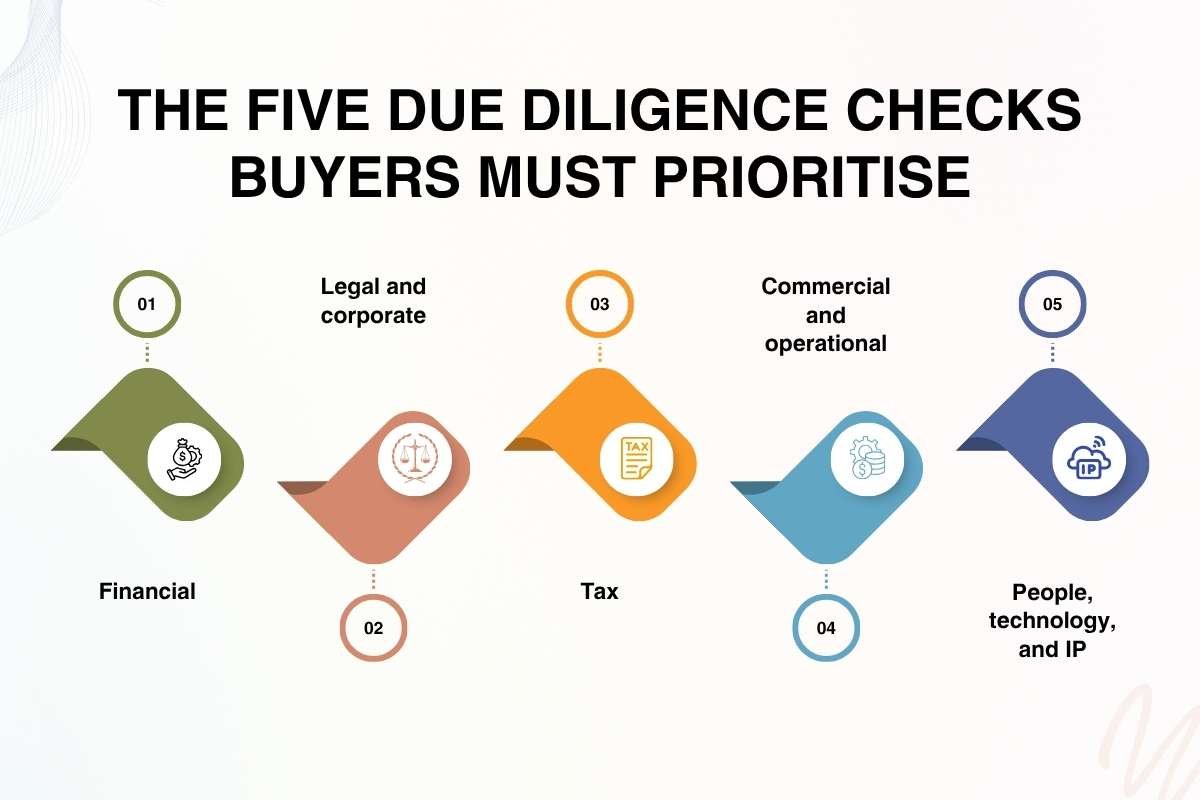
The five due diligence checks buyers must prioritise
“What counts is whether you’re wrong about; whether you’ve really got a fix on the basic economics and how the industry’s likely to develop.”
Warren Buffett, Berkshire Hathaway Annual Meeting, 2016
Due diligence in M&A works best when buyers focus on risks that can change the deal. Each review must link the evidence to a clear business decision. In India, that means checking financial records, company filings, tax compliance, and business operations.
| Review area | What to verify in India | Red flags and deal impact |
| Financial | Audited accounts, bank records, receivables, debt, and working capital | Mismatched sales, hidden debt, or inflated EBITDA may lower the price. |
| Legal and corporate | MCA filings, shareholding, board approvals, contracts, lawsuits, and asset titles | Disputed ownership or missing approvals may delay or block closing. |
| Tax | Income-tax returns, GST filings, TDS records, tax disputes, and transfer pricing, where applicable | Unpaid demands or disputed credits may increase costs or require protection. |
| Commercial and operational | Key customers, orders, suppliers, pricing, capacity, and key-person dependence | Client concentration or loss-making contracts may weaken future earnings. |
| People, technology, and IP | Employment terms, statutory dues, IP ownership, software licences, cybersecurity, and data duties | Unpaid dues, unclear IP rights, or weak systems may add costs or limit operations. |
Buyers should also cross-check company records on the Ministry of Corporate Affairs portal. For tax checks, the GST portal and Income Tax Department offer useful official resources.
A red flag in due diligence in M&A does not always mean the buyer should walk away. First, quantify the risk and verify the facts. Then decide how to address the finding. A price cut may cover weaker earnings or hidden debt.
A seller indemnity may cover defined past liabilities. A seller undertaking may require specific action. A closing condition may require consent or approval before completion. Legal and tax advisers should confirm the right response for each deal.
How buyers should investigate a red flag?
A red flag matters only when buyers understand its real cost. Due diligence in M&A must turn a suspicious finding into a clear deal decision.
Imagine a target earns 45% of its sales from one customer. This figure is illustrative, not an industry benchmark. Here is how a buyer should test that risk.
- Verify the revenue: Match customer invoices with bank receipts and sales records. Check for unpaid bills, unusual credits, or sales that lack proof.
- Review the contract: Check the term, renewal history, and termination rights. See whether the customer can exit after a change in control.
- Measure the exposure: Ask how much profit depends on this customer. Assess how fast the business could replace those sales.
- Change the deal terms: Lower the price if future sales look less certain. Seek an indemnity or other contract protection where suitable. The buyer may also require customer consent before closing.
- Decide whether to proceed: If the customer can leave soon, reassess the deal. Walk away if the risk outweighs the likely value.
The key is to link verified evidence with financial impact. That helps buyers act on facts, not fear.
How does due diligence in M&A affect the deal?
A due diligence report should guide the buyer’s next move. Mergers & acquisitions due diligence findings can change the price, deal terms, or decision to proceed.
| Finding | Potential buyer response |
| Receivables are overdue | Recheck cash flow and working capital before setting the price. |
| A tax demand remains disputed | Measure the exposure and negotiate suitable protection. |
| A key licence needs consent or reissue | Confirm the approval path and address it before closing, where needed. |
| The target lacks core software IP rights | Seek a valid transfer or assess whether the defect blocks the deal. |
| A key customer can exit after a change in control | Reassess future sales and seek consent or other protection. |
The sale agreement should address material risks through negotiated terms. These may include warranties, indemnities, seller promises, or closing conditions. The right remedy depends on the facts and legal advice.
Some risks can be priced; others need fixing first. If a core asset or approval remains out of reach, the buyer may walk away.
Where can buyers commonly miss critical risks?

Even a detailed due diligence in an M&A review can miss risks if buyers trust claims too quickly. Three common mistakes deserve attention.
- Trusting explanations without proof: Management may explain weak sales or unpaid bills. Buyers should seek records that support those claims.
- Checking documents in isolation: Compare management accounts with audited statements and bank records. Match shareholding registers with MCA filings and deal documents. Differences may reveal errors or hidden risks.
- Treating missing records as harmless: An absent contract or unclear liability does not prove safety. It leaves a question that the buyer must resolve.
Buyers should keep a list of open questions and missing evidence. Assign each issue to a named person, with a clear deadline. Record the evidence needed and the likely impact if it remains unresolved. Missing evidence is itself a finding. Buyers should assess that uncertainty before they agree to the deal.
Conclusion:
Due diligence in M&A helps buyers assess a target’s true value before closing. The review can reveal hidden liabilities, weak contracts, or risks to future earnings. Buyers can then use these findings to renegotiate terms, seek legal protection, or withdraw. The goal is not to eliminate every risk, but to know which risks the deal can bear.
Frequently asked questions about due diligence in M&A
1. Who conducts due diligence in an M&A transaction?
The buyer’s team includes legal advisers, financial and tax experts, and relevant business or technical specialists. The target’s risks determine the team’s scope.
2. How long does due diligence take in India?
The timeline depends on the target’s size, complexity, record quality, and open issues. Missing documents or disputed claims can extend the review.
3. Can a buyer withdraw after due diligence in M&A?
Yes, where the deal terms and applicable law allow it. The buyer’s options depend on the transaction stage and existing contractual commitments.