



Companies pursue mergers and acquisitions to gain market access, new skills, better tech, or key suppliers. Building these strengths alone can take years, while a deal may help them grow faster.
However, not every deal delivers the expected gains. The reasons companies pursue mergers and acquisitions vary, from business expansion to succession planning. Here are 8 key motives and the risks behind each.
Top 8 reasons why companies pursue mergers and acquisitions
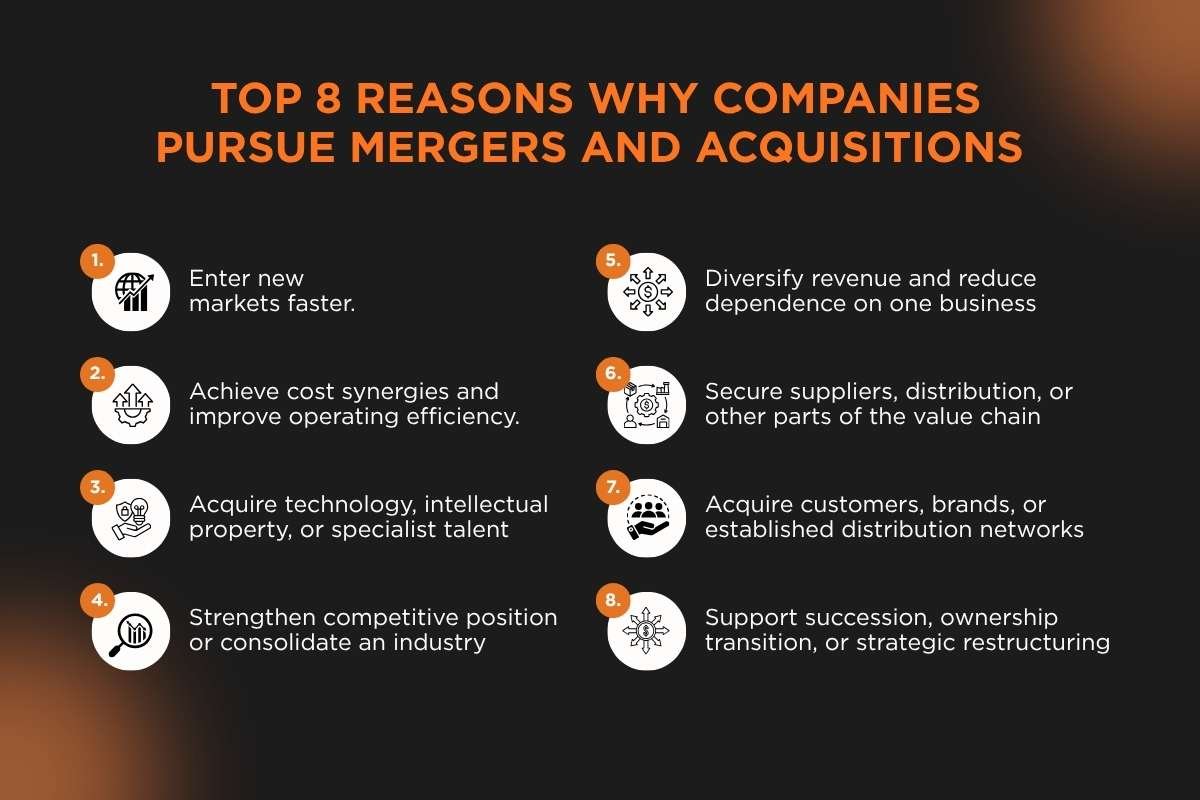
Each acquisition should solve a clear business problem. The challenge is to identify which gains justify the price, risk, and effort of combining two businesses. The following eight motives show how buyers assess these opportunities.
1. Enter new markets faster.
A company may have a strong product but lack local reach. Buying a business with known customers, trusted dealers, and regional ties can shorten the path to market. This can save years of sales, hiring, and brand-building work.
For example, an Indian food brand could buy a local snack maker. The buyer gains shelf space, local recipes, and dealer links. It may also learn what local buyers prefer. These gains can speed up market entry.
But an old customer base does not ensure future sales. The buyer must check repeat orders, brand loyalty, and channel overlap. It should also study why M&A activity is rising in India before making claims about wider market trends.
2. Achieve cost synergies and improve operating efficiency.
Two businesses may cut costs by sharing resources. They can combine purchasing, storage, delivery, software, or office teams. Cost synergy means the combined business can lower costs beyond what each could achieve alone.
| Synergy source | Potential benefit | Key risk |
| Procurement | Better supplier terms | Savings may fall short |
| Warehousing | Fewer duplicate sites | Delivery may slow |
| Shared functions | Lower overhead | Staff cuts may disrupt work |
| Technology systems | Fewer platforms to run | Migration may delay work |
A buyer must test each saving against the cost of change. It should include staff payouts, system upgrades, and site closures. Teams must also track results after closing. The stages of an M&A deal process explain where buyers test these claims and track gains after the deal.
3. Acquire technology, intellectual property, or specialist talent
Developing new technology takes time and skilled people. An acquisition can give a buyer access to software, patents, research teams, or specialist know-how. It may also bring a working product and an established customer base.
For example, Tata Digital agreed to acquire a majority stake in 1mg in 2021. 1mg brought digital health services and a supply chain across more than 20,000 PIN codes.
This gave Tata a route into online health services.
New technology may not fit existing systems, and key staff may leave. Buyers should check ownership, contracts, and technical quality through due diligence in M&A. They should also plan how to retain critical employees before the deal closes.
4. Strengthen competitive position or consolidate an industry
A company may buy a rival to gain market share or use its plants more efficiently. In a fragmented market, a deal can combine local reach with wider resources. The buyer may also gain better bargaining power with suppliers.
Yet, buying a rival does not always create a stronger business. Customers may leave if service drops or prices rise. Overlapping operations can also lead to job cuts and costly changes.
India’s competition rules matter, too. The Competition Commission of India reviews deals that meet the relevant legal tests. It may approve a deal, set conditions, or block it. The regulatory approvals depend on the deal and the rules that apply. Buyers must assess these limits before they count on gains from consolidation.
5. Diversify revenue and reduce dependence on one business
Another reason why companies pursue mergers and acquisitions is to reduce reliance on one source of income. A company may depend too much on one product, market, or buyer. An acquisition can spread that risk across other revenue streams. Yet, diversification works best when the buyer knows why the new business fits.
Related diversification can use shared customers, sales teams, or supply chains. Unrelated diversification offers fewer links and may require new skills. A food maker buying a health food brand may share stores and delivery routes. A company buying an unrelated software business may need a separate team.
Before proceeding, the buyer should assess the target’s market, cost base, and operating needs. It should also compare an acquisition with a merger, partnership, or internal expansion.
6. Secure suppliers, distribution, or other parts of the value chain
Dependence on outside suppliers can expose a business to delays, quality issues, and price changes. Buying a key supplier gives the buyer greater control over production inputs and supply continuity.
For example, Reliance Retail acquired METRO Cash & Carry’s India business. Reliance’s annual report noted that the deal strengthened its store network and new commerce business.
This shows how a buyer can gain access to an established supply network.
Owning a supplier also means managing its workforce, stock, and working capital. Buyers should compare these added duties with the cost and reliability of a long-term supply contract.
7. Acquire customers, brands, or established distribution networks
Building consumer trust can take years, especially in India’s diverse markets. A known brand may already have loyal buyers and strong links with local shops. An acquisition lets a buyer build on these assets instead of starting from scratch.
ITC’s 2020 agreement to acquire Sunrise Foods shows this motive. Sunrise had a strong spice brand in eastern India, with more than 70 years of history. ITC aimed to expand its spice business and use its wider distribution network.
But a familiar name alone cannot protect sales. Buyers must preserve the taste, quality, and trust that attract customers. They must also decide whether to keep the acquired brand or merge identities. Poor planning can weaken the very brand value that made the deal attractive. A clear brand integration plan after a merger helps protect customer trust during the transition.
8. Support succession, ownership transition, or strategic restructuring
In family-owned Indian businesses, why companies pursue mergers and acquisitions can come down to succession. Sometimes, an owner needs a buyer to keep the business running. This can happen when family members do not wish to take over. A sale may also give the owner a way to retire.
For the buyer, a small business can offer trained staff, known customers, and steady local demand. It may also bring useful assets and supplier ties. Yet, a smooth handover needs more than a signed deal.
The buyer must check accounts, debts, contracts, and customer links before agreeing on a price. A transition plan should also identify key employees and reduce dependence on the founder. Owners and buyers can review the basics of small business acquisition before they assess such a deal.
How companies assess an acquisition’s value?

A clear strategic motive does not guarantee a sound investment. A buyer may gain market share or new capabilities but still destroy value by paying too much. It must test the expected returns before committing funds.
| Decision test | Question to ask | Evidence to examine |
| Strategic fit | Does the deal solve a clear problem? | Business plan and market data |
| Financial value | Can gains justify the price? | Valuation, cash flow, and savings |
| Execution | Can both businesses work well together? | Systems, staff, and operating plans |
| Risk | What could weaken the expected return? | Legal, financial, and commercial checks |
| Alternatives | Is buying better than building or partnering? | Cost, time, and control |
Why can these motives fail after the deal closes?
A deal may look strong on paper but struggle once teams join. Expected savings may fall short, while system changes raise costs. Customers may leave when service drops, or prices change. These setbacks can weaken the very motive that drove the deal.
People also shape the outcome. Skilled staff may leave if roles feel unclear or leaders change key terms. Different work styles and goals can also slow joint decisions.
Good plans need clear owners, timelines, and checks. Without them, the buyer may struggle to turn its plans into results. These post-merger integration challenges can erase expected gains. A buyer must align teams, systems, and goals early. It should also track results against the deal plan.
Conclusion:
The real value of a deal lies in what happens after the agreement. A buyer must turn its plans into better operations, stronger market reach, or lasting business value. The price, timing, and integration plan all shape the outcome.
Understanding why companies pursue mergers and acquisitions helps explain the goal behind each deal. But the motive alone cannot justify the purchase. Buyers need clear targets, sound due diligence, and a plan to measure results after closing. That is what separates a strategic move from an expensive mistake.
Frequently asked questions
1. How do mergers and acquisitions affect employees?
Employees may face new roles, reporting lines, or work policies, while job cuts depend on the deal’s goals and the overlap between both businesses.
2. What role does due diligence play in an acquisition?
Due diligence helps buyers verify financial records, legal duties, contracts, and business risks before they commit to a deal.
3. How do companies decide what a business is worth during an acquisition?
Buyers assess cash flow, assets, debt, market position, growth prospects, and comparable deals to estimate a fair purchase price.