



Mergers and Acquisitions (M&A) are strategic business transactions that allow companies to combine operations, acquire another business, or gain control of a company. A merger brings businesses together, while an acquisition lets one party buy another business or its assets.
Companies use M&A to enter new markets, gain customers, acquire technology, or expand capacity. Buying an existing business can be faster than building the same setup from scratch.
But agreeing on a price is only one part of the deal. Buyers must assess the target, check its finances and legal risks, arrange funding, and secure the required approvals. Both sides must also agree on the terms and plan what happens after closing.
In India, the process can involve company law, competition rules, securities regulations, tax laws, and foreign-exchange rules. The exact requirements depend on the deal structure, parties, and sector.
This guide to Mergers and Acquisitions in India covers the complete deal process, including strategy, valuation, due diligence, financing, regulatory approvals, and post-merger integration. It also explains common risks and why a deal can struggle to deliver value after closing.
What are mergers and acquisitions in India?
At its core, M&A changes who owns or controls a business. Yet, the deal can take many legal forms.
A merger combines two businesses into one structure. The parties may seek shared costs, wider reach, or stronger capabilities. In India, the structure can involve a court-approved scheme under company law.
An acquisition happens when one party buys another business or gains control. The buyer may purchase shares, assets, or a whole business. The choice can change the deal’s tax, legal, and operating impact.
This is where the basics of mergers and acquisitions need more than simple definitions. The legal form may differ from the deal’s real business goal. A share purchase can give control without merging two companies. An asset deal can transfer a business without buying its entire company.
A takeover focuses mainly on a change in control. The buyer may gain control through shares, voting rights, or other arrangements. Listed-company takeovers can also trigger SEBI rules.
| Transaction | What changes? | Typical objective | Key consideration |
| Merger | Two businesses combine | Combination or synergy | Structure and approvals |
| Acquisition | One party gains a business or control | Expansion or capability | Price and control |
| Takeover | Control changes hands | Control of the target | Shareholding and governance |
Understanding the difference between merger, acquisition, and takeover helps you assess the right deal path before valuation or due diligence begins.
Why companies pursue mergers and acquisitions?

A good deal starts with a clear business need, not excitement. Buyers usually want something they cannot build fast enough alone.
Here are the main reasons why Indian businesses pursue Mergers and Acquisitions to accelerate growth and strengthen their market position:
- Market entry: Buying a local player can give quick access to customers. It can also bring sales teams, dealers, and local market know-how.
- Technology acquisition: A buyer may seek software, patents, data, or other tech. This can cut years from internal product development.
- Capacity expansion: Buying an existing plant can save time and setup costs. This matters when demand grows faster than new capacity.
- Customer acquisition: Some targets bring loyal customers and steady sales. The buyer can then cross-sell its own products to them.
- Supply-chain control: A vertical deal can secure key inputs or routes. This can help reduce supply risk and improve control over costs.
- Talent and expertise: A target may have skills that take years to build. This often matters in tech, pharma, finance, and niche industries.
- Geographic expansion: A regional company can open doors in new markets. Local staff may also know customers, rules, and trade habits.
- Business consolidation: Buyers may combine similar operations to cut overlap. They may also gain scale across sales, plants, or support teams.
The key point remains simple: the buyer needs a reason to buy. A strong deal links that reason to measurable business value.
What are the types of mergers and acquisitions?
Not every M&A deal solves the same business problem. The deal type often shows what the buyer wants to gain.
| Type | Basic structure | Why it happens |
| Horizontal | Same industry or market | Scale or market consolidation |
| Vertical | Different supply-chain stages | Supply or distribution control |
| Conglomerate | Unrelated businesses | Diversification |
| Product extension | Related products | Customer or product expansion |
| Market extension | Same product, new market | Geographic growth |
| Acquisition | Buyer gains business or control | Strategic expansion |
A horizontal merger joins businesses that compete in the same space. For example, two Indian manufacturers may combine to gain scale and reach.
A vertical deal links different parts of one supply chain. A food maker might buy a key supplier or distributor. This can give the buyer more control over supply and delivery.
A conglomerate deal links unrelated businesses. The buyer gains exposure to a new sector rather than deeper reach in its current one.
A product extension adds related products to an existing range. A market extension takes an existing product into a new customer or region.
Finally, an acquisition focuses on ownership or control. It can use a share purchase, asset purchase, or another structure.
Understanding these types of Mergers and Acquisitions helps Indian entrepreneurs select the right transaction structure for their business objectives.
Mergers vs acquisitions vs spin-offs: the difference between these deal types
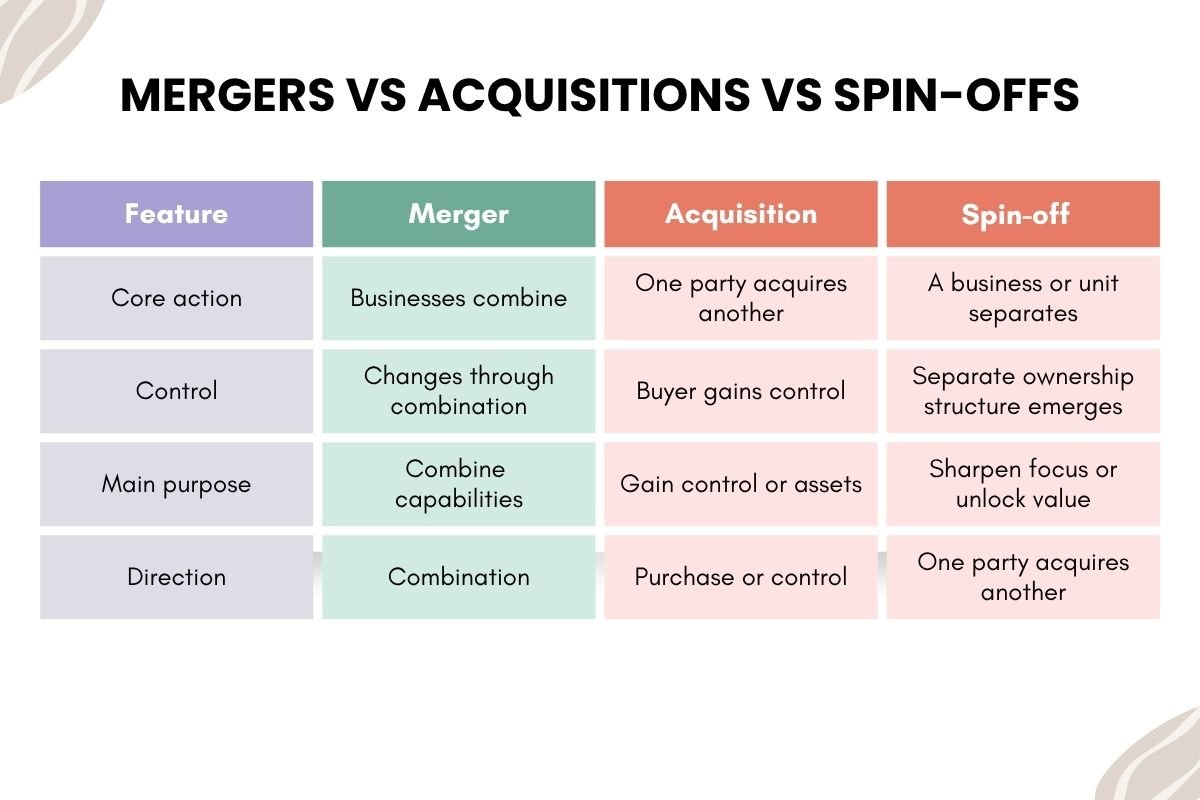
M&A usually focuses on combining or buying businesses. A spin-off moves in the other direction.
| Feature | Merger | Acquisition | Spin-off |
| Core action | Businesses combine | One party acquires another | A business or unit separates |
| Control | Changes through combination | Buyer gains control | Separate ownership structure emerges |
| Main purpose | Combine capabilities | Gain control or assets | Sharpen focus or unlock value |
| Direction | Combination | Purchase or control | Separation |
A merger brings two businesses into one structure. The aim may include scale, wider reach, or shared resources.
An acquisition lets one buyer gain another business. The buyer may seek its shares, assets, technology, people, or customers.
A spin-off separates part of an existing business. The parent company may do this when one unit needs a different strategy. The unit may also attract investors better as a focused business.
This creates an important strategic choice. A company does not always need to buy another business to grow. Sometimes, separating a non-core unit can free capital and management time.
For readers comparing deal paths, these three distinctions matter. It shows whether the strategy aims to combine value or separate it.
What are the stages of the mergers and acquisitions process in India?
An M&A deal rarely follows one fixed path in India. The sequence can change with deal structure, sector, and listing status. Still, most transactions follow a clear commercial and legal flow.
Here are the main stages of an M&A deal process:
1. Strategy and target identification
The buyer first defines what it wants to gain. It then sets target criteria and finds suitable businesses.
2. Initial approach
Both sides hold early talks and assess strategic fit. They may also sign a confidentiality agreement before sharing sensitive data.
3. Preliminary valuation
The buyer estimates a sensible value for the target. This review may use financial data, peers, and past deals.
4. Letter of Intent or term sheet
The parties outline key commercial terms at this stage. They may also set exclusivity, price ranges, and key deal conditions.
5. Due diligence
The buyer then checks the target in depth. Reviews can cover finance, tax, law, operations, HR, technology, and commercial risks.
6. Negotiation
The parties settle price, payment terms, warranties, indemnities, and closing conditions. These terms decide who carries future risks.
7. Regulatory approvals
Some deals need approval before closing. CCI rules can apply when a transaction qualifies as a combination. Listed-company deals can also trigger SEBI takeover rules. Other deals may involve MCA, RBI, tax, or sector rules.
8. Definitive agreements
The parties sign the final transaction documents. These documents set out rights, duties, conditions, and closing steps.
9. Closing
The parties satisfy the agreed conditions before closing. The buyer then transfers consideration and gains the agreed shares, assets, or control.
10. Post-merger integration
The real work often starts after closing. Teams must align people, systems, operations, governance, customers, and brands.
That final step matters because buying a business does not create value by itself. The buyer must turn the deal thesis into results.
What is due diligence in M&A?
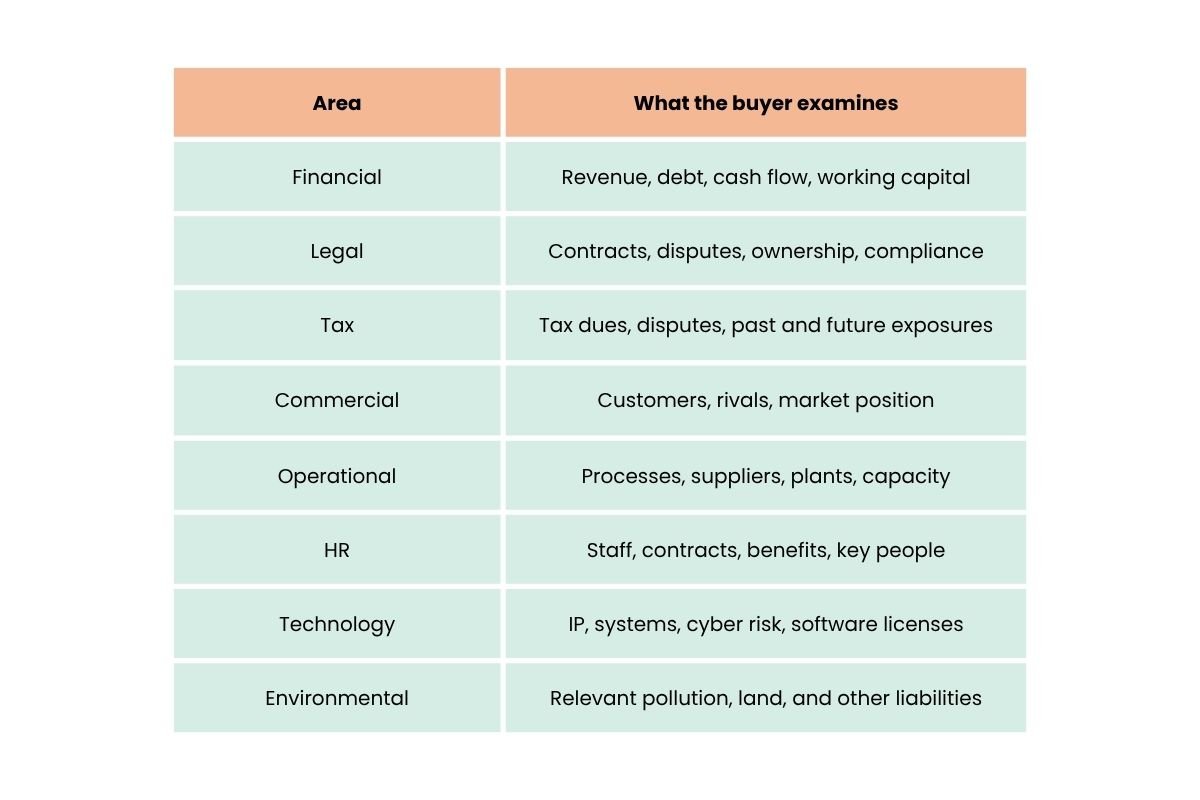
Due diligence means testing the target before committing to the deal. It goes far beyond checking a few files.
The buyer looks for hidden risks, weak numbers, legal gaps, and future costs. PwC India describes buy-side diligence as a way to test financial, commercial, operational, and strategic issues. EY India also covers financial, tax, commercial, operational, regulatory, IT, and cyber diligence.
| Area | What the buyer examines |
| Financial | Revenue, debt, cash flow, working capital |
| Legal | Contracts, disputes, ownership, compliance |
| Tax | Tax dues, disputes, past and future exposures |
| Commercial | Customers, rivals, market position |
| Operational | Processes, suppliers, plants, capacity |
| HR | Staff, contracts, benefits, key people |
| Technology | IP, systems, cyber risk, software licenses |
| Environmental | Relevant pollution, land, and other liabilities |
The key point is simple: due diligence can change the deal itself.
A major finding can lower the valuation or change payment terms. It can also add warranties, indemnities, escrow, or new closing conditions. In serious cases, the buyer may walk away.
PwC India notes that diligence can uncover liabilities, debt-like items, tax exposures, and working-capital adjustments. Its India research also shows that diligence often needs wider coverage beyond finance and law.
That makes due diligence in Mergers and Acquisitions more than a basic checklist. It is a decision-making tool that helps buyers assess risks and determine whether a transaction makes business sense.
What are the financing options for a business acquisition?
The buyer must decide more than how much to pay. It must also decide how to fund the deal. That choice can change ownership, risk, and future cash needs.
| Financing method | How it works | Key issue |
| Cash | Buyer uses available funds | Liquidity |
| Debt | Buyer funds the purchase through borrowing | Repayment and leverage |
| Equity | New shares or capital fund the deal | Ownership dilution |
| Seller financing | Seller accepts payment over time | Seller credit risk |
| Earn-out | Some payment depends on future results | Measurement disputes |
| Combination | Buyer uses several funding sources | Structure complexity |
Cash gives the buyer a simple funding route. Yet, a large payment can reduce cash reserves after closing.
Debt lets buyers preserve ownership while funding the purchase. However, new repayments can put pressure on the combined business.
Equity can reduce debt pressure but may dilute existing owners. This matters when the buyer raises fresh capital through shares.
Seller financing spreads payment over an agreed period. It can help bridge a valuation gap between both sides.
An earn-out links part of the price to future performance. This can align expectations, but both sides must define results clearly.
A combination can balance these trade-offs. For example, a buyer may use cash, debt, and seller financing together.
The right financing options for a business acquisition depend on the deal. Funding can shape the purchase price, control rights, risk sharing, and post-deal balance sheet.
The cheapest funding route may not create the best deal. A safer structure can matter more than a lower funding cost.
8 things to remember about negotiation strategies in mergers and acquisitions
The purchase price matters, but it does not tell the whole story. Strong negotiation strategies in mergers and acquisitions also consider payment terms, risk, and closing conditions.
- Price and payment: Agree on the purchase price, payment schedule, and any adjustments.
- Risk and protection: Use warranties and indemnities to define responsibility for undisclosed issues, losses, or claims.
- Future payments: Seller financing or earn-outs can bridge valuation gaps, while escrow can hold back funds for agreed claims.
- Closing terms: Set clear conditions for approvals, required consents, exclusivity, and when either side can walk away.
These terms can change the deal’s real value. A lower price may come with greater risk, while a higher price may offer better payment terms or stronger protections.
The goal is to reach an agreement that balances price, risk, and certainty.
Regulatory approvals needed for M&A in India
There is no single approval for every M&A deal in India. Requirements depend on the deal structure, parties, sector, and ownership.
| Situation | Regulatory area to examine |
| Mergers and amalgamations | Companies Act and MCA |
| Competition concerns | CCI and Competition Act |
| Listed companies | SEBI takeover and disclosure rules |
| Foreign investment | FEMA and RBI rules |
| Regulated sectors | Sector-specific approvals |
| Taxable transfers | Income-tax and GST rules |
The CCI reviews combinations that meet applicable legal thresholds. Not every deal needs its approval, but notifiable combinations generally require clearance before closing.
Parties should also check the Companies Act, FEMA rules, and relevant sector regulations.
Therefore, regulatory approvals for Mergers and Acquisitions in India depend on the transaction structure, the parties involved, the sector, and applicable legal requirements. The buyer should map these checks before signing, not after.
Tax considerations in an Indian M&A deal

Tax can change the value and risk of an M&A deal. The structure often decides which taxes arise and who carries them.
A share acquisition usually transfers ownership of the company. The buyer should still review the target’s past tax position and open disputes. An asset or business acquisition can create different tax outcomes because specific assets, liabilities, and consideration are transferred.
Capital gains are a key issue for sellers. The Income Tax Department states that gains from transferring a capital asset can fall under Capital Gains. The tax result depends on the asset, holding period, consideration, and other facts.
GST also needs review in a business transfer. The GST law contains specific rules for transfers of business, mergers, and amalgamations. It also addresses the transfer of unused input tax credit in certain business transfers.
Stamp duty may apply to transaction documents or transferred assets. The exact duty can depend on the instrument, asset, and applicable state rules.
Tax due diligence should therefore check past returns, unpaid taxes, notices, assessments, litigation, and disputed positions. Professional transaction-tax guidance also treats historical and future tax exposure as a core part of deal diligence.
These tax considerations in an Indian M&A deal should be assessed before final terms. Tax treatment can affect price, consideration, protections, and deal structure.
What happens to employees after a merger? Post-mergers and acquisitions scenarios
The deal may close on paper, but employees still need a clear path forward. What happens to employees after a merger depends on the deal structure, business needs, and integration plan.
Reporting lines may change as both businesses combine. Some managers may take wider roles, while others may report to new leaders.
Role overlap can also arise. Two companies may have separate finance, HR, sales, or technology teams. The buyer may retain both teams, combine roles, or remove duplicate positions.
Employment terms also need review. Pay, benefits, leave rules, contracts, incentives, and HR systems may differ between the businesses.
Key employees may receive retention plans or other incentives. Their knowledge can help protect customers, operations, and critical projects during the transition.
Redundancies can arise when functions overlap. However, the process must follow the employment terms and legal obligations that apply to the transaction and circumstances.
The best planning starts before closing. Integration teams can map roles, reporting lines, benefits, systems, and key talent in advance.
Clear employee communication also matters. It can explain what changes, what stays the same, and when decisions will happen.
Therefore, employee outcomes are often shaped during integration planning, not simply after the merger closes.
Cultural integration challenges of mergers and acquisitions
Cultural integration challenges can slow a deal even when the business case looks strong. The issue often appears in daily decisions, not formal policies.
| Problem | Why it matters | Integration response |
| Different decision styles | Decisions may slow down | Set clear decision rights |
| Different incentives | Teams may chase different goals | Align performance metrics |
| Different management structures | Reporting can become unclear | Define reporting lines early |
| Different leadership styles | Teams may get mixed signals | Set shared leadership norms |
| Different risk tolerance | Teams may disagree on choices | Define risk limits |
| Different communication norms | Messages may get missed or delayed | Set clear communication rules |
| Different views on autonomy | Managers may overstep or wait for approval | Clarify authority levels |
Performance expectations can also differ. One business may reward speed, while another values strict process.
These differences need action during integration planning. Leaders should map decision rights, reporting lines, targets, incentives, and authority before teams settle into new roles.
The goal is not to erase one culture. It is to create operating rules that let both teams work effectively together.
Brand integration after a merger
Brand integration after a merger should start with customers, not logos. The buyer must assess how each brand performs in its market before choosing a new identity.
| Option | When it may work |
| Retain both brands | Both have strong, distinct customer bases |
| Retire one brand | One brand has weak equity or overlaps heavily |
| Create a combined identity | Both brands add value to the new position |
| Use an endorsed brand | One brand needs support from the stronger name |
| Keep brands separate | Each serves a different market or position |
Customer recognition matters because a sudden name change can affect trust and sales. Brand equity, reputation, product positioning, and market overlap also need review.
The cost of rebranding can extend beyond design. It may affect packaging, websites, sales materials, signage, contracts, invoices, and customer communications.
The right choice depends on customer behavior and commercial positioning. A strong brand should not disappear simply because ownership changed.
Before making the switch, management should test customer response, market overlap, reputation, and expected commercial gains. The goal is to protect existing value while building the combined business.
Post-merger integration challenges every company must consider
Closing the deal is only a milestone. The harder task is making two businesses work as one. That is why post-merger integration challenges can decide whether the deal delivers its expected value.
| Integration challenge | Potential impact |
| Duplicate systems | Higher costs and disruption |
| Leadership overlap | Decision delays |
| Employee turnover | Loss of expertise |
| Different processes | Operational friction |
| Customer uncertainty | Relationship risk |
| Technology integration | Delays and security risks |
| Brand confusion | Market positioning problems |
| Data migration | Operational disruption |
These problems can also interact. For example, weak technology integration can slow teams and frustrate customers. Poor role clarity can then increase employee turnover.
Integration planning should begin before closing. The buyer should set priorities for people, systems, customers, data, technology, and reporting lines.
Success should also be measured against the original deal thesis. If the buyer expected new customers, lower costs, stronger capacity, or faster growth, those outcomes need clear targets.
A transaction can therefore close without delivering its expected value. Deal completion proves ownership changed. Integration proves whether the business case worked.
What is the meaning of hostile takeover and famous examples?

A hostile takeover starts when an acquirer seeks control without the target board’s support. This differs from a negotiated acquisition, where both sides agree on the transaction before it moves ahead.
The target board may oppose a takeover if it believes the offer undervalues the business, threatens its strategy, or may harm shareholder interests. Shareholders then become central because their decision can determine whether the acquirer gains enough control.
An Indian example: l&t and mindtree
In 2019, Larsen & Toubro pursued control of Mindtree after agreeing to buy a 20.32% stake. L&T then made an open offer for another 31% of Mindtree under SEBI’s takeover rules. Mindtree’s promoters opposed the bid, while its independent directors later said the ₹980 offer price appeared fair and reasonable.
The case shows how control can shift through shareholder ownership even when the target’s promoters resist. SEBI filings also show the formal open-offer process and disclosures required in the transaction.
For the current hostile takeover meaning, the key lesson is simple: control, shareholder choice, board views, and securities rules can all shape the outcome.
Small business acquisition basics you must know about
Small business acquisition basics start with one question: can the business succeed under new ownership?
Smaller businesses may rely heavily on the owner and keep fewer formal records. Buyers should focus on four key areas before making an offer:
- Financial health: Check revenue trends, cash flow, debt, working capital, and the quality of financial records.
- Customer and supplier ties: Assess whether sales depend on a few customers or key suppliers.
- Legal and tax status: Review tax compliance, licenses, contracts, and any ongoing disputes.
- People and ownership: Check employee obligations and confirm that the business owns its key assets, brand, and technology.
Owner dependence deserves special attention. If key customers or daily operations rely on the seller, the buyer needs a clear transition plan.
A smaller deal may involve less paperwork, but that does not mean fewer risks. Buyers should verify the business’s core claims before agreeing on a price.
10 signs a company might be an acquisition target
A business can attract buyers without ever announcing a sale. Certain traits make it strategically useful to a larger company or investor.
Common signs a company might be an acquisition target include:
- Strong niche position: The business holds a useful share in a focused market.
- Valuable IP or technology: Patents, software, data, or technical skills can attract buyers.
- Strategic customers: Long-term customer relationships can add immediate commercial value.
- Distribution reach: A strong dealer or distribution network can help buyers expand faster.
- Geographic presence: Local market access can support entry into new regions.
- Complementary products: The business fills a gap in an existing product range.
- Strong cash generation: Predictable cash flow can make the business financially attractive.
- Succession challenges: An owner-led business may need a new path for continuity.
- Capital requirements: A business needing funds may attract buyers with greater resources.
- Strategic value: A competitor may gain customers, technology, capacity, or market share through the deal.
These are signals, not proof that a company is for sale. A buyer still needs to assess valuation, willingness to sell, risks, and strategic fit before approaching the target.
Lessons from failed mergers in India
M&A failure does not always mean the deal closed and later collapsed. Some transactions fail before completion because the original deal thesis cannot survive legal, financial, or market pressures.
| Case | Intended rationale | What went wrong | Lesson |
| RCom–Aircel | Combine telecom businesses and reduce debt | Legal and regulatory delays, financing issues, and changing market conditions caused the merger to lapse | Test funding and regulatory risks early |
| Kingfisher–Air Deccan | Build scale and gain network and operational synergies | The combined airline faced financial strain and operational problems | Validate the business model beyond expected synergies |
| Vodafone–Idea | Build scale and capture cost and network synergies | Integration required major network, IT, distribution, and brand consolidation | Plan integration around execution, not only deal value |
These lessons from failed mergers in India show that a strong rationale is only the starting point. Buyers must test execution, funding, regulation, and integration before committing.
How to assess whether an M&A deal makes sense?
Before committing capital, we could reduce the deal to five questions. This makes mergers and acquisitions basics in India more useful as a decision framework.
1. What problem does the transaction solve?
Identify the main reason for buying. Is it market entry, technology, capacity, customers, talent, or supply-chain access? A deal needs a clear business problem.
2. Is the valuation defensible?
Compare the target’s financial performance with comparable companies and past transactions. Test the assumptions behind future growth, margins, cash flow, and synergies.
3. What risks could change the economics?
Review legal claims, tax exposure, customer concentration, debt, contracts, and operational weaknesses. Ask how each risk could affect the final deal value.
4. Can the businesses actually integrate?
Test the fit across people, systems, brands, technology, and operations. A strong target can still struggle when the two businesses cannot work well together.
5. What if the synergies do not materialize?
Build a downside case. Check whether the deal still makes sense if cost savings arrive late, revenue falls short, or integration costs rise.
The strongest deals can survive this final test. If the economics work only under perfect assumptions, the buyer should reconsider the transaction.
M&A decision framework
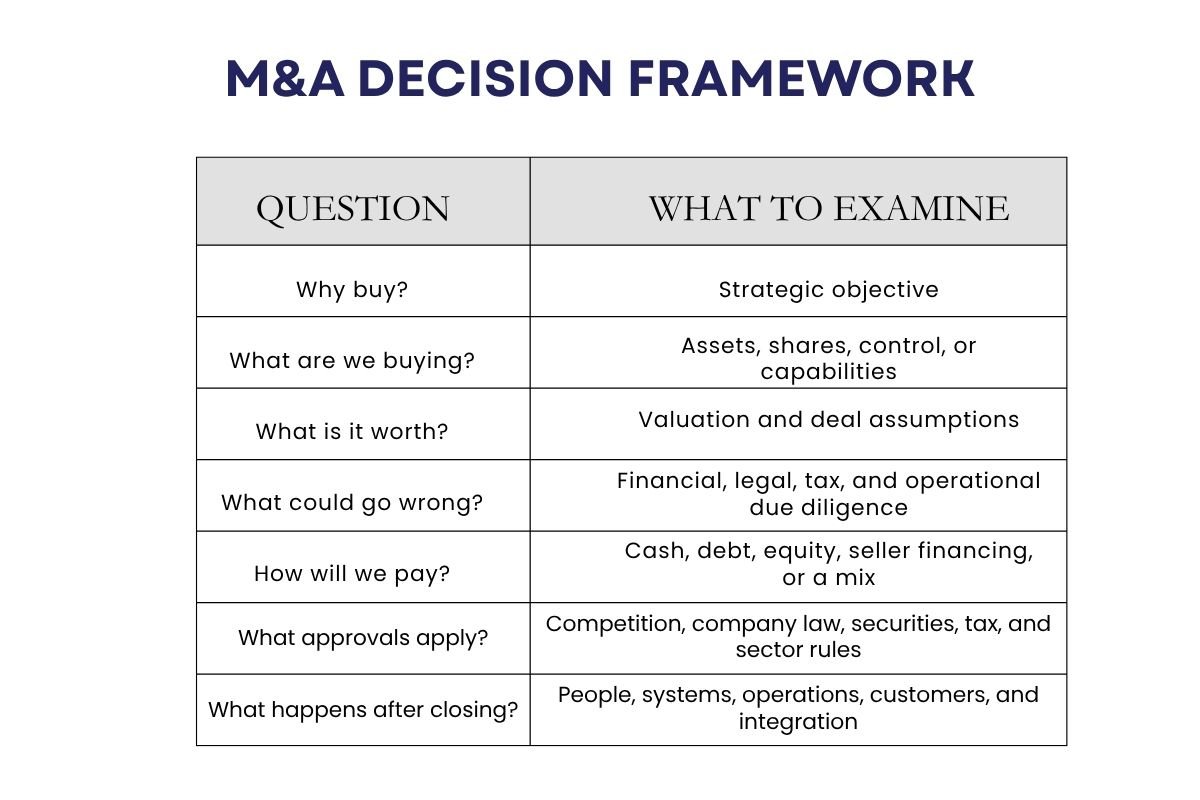
A sound M&A decision follows a simple chain. Each answer should support the next step.
| Question | What to examine |
| Why buy? | Strategic objective |
| What are we buying? | Assets, shares, control, or capabilities |
| What is it worth? | Valuation and deal assumptions |
| What could go wrong? | Financial, legal, tax, and operational due diligence |
| How will we pay? | Cash, debt, equity, seller financing, or a mix |
| What approvals apply? | Competition, company law, securities, tax, and sector rules |
| What happens after closing? | People, systems, operations, customers, and integration |
The framework keeps the decision focused. A buyer should not move to price before understanding the strategic goal. It should not close before checking risks and approvals.
Most importantly, the process does not end at closing. The final test is whether integration turns the original deal rationale into measurable business results.
Conclusion:
An M&A deal is a chain of connected decisions. The first step is knowing why the buyer wants the business. From there, valuation tests the price, while due diligence tests the risks.
Negotiation then sets the deal terms and decides how risk is shared. Financing determines how the buyer funds the transaction. Regulatory checks confirm which approvals and rules apply before closing.
Yet, closing does not end the transaction’s business impact. The buyer still needs to integrate people, systems, operations, customers, technology, and brands. That work determines whether the expected value becomes real business results.
Indian transactions can also follow different legal and regulatory paths. The exact requirements depend on the deal structure, parties, sector, ownership, and other transaction facts.
This guide to Mergers and Acquisitions in India covers the full deal process, from strategy and valuation to due diligence, financing, approvals, and integration. Copy replacement
Frequently asked questions about mergers and acquisitions
1. What are mergers and acquisitions?
A merger combines businesses into one structure, while an acquisition involves one party obtaining another business, its assets, shares, or control.
2. What are the main stages of an M&A deal in India?
The main stages include strategy, target identification, valuation, due diligence, negotiation, regulatory approvals, closing, and post-deal integration.
3. What is due diligence in M&A?
Due diligence assesses financial, legal, tax, commercial, operational, technology, and other risks before the buyer commits to closing the transaction.
4. Do all M&A deals in India need regulatory approval?
No, requirements vary based on the transaction structure, companies involved, sector, competition concerns, ownership, and other applicable legal and regulatory rules.