

An M&A deal involves more than agreeing on a price. Buyers must assess the target, test risks, secure funding, and obtain required approvals before control changes hands.
The stages of an M&A deal process map these decisions, from target selection to post-merger integration. In India, the steps vary by deal structure, listed status, industry, and foreign investment. Some stages may overlap, while new findings can change the terms or stop the deal.
This article explains what happens at each stage, which decisions matter, and where a deal can slow down or fail.
At a quick glance: the 9 stages of an M&A deal process
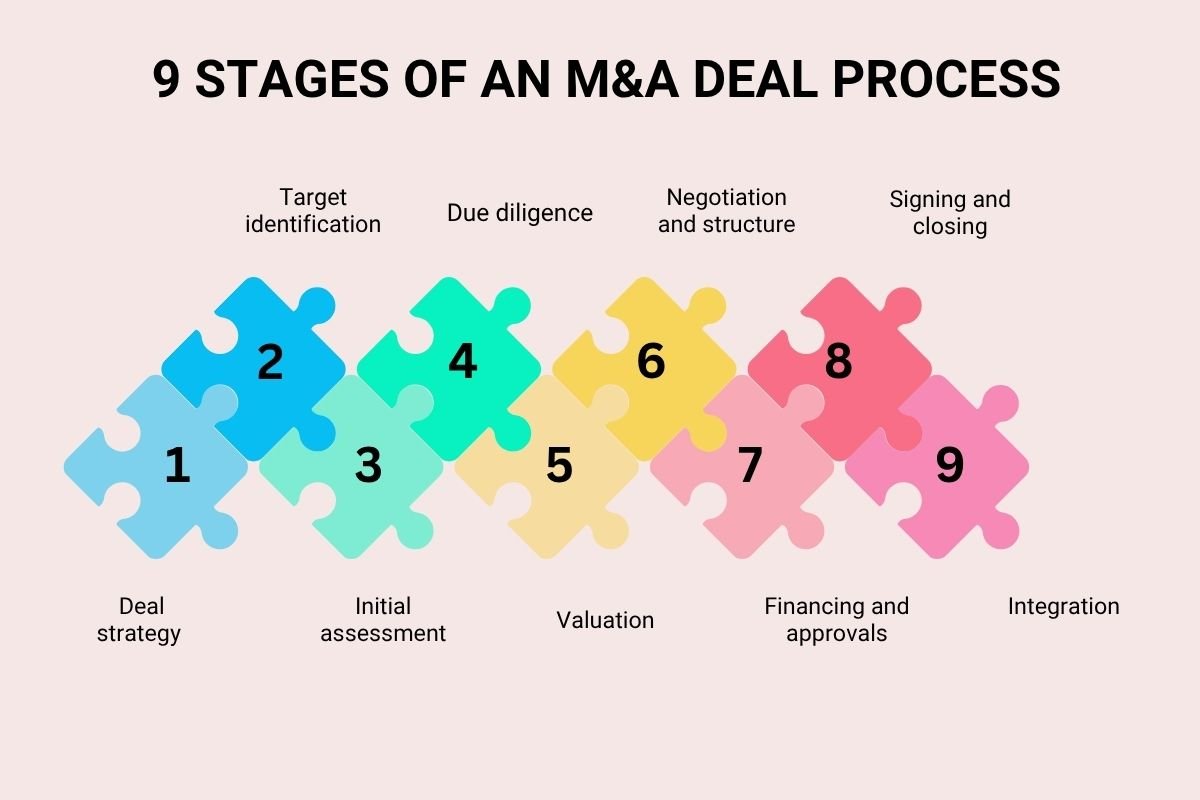
Each stage answers one key question before the deal moves ahead. Some stages may overlap as new facts shape the buyer’s choices.
| Stage | Core question |
| 1. Deal strategy | Why pursue this transaction? |
| 2. Target identification | Which company fits the strategy? |
| 3. Initial assessment | Is the target worth pursuing? |
| 4. Due diligence | What risks and liabilities exist? |
| 5. Valuation | What is the target worth? |
| 6. Negotiation and structure | What are both sides agreeing to? |
| 7. Financing and approvals | How will the deal close legally and financially? |
| 8. Signing and closing | When does control legally transfer? |
| 9. Integration | How will the combined business operate? |
Think of this table as your deal map. The sections ahead explain the choices, checks, and risks at each stage.
Stage 1: define the M&A strategy and deal thesis
Every M&A deal should start with one clear question: Why buy?
Before searching, the buyer needs a clear goal. That goal should guide every later choice. This could mean entering a new market or adding key technology. It could also mean gaining customers, distribution, or production capacity. Operating synergies can also support the case.
The key difference lies in having a strategic rationale. Growth alone does not prove that an acquisition makes sense. A sound deal links the target to a specific business need.
The buyer should then frame a simple deal thesis. Ask what gets bought, and why this target fits. Then ask how value gets created after closing. Also decide what the buyer must protect.
Before contacting a target:
- Strategic objective: What business gap should this deal solve?
- Target profile: Which traits must the target have?
- Maximum valuation: What price range makes sense?
- Financing capacity: How much capital can the buyer commit?
- Integration priorities: What needs early focus after closing?
- Walk-away conditions: Which issues should end the deal?
Stage 2: identify, screen and approach the target

Once the strategy is clear, the buyer needs a target profile. That profile turns broad goals into clear search rules. It can cover revenue, profit, market position, and geography. It can also assess customer concentration, technology, debt, ownership, and regulatory exposure.
Target identification means finding companies that fit the broad thesis. Screening then tests those companies against tighter deal criteria. Initial outreach starts contact with the strongest prospects. Advisers, investment bankers, existing business links, or direct approaches can open that door.
This stage matters even more in selective markets. EY says Indian M&A deal value rose 18% in 2025. Deal volume fell 3% during the same year. That gap points to a sharper focus on larger, stronger targets.
Some companies may also show clear buyer signals. These can include ownership changes, strong niche positions, funding needs, or succession issues.
The goal is simple: build a shortlist worth deeper review.
Stage 3: preliminary assessment and letter of intent
Before full due diligence, both sides test whether the deal makes sense. The buyer reviews key financials and meets the target’s management team. These talks test strategic fit, business quality, and major deal risks.
At this point, the buyer may set an indicative valuation. Both sides may also discuss the transaction structure and key conditions. A deal could involve cash, shares, or a mix of both. The exact structure depends on the transaction and the parties involved.
Some deals then move toward a non-binding offer or Letter of Intent (LOI). An LOI can outline an indicative price, transaction form, exclusivity, confidentiality, and a proposed timetable. It gives both sides a working framework for the next steps.
However, headline terms do not complete an acquisition. The stages of an M&A deal process still require deeper checks before closing. Either side can walk away as new facts emerge.
What can kill a deal before due diligence?
- Valuation gap: Both sides cannot agree on a fair price.
- Strategic mismatch: The target does not solve the buyer’s core need.
- Ownership disagreement: Sellers disagree on control or deal terms.
- Financing uncertainty: Funding cannot support the proposed transaction.
- Regulatory concerns: The deal may face major approval hurdles.
- Undisclosed risks: Early talks reveal issues that change the deal case.
Stage 4: Due diligence
Due diligence tests whether the deal story matches the facts. The buyer checks the target’s records, claims, risks, and hidden gaps.
A strong review covers more than financial statements. Buyers also test legal rights, tax exposure, customers, systems, staff, and permits.
| Due diligence area | What is examined |
| Financial | Revenue, margins, debt, cash flow, working capital |
| Legal | Contracts, disputes, ownership, compliance |
| Tax | Tax liabilities, disputes, exposures |
| Commercial | Customers, rivals, market position |
| Operational | Processes, suppliers, capacity |
| Technology | Systems, cybersecurity, IP |
| HR | Key staff, pay, benefits, obligations |
| Regulatory | Licences, approvals, sector rules |
These checks can reshape the stages of an M&A deal process. New risks may cut the price or change the structure. They may also lead to stronger warranties, indemnities, or conditions precedent.
For example, a buyer may find one customer drives most sales. That risk can change both price and terms. A legal dispute may also delay closing or end talks.
That makes due diligence more than a checklist. It gives the buyer facts for the next deal decision.
Stage 5: valuation and deal structuring

Valuation does not simply find one fixed price for a company. It tests what the business could reasonably be worth under different assumptions. Buyers may use DCF, comparable companies, or precedent transactions. Asset-based valuation can also fit asset-heavy businesses.
The same target can produce different values across these methods. Growth rates, margins, risks, and future cash flows can change the result. Synergies can also raise what a buyer may pay.
Valuation is affected by:
- Quality of earnings: Are profits stable and repeatable?
- Growth assumptions: Can the target sustain its growth?
- Debt: How much debt comes with the business?
- Working capital: How much cash does daily trade require?
- Customer concentration: Does one customer drive too much revenue?
- Synergies: What extra value can the buyer create?
- Contingent liabilities: Could hidden claims add future costs?
- Competitive position: Can the target defend its market share?
Once value takes shape, both sides consider deal structure. They may choose a share acquisition, asset acquisition, or merger types.
Consideration may involve cash, shares, or both. The choice affects control, funding, tax, and risk.
These choices shape the stages of an M&A deal process that follow.
Stage 6: negotiation, documentation and final deal terms
Negotiation often starts before contracts take shape. After diligence and valuation, however, talks become far more precise. Both sides now know more about value, risk, and the target’s weak points.
The discussion covers price, payment terms, earn-outs, warranties, and indemnities. Parties may also agree on conditions precedent and closing conditions. Non-compete terms may apply where the law permits them. These terms decide who carries risk after the deal closes.
That makes negotiation more than a fight over purchase price. Diligence findings can shift the buyer’s position. A major contract risk may support a lower price. A strong growth outlook may push the seller to seek more value.
| Negotiation issue | What it affects |
| Higher purchase price | Seller proceeds |
| Earn-out | Future performance risk |
| Indemnity | Post-closing risk allocation |
| Warranty | Seller’s contractual assurances |
| Escrow/holdback | Buyer protection |
The final documents capture these agreed terms. They turn commercial talks into binding obligations and clear closing steps.
This stage can reshape the stages of an M&A deal process before signing.
Stage 7: financing and regulatory approvals

Once terms take shape, the buyer must secure funding and clear the right approvals. Financing may come from internal cash, bank debt, acquisition financing, equity issuance, or seller financing. Many deals use a mix of these routes.
The regulatory path depends on the deal itself. Transaction structure, listed status, industry, size, foreign investment, and competition impact can all change the requirements.
For qualifying combinations, the CCI reviews mergers, amalgamations, and acquisitions that cross prescribed thresholds. Some transactions may fall within exemptions or categories that are not ordinarily notifiable.
If companies use a merger or amalgamation scheme, Sections 230–232 of the Companies Act provide the statutory framework, with the NCLT involved in the applicable process.
Listed-company acquisitions can trigger SEBI requirements, including the current SAST framework. SEBI records the SAST Regulations as last amended on December 5, 2025.
Where foreign investment is involved, FEMA and RBI rules can govern entry routes, sectoral caps, pricing, reporting, and payment.
Therefore, the M&A process starts with the deal structure, not a fixed checklist. The stages of an M&A deal process move forward only when the required funding and approvals align.
Stage 8: signing, closing and transfer of control
Signing and closing mark two different points in an M&A deal. At signing, both sides execute the definitive transaction documents. However, the buyer may not gain control that day.
Closing happens after all required conditions are met or waived. These can include regulatory approvals, shareholder approvals, financing availability, third-party consents, and other agreed conditions.
Signing does not always equal closing
A signed deal can still face delays or fail to close. The parties remain bound by the signed terms, subject to their conditions and rights. This gap explains why a headline saying a company was “acquired” may not mean control has already changed.
At closing, the agreed consideration gets paid or transferred. Shares or assets then change hands as set out in the transaction documents. Control moves to the buyer where the deal provides for that change. The agreed documents also become operative according to their terms.
This is a key checkpoint in the stages of an M&A deal process. Until closing occurs, signing alone does not complete the transaction.
Stage 9: post-merger integration

Closing ends the transaction, but it does not end the business challenge. The buyer now has to make the combined business work.
Early integration usually focuses on leadership, employees, technology, finance systems, customers, suppliers, reporting, and operating processes. The order can vary by deal. A technology-led acquisition may protect product teams first. A cost-focused deal may move faster on shared systems and operations.
The integration plan should also link directly to the original deal thesis. If the buyer acquired technology, the plan should show how teams will use it. If customer access drove the deal, sales teams need a clear path to those customers. If geographic expansion was the goal, local operations must connect to the wider business.
PwC’s 2026 M&A Integration Survey found that only about one in three acquirers fully achieved their prioritized deal thesis objectives. It also found that successful acquirers were more likely to define thesis-related operating choices before closing.
People’s issues matter too. The final test of the stages of an M&A deal process is whether the promised value becomes real.
Where M&A deals commonly slow down or break?
An M&A deal can weaken at any stage, not just during negotiation. The table below links each stage to a common point of failure.
| Stage | Common problem |
| Strategy | Weak acquisition rationale |
| Target screening | Poor strategic fit |
| Due diligence | Hidden liabilities |
| Valuation | Price expectations diverge |
| Negotiation | Risk allocation disagreement |
| Financing | Funding gap |
| Approvals | Regulatory conditions |
| Closing | Unresolved conditions |
| Integration | Systems, people, or culture clash |
The stages of an M&A deal process connect closely. A weak strategy can lead to poor target choices. Poor diligence can then distort valuation and negotiation. Approval issues may delay closing, while weak integration can erode the deal’s value after completion.
5 related transaction scenarios to M&A deal process
The core stages stay similar, but some deals need extra steps or controls.
| Scenario | How the process changes |
| Hostile acquisition | Target management may not support the transaction. |
| Small business acquisition | Owner dependence and informal processes may need deeper review. |
| Listed-company acquisition | Disclosure and takeover requirements become important. |
| Cross-border transaction | Foreign investment rules and additional regulatory checks may apply. |
| Merger/amalgamation | Tribunal and scheme processes can become central. |
These variations can change the timing, documents, approvals, and risks involved. Still, the stages of an M&A deal process provide the basic roadmap. The transaction type determines where that roadmap needs added checks.
Conclusion:
A merger & acquisitions transaction is a chain of linked decisions, not one purchase event. In India, the stages of an M&A deal process vary by deal structure, listed status, industry, deal size, and foreign investment.
Understanding these stages helps buyers and sellers assess risks, make informed decisions, and capture value from the deal.
Frequently asked questions
1. What are the main stages of an M&A deal process?
The stages of an M&A deal process cover strategy, target identification, assessment, due diligence, valuation, negotiation, financing and approvals, closing, and post-merger integration.
2. How long does an M&A deal take in India?
Timing varies with deal complexity, due diligence, financing, regulatory approvals, shareholder processes, negotiations, and integration planning. There is no reliable fixed timeline for every transaction.
3. What happens during M&A due diligence?
Due diligence reviews financial, legal, tax, commercial, operational, technology, and HR matters.