


. There comes a stage in every successful business when experience becomes both its greatest strength and its biggest weakness. Processes are polished, targets are predictable, and risk is carefully managed. But somewhere along the way, curiosity can take a back seat. Eric Ries believes that’s where trouble begins.
Reading The Startup Way by Eric Ries feels less like reading about startups and more like exploring how businesses survive success. Ries wants established organizations to rediscover what made them successful in the first place: the willingness to question assumptions, test ideas, and keep learning.
That message feels even more relevant today, as businesses face new technologies, changing customer expectations, AI-driven disruption, and startups that can rewrite the rules almost overnight.
So, rather than simply summarising the book, let’s start where any good conversation should, with the author himself.
Coffee with the author: the ideas behind the book

What the author wants you to know?
If Eric Ries were sitting across the table with a cup of coffee, he probably wouldn’t begin by talking about startups. He’d ask a much simpler question. “How does your company learn?” That’s the question at the heart of The Startup Way by Eric Ries.
It’s an interesting way to look at business, because most organizations spend far more time planning than learning. Annual budgets are prepared. Sales forecasts are debated. Five-year strategies are carefully documented. Yet when a new idea arrives, many companies still expect someone to prove it’ll succeed before they’re even allowed to try it. Ries challenges that way of thinking.
He argues that uncertainty isn’t something businesses should fear; it’s something they should learn to manage. And the best way to manage uncertainty isn’t through endless meetings or thicker reports. It’s through small experiments.
That’s where many readers may have an “aha” moment. Ries isn’t asking companies to gamble with their future. He’s asking them to spend less time predicting customer behaviour and more time observing it.
Instead of building the perfect product, build something useful enough to test. Instead of assuming customers will love an idea, put it in front of them and find out. Every reaction becomes information. Every mistake becomes a lesson. Every experiment moves the business a little closer to understanding what customers actually value. It’s a refreshingly practical philosophy because it replaces ego with evidence.
One line kept coming back while reading this book, not because Ries repeats it, but because every chapter quietly points in the same direction: companies don’t become irrelevant because they stop working hard. They become irrelevant because they stop learning.
The one idea that changes everything
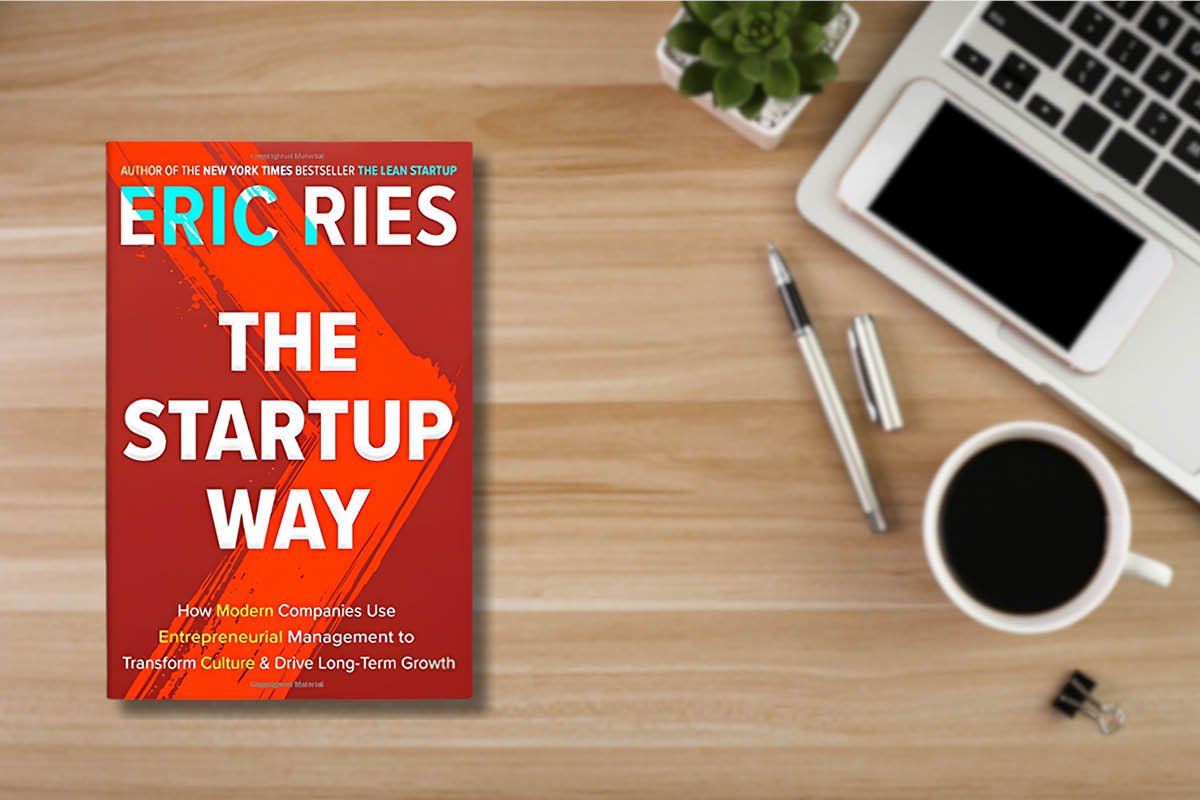
Every business book has one idea that stays with you long after you’ve closed the final page.
For The Startup Way by Eric Ries, that idea is the internal startup.
At first glance, it sounds like another piece of management jargon. But the more Ries explains it, the more sensible it becomes.
He believes innovation shouldn’t live inside a separate department with “Innovation Lab” written on the door. It should happen inside the business itself, through small, cross-functional teams that are trusted to solve one important customer problem at a time.
Imagine giving a handful of people from product, finance, marketing, technology, and operations one clear challenge, not fifty competing priorities, not endless approval meetings, just one problem worth solving. Now permit them to experiment. That’s the difference.
These teams don’t spend months trying to predict success. They build a simple version of an idea, gather feedback, measure what happened, and decide whether to improve it, change direction, or walk away.
Ries calls this the Build-Measure-Learn cycle, but beneath the framework lies a much bigger idea. Progress doesn’t come from having all the answers. Progress comes from asking better questions.
That’s a subtle shift, but it changes how an organization behaves. Suddenly, failure isn’t embarrassing if it helps avoid a much bigger mistake later. Success isn’t measured by how much money was spent or how many meetings were held. It’s measured by what the team discovered.
For leaders used to rewarding certainty, that’s a significant mindset change.
The other side of the table
No good business book escapes criticism, and The Startup Way by Eric Ries is no different.
Some readers feel that if you’ve already read The Lean Startup, many of the core ideas will sound familiar, making this book feel more like an extension than a breakthrough. Others point out that Ries places significant emphasis on support from senior leadership, leaving employees lower in the hierarchy wanting more practical advice on driving change from within.
That said, even many critics appreciate the book’s real-world examples and its practical approach to bringing entrepreneurial thinking into established organizations. It may not answer every question, but it certainly starts an important conversation.

A question we’d ask the author
If experimentation is so valuable, why do so many established companies still struggle to embrace it? The answer, judging by the book, has very little to do with technology; it’s culture.
Most organizations unknowingly reward predictability. Employees learn that it’s safer to defend proven ideas than to question them. Managers are expected to have answers rather than hypotheses. Budgets are approved based on forecasts, even when everyone knows forecasts become less reliable the further they look into the future.
Ries isn’t suggesting businesses throw away discipline. In fact, he repeatedly argues that experimentation needs structure. Good experiments begin with a clear assumption, measure real customer behaviour, and produce evidence that everyone can understand.
Perhaps the hardest part isn’t building that system. It’s convincing people that changing their minds after seeing new evidence isn’t a weakness. It’s exactly what good leadership looks like.
Who should read this?
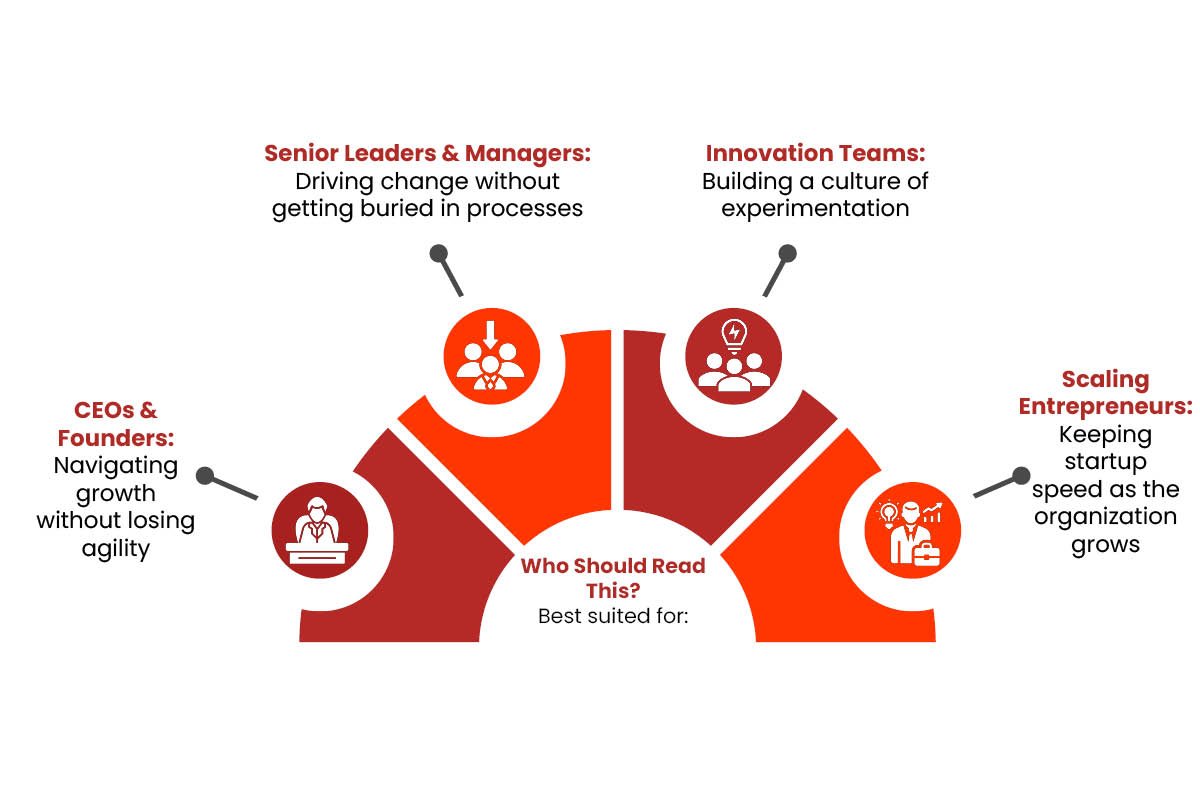
Best suited for:
- CEOs & Founders: navigating growth without losing agility
- Senior Leaders & Managers: driving change without getting buried in processes
- Innovation Teams: building a culture of experimentation
- Scaling Entrepreneurs: keeping startup speed as the organization grows
Already read The Lean Startup?
Expect familiar ideas, but with a new focus: how to bring entrepreneurial thinking into large, established organizations.
Is it recommended?
Yes, especially for leaders managing growth and change. Some ideas will feel familiar to readers of The Lean Startup, but the book offers a useful framework for bringing experimentation into established organizations.
Business Viewpoint verdict: Worth reading for anyone trying to keep a successful company from becoming too comfortable.
But a book like this shouldn’t be judged only by how well its ideas work in Silicon Valley. The real question is what happens when those ideas meet a different business environment. And India offers a particularly interesting test.
So, let’s put the coffee down and bring the conversation home.
In Chai with India: putting Ries’s ideas to the Indian test
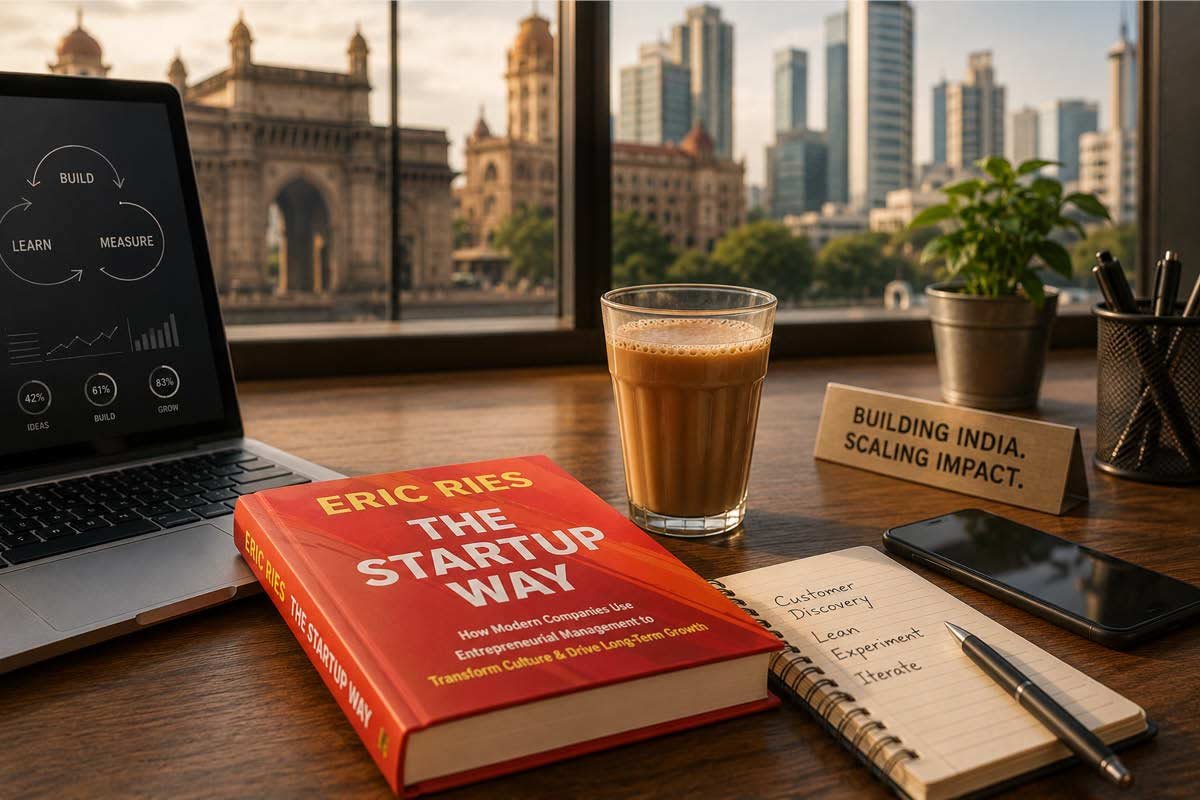
Would this work in India?
Every time we pick up a business book from Silicon Valley, the same question comes to mind: “Would this actually work in India?” With The Startup Way by Eric Ries, the answer is yes, but only if we adapt the ideas instead of copying them.
India’s business landscape is unique. Century-old family businesses coexist with AI startups, manufacturing firms are embracing automation, and millions of MSMEs continue to innovate with limited resources. That diversity makes Eric Ries’s ideas surprisingly relevant.
Take a typical manufacturing company. A new product often passes through multiple layers of approvals before reaching customers. Ries would ask a simpler question: “What’s the smallest experiment you can run next month?” Instead of betting heavily on assumptions, businesses can test ideas early, learn from customers, and make better decisions with real evidence.
In many ways, Indian entrepreneurs have been following this approach for years. Limited resources have encouraged them to test, adapt, and scale only after proving what works. The Startup Way by Eric Ries
simply provides a structured framework that helps businesses, large and small, turn those instincts into a repeatable process.
Zomato provides an interesting example of Ries’s philosophy in practice. The company has repeatedly experimented with new services and business models, learned from customer behaviour, and changed direction when necessary. Not every initiative succeeded, but each offered a lesson.
That’s the heart of The Startup Way: a business doesn’t need to get every decision right. It needs the discipline to learn quickly and the courage to change course.
And perhaps that’s the most useful lesson from The Startup Way by Eric Ries: take the idea from the page and turn it into one small experiment.
One action before your next cup of Chai

Before your next strategy meeting, forget the presentation for a moment.
Instead, write down one belief your business has always accepted without questioning. Maybe it’s about what customers want. Maybe it’s about pricing. Maybe it’s about how your products reach the market.
Now ask one simple question. “How could we test this instead of debating it?” You don’t need a massive budget. You don’t need a new department. You only need a small experiment that can teach you something your spreadsheets cannot.
Because that’s the quiet brilliance of The Startup Way by Eric Ries. It reminds us that businesses rarely grow because they have all the answers. They grow because they’re never afraid to keep asking better questions.