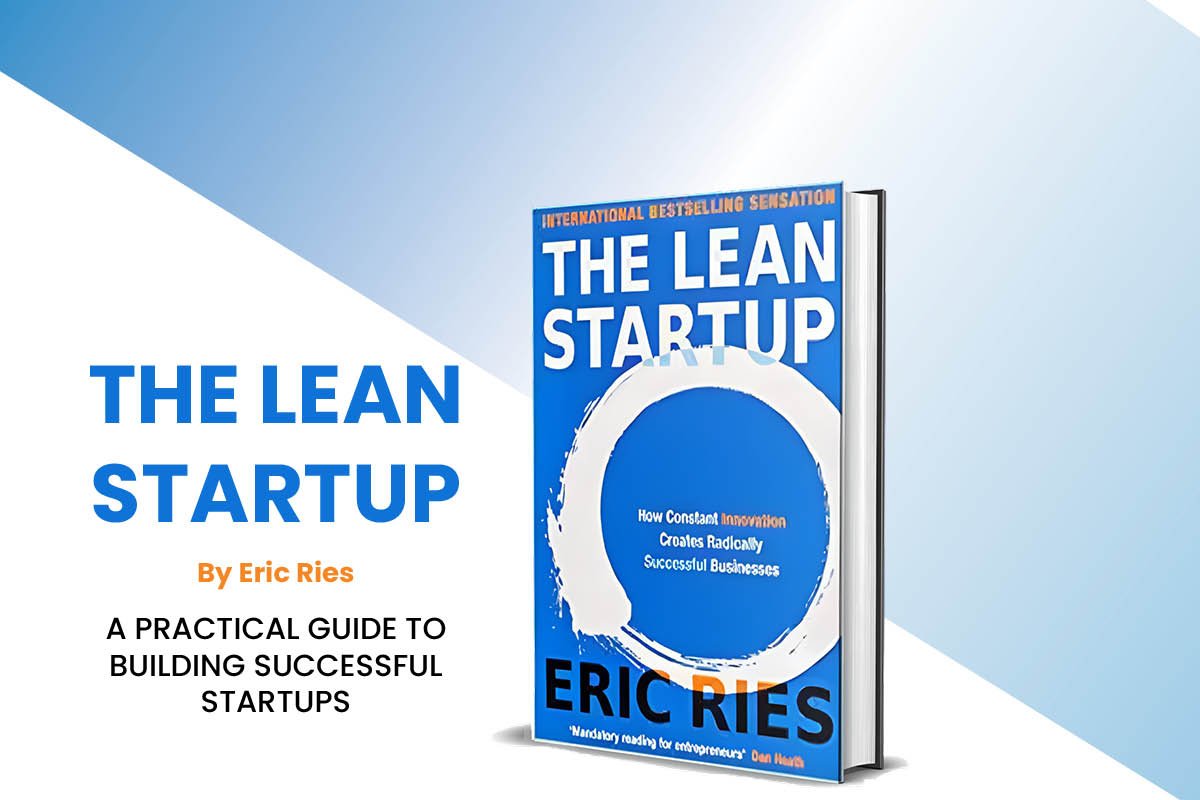



What if the biggest reason businesses fail is not poor ideas, but building products before finding out whether anyone actually wants them?
Many startups invest time, money, and effort into creating products based on guesswork instead of real customer needs. The Lean Startup challenges this common approach and shows why testing ideas early can lead to better business decisions.
Purpose of the Book:
The Lean Startup encourages entrepreneurs to replace assumptions with customer feedback and practical experiments. Eric Ries presents a management approach for businesses working under uncertainty, helping them test ideas before making major investments.
The book aims to reduce waste, improve learning, and guide companies toward a business model that customers truly value through continuous testing and real market responses.
Author’s perspective
Eric Ries shaped his startup philosophy through personal victories, costly mistakes, and practical experience.
Author profile:

- Primary Voice: Practical entrepreneur and startup advisor
- Background: Entrepreneur, blogger, startup mentor
- Key Expertise: Startup management, product experimentation, innovation
- Core Strength: Turning uncertainty into measurable learning
The book presents the idea that every startup should operate like a scientific experiment where ideas are tested before major commitments are made. It explains that every business begins with assumptions, and those assumptions require evidence instead of confidence alone. The author gives priority to observing customer behaviour and using those insights to guide future decisions rather than depending on lengthy business plans.
This guide also argues that effective management becomes a valuable advantage when learning is measured clearly. It suggests that businesses make better decisions by collecting reliable evidence and adjusting their direction based on real customer responses.
An overview of the core concepts
The Lean Startup defines a startup as an organization created to build a new product under uncertain conditions. It introduces the Build, Measure, Learn feedback loop, encouraging teams to test ideas with a Minimum Viable Product (MVP).
The book explains validated learning, innovation accounting, and the importance of deciding whether to pivot or persevere based on customer evidence. Divided into Vision, Steer, and Accelerate, it shows how startups can learn faster, make informed decisions, and reduce unnecessary effort.
Most important section for business readers
Top takeaway
The Build, Measure, Learn framework stands out as the book’s most valuable section. It combines customer feedback, practical experimentation, and continuous business improvement into a clear process that readers can understand quickly and apply confidently when testing ideas and making business decisions.
The book’s strengths and drawbacks
Like any influential business book, The Lean Startup offers valuable strengths while leaving room for a few limitations.
What works well
- Clear and practical framework for testing business ideas.
- Connects theory with real business examples in an easy-to-follow way.
- Encourages customer-focused thinking.
- Useful for many businesses beyond technology startups.
Points to consider
- Some business examples feel dated.
- Less useful for industries with long product development cycles.
- Readers may need additional books for detailed implementation methods.
Overall, the book’s practical guidance and useful concepts make its advantages far more valuable than its limitations for most entrepreneurs.
Readability, practical value, and who should read it
The book uses a conversational writing style, real business stories, and simple explanations that make its ideas easy to follow, although a few management terms require extra attention.
Who should read it?
- Entrepreneurs
- Startup founders
- MBA students
- Product managers
- Innovation teams
- Small business owners
Its ideas can be applied to product development, customer interviews, marketing experiments, and business model testing. The book encourages readers to test assumptions early, measure meaningful progress, and confirm customer demand before making major investments.
Business impact of the book
The Lean Startup helped popularise the lean startup methodology and changed how many businesses approach product development. Its principles encouraged innovation teams in large organisations to experiment before making major commitments and promoted data-based decision-making instead of relying on assumptions. After its publication, many startups and established companies adopted its methods to improve learning, reduce waste, and make smarter business decisions.
Key frameworks, models, and principles
- Build, Measure, Learn Loop: Tests ideas through continuous customer feedback.
- Minimum Viable Product (MVP): Launches a basic version to collect early insights.
- Validated Learning: Confirms decisions using real customer evidence.
- Innovation Accounting: Tracks meaningful progress with practical business measurements.
- Pivot versus Persevere: Decides whether to change direction or continue the current strategy.
- Actionable Metrics: Use useful data that supports better business decisions.
- Five Principles of Lean Startup: Provide a practical foundation for managing startups under uncertainty and encouraging continuous learning.
What readers say
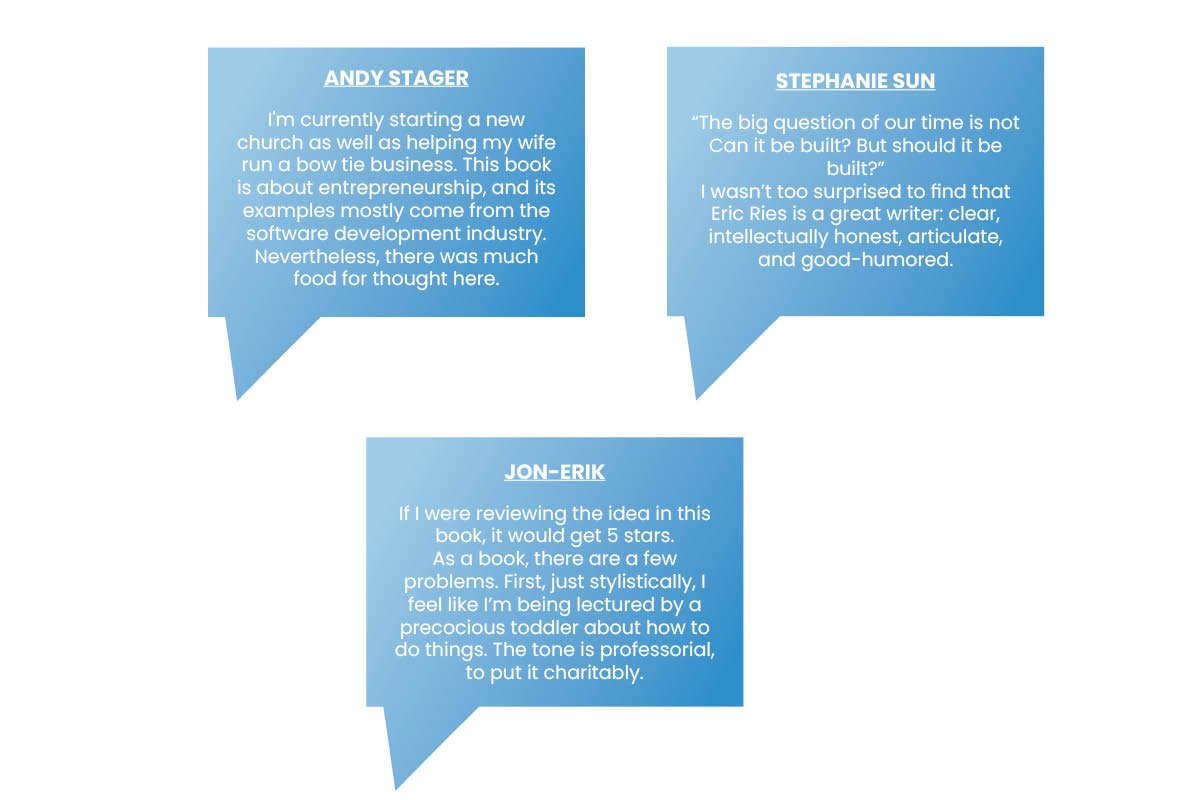
Readers appreciate the book for its practical business thinking and often recommend it to first-time entrepreneurs. Some feel the examples reflect an earlier startup era and suggest newer implementation guides for deeper execution.
I’m currently starting a new church as well as helping my wife run a bow tie business. This book is about entrepreneurship, and its examples mostly come from the software development industry. Nevertheless, there was much food for thought here.
Andy Stager
“The big question of our time is not Can it be built? But should it be built?”
I wasn’t too surprised to find that Eric Ries is a great writer: clear, intellectually honest, articulate, and good-humored.
Stephanie Sun
If I were reviewing the idea in this book, it would get 5 stars.
As a book, there are a few problems. First, just stylistically, I feel like I’m being lectured by a precocious toddler about how to do things. The tone is professorial, to put it charitably.
Jon-Erik
Overall judgement
The Lean Startup remains a valuable guide for anyone building ideas in uncertain markets. Its practical principles encourage thoughtful experimentation, informed decision-making, and careful use of resources. Although some examples feel dated, the book continues to offer useful lessons that help entrepreneurs make smarter business choices with greater confidence.
Thank You For Reading!
Read More
Beyond Survival Mode: Lessons From Build a Business You Love