


A single conversation can introduce you to a valuable client, a reliable supplier, a business mentor, or a partner who helps you enter a new market. But for small business owners, the real challenge is not meeting more people. It is turning the right connections into lasting business relationships.
Networking for small business owners is becoming more important as competition increases and buyers rely on recommendations before making decisions. LinkedIn’s Work Change research for 2026 reports that 85% of professionals in its India findings believe human relationships and networks are more important than ever. The same research says 73% of small business leaders across key markets view networking as important for long-term growth.
For Indian entrepreneurs, this creates a practical opportunity. Whether you run a consultancy in Pune, a manufacturing unit in Ahmedabad, a retail business in Jaipur, or a digital agency serving clients across India, a focused network can help you build credibility, generate referrals, find partners, and understand market changes.
The key is to treat networking as a business activity with clear goals, consistent follow-ups, and measurable results, not simply a collection of business cards and social media connections.
Why is networking important for small business owners?

For networking for small business owners, the value goes beyond collecting contacts. Small businesses often operate with limited budgets, small teams, and less brand recognition than established companies. Networking can help close some of these gaps by giving business owners access to relationships, knowledge, and opportunities they may not be able to build independently.
1. Generate referrals and qualified leads.
A recommendation from a trusted customer, accountant, consultant, or business partner can help a potential buyer feel more confident about contacting your business.
For example, a Pune-based accounting firm could build relationships with business consultants and company secretaries who regularly work with businesses needing accounting support. These connections may lead to relevant introductions without requiring the firm to spend heavily on advertising.
The business takeaway: Do not ask everyone you meet for leads. Explain the type of customer you help, the problem you solve, and the signs that indicate someone might need your service. This makes referrals easier and more relevant.
2. Find business partners and new opportunities.
Networking can connect entrepreneurs with complementary businesses. A web development agency might collaborate with a branding consultant, while a food manufacturer could connect with packaging suppliers, distributors, and retail buyers.
These relationships can help businesses serve customers more effectively or enter new markets without building every capability in-house.
Practical insight: Look for partners who serve the same customer but do not directly compete with you. A shared audience creates a natural reason to collaborate.
3. Learn from other business owners.
Networking gives entrepreneurs access to practical knowledge about pricing, hiring, customer retention, technology, and operational challenges.
A conversation with another small business owner may reveal how they manage delayed payments, evaluate a CRM system, or handle seasonal demand. Such discussions can help you compare approaches before committing time or money.
However, treat advice as an input rather than a substitute for due diligence. A strategy that works for a large business may not suit a small firm with different cash flow, staffing, or customer needs.
4. Build credibility before a sales conversation.
People are more likely to consider a business when they can understand what it does and find evidence that it delivers value.
Networking helps build familiarity, but relationships work best when supported by proof. Maintain an updated business profile, relevant case studies, customer testimonials, and a clear description of your services.
LinkedIn’s 2026 small business research also highlights the role of testimonials and case studies in building buyer confidence. Its early findings are based on a US survey, so they should not be treated as India-specific statistics.
5. Access wider markets and business communities
Indian entrepreneurs can connect through local industry associations, chambers of commerce, trade fairs, professional groups, and digital business platforms.
For example, a small manufacturer could attend an industry exhibition to meet distributors, while a service provider could join a local business association to build relationships with nearby companies.
The aim is not to join every available group. It is to identify the communities where your prospective customers, partners, and industry peers already spend time.
Types of business networking opportunities
The best channel for networking for small business owners depends on the industry, budget, business goals, and preferred way of communicating.
| Networking channel | Typical cost | Main benefit | Best use |
| Free basic access; paid features optional | Professional visibility and direct connections | B2B leads, partnerships, industry insights | |
| Industry events and trade fairs | Free to paid; travel may add costs | Direct access to buyers and suppliers | Product demonstrations and market expansion |
| Chambers of commerce | Membership or event fees may apply | Local business connections and industry support | Regional relationships and business introductions |
| Referral groups | Membership or participation fees may apply | Structured relationship-building and referrals | Businesses that benefit from repeat referrals |
| Local business communities | Often free or low cost | Personal relationships and local visibility | Retailers, service providers, and local entrepreneurs |
| Webinars and online communities | Often free; some paid | Convenient access to specialised knowledge | Remote networking and niche industries |
Costs vary by city, organiser, membership level, and event. Check what is included before paying for a membership or ticket.
Where can Indian entrepreneurs find networking opportunities?
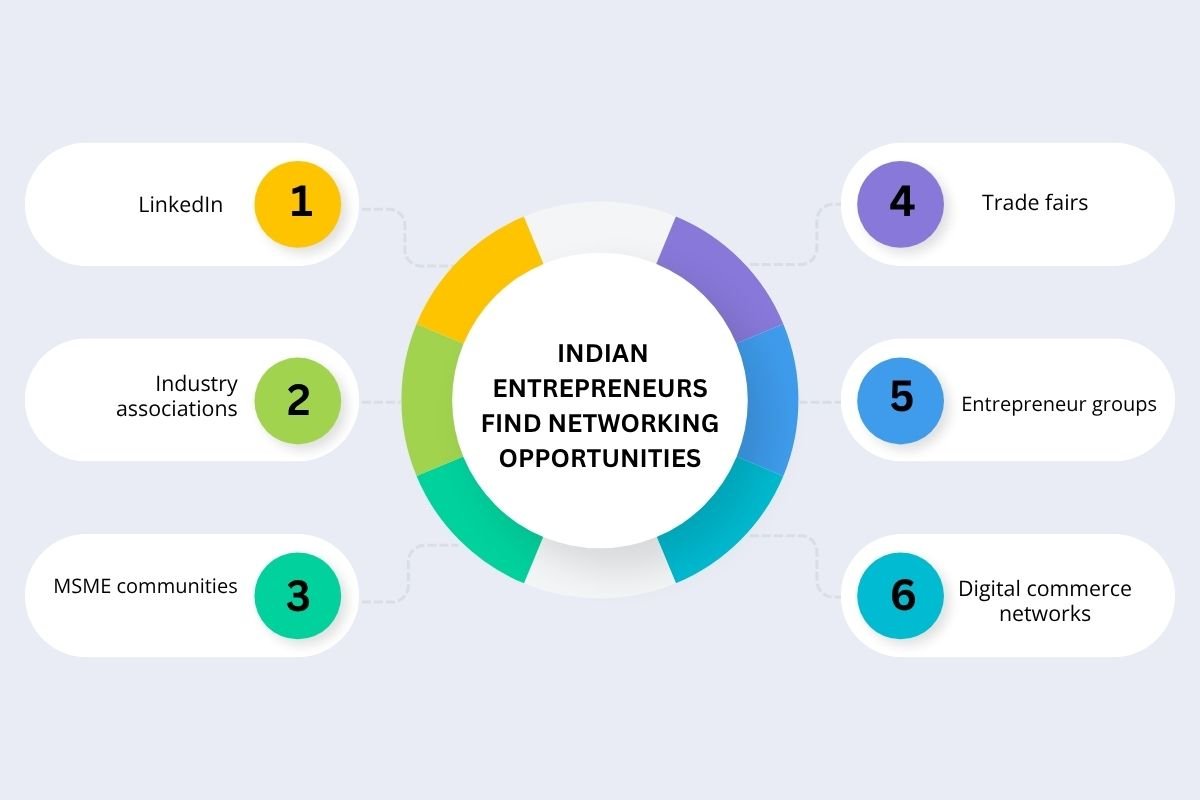
- LinkedIn: Search for people in your industry, relevant professional groups, and business events.
- Industry associations: Explore organisations such as FICCI, CII, and local chambers relevant to your sector.
- MSME communities: Look for local MSME associations, industry clusters, and business support programmes.
- Trade fairs: Attend exhibitions where your target buyers, distributors, suppliers, or partners are likely to participate.
- Entrepreneur groups: Consider structured referral networks, founder communities, and local business meetups.
- Digital commerce networks: Businesses exploring online market access can research the Open Network for Digital Commerce (ONDC) and assess whether its ecosystem fits their products or services.
Before joining a group, check its member profile, activity level, event frequency, and relevance to your goals.
10 effective networking strategies for small business owners
Networking for small business owners works better when it is focused, consistent, and linked to a business objective. These small business networking strategies can help entrepreneurs build relationships without spending every week at events.
1. Set a clear networking goal.
For effective networking for small business owners, start by identifying what your business needs most over the next three to six months.
Your priority might be finding new customers, meeting distributors, developing partnerships, hiring skilled employees, or learning about a new market.
Choose one primary objective and two secondary objectives. This makes it easier to decide which events to attend and which people to contact.
Example: A small HR consultancy seeking corporate clients should prioritise HR leaders, business owners, and professional service providers rather than joining unrelated networking groups.
2. Identify the right people to connect with
A larger network is not automatically a more valuable network. Networking for small business owners should focus on people who can offer relevant knowledge, become customers, introduce suitable contacts, or collaborate with your business. Focus on people who can offer relevant knowledge, become customers, introduce suitable contacts, or collaborate with your business.
Create a simple list of 20 potential connections. Include their industry, role, possible relevance, and the reason you want to connect.
Avoid treating people only as sales opportunities. A useful network includes peers, mentors, suppliers, potential partners, and people whose experience can help you make better decisions.
3. Prepare a clear business introduction.
You should be able to explain your business in around 20 to 30 seconds.
Use this structure:
- Who you help.
- What problem you solve.
- What makes your approach useful.
- What type of connection you want to build.
Example: “I help small manufacturers improve their digital presence and generate qualified B2B enquiries. I am currently connecting with industrial suppliers and export-focused businesses.”
This is more effective than simply saying, “I run a digital marketing agency.” It helps the listener understand where your business fits.
4. Build relationships before asking for business.
A first conversation should create understanding, not pressure. This is a core principle of networking for small business owners because trust often comes before referrals or sales.
Ask thoughtful questions about the other person’s work, current priorities, or industry challenges. Share relevant knowledge where you can, and look for opportunities to help.
For instance, you could introduce two businesses that would benefit from working together or share a useful industry report with a contact.
The principle is simple: build a relationship in which both sides understand each other’s work before expecting a referral or sale.
5. Use LinkedIn with a purpose.
LinkedIn can support networking for small business owners without requiring frequent travel or event fees.
Optimise your profile with a clear headline, relevant business information, and evidence of your work. Connect with people whose roles or interests align with your goals.
When sending a connection request, include a short, specific reason for reaching out. After connecting, engage with their relevant posts or share useful information instead of immediately sending a sales pitch.
A practical weekly target: Send five thoughtful connection requests, contribute to two relevant discussions, and publish one useful business insight. Adjust the target to your available time and audience.
6. Attend networking events selectively.
Choose events based on the people attending, the quality of discussions, and the opportunities to make relevant connections.
Before registering, ask:
- Will my target customers or potential partners attend?
- Is there time for meaningful conversations?
- Does the organiser have a credible track record?
Set a goal of having three useful conversations rather than collecting 30 business cards. A smaller number of relevant connections is often easier to follow up with effectively.
7. Offer useful introductions and resources.
Being helpful gives people a reason to remember you.
You could share a supplier recommendation, introduce two professionals with complementary needs, provide a relevant checklist, or explain a lesson from a recent business project.
Keep your help relevant and genuine. Avoid making introductions without permission or sharing confidential business information.
8. Build relationships with complementary businesses.
Partnerships can help small businesses reach customers they might not otherwise access. For networking for small business owners, complementary businesses can be especially valuable because they serve similar audiences without directly competing.
For example, an accountant could collaborate with a business lawyer on an educational webinar for startup founders. A packaging manufacturer could develop relationships with food producers looking for reliable suppliers.
Start with a small, clearly defined collaboration. Agree on responsibilities, customer ownership, costs, and how results will be measured before expanding the arrangement.
9. Use AI to prepare and organise your networking.
AI tools can help reduce the administrative work involved in networking, but they should support genuine conversations rather than replace them.
Useful applications include:
- Researching a public speaker’s professional background before an event.
- Drafting a personalised connection message for you to review.
- Summarising your own meeting notes into follow-up actions.
- Grouping contacts by industry, customer type, or potential collaboration.
- Creating a weekly reminder list for people you want to reconnect with.
Example prompt: “Help me draft a short, professional LinkedIn message to a business consultant. We met at an industry event and discussed challenges faced by small manufacturers. Make the message specific, friendly, and free of sales pressure.”
Check all AI-generated details before sending a message. Do not upload confidential
customer information or sensitive contact data into tools without appropriate safeguards.
10. Track relationships and follow through
Networking for small business owners becomes more valuable when you remember what people discussed and act on agreed next steps.
Maintain a simple spreadsheet with the person’s name, business, date of contact, discussion notes, follow-up date, and next action.
Review the list every week. Follow up on promised introductions, share relevant resources, and reconnect when you have a genuine reason.
A contact database is useful only if it leads to thoughtful action. Do not measure success by the number of names you collect.
How to follow up after a networking event?

The first conversation creates an opportunity. For networking for small business owners, the follow-up helps keep it alive.
Follow-up steps
- Reconnect while the conversation is still fresh. Send a personalised message within one to three business days when appropriate.
- Mention a specific detail. Refer to the topic you discussed so the message does not feel generic.
- Offer a relevant next step. Share a resource, suggest a short meeting, or make an agreed introduction.
- Respect the other person’s time. Do not repeatedly message someone who has not responded.
- Keep the relationship active. Reconnect when you have something useful to contribute, not only when you need a favour.
Sample follow-up message
“Hi [Name], it was great meeting you at [Event Name]. I enjoyed our conversation about [specific topic]. I came across a resource that may be useful for your work and wanted to share it with you. It would be great to stay connected and exchange ideas.”
Personalise the message before sending it. A relevant reference to your actual conversation is more valuable than an elaborate template.
How to build a business network in 30 days?
You do not need a large budget or a packed calendar to start networking for small business Owners. A simple month-long plan can help you build a repeatable habit.
| Timeline | Action | Intended outcome |
| Days 1–5 | Define your goal, update your LinkedIn profile, and identify 20 relevant contacts | A clear networking direction |
| Days 6–10 | Send five to ten personalised connection requests and reconnect with existing contacts | Initial conversations |
| Days 11–15 | Attend one relevant event, webinar, or business meetup | New industry connections |
| Days 16–20 | Follow up, share useful resources, and make relevant introductions | Stronger relationships |
| Days 21–25 | Explore one potential partnership and schedule follow-up conversations | A practical collaboration opportunity |
| Days 26–30 | Review conversations, referrals, meetings, costs, and next steps | A measurable networking plan |
What should you measure at the end of 30 days?
Track both activity and business outcomes:
- Relevant new connections made.
- Meaningful conversations held.
- Follow-ups completed.
- Qualified leads or referrals received.
- Meetings booked with prospective customers or partners.
- Collaboration opportunities identified.
- Revenue or profit attributable to networking, where measurable.
Do not expect every new connection to generate immediate revenue. The first month may primarily produce conversations and early opportunities. Use the results to decide which activities deserve more time in the next month.
Best networking tools and platforms for small businesses
The right tools help you organise relationships without adding unnecessary complexity, especially when networking for small business owners becomes a regular business activity.
| Tool or platform | How it helps | Best for |
| Professional profiles, connections, posts, and industry conversations | B2B networking and credibility | |
| Google Sheets or Excel | Tracks contacts, follow-ups, and networking outcomes | Entrepreneurs starting with a simple system |
| HubSpot CRM | Organises contacts, deals, and customer interactions | Businesses managing a growing pipeline |
| Google Meet or Zoom | Supports remote introductions and follow-up meetings | Businesses networking across cities |
| AI writing assistants | Help prepare messages, summarise notes, and plan outreach | Owners looking to save administrative time |
Choose tools based on your actual workload. A spreadsheet may be sufficient when you have a small number of contacts. A CRM becomes more useful when multiple team members manage leads or when follow-ups are frequently missed.
AI is most valuable when it improves a defined workflow. Measure whether it saves time, improves follow-up consistency, or supports better lead management before paying for additional features.
How to measure networking ROI?
Networking for small business owners has a business cost, even when an event is free. Your time, travel, memberships, and follow-up activities all require resources.
To evaluate the return, compare the profit attributable to networking with the cost of the activity.
Networking ROI formula:
Networking ROI (%) = [(Attributable profit − Networking cost) ÷ Networking cost] × 100
For example, suppose a business spends ₹10,000 on event fees, travel, and related follow-up activities. It later earns ₹25,000 in profit that can reasonably be attributed to the resulting business opportunities.
The calculation is:
[\frac{₹25,000-₹10,000}{₹10,000}\times100=150%]
The networking activity produced a 150% return under these assumptions.
Use profit rather than total sales revenue for this calculation, and include relevant costs. Attribution can be difficult when a customer interacts with multiple marketing channels, so document how the relationship originated and avoid counting the same profit twice.
For longer sales cycles, track leading indicators such as qualified leads, meetings, proposals, and referral quality while waiting for revenue outcomes.
Common networking mistakes small business owners should avoid
Even regular networking may produce limited results when the approach is poorly planned. Networking for small business owners needs a clear purpose, not just frequent activity.
- Focusing on quantity over quality: Hundreds of connections are not useful if they are unrelated to your goals.
- Selling too early: A direct pitch before understanding someone’s needs can damage trust.
- Ignoring follow-ups: A good conversation may be forgotten if you never reconnect.
- Attending every event: Unfocused participation consumes time and money without a clear business purpose.
- Expecting immediate returns: Some relationships take months to develop into partnerships or referrals.
- Using generic AI-generated messages: Personalise messages and verify every detail before sending.
- Failing to track outcomes: Without records, it is difficult to identify the channels producing meaningful opportunities.
- Sharing too much information: Protect customer data, business plans, and confidential commercial details.
The goal is to build a reliable network, not to remain constantly visible without a clear business reason.
Networking tips for beginners and introverted entrepreneurs
Networking for small business owners does not require being the most outgoing person in the room. Listening well, asking thoughtful questions, and following through can be just as useful.
If you are new to networking or prefer smaller conversations, start with these approaches:
Begin with people you already know. Former colleagues, existing customers, suppliers, classmates, and professional acquaintances can provide a comfortable starting point.
Choose smaller settings. One-to-one conversations, small business meetups, online discussions, and focused webinars may feel more manageable than large events.
Prepare two or three questions. Ask what someone does, which business challenges they are currently working on, or what they have learned recently. Listen closely rather than planning your next sentence.
Set a realistic target. Aim for two meaningful conversations at an event instead of trying to meet everyone.
Use online networking as a starting point. A thoughtful message or comment can help establish familiarity before a phone call or in-person meeting.
Follow up in your own style. A short, genuine message is enough. You do not need to adopt an aggressive sales approach to build useful relationships.
Consistency matters more than personality type. A steady approach to networking for small business owners can gradually create a strong professional network. Small, regular actions can gradually create a strong professional network.
Conclusion:
Networking for small business owners is most effective when it supports a clear business objective. The right relationships can help entrepreneurs find customers, strengthen credibility, identify partners, and make better decisions.
In India’s competitive business environment, owners do not need to attend every event or invest in expensive memberships to get started. They can begin by identifying relevant contacts, participating in suitable communities, offering useful support, and following up consistently.
Use the 30-day How do small business owners start networking for small business owners?action plan to establish a routine, track the outcomes that matter, and invest more time in the channels that generate meaningful relationships. The aim is not simply to know more people. It is to build a network that helps your business grow sustainably.
FAQs
1. How do small business owners start networking for small business owners?
To begin networking for small business owners, define one business goal, such as finding customers or potential partners. Update your LinkedIn profile, list relevant contacts, reconnect with people you already know, and attend one suitable business event. Follow up with personalised messages and track the conversations that lead to useful opportunities.
2. Where can entrepreneurs find networking events?
Entrepreneurs can find events through LinkedIn, local chambers of commerce, industry associations, MSME communities, trade fairs, professional groups, and founder meetups. Check the attendee profile, organiser credibility, cost, and relevance to your business before registering.
3. How often should you follow up?
For a new connection, a personalised follow-up within one to three business days is often a practical starting point. After that, reconnect when you have something relevant to share or a clear next step. Avoid repeated messages that do not respect the other person’s time.
4. Is networking for small business owners worth the cost?
Networking for small business owners can be worthwhile when it generates qualified leads, referrals, partnerships, useful knowledge, or other measurable business benefits. Track direct costs, time invested, follow-up activity, and attributable profit. Review the results over an appropriate period because some relationships take time to produce revenue.