

You approved a celebrity fee, but what did that spend earn? As a marketer, one cannot judge success through likes alone. A founder also needs proof before approving another costly deal. That is why you need to know how to measure the ROI of brand endorsement properly.
The ROI of brand endorsement can reach beyond direct sales. It can include leads, searches, traffic, trials, and repeat buys. It can also show stronger brand recall after campaigns end. Today, I’ll try to explain costs, returns, formulas, metrics, and attribution. We will also separate endorsement impact from other marketing activity. That makes budget reviews clearer for brands and agencies.
What does ROI mean in brand endorsement?
ROI shows whether an endorsement earned more value than it cost. For marketers, investment means every cost tied to endorsement activity. That includes celebrity fees, agency fees, and production costs. Content creation, travel, events, and media amplification also count.
Return means measurable value created from that campaign spend. This value could include sales, leads, traffic, or brand searches. The basic formula looks like this for most campaign reviews. This is how to measure ROI of brand endorsement:
ROI = (Campaign Return − Campaign Investment) ÷ Campaign Investment × 100
The ROI of brand endorsement changes with campaign goals. A launch campaign may value reach before sales or leads. A sales campaign should focus more closely on profit generated. The American Marketing Association supports linking spend with outcomes.
What returns should you measure?
Not every endorsement campaign should chase sales from day one. Your main goal should decide which returns matter most.
- Direct sales: Track revenue from unique codes, links, or offers.
- Leads: Count sign-ups, enquiries, downloads, and event registrations.
- Website traffic: Measure visits from endorsement posts and links.
- Conversions: Track purchases or other planned customer actions.
- Customer acquisition: Count new customers gained during campaigns.
- Brand awareness: Measure recall, recognition, and purchase consideration changes.
- Engagement: Use likes and comments as supporting campaign signals.
- Search demand: Track growth in searches for your brand name.
For example, product launches should track sales and conversion first. New brands may value awareness and consideration much more initially. This approach stops brands from judging every campaign through sales. It also gives marketers a fairer view of campaign value.
How to measure ROI of brand endorsement step by step?
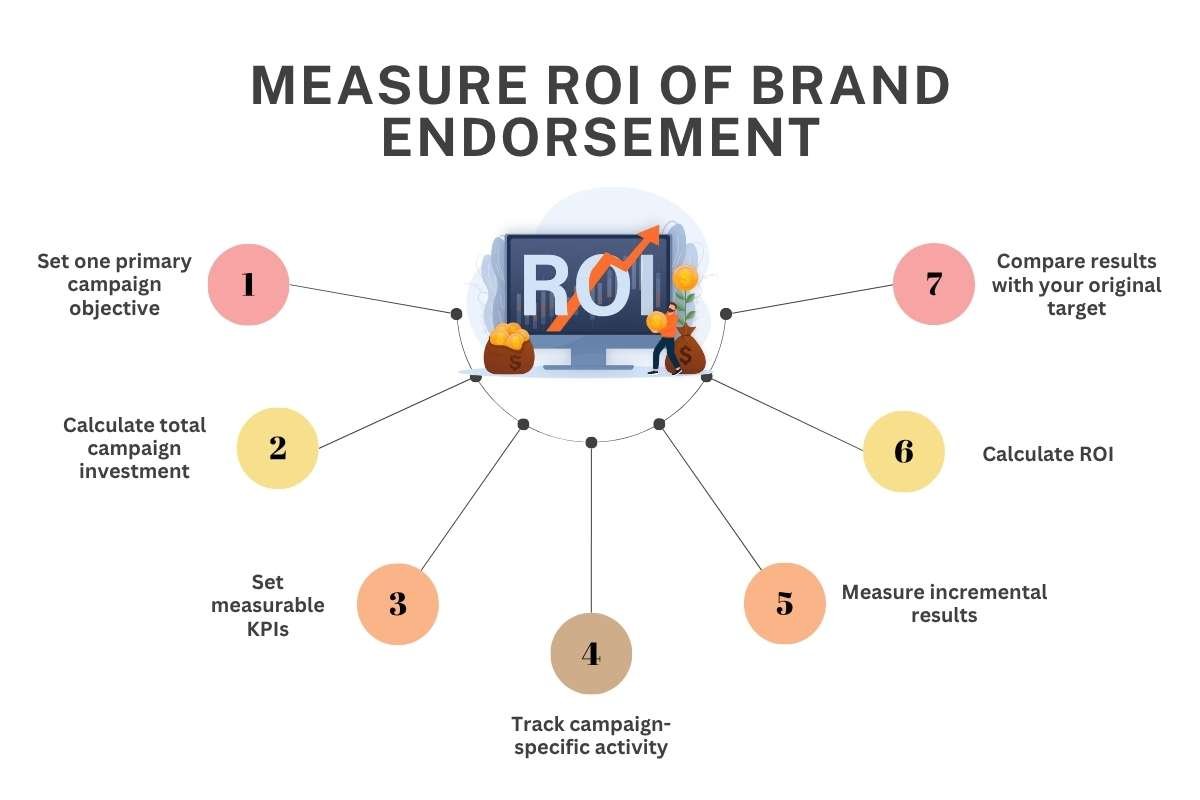
If you want to know how to measure ROI of brand endorsement, follow these steps.
- Set one primary campaign objective: Choose sales, leads, awareness, traffic, or customer acquisition first.
- Calculate total campaign investment: Add fees, production, travel, events, content, and media costs. Do not hide costs that sit outside the endorsement fee.
- Set measurable KPIs: Set clear targets before the campaign goes live publicly.
- Track campaign-specific activity: Use unique links, codes, landing pages, QR codes, and UTMs.
- Measure incremental results: Compare campaign results against a suitable pre-campaign or control baseline.
- Calculate ROI: Use only returns that you can reasonably attribute here. Then apply the standard ROI formula from the earlier section.
- Compare results with your original target: A positive ROI does not always mean strong campaign performance.
For example, industry benchmarks suggest influencer marketing can generate an average return of about $5.78 for every $1 spent, depending on execution, industry, and targeting (Influencer Marketing Hub, 2024).
That shows why brands need context beyond impressive percentage gains.
The 4 metrics for measuring ROI of brand endorsements
Your customer journey should guide which endorsement metrics matter.
1. Awareness
- Reach: Count people who saw the endorsement content.
- Impressions: Track total times audiences saw campaign content.
- Brand recall: Measure how well audiences remember your brand.
- Search volume: Watch changes in branded searches after campaigns.
2. Consideration
- Website visits: Track traffic from endorsement links and posts.
- Engagement rate: Compare meaningful actions against total audience exposure.
- Product-page views: Measure interest after endorsement content exposure.
- Time spent: Check whether visitors explore your product pages.
3. Conversion
- Sales: Track revenue linked to campaign activity.
- Conversion rate: Measure how many visitors complete desired actions.
- Coupon usage: Count purchases using campaign-specific discount codes.
- Cost per acquisition: Divide campaign spend by the number of new customers.
4. Retention
- Repeat purchases: Track customers who buy again after campaigns.
- Customer lifetime value: Measure the long-term revenue generated by acquired customers.
Engagement remains useful, but it cannot prove financial returns. I separate vanity metrics from business metrics during campaign reviews. That keeps high likes from masking weak commercial campaign results.
How to attribute results to an endorsement?
Attribution gets hard when several campaigns run at once. A sale may come from ads, search, email, or endorsement content. So, the ROI of brand endorsement needs stronger tracking methods.
- Unique discount codes: Link purchases directly to endorsement campaigns.
- Affiliate links: Track clicks, sales, and revenue from creators.
- UTM parameters: Mark traffic from each endorsement source clearly.
- Dedicated landing pages: Give campaign audiences one trackable destination.
- Geographic testing: Compare regions with endorsement exposure against regions without.
- Before-and-after comparisons: Compare results before and after campaign launch.
- Control groups: Hold back similar markets and compare their results.
Correlation alone cannot prove that endorsement caused those results. Branded searches may rise because other campaigns also gained traction. Google recommends experiments when marketers need stronger causal evidence.
John Chen, Senior Director of Product Management at Google Ads Measurement, says marketers should combine attribution with incrementality and marketing mix modeling to build a more complete view of campaign performance. This makes incrementality more useful than simple last-click reporting.
Nielsen defines incremental lift as the increase in sales or other KPIs that would not have happened without the marketing activity.
What can distort your ROI calculation?
Small measurement errors can make endorsement results look far better. I would watch these risks before judging any campaign result:
- Counting only celebrity fees: Include every campaign cost involved.
- Counting every sale: Some buyers would purchase without endorsements.
- Chasing likes: Engagement cannot replace sales or lead data.
- Ignoring delayed purchases: Some customers need time before buying.
- Ignoring repeat buyers: Track later purchases from newly acquired customers.
- Comparing unlike campaigns: Match results against similar campaign goals.
- Trusting follower counts: Large audiences cannot guarantee strong results.
- Ignoring reputation costs: Negative publicity can reduce future brand value.
A campaign can show positive short-term ROI yet hurt brands later. That risk deserves attention alongside sales and conversion figures, and endorsement marketing risks should be considered in deeper risk planning.
How to judge whether an endorsement was worth it?

A good ROI number needs context before you renew any deal. I use four checks to judge whether endorsement spend worked.
- Exceeded target: Consider scaling the campaign or renewing the partnership.
- Met target: Check campaign efficiency before increasing your budget.
- Missed target: Find whether creative, audience, offer, or talent failed.
- Negative ROI: Reassess the partnership before committing more campaign spend.
Always compare results against your goals and relevant benchmarks. Do not judge performance against another celebrity campaign alone. Your choice of celebrities for endorsements can shape campaign outcomes.
So can your types of brand endorsements and partnership model. For deeper context, compare brand endorsement vs brand ambassador strategies.
Conclusion:
A famous face does not guarantee a profitable campaign. Brands need clear goals before they sign endorsement deals. They also need tracking before campaigns reach Indian consumers. That means linking spend, attributable returns, and campaign objectives.
If you ask how to measure ROI of brand endorsement, start early. Set your KPIs before launch, then track results through each stage. This gives marketers stronger proof for future endorsement decisions.
It also creates a useful base for broader brand endorsement planning.
Frequently Asked Questions
1. How to measure ROI of brand endorsement with a formula?
Use ROI = (Return − Investment) ÷ Investment × 100. Return means measurable value that your endorsement campaign creates.
2. What is a good ROI for a brand endorsement?
No universal benchmark exists because margins and goals vary. Industry, audience, campaign costs, and product prices also change results.
3. Can you measure celebrity endorsement ROI?
Yes, brands can track sales, codes, links, studies, and lift. Incremental tests can also show whether endorsements caused extra results.
4. Are likes and views enough to measure endorsement ROI?
No, likes and views show attention rather than business value. Connect engagement with traffic, leads, sales, or brand outcomes.
5. How long should brands measure endorsement ROI?
Measure immediate results alongside delayed purchases and repeat orders. Your product cycle and campaign goal should guide the timeframe.