



A buyer and seller may agree on a deal, but closing can still face delays. Regulatory clearance can even stop the transaction from moving ahead. The regulatory approvals for M&A in India depend on several factors, including deal structure, ownership, industry, and company status. These include deal structure, ownership, sector, and company status. Not every deal needs clearance from every regulator.
This blog explains which authorities matter and what triggers their involvement.
Which regulatory approvals for M&A are required in India?
The regulatory approvals for M&A in India depend on the transaction structure and applicable legal requirements. The buyer must check the transaction type, ownership, and sector. Different authorities may review different parts of the same deal.
| Authority | When its approval or involvement matters |
| Competition Commission of India (CCI) | Transactions that qualify as combinations under competition law. |
| National Company Law Tribunal (NCLT) | Schemes of merger, amalgamation, or arrangement. |
| Securities and Exchange Board of India (SEBI) | Acquisitions involving listed companies and takeover obligations. |
| Reserve Bank of India (RBI) | Cross-border deals and foreign exchange compliance. |
| Sector regulators | Transactions involving regulated industries, where applicable. |
The Ministry of Corporate Affairs (MCA), Registrar of Companies (RoC), and stock exchanges also play key roles. They handle statutory filings, disclosures, and other deal requirements.
However, an approval, notification, and filing serve different purposes. Approval grants permission, notification informs a regulator, and filing records statutory details. A deal may need one, two, or all three.
Key regulatory approvals for mergers and acquisitions in India
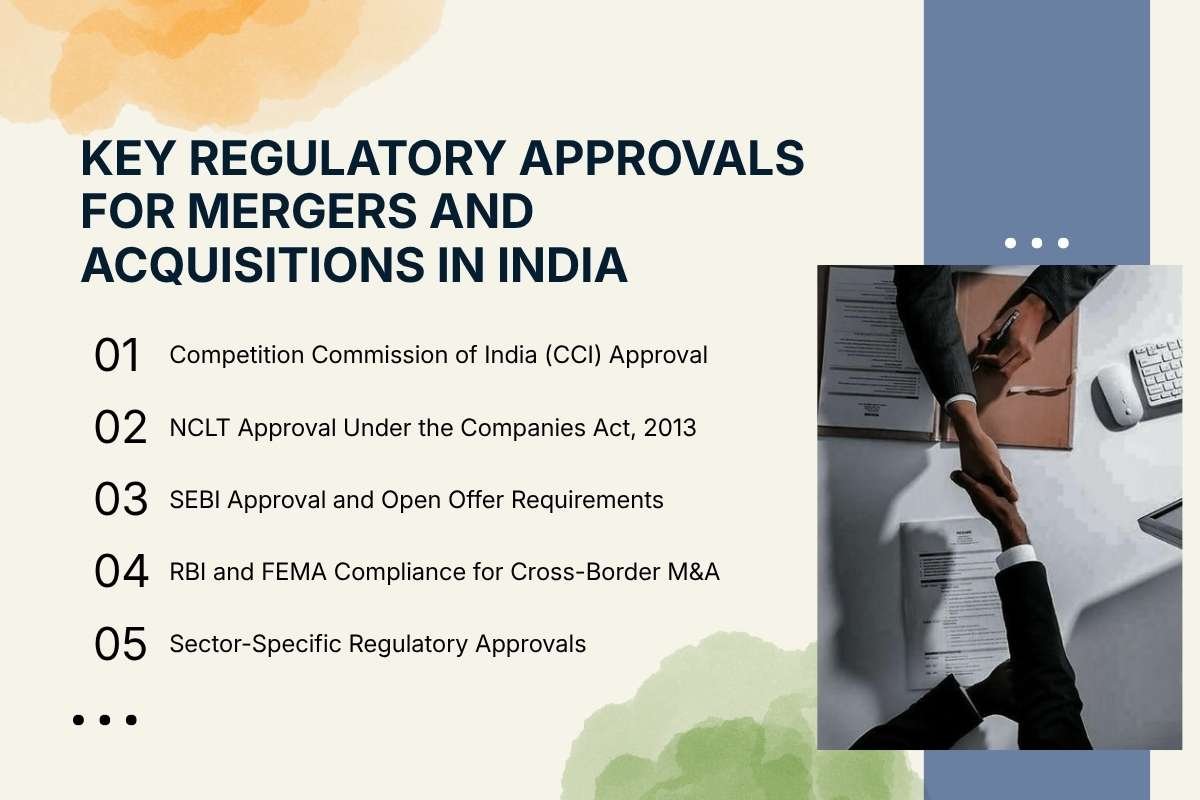
The regulatory approvals for M&A depend on the deal structure. Some deals need prior clearance before either party can close. Others need statutory filings or sector-specific consent. Here are the main authorities and their approval triggers.
1. Competition commission of India (CCI) approval
The Competition Act, 2002 governs combinations under Sections 5 and 6. A deal may qualify through enterprise or group thresholds. The current India-level thresholds are:
- Enterprise: Assets above ₹2,500 crore or turnover above ₹7,500 crore.
- Group: Assets above ₹10,000 crore or turnover above ₹30,000 crore.
The Act also sets worldwide thresholds with Indian business limits. A deal value above ₹2,000 crore creates another trigger. However, the target must have substantial business operations in India. For example, a ₹2,500 crore acquisition may trigger review. This can happen even when the target owns few physical assets. Its Indian business activity can still meet the test.
CCI approval is one of the key regulatory approvals for M&A in India, and qualifying deals must receive clearance before closing. The 2024 Combination Regulations also changed filing and review rules. Parties must check exemptions before they submit a notice.
2. NCLT approval under the companies act, 2013
NCLT approval is another important part of regulatory approvals for M&A in India, particularly for company merger and arrangement schemes under Sections 230–232. A scheme needs sanction from the NCLT. The process may include:
- Filing the scheme and seeking NCLT directions.
- Holding shareholder and creditor meetings, where required.
- Sending notices to relevant authorities.
- Securing NCLT review and sanction.
- Filing the sanctioned order with the RoC.
A normal share purchase does not need this merger scheme. The buyer acquires shares rather than merging two companies.
3. SEBI approval and open offer requirements
Listed-company acquisitions must follow SEBI’s Takeover Regulations, 2011.
An open offer generally applies when an acquirer:
- Reaches 25% or more voting rights.
- Crosses the permitted 5% annual creeping acquisition limit.
- Acquires control, even below the 25% threshold.
The acquirer must follow the public announcement and open offer rules. Listed companies must also make required stock exchange disclosures. These disclosures do not amount to separate SEBI approval.
Securities and Exchange Board of India+1
4. RBI and FEMA compliance for cross-border M&A
Foreign investment brings FEMA rules into the deal. Buyers must check sectoral caps and entry routes. Some investments follow the automatic route without prior approval. Others need government approval under the FDI framework.
The RBI Cross Border Merger Regulations, 2018 also govern inbound and outbound merger schemes. Compliant schemes receive deemed RBI approval under these rules. Parties must still meet pricing, reporting, and other FEMA conditions.
Notifications
5. Sector-specific regulatory approvals
Some industries have extra ownership and control rules.
| Sector | Relevant authority |
| Banking | RBI |
| Insurance | IRDAI |
| Telecom | Department of Telecommunications |
| Electricity | CERC or State Electricity Regulatory Commission |
For banks, RBI rules require prior approval at 5% shareholding. For insurers, IRDAI rules also set prior approval triggers above 5%. Telecom and power deals must meet their licence and sector-specific control rules.
Sector-specific regulatory approvals your businesses need
Some industries face extra rules during an acquisition. Buyers must check ownership limits, control changes, and licence terms. These rules differ across sectors and regulators.
| Sector | Relevant authority |
| Banking | Reserve Bank of India (RBI) |
| Insurance | Insurance Regulatory and Development Authority of India (IRDAI) |
| Telecom | Department of Telecommunications (DoT) |
| Electricity | CERC or relevant State Electricity Regulatory Commission |
For example, banking acquisitions need prior RBI approval at 5% shareholding. The RBI also checks whether proposed major shareholders meet its fit-and-proper criteria. RBI’s 2023 Banking Shareholding Directions.
Insurance deals also face specific share transfer rules. Under IRDAI’s 2024 Regulations, buyers need prior approval at 5% shareholding. IRDAI’s 2024 Regulations.
Telecom acquisitions must also meet DoT licence conditions. Electricity deals may need consent under applicable power-sector rules. The exact trigger depends on the licence and ownership structure. A sector regulator’s consent may apply even when CCI approval does not.
When do businesses need multiple regulatory approvals?
One transaction can trigger several regulatory requirements at once. For example:
- Listed bank acquisition: SEBI takeover rules may apply alongside RBI approval for qualifying shareholdings.
- Listed company acquisition: CCI clearance may apply if competition thresholds are met. SEBI obligations may also arise from changes in shareholding or control.
- Cross-border merger: The scheme may need NCLT approval alongside FEMA compliance.
These requirements operate separately, not as alternatives. Parties must identify every applicable clearance before setting the transaction closing date.
entire approval checklist.
What happens if a company closes an M&A deal without required approval?

Closing without mandatory approval can lead to penalties and enforcement action. CCI can investigate and penalise parties for missed filings or premature closing. In 2021, it imposed a ₹200 crore penalty on Amazon for failing to notify a combination.
SEBI can act against breaches of takeover rules. RBI or FEMA violations can also invite enforcement. Without NCLT sanction and required filings, a merger scheme cannot take effect. Premature closing creates financial, legal, and operational risks.
How should businesses plan regulatory approvals before closing an M&A deal?
Businesses should map every approval before they sign the deal.
Use this checklist to avoid delays and missed filings:
- Identify the structure: share purchase, acquisition, or merger.
- Check both parties’ ownership, turnover, assets, and sector.
- Assess CCI thresholds and available exemptions.
- Check SEBI, RBI, FEMA, and sector-specific requirements.
- Add approval conditions to the transaction agreement.
- Secure mandatory pre-closing clearances before transferring control.
- Complete post-approval filings within the prescribed timelines.
Assign an owner to each approval. Include expected review periods in the closing schedule.
Conclusion:
Every M&A deal faces a different set of regulatory requirements. Deal structure, listed status, foreign ownership, and sector determine which approvals apply. Identifying these requirements early helps avoid delays and compliance risks. Businesses must check current regulations before signing and closing any transaction. Regulatory approvals for M&A should form part of deal planning from the start.
Frequently asked questions
1. Can an M&A deal proceed before CCI approval?
No, a notifiable combination generally cannot close before CCI clearance.
2. Does every merger in India require NCLT approval?
No, a share or asset acquisition does not always require an NCLT-sanctioned scheme.
3. Is RBI approval mandatory for every foreign acquisition in India?
No, the requirement depends on the FDI route, sector, deal structure, and FEMA rules.
4. Can a company complete an acquisition while regulatory approval is pending?
Only if applicable standstill rules, sectoral conditions, and change-of-control restrictions permit it.