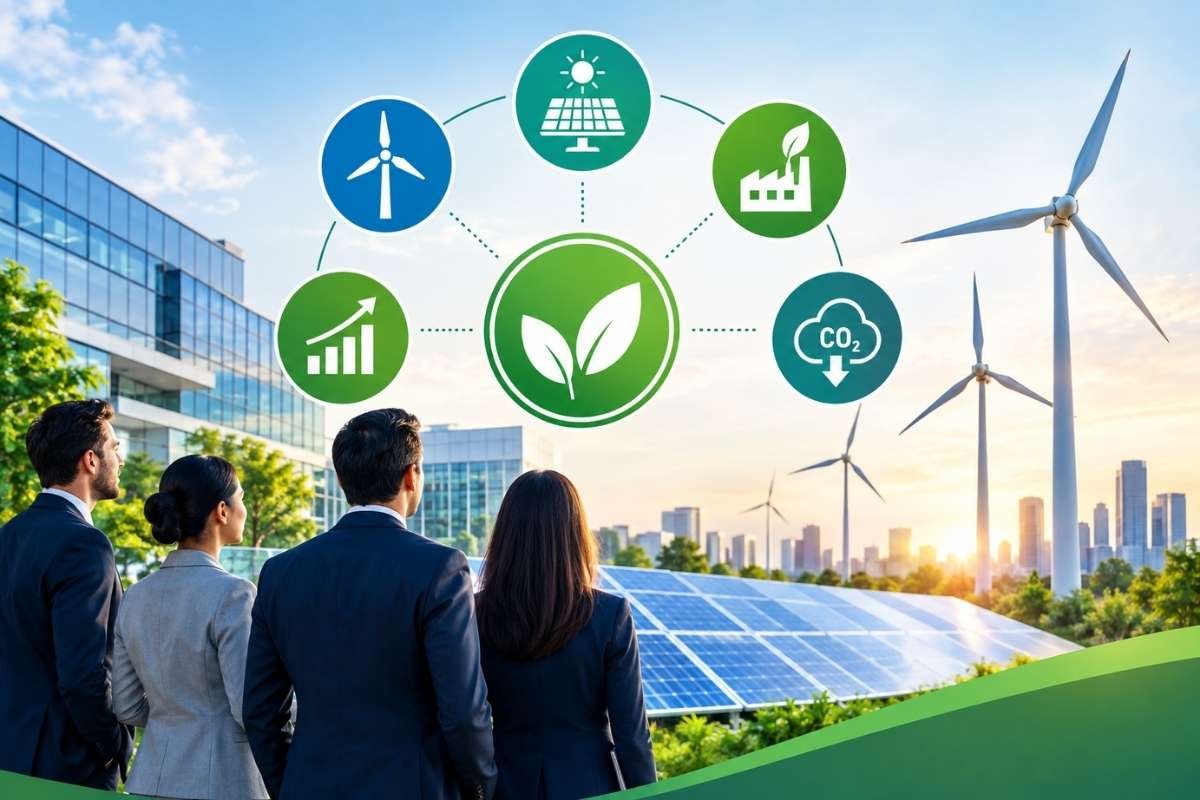

India’s green-energy market now solves more than power needs. Companies want cheaper clean power, storage, and better energy control. New ventures also target green hydrogen and distributed energy systems.
Funding signals this shift. India’s climate-tech startups raised $2.6 billion in 2025, up from $315 million in 2020. This growth creates room for successful green energy startups with clear business models. The real question is not who looks green, but who scales. So, this list examines what each startup sells and who pays. It also tracks the proof behind their growth.
How to evaluate a successful green energy startup?
Not every green startup deserves the label “successful.” A strong model must solve a real need and earn market trust. For this list, I use four simple checks. These checks keep the focus on business value, not hype.
- Problem solved: Does it fix a clear energy or climate need?
- Customer: Who pays for the product, service, or system?
- Scalability: Can the model grow across sites, states, or segments?
- Traction: Does funding, adoption, capacity, or growth prove demand?
10 successful green energy startups in India
The strongest green ventures solve a clear need and build repeatable revenue. These companies show different paths across India’s energy market.
1. Fourth Partner Energy
Fourth Partner Energy builds renewable power systems for Indian businesses. Its portfolio spans solar, wind, hybrids, storage, and EV charging. C&I customers use these systems to cut power costs and emissions. Its project-finance model helps it expand across states and customer sites. Its 2024 funding round raised $275 million from IFC, ADB, and DEG.
- Model: C&I renewable power and decarbonisation services.
- Funding: $275 million equity round in 2024.
- Lesson: Financing can help energy projects scale faster.
2. Renew Green
ReNew Green targets India’s growing corporate demand for clean power. It develops renewable assets and supplies power through C&I arrangements. Large buyers gain cleaner electricity without building every asset themselves. The platform had 2.5 GW of committed capacity in 2026. Its $95 million equity round supports further C&I growth.
- Model: Renewable power solutions for corporate buyers.
- Funding: $95 million equity investment in 2026.
- Lesson: Large buyers can anchor infrastructure-led growth.
3. Ampyr Energy
Ampyr Energy builds renewable projects for commercial and industrial users. Its approach focuses on repeatable projects rather than one-off installations. The Somasamudra plant in Karnataka shows that model in action. The 67.5 MWp project should generate over 118 GWh each year. It also marks the platform’s fourth delivered project.
- Model: Repeatable C&I renewable project development.
- Funding: Climate Investor One backs its expansion platform.
- Lesson: Repeatable assets can create platform-level scale.
4. Hygenco
Hygenco tackles one of India’s harder energy problems: green hydrogen supply. It designs, builds, owns, and runs commercial hydrogen projects. Industrial users can buy hydrogen without building full systems themselves. Hygenco now runs two commercial plants and plans three to four more. Its 2026 funding round secured $105 million from global investors.
- Model: Commercial green hydrogen and green ammonia projects.
- Funding: $105 million institutional equity round in 2026.
- Lesson: Long-term industrial demand can support new energy markets.
5. SolarSquare
SolarSquare brings rooftop solar to India’s home market. It handles installation, customer support, and related technology through one platform. That approach tackles a key barrier: homeowners often struggle with vendor trust and service quality. The company raised $53 million in Series C funding in 2026. Total capital raised now exceeds $100 million.
- Model: End-to-end residential rooftop solar.
- Funding: $53 million Series C in 2026.
- Lesson: Better customer experience can simplify clean-energy adoption.
6. LOHUM

LOHUM shows how successful green energy startups can profit beyond power generation. It recycles batteries and recovers critical materials such as lithium, cobalt, nickel, copper, and aluminium. This gives battery makers a local source for recovered materials. LOHUM currently has 25,000 tonnes of annual recycling capacity. It also plans advanced material production.
- Model: Battery recycling and critical-material recovery.
- Funding: Growth capital supports recycling and material expansion.
- Lesson: Circular models can create value across energy supply chains.
7. GPS Renewables
GPS Renewables turns organic waste into energy and fuel. Its work spans biogas, compressed biogas, and project engineering. The company uses partnerships with major oil companies to expand projects across India. Its FY2025 report cites nearly 163,000 tonnes of organic waste processed. It also reported 294,372 tonnes of emissions avoided.
- Model: Waste-to-energy technology and project delivery.
- Funding: Strategic partnerships support wider project deployment.
- Lesson: Local waste streams can become scalable energy inputs.
8. Smart Joules
Smart Joules sells energy savings instead of new power capacity. It combines automation, cooling systems, and a pay-as-you-save model. Large facilities can cut energy use without taking on high upfront costs. The company now serves 100+ facilities across 28 Indian cities. Its clients have conserved 37 crore kWh of electricity.
- Model: Energy efficiency and cooling-as-a-service.
- Funding: $10 million raised in 2025 for expansion.
- Lesson: Cutting energy waste can create recurring enterprise value.
9. Husk Power Systems
Husk Power Systems brings distributed solar power to rural markets. Its microgrids serve homes, small businesses, and local enterprises across underserved areas. Modular systems help the company enter new communities without huge grid projects. By early 2025, Husk operated across 400+ communities in Africa and South Asia. Its portfolio represented 20 MW of solar generation.
- Model: Solar mini-grids for rural communities.
- Funding: Its Series D raised $103 million in 2023.
- Lesson: Modular infrastructure can solve India’s last-mile gaps.
10. Newtrace
Newtrace proves that successful green energy startups can target one deep-tech bottleneck. It develops advanced electrodes for alkaline hydrogen electrolysers. Better electrode performance can help lower green hydrogen costs. Its 2026 funding will support pilot manufacturing, customer trials, and supply deals. Newtrace raised $6.3 million in its latest round.
- Model: Electrolyser and electrode technology for green hydrogen.
- Funding: $6.3 million Pre-Series A in 2026.
- Lesson: Solving one costly bottleneck can unlock larger markets.
What these successful green energy startups have in common?
The list points to a few clear business patterns. Successful green energy startups rarely sell “green” as the main value. They solve a costly business need first, then add an energy or climate benefit.
| Common pattern | What it means for founders |
|---|---|
| B2B demand | Large customers can support bigger contracts and steady demand. |
| Asset-light + financing | Partners can help spread large capital needs. |
| Technology differentiation | Better tech can reduce price-based competition. |
| Repeatable deployment | Standard models can expand across sites and states. |
| Long-term energy demand | Longer contracts can support recurring revenue. |
The strongest models solve a specific commercial problem first. Green impact then becomes part of the value, not the whole pitch.
What founders can learn from these startups?
These models offer clear steps for new energy founders. Start with the buyer, then shape the solution around their needs. If you want to start a green energy business, begin with these checks:
- Find the pain: Identify one costly customer problem before building.
- Know the buyer: Confirm who pays and why they pay.
- Plan revenue: Separate equipment sales from recurring service income.
- Plan capital: Build financing into capital-heavy models from day one.
- Test first: Use pilots before committing to large deployments.
- Track proof: Measure costs, output, savings, uptime, and customer growth.
Conclusion:
The strongest green-energy businesses solve a real energy problem first. They know who pays, build a scalable model, and manage capital with care. India’s growing corporate power needs will create more room for such models.
For founders, the lesson from successful green energy startups is clear: focus on value, repeatable delivery, and proven demand within India’s broader green energy business opportunities landscape.
Frequently asked questions
1. What makes a green energy startup successful?
Success depends on customer adoption, commercial traction, scalable delivery, strong financing, project execution, and measurable performance rather than funding alone.
2. Which green energy startup models are growing in India?
Key successful green energy startups include C&I renewable power, energy storage, green hydrogen, energy technology, and distributed energy systems serving specific business and industrial needs.
3. Are green energy startups profitable?
Profitability varies by model, capital needs, project maturity, pricing, operating costs, and financing structure. Asset-heavy ventures may take longer to reach stable profits.
4. How can entrepreneurs enter India’s green energy market?
Start with one customer problem, validate demand, assess capital needs, study the relevant regulations, and choose a model that can deliver value.