
Table of contents:
- What is a Brand Endorsement? Definition and Core Benefits
- How to Measure the ROI of a Brand Endorsement Campaign?
- How Endorsements in Advertising Change the Way We Shop?
- What Are the 4 Main Types of Brand Endorsements?
- Celebrity Endorsement vs. Influencer Marketing: Which Model Wins?
- Micro-Influencers vs. Mega-Celebrities: Evaluating Cost and Engagement
- The Psychology Behind Why Celebrity Endorsements Work
- Endorsement Marketing Risks: How Bad PR and Scandals Harm Brands
- How to Structure Brand Endorsement Contracts to Protect Your Budget
- Memorable Brand Endorsement Examples That Changed Marketing History
- Negotiation Tips for Influencer Partnership and Endorsement Deals
- Frequently Asked Questions
Cristiano Ronaldo sits at a press conference table; the eyes of the world are on him. Two bottles of Coca-Cola stand in his path. With a flicker of disdain, he shoves them out of the camera’s frame, holds up a plain bottle of water, and mutters a single word: “Agua.” In those few seconds, £2.8 billion in market value vanishes into thin air.
This is the hyper-reactive reality of the modern brand endorsement ecosystem. When you tie your enterprise to global superstars, you aren’t just buying advertising space; you are using a highly volatile financial asset.
Look at March 2025. Virat Kohli casually tries a bottle-flip challenge in a dressing room with a bottle of Bisleri. The bottle tumbles onto its side. Within hours, a wave of playful social media trolling floods the company’s pages, treating a failed dressing-room trick as a structural product defect. A single spontaneous gesture from an icon can pivot consumer sentiment and disrupt equity faster than any legacy marketing campaign you approve in the boardroom.
For an executive, leaving this dynamic to chance is a severe risk. You cannot rely on gut feelings, vague creative intuition, or flashy agency pitches. You need a rigorous operational framework.
This blueprint strips away the glamour to give you the hard math of consumer trust matrices, the protective legal shields required to insulate your capital, and the precise structural systems needed to turn raw human attention into undeniable, bottom-line revenue. Let’s look inside the machine.
What is a brand endorsement? Definition and core benefits
An endorsement happens when a celebrity, a top business boss, or a trusted expert publicly supports a product. This public support builds fast trust, makes the brand famous overnight, and drives massive sales.
Ads must make a product stand out immediately. When a trusted authority praises a product, shoppers stop worrying about wasting money. You might spend hours researching an unknown company. Instead, you trust the product right away because you already love the famous face attached to it.
Like a bridge, on one side stands a company trying to sell a new item. On the other side stands a skeptical customer. The famous endorser stands in the middle. They pass their own popularity and trust directly to the product.
Marketing experts call this equity transfer. Think of it as “Borrowing Star Power.” The brand borrows the star’s good reputation to close sales fast.
How to measure the ROI of a brand endorsement campaign?
Measuring endorsement ROI requires balancing upfront talent acquisition costs against incremental commercial gains across both immediate conversion channels and long-term enterprise value. Evaluating true financial performance demands concrete attribution frameworks and commercial metrics:
- Attribution & Incrementality: Deploy Media Mix Modeling (MMM) and geo-holdout testing to isolate the exact sales lift driven by the ambassador versus baseline organic demand.
- Direct Financial KPIs: Track changes in blended Customer Acquisition Cost (CAC), retargeting conversion rates, direct traffic spikes, and net sales velocity.
- Long-Term Enterprise Value: Measure sustained impacts on Customer Lifetime Value (LTV), retail shelf expansion, and pricing power.
To establish financial discipline, evaluate campaigns using the standard return metric:

An endorsement is financially successful when the ambassador’s presence measurably reduces acquisition friction and accelerates margin growth. Understanding how to measure ROI of brand endorsement campaigns helps growth teams separate short-term engagement spikes from true capital efficiency.
How endorsements in advertising change the way we shop?
An endorsement in advertising strategy puts a famous face on TV ads, social media posts, and store packaging. This visual placement lowers the cost of finding new customers and boosts overall sales.
A study by Nielsen proves this method works. Creative ads with celebrities lift public brand awareness by an average of 37%. This completely beats normal ads without a star.
Data shows that companies sometimes put multiple stars in ads during huge sports games. When they do, viewers do not just sit on the couch. They grab their phones and search for the product immediately. A great brand endorsement makes every advertising dollar work twice as hard.
Can you quantify trust? The math behind the match
Marketing teams want to avoid wasting millions of dollars. Because of this, they use a special formula before signing a contract. We call this math tool the Topical Congruence Score (TCS). A score for how well a star fits a product:

Let’s break down these math ingredients easily:
- Ao (Audience Overlap): This measures how many of the star’s fans match the brand’s ideal customer. The team wants at least 60% overlap.
- Es (Expertise Score): This measures how much shoppers trust the star’s knowledge about this specific product. We score this from 1 to 10.
- Sd (Saturation Dilution): This counts how many other brands the star promotes. If they promote too many things, their voice loses power.
- Cf (Cognitive Friction): This checks if the star’s lifestyle looks weird next to the brand’s identity. A bad match creates confusion in the buyer’s brain.
This formula helps businesses predict financial success before they spend big bucks.
What are the 4 main types of brand endorsements?
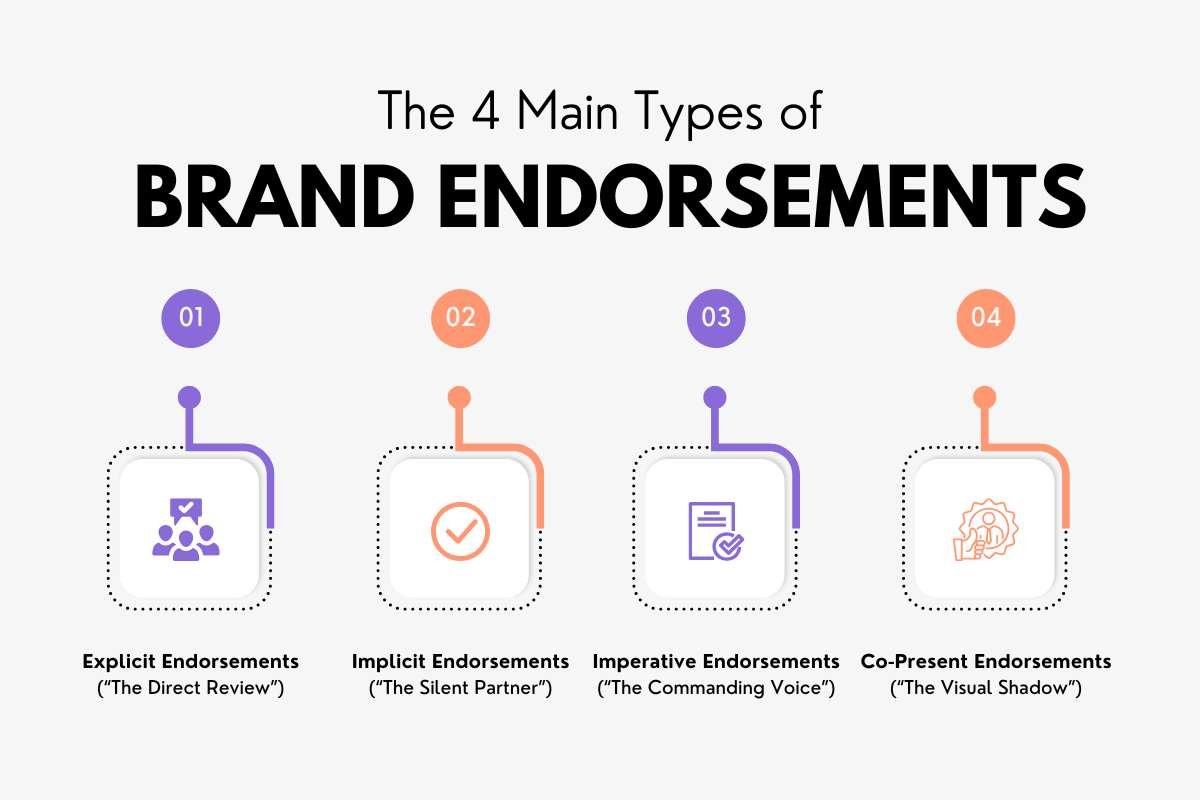
Companies select from four primary endorsement structures depending on market positioning, competitive density, and campaign objectives. Enterprise teams select their execution strategy from these core formats:
1. Explicit endorsements (“The direct review”)
The star states a clear message: “I use this product, and you should too.” They describe the benefits of the item. This direct approach works perfectly for complex products like electronics or skincare, where users need proof that the item works.
2. Implicit endorsements (“The silent partner”)
Here, the star does not say a single word about the brand. Instead, they simply wear the clothes, drive the car, or use the gear in public. The audience catches them using it naturally. This silent validation makes the product look like a part of the star’s cool lifestyle.
3. Imperative endorsements (“The commanding voice”)
This style takes an aggressive approach. The star looks directly at the camera and tells the viewer, “Go buy this item today.” Brands use this style during big sales events or holiday shopping rushes to force fast action.
4. Co-present endorsements (“The visual shadow”)
The star simply appears next to the product in a print ad or on a giant billboard. They do not say they use it. Their physical presence next to the logo creates a mental link for the shopper.
Choosing the right structure depends on campaign objectives. Selecting the appropriate format among the various types of brand endorsements ensures the creative strategy aligns with the broader marketing architecture.
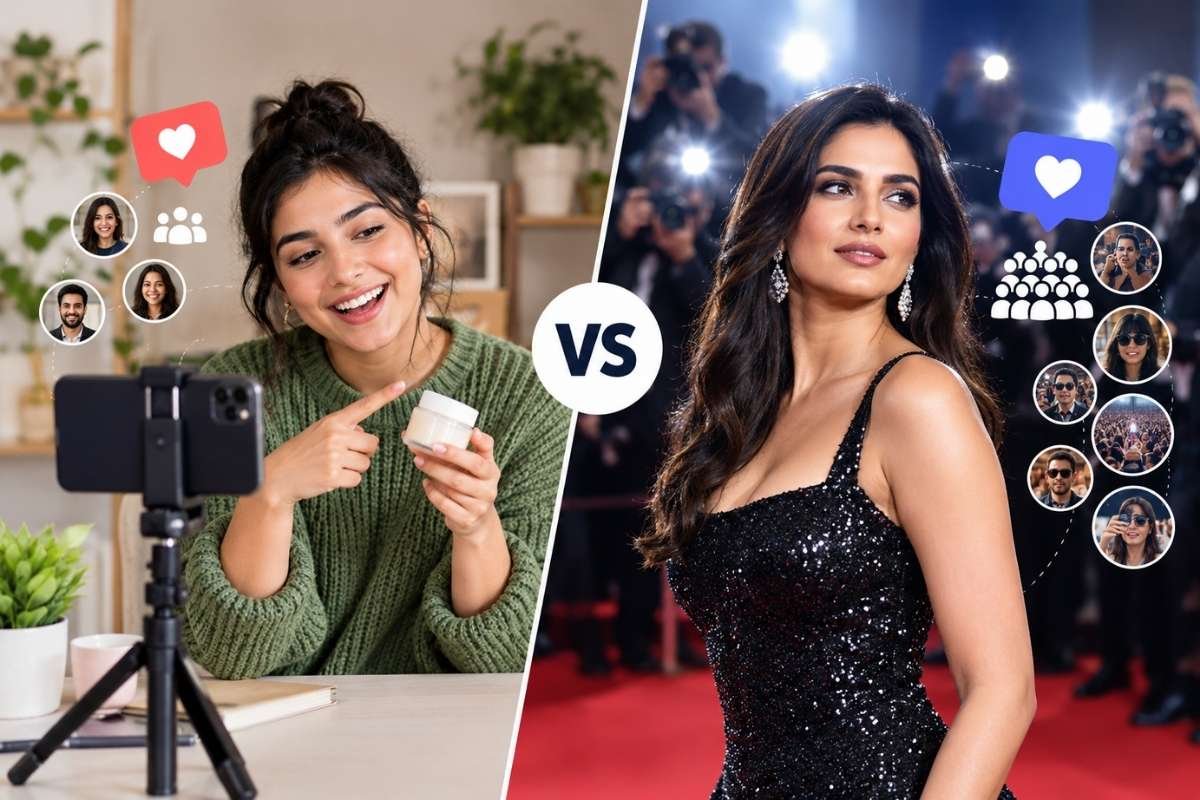
Celebrity endorsement vs. Influencer marketing: which model wins?
Choosing between traditional celebrity partnerships and digital influencer activations depends on whether the strategic goal is broad market awareness or hyper-targeted conversion velocity.
| Celebrities For Endorsements | Feature | Influencer Marketing |
| Television, Billboards, Movies | Main Channel | YouTube, TikTok, Instagram |
| Millions of general viewers | Audience Size | Thousands of specific fans |
| Aspirational (“I want to be like them”) | Trust Style | Peer-to-Peer (“I trust their advice”) |
| Extremely High (Millions of dollars) | Upfront Cost | Low to Moderate |
| Mass Brand Awareness | Main Goal | Direct Clicks and Fast Sales |
Traditional deals excel at establishing macro-level market presence. Conversely, digital channels use peer-to-peer trust within specific verticals. When structuring these channel strategies, enterprise leaders must decide when to deploy legacy celebrities for endorsements versus targeted creator networks.
Micro-influencers vs. Mega-celebrities: evaluating cost and engagement
Evaluating creator partnerships requires balancing absolute audience scale against cost-per-conversion dynamics. While mega-celebrities drive massive reach, micro-influencers (10,000 to 100,000 followers) yield 60% higher engagement rates relative to audience size, driving stronger purchase intent at lower acquisition costs.
To understand why this happens, look at this simple metaphor:
Mega-celebrities (broad top-of-funnel scale): Command massive total reach but average just 1.21% organic engagement on platforms like Instagram. Because followers view these endorsements primarily as paid commercial broadcasts. These placements suffer from higher ad fatigue, lower message retention, and minimal direct audience interaction.
Micro-influencers (high-intent conversion drivers): Generate average engagement rates ranging from 3.86% on Instagram up to 8.7% on TikTok, over 3x the engagement density of celebrity tiers. Operating within focused interest niches, these creators maintain active comment-section dialogues that directly resolve buyer friction (such as product efficacy, sizing, and usability) to accelerate conversion velocity.
Analyzing these performance dynamics allows teams to evaluate the tradeoffs between micro-influencers vs. mega-celebrities when allocating capital across creator portfolios.
The psychology behind why celebrity endorsements work
The psychological mechanism driving endorsement efficacy rests on cognitive heuristics, mental shortcuts consumers use to simplify purchase decisions. Rather than analyzing product specifications, buyers apply two core psychological principles:
- The halo effect: When an individual demonstrates excellence in one domain (e.g., professional sports or elite performing arts), consumers unconsciously assume competence across unrelated domains. Overcoming consumer doubt relies on using the psychology behind why celebrity endorsements work to transfer positive brand perception efficiently.
- Source congruence theory: Consumer acceptance increases when the perceived domain expertise of the endorser aligns logically with the product category. A professional athlete endorsing performance footwear creates high congruence, whereas the same athlete endorsing insurance products introduces cognitive friction, reducing message retention.
Endorsement marketing risks: how bad PR and scandals harm brands
The primary hazards in an endorsement marketing risks matrix include public celebrity scandals, over-saturation dilution, mixed messaging, and breaking national advertising disclosure laws.
Bad news travels like wildfire on social media. Tracking your risks protects a company’s total money value. A famous study on the 2009 Tiger Woods scandal calculated that partner companies lost a total of $5 billion in stock market value. This massive loss happened because the public associated the corporate brands with the athlete’s personal mistakes.
- The hazard of over-saturation dilution
If a star promotes a phone company, a clothing brand, a watchmaker, and a snack food all at the same time, their voice gets watered down. Consumers stop paying attention because the star looks like they will say anything for a paycheck.
- Regulatory enforcement & compliance mandates
The Federal Trade Commission (FTC) enforces strict rules on honesty. Suppose an influencer gets money, gifts, or company stock to promote an item. The rules say they must tell their audience clearly.
They cannot hide the word “#ad” down in a giant sea of hashtags where no one can find it. The note must sit prominently at the very top of the post so it is completely unmissable.
How to structure brand endorsement contracts to protect your budget?
A robust brand endorsement contract framework must govern creative asset usage rights, category exclusivity, explicit content schedules, and strict morals clauses to insulate the corporation from sudden personal scandals.
Smart legal rules keep marketing campaigns safe. A contract is a shield that protects your cash. Lawyers and managers must agree on three main factors when drafting these deep documents:
- The Exclusivity Lockout: This clause blocks the star from working with direct rivals. If an actor signs with a car brand, they cannot drive a competitor’s vehicle in public or post about another auto brand for the duration of the deal.
- The Morals Clause: This protects the brand if the star causes a massive public scandal. If the endorser gets into legal trouble or behaves badly, this clause allows the company to break the contract instantly without paying any penalties.
- Usage Rights and Content Lifespans: The contract must state exactly where the videos and photos can live. Does the brand own the right to use the star’s face on billboards forever, or do the internet ads have to come down after six months?
Today, smart corporations often swap simple flat cash fees for performance bonuses or company stock options. This structure ensures the star works hard to make the business succeed.
Memorable brand endorsement examples that changed marketing history
Looking at brand endorsement examples shows the evolution of marketing, moving from traditional ad setups to modern, equity-backed co-founding business structures.
Nike and Michael Jordan
The partnership between Nike and Michael Jordan set the ultimate gold standard for the industry. It started as a basic shoe ad in the 1980s and grew into a massive, multi-billion-dollar empire.
This deal shows what happens when a company matches its best gear with a legend. It links the product directly to an athlete’s life story of winning. Nike did not just buy a face for a commercial; they built a brand identity around a star’s career.
One 8 by virat kohli and agilitas sports
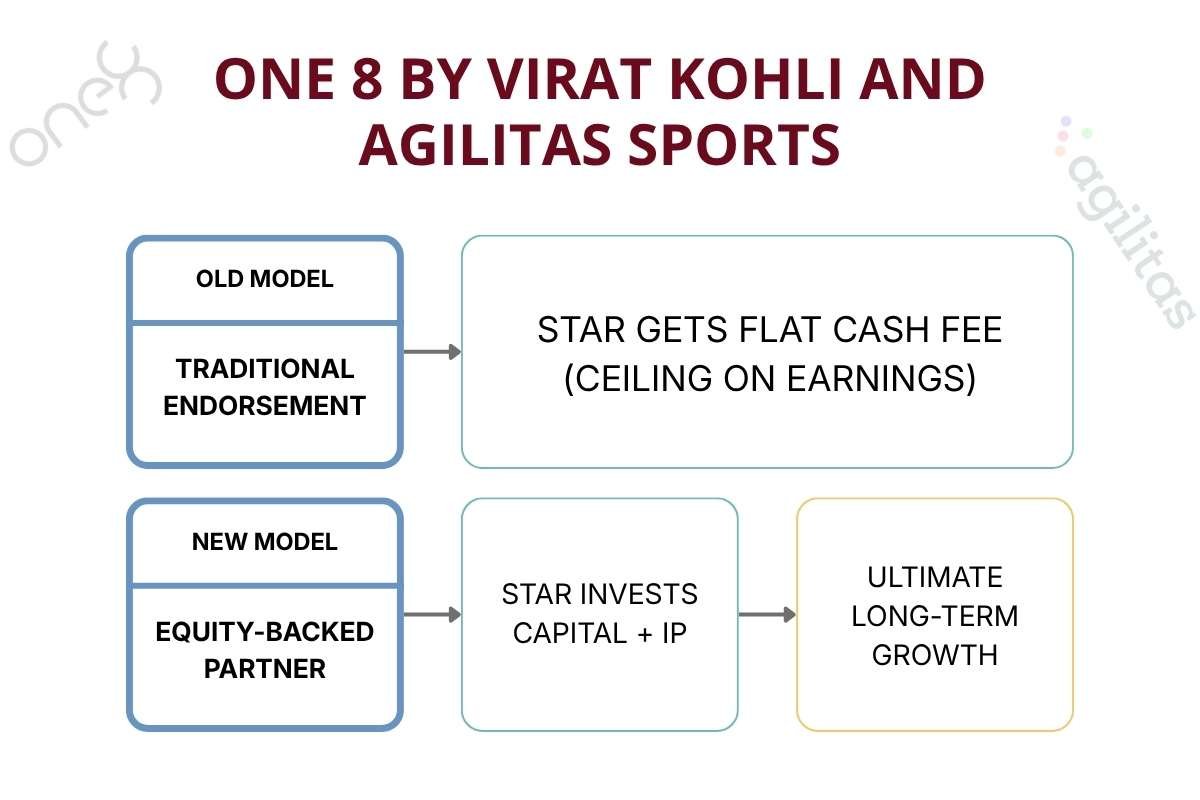
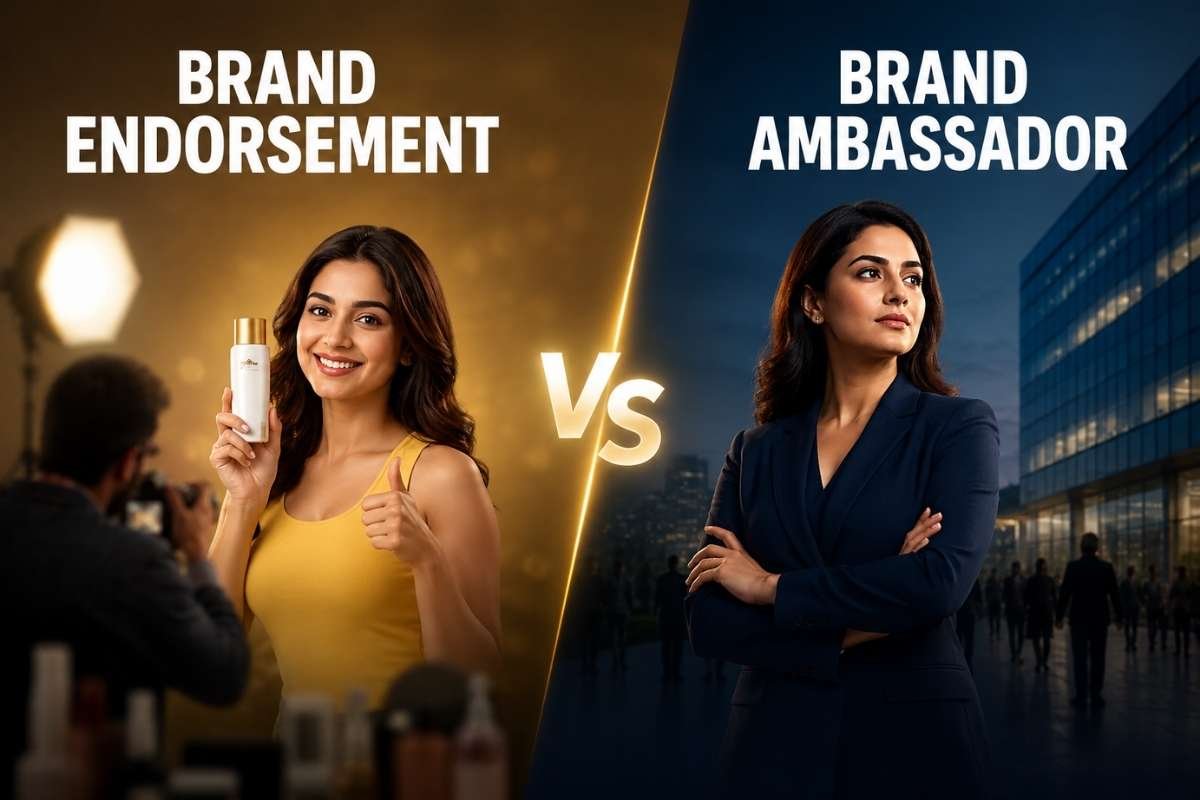
Market movements show a massive shift. Stars no longer want to rent out their faces for quick cash. Instead, they want real company ownership. This trend highlights the big difference in a modern brand endorsement vs brand ambassador battle.
Cricket superstar Virat Kohli gave everyone a masterclass in this strategy. He ran a highly successful ₹110 crore deal with Puma. This deal lets him manage his own clothing line called One 8 by Virat Kohli. Later, Puma offered him a massive ₹300 crore renewal package. Kohli turned it down.
[Old Model: Traditional Endorsement] ──► Star gets flat cash fee (Ceiling on earnings)
[New Model: Equity-Backed Partner] ──► Star invests capital + IP ──► Ultimate long-term growth
Kohli refused to work as a regular paid spokesperson. Instead, he invested ₹40 crore of his personal money straight into Agilitas Sports. This sports company has a total value of ₹2,058 crore. He moved his One8 brand into this company as a co-founder and stock owner. With this move, Kohli smashed through old payment limits. Now, his long-term earnings grow directly alongside the total value of the entire business.
Negotiation tips for influencer partnership and endorsement deals
Modern negotiation tips for influencer deals focus on securing long-term media usage rights, building result-based bonuses, and capping total active brand portfolios.
Securing elite agreements requires changing your game plan. Follow these simple rules to get the best results:
- Keep the rights to the content: Focus on owning the digital videos forever. Do not just try to make the contract last a long time. Ensure your brand can reuse high-performing ads across the web without paying extra fees.
- Pay for real results: Structure your deals with a modest baseline fee. Add big bonus payments for specific results. Pay extra when the creator brings in real website traffic, clicks, or verified sales.
- Check their current deals: Say no to creators who promote more than five brands at the same time. Too many ads make fans tune out immediately.
Establishing these contractual guardrails transforms creator talent from an unpredictable marketing expense into a managed, high-performing acquisition channel. Ultimately, executing precise negotiation tips for influencer partnership agreements ensures that every unit of capital committed to human equity yields measurable, sustainable enterprise value.
BVP’s point of view: the verdict on rented credibility
The Bottom Line: A brand endorsement is no longer a creative vanity project; it is a high-stakes financial instrument. The era of blindly throwing capital at a famous face is officially dead.
When Cristiano Ronaldo shoves a soda bottle out of the frame, or Virat Kohli flubs a simple dressing-room trick, they prove the same thing: human equity is incredibly powerful, fast, and volatile. A single spontaneous gesture can build or burn billions in corporate value in a matter of seconds. For a C-suite executive, this shouldn’t inspire fear; it should inspire execution.
Fame itself is unpredictable, but your bottom line doesn’t have to be. When you anchor raw star power with rigorous trust math, insulate it with airtight contracts, and treat human attention as an engineered asset, you create an unbeatable shortcut to market dominance.
Stop gambling your capital on agency hype, gut feelings, or flashy vanity metrics. Run the numbers, secure your equity, and turn unpredictable human moments into predictable enterprise returns. The next time a global icon holds up a bottle, make sure your brand owns the machine behind it.
Frequently asked questions:
1. What separates a standard corporate partnership from a long-term ambassador structure?
A brand endorsement is a quick, campaign-focused deal. A person simply lends their name and face to a specific ad layout. A brand ambassador works differently. They build a deep, multi-year relationship. They act as the permanent public face of the company across events and community projects.
2. How do regulatory guidelines affect a digital partnership campaign?
The rules demand clear, unmissable text disclosures. Shoppers must see them before they click a link or buy an item. Standard platform tags fail the legal test. Hidden hashtags at the bottom of a caption also fail. Creators must place disclosures right at the top of the post.
3. Why should a company select micro-influencers over a classic celebrity partnership?
Micro-influencers lead dedicated online communities. These groups generate 60% stronger engagement metrics. This setup lets everyday brands run targeted, low-cost sales campaigns. They get great results without paying the massive prices of Hollywood stars.