

Global economic uncertainty is rising as businesses grapple with persistent inflation, high interest rates, and slowing trade. This article explores the global recession warning signs businesses watch, from declining consumer spending and weaker manufacturing activity to tighter credit conditions and falling corporate earnings. It also examines India’s exposure to a potential global slowdown and outlines practical steps businesses can take to build resilience and prepare for economic uncertainty.
Global recessions may start elsewhere, but their impact quickly reaches India. The 2008 financial crisis slowed exports, hit investments, and weakened business confidence across sectors. Even today, concerns over high interest rates, geopolitical tensions, and slowing global growth have businesses keeping a close eye on the economy. These global recession warning signs businesses watch often provide early clues about changing economic conditions.
For Indian companies, the real challenge isn’t predicting the next recession; it’s spotting the warning signs early. Indicators such as weaker consumer demand, slowing manufacturing activity, tighter credit conditions, and falling global trade often provide clues before a downturn takes hold.
No one can say with certainty if a global recession is around the corner. But businesses that pay attention to global recession warning signs businesses watch are usually better prepared to protect cash flow, manage risks, and navigate uncertainty with confidence.
What is a global recession?
A global recession is a prolonged period of economic slowdown that affects multiple countries at the same time. It is typically marked by weaker economic growth, lower consumer spending, falling trade activity, declining investments, and rising unemployment.
Unlike a recession in a single country, a global recession has a much wider impact because economies today are deeply interconnected. A slowdown in major economies such as the United States, China, or the European Union can quickly affect businesses and consumers across the world, including in India.
For India, the effects often show up in the form of lower export demand, reduced foreign investments, currency volatility, and slower business expansion. Sectors such as information technology, manufacturing, textiles, and exports are particularly sensitive to changes in global economic conditions.
This is why businesses don’t wait for an official recession announcement. Instead, they closely monitor economic indicators that can signal trouble ahead. By tracking global recession warning signs businesses watch, companies can manage risks and make informed decisions before the slowdown becomes more severe.
Why businesses monitor recession indicators?
For businesses, a recession is rarely a sudden event. Economic slowdowns usually leave clues months in advance, which is why global recession warning signs businesses watch have become an important part of strategic planning.
This is especially important in India, where businesses are closely tied to global markets. A slowdown in the U.S. or Europe can reduce export demand, affect foreign investments, and weaken consumer sentiment at home. Even companies that operate primarily within India can feel the impact through higher costs, delayed investments, or slower spending.
That’s why business leaders closely track recession indicators. These signals help companies:
- Protect cash flow by planning for potential declines in revenue.
- Adjust hiring and expansion plans before market conditions worsen.
- Manage inventory and supply chains more efficiently.
- Reduce financial risks by controlling debt and unnecessary spending.
- Identify new opportunities that often emerge during periods of economic uncertainty.
Companies that monitor these indicators aren’t trying to predict the future with certainty. They are trying to stay prepared. And the sooner they spot the warning signs, the more time they have to make informed decisions.
So, what are the signals that economists, investors, and business leaders are watching right now? Let’s look at the key global recession warning signs businesses watch closely today.
10 global recession warning signs businesses watch
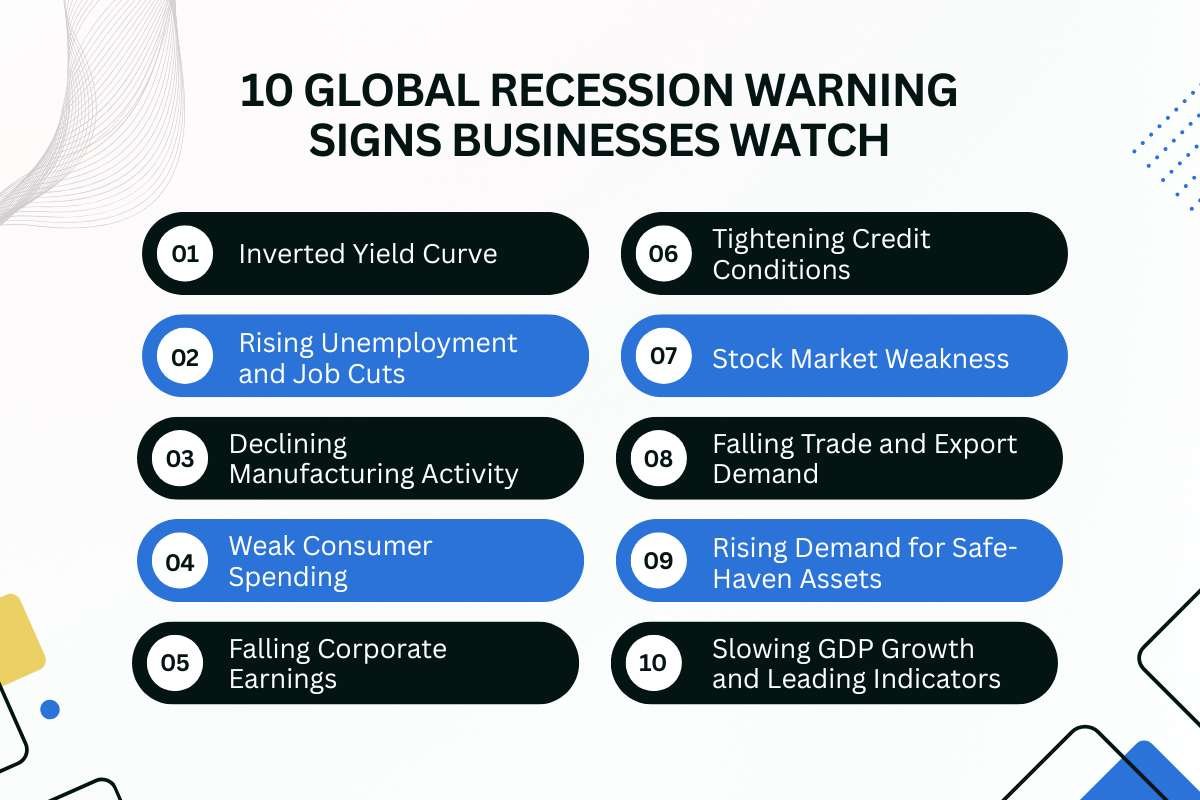
No single indicator can predict a recession with complete accuracy. But when multiple signals start flashing at the same time, businesses pay attention. For Indian companies, these indicators matter because the country’s economy is deeply connected to global trade, capital flows, and consumer demand.
| Warning Sign | What It Indicates | Why It Matters for India |
| Inverted Yield Curve | Investors expect slower economic growth ahead. | A U.S. slowdown can affect Indian exports, IT services, and foreign investment inflows. |
| Rising Unemployment | Businesses are becoming cautious and reducing hiring. | Lower global hiring can impact India’s IT and outsourcing sectors. |
| Weak Manufacturing Activity (PMI) | Falling production and declining business demand. | Can reduce export orders and slow industrial growth. |
| Slowing Consumer Spending | Households are cutting discretionary spending. | Private consumption contributes nearly 60% of India’s GDP. |
| Tightening Credit Conditions | Higher borrowing costs and reduced lending. | MSMEs, which contribute around 31.1% of India’s GDP, are particularly vulnerable. |
1. Inverted yield curve
An inverted yield curve occurs when short-term government bond yields rise above long-term yields. Historically, this has been one of the most reliable predictors of a U.S. recession and has preceded several downturns, including the 2008 financial crisis.
Why does this matter for India? The U.S. is one of India’s largest trading partners and a major source of foreign investment. A slowdown in the U.S. can reduce export demand and impact sectors such as IT services, pharmaceuticals, and manufacturing.
2. Rising unemployment and job cuts
Companies typically reduce hiring and begin layoffs when they expect demand to weaken. Rising unemployment is often an early sign of economic stress.
For India, this is particularly important because the country’s IT and outsourcing industries are closely tied to global markets. During periods of global uncertainty, hiring in export-driven sectors tends to slow, affecting consumer spending and business confidence.
3. Declining manufacturing activity
Manufacturing is usually one of the first sectors to reflect economic weakness. Purchasing Managers’ Index (PMI) readings below 50 indicate contraction.
India has been relatively resilient, with its manufacturing PMI remaining above the 50-mark for more than four years, making it one of the longest expansion streaks among major economies. However, a sustained decline in PMI readings can still signal weakening domestic and global demand.
4. Weak consumer spending
Consumer spending accounts for nearly 60% of India’s GDP, making household demand a key driver of economic growth. When consumers cut back on discretionary purchases, sectors such as automobiles, retail, real estate, and consumer durables often feel the impact first.
Slowing demand is often one of the earliest signs that economic momentum is weakening.
5. Falling corporate earnings
Corporate earnings provide a real-time picture of business conditions. Lower profits usually indicate weaker demand, rising costs, or declining consumer confidence.
Companies facing profit pressures often delay expansion plans, reduce capital expenditure, and become more cautious about hiring developments that can further slow economic activity.
Read More: Global Expansion vs Domestic Growth Strategy
6. Tightening credit conditions
When borrowing becomes expensive or banks become more cautious about lending, businesses and consumers tend to spend less.
This is especially important in India, where micro, small, and medium enterprises (MSMEs) contribute nearly 30% of the country’s GDP and rely heavily on credit for working capital and expansion. Tighter lending conditions can therefore have a ripple effect across the economy and remain one of the key global recession warning signs businesses watch.
7. Stock market weakness
Stock markets often react to economic concerns before official data does. Broad-based declines in equities can indicate that investors expect slower growth and weaker corporate earnings ahead.
While market corrections do not always lead to recessions, prolonged weakness can affect business sentiment and delay investment decisions.
8. Falling trade and export demand
India’s merchandise and services exports play a crucial role in economic growth. A slowdown in global trade can reduce export orders, weaken manufacturing activity, and affect sectors ranging from textiles to information technology.
The Reserve Bank of India has repeatedly highlighted global trade uncertainties and geopolitical tensions as key risks to India’s growth outlook.
9. Rising demand for safe-haven assets
During uncertain times, investors typically move money into safer assets such as gold and government bonds.
This trend is particularly relevant in India, which is one of the world’s largest consumers of gold. A sharp rise in gold demand often reflects growing concerns about inflation, market volatility, and economic uncertainty.
10. Slowing GDP growth and leading indicators
GDP data is backward-looking, but leading indicators such as new orders, business confidence, consumer sentiment, and industrial activity often provide early clues about where the economy is headed.
Despite global headwinds, India is still expected to remain one of the fastest-growing major economies, with GDP growth projected at around 6.4%-6.6% in FY27. However, institutions such as the IMF and ADB have recently trimmed their forecasts due to concerns over higher oil prices, geopolitical tensions, and slowing global demand.
Individually, none of these indicators guarantees a recession. But when several of them begin weakening at the same time, businesses take notice. Taken together, these represent some of the most important global recession warning signs businesses watch when assessing future economic risks.
What are the odds of a global recession warning in 2026?
The world’s major economies have avoided a deep recession so far, but the risks haven’t disappeared. Persistent inflation, high interest rates, geopolitical tensions, and slowing global trade continue to cloud the economic outlook.
For India, the picture is more balanced. The country remains one of the fastest-growing major economies, supported by strong domestic demand, government spending, and a growing services sector. However, India is not insulated from global shocks. A slowdown in the U.S., Europe, or China can affect exports, foreign investment, and business sentiment at home.
India’s economic exposure to a global slowdown:
| Economic Indicator | Latest Trend | Why It Matters During a Global Slowdown |
| India’s GDP Growth Forecast | Around 6.4%-6.6% for FY27 | India remains one of the fastest-growing major economies. |
| Private Consumption Share of GDP | Nearly 60% | Strong domestic demand can cushion external shocks. |
| MSME Contribution to GDP | Around 30% | Smaller businesses are highly vulnerable to weaker demand and tighter credit. |
| Services Sector Share of GDP | Around 55% | Global demand for IT and business services remains critical. |
| Major Export Markets | U.S., UAE, Netherlands, China | Slowdowns in these economies can impact exports and corporate earnings. |
| Foreign Investment Flows | Sensitive to global interest rates and risk sentiment | Higher uncertainty can trigger market volatility and capital outflows. |
Recent forecasts also suggest that global growth could remain below its long-term average in the coming years. Institutions such as the International Monetary Fund (IMF) and the Asian Development Bank (ADB) have trimmed growth projections for several economies due to trade uncertainties and geopolitical risks.
For Indian businesses, this means two things. First, a global recession in 2026 is far from certain. Second, the possibility of slower global growth cannot be ignored.
Rather than trying to predict the exact timing of the next downturn, businesses should focus on monitoring global recession warning signs businesses watch and building resilience. Companies that strengthen cash flows, diversify revenue streams, and prepare for different economic scenarios are often better positioned to navigate uncertainty.
The question, then, isn’t whether a recession will happen tomorrow. It’s whether businesses are ready if economic conditions begin to deteriorate.
What should businesses do before a recession?

Businesses cannot control economic cycles, but they can control how prepared they are. Companies that act early during periods of uncertainty are often better equipped to withstand downturns and recover faster.
Here are a few steps businesses should consider:
1. Strengthen cash flow
Cash is critical during a downturn. Businesses should improve collections, monitor working capital, and build sufficient reserves to handle unexpected disruptions. The RBI has also highlighted liquidity pressures as a major challenge for Indian businesses, especially MSMEs, during economic stress.
2. Diversify revenue streams
Overdependence on one market, customer, or product increases risk. Expanding into new geographies, customer segments, or revenue channels can help reduce exposure to a slowdown in any single market.
3. Reassess hiring and expansion plans
Economic uncertainty calls for caution, not necessarily a halt in growth. Businesses should prioritize essential investments, evaluate expansion plans carefully, and focus on productivity improvements.
4. Build supply chain resilience
Recent global disruptions have shown the dangers of relying on a limited number of suppliers. Diversifying sourcing and improving inventory planning can reduce operational risks.
5. Focus on customer retention
Winning new customers becomes costlier during a slowdown. Strengthening relationships with existing customers and improving service quality can provide a more stable revenue base.
A recession may or may not happen in 2026, but preparation is rarely wasted. Businesses that build resilience early are often better positioned to survive uncertainty and seize opportunities when conditions improve.
That said, preparation isn’t only about what businesses should do; it’s also about the mistakes they should avoid.
What not to do during a recession?
Economic downturns often lead to tough decisions, but some of the biggest mistakes come from reacting in panic and focusing only on short-term survival.
1. Avoid panic-driven cost cuts
Cutting expenses is necessary, but reducing investments in technology, innovation, or customer service can weaken long-term growth. Focus on efficiency, not indiscriminate cost-cutting.
2. Don’t ignore cash flow
Poor cash flow management can hurt even profitable businesses. Monitor receivables, maintain reserves, and avoid unnecessary financial risks.
3. Avoid excessive debt
Taking on too much debt during uncertain times can become a burden if revenues slow. Maintain a balance between growth and financial stability.
4. Don’t stop investing completely
Halting all expansion plans can mean missing future opportunities. Strategic investments in innovation and customer relationships often pay off when markets recover.
5. Don’t neglect customers and employees
Trust and stability matter most during downturns. Strong customer relationships and engaged employees can become a major competitive advantage during challenging times.
Industries most vulnerable during a recession

A global recession does not impact every industry in the same way. Many of the global recession warning signs businesses watch affect industries differently, making sector-specific preparation essential.
Understanding which sectors are more vulnerable can help companies prepare early and adjust their strategies.
1. Real estate and construction
Real estate is among the first sectors to experience pressure during economic slowdowns. Higher interest rates, reduced borrowing capacity, and cautious consumer sentiment can delay property purchases and construction projects.
In India, the real estate sector contributes significantly to economic activity and employment. A slowdown can affect not only developers but also related industries such as cement, steel, construction materials, and home furnishings.
2. Consumer discretionary and retail
When economic uncertainty rises, consumers often reduce spending on non-essential products such as luxury goods, electronics, automobiles, and premium services.
Since private consumption is a major driver of India’s economy, a decline in discretionary spending can directly impact retailers, manufacturers, and consumer brands.
3. Export-oriented industries
Businesses dependent on international demand are highly sensitive to global economic conditions. A slowdown in major markets such as the U.S., Europe, or China can reduce export orders and affect revenue growth.
Indian sectors such as information technology, textiles, gems and jewellery, and manufacturing may experience pressure if global businesses cut spending or delay investments.
Industries that tend to remain resilient during a recession
While some sectors face greater challenges, certain industries often demonstrate stronger resilience because they provide essential products or services.
1. Healthcare and pharmaceuticals
Healthcare demand generally remains stable because medical needs continue regardless of economic conditions. India’s pharmaceutical sector, one of the largest in the world by volume, has historically shown resilience during global downturns.
2. Consumer staples
Essential goods such as food, household products, and personal care items typically see more stable demand compared to discretionary products.
Companies operating in these segments often experience smaller declines because consumers continue purchasing everyday necessities.
3. Information technology and digital services
Although IT services can be affected by reduced global technology spending, companies offering cost-saving solutions, cloud services, cybersecurity, and automation often continue to see demand.
For India, the IT sector remains closely linked to global businesses looking to improve efficiency during challenging economic periods.
For Indian companies, the key is not simply identifying whether a recession is coming; it is understanding how different economic scenarios could affect their industry and preparing accordingly.
Conclusion:
A recession rarely arrives without warning. In fact, many of the global recession warning signs businesses watch, including slowing demand, weaker trade, rising costs, and tighter credit conditions, tend to emerge months before a downturn.
For Indian companies, global slowdowns can create challenges, but strong domestic demand and a growing economy provide some resilience. The key is not predicting the next recession perfectly; it is being prepared for it.
Businesses that consistently track global recession warning signs businesses watch, manage cash flow effectively, diversify risks, and make informed decisions are better positioned to handle uncertainty and capture opportunities when growth returns.
FAQs
1. What are the early warning signs of a global recession?
Early warning signs include slowing consumer spending, rising unemployment, declining manufacturing activity, tighter credit conditions, falling corporate earnings, and weaker global trade.
2. How can businesses prepare for a global recession warning?
Businesses can prepare by strengthening cash flow, reducing unnecessary costs, diversifying revenue streams, improving operational efficiency, and creating contingency plans.
3. Is India at risk of a global recession?
India is not immune to global economic slowdowns, as exports, investments, and market sentiment are linked to global conditions. However, strong domestic demand and economic growth provide some resilience.
4. Which industries are most affected during a recession?
Industries dependent on consumer spending, borrowing, and global demand, such as real estate, luxury retail, travel, hospitality, and export-driven sectors, are often more vulnerable during recessions.
5. Can businesses predict a recession accurately?
No indicator can predict a recession with complete certainty. However, tracking economic signals such as GDP growth, inflation, interest rates, employment trends, and market conditions can help businesses prepare early.