


This article explains how startups can grow smartly with limited funding through better cash flow management, lower burn rates, and disciplined spending. It also shares practical lessons from successful Indian founders who scaled sustainably without heavy investor dependence.
What if your startup does not need crores in funding to win?
Many founders believe success begins after investors arrive. Reality says something else. Some of the strongest businesses started with tiny budgets, second-hand laptops, shared offices, and founders who counted every rupee twice before spending it once.
That is where smart bootstrapping techniques change the game.
Think about a founder who skips luxury office space, focuses on customer revenue, and reinvests profits slowly. Sounds boring? Maybe. But boring businesses often survive while flashy startups disappear.
During the early days of Zerodha, the company avoided unnecessary marketing and focused on low-cost customer acquisition. Today, it stands as one of India’s biggest fintech success stories.
The lesson is simple. Money helps. Smart decisions matter more.
What are smart bootstrapping techniques?
These techniques are practical business methods that help startups grow with limited money while maintaining stability and control. Instead of depending heavily on investors, founders use careful spending, customer revenue, lean operations, and smart planning to build sustainable growth.
These techniques focus on survival first and rapid expansion second.
Many startups fail because they spend too fast before building strong revenue. Smart Bootstrapping helps founders avoid that trap. They teach businesses how to stretch every rupee and create long-term value.
A bootstrapped startup usually focuses on:
- Low operational costs
- Fast customer feedback
- Revenue-driven growth
- Small but efficient teams
- Strong cash flow management
- Sustainable scaling
This approach does not mean founders avoid growth. It means they grow carefully.
Six smart bootstrapping techniques Indian founders used to reduce burn rate
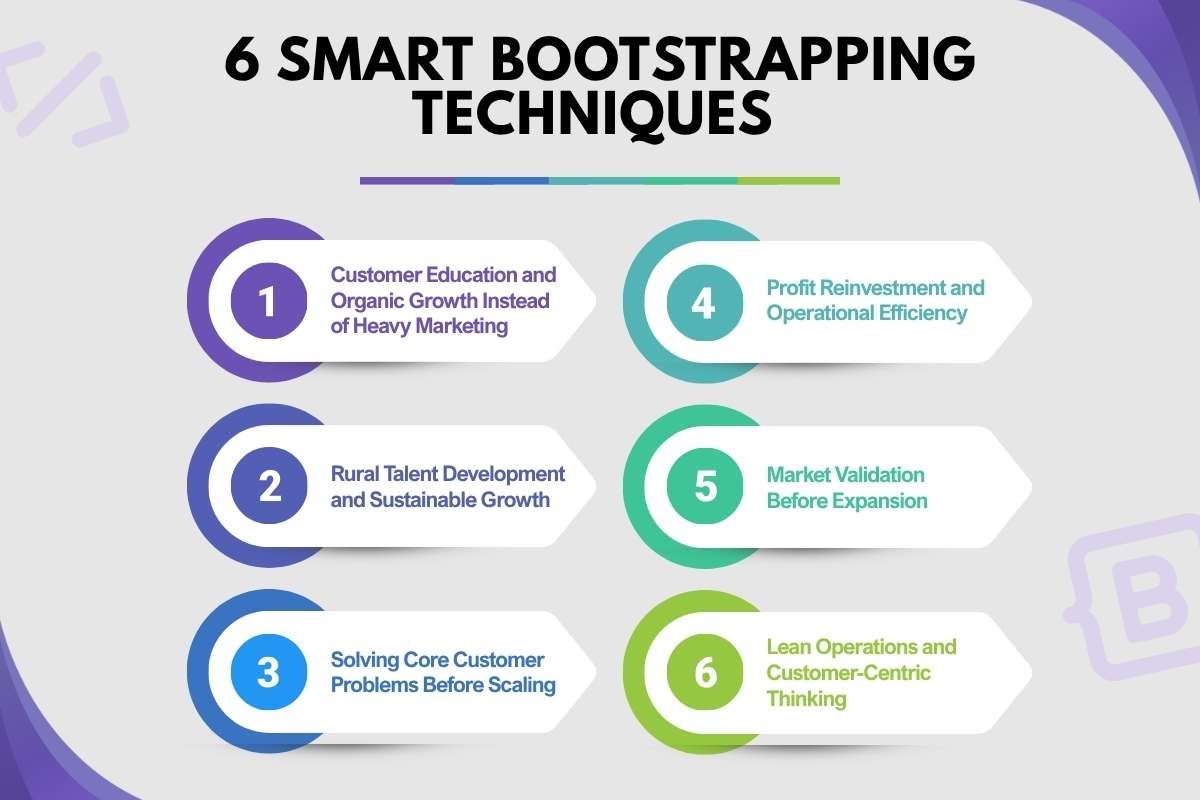
India’s startup world often celebrates companies that raise massive funding rounds. But many successful founders built strong businesses by spending carefully instead of burning cash aggressively.
That is where smart bootstrapping techniques became important.
These founders focused on profits, customer trust, product quality, and operational discipline. Instead of chasing rapid expansion at any cost, they grew step by step. This strategy helped them reduce burn rate and build long-term businesses that survived market pressure.
Let us understand how these Indian founders used practical and smart business techniques and strategies to grow successfully.
1. Customer education and organic growth instead of heavy marketing

Zerodha is one of the strongest examples of smart bootstrapping in India.
When many fintech startups spent heavily on advertisements and investor-driven expansion, Zerodha followed a completely different path.
Founder Nithin Kamath focused on keeping the business simple and profitable from the beginning. Instead of spending crores on television ads and celebrity promotions, Zerodha concentrated on customer education and organic growth.
The company created useful educational platforms like Varsity, which helped people understand stock market investing for free. This strategy built trust naturally. Customers started recommending Zerodha to friends and family. Word-of-mouth marketing reduced customer acquisition costs significantly.
This was a smart move because marketing expenses are usually one of the biggest reasons startups burn cash quickly.
Another important factor was operational discipline.
Zerodha avoided unnecessary hiring during the early years. The company built lean teams and focused on efficiency. It also avoided opening expensive luxury offices just to create a startup image.
Instead of chasing valuation headlines, Zerodha focused on profitability and customer satisfaction.
Today, Zerodha is one of India’s largest brokerage firms and remains profitable without depending heavily on venture capital.
Key lesson from Zerodha
Smart Bootstrapping works best when businesses:
- Focus on customer trust
- Avoid unnecessary spending
- Grow through strong products instead of aggressive advertising
2. Rural talent development and sustainable growth

Zoho became a global software company without depending on outside investors.
That alone makes Zoho one of the most powerful examples of smart bootstrapping techniques.
Founder Sridhar Vembu believed that businesses should focus on customers instead of investor pressure. Because of this mindset, Zoho concentrated heavily on product quality and sustainable growth. Instead of raising huge funding rounds, the company used customer revenue to grow gradually.
This approach gave Zoho complete control over its business decisions.
One of the smartest decisions made by Sridhar Vembu was investing in rural talent.
Most startups spend heavily in expensive metro cities like Bengaluru, Mumbai, and Delhi. Office rent, salaries, and operational costs become very high in these cities.
Zoho chose a different path.
The company built offices in smaller towns and trained local talent. This reduced operational expenses while creating job opportunities outside major cities. That decision helped Zoho maintain financial stability for years.
Another reason behind Zoho’s success was product diversification. Instead of relying on one software product, Zoho built an entire ecosystem of business tools. This created multiple revenue streams and reduced business risk.
Today, Zoho serves customers globally while remaining privately owned and financially stable.
Key Lesson From Zoho
Bootstrapping techniques become stronger when businesses:
- Prioritize profitability
- Control operational costs
- Build sustainable long-term systems
Read More: India-Specific Bootstrapped Scaling Frameworks
3. Solving core customer problems before scaling

Before Paytm became one of India’s biggest fintech brands, the company focused heavily on solving practical digital payment problems.
During the early phase, founder Vijay Shekhar Sharma understood that customer convenience mattered more than rapid expansion.
The company concentrated on building user trust and improving payment experiences. Instead of entering too many markets immediately, Paytm focused on strengthening its core services first. This careful approach helped the company avoid operational confusion during its initial growth stage.
One major strength was customer adoption.
Paytm made digital payments simple for ordinary users. This helped the platform grow naturally because people started using it regularly for mobile recharges, bill payments, and money transfers.
The company also focused strongly on market timing.
When digital payments started growing rapidly in India, Paytm already had strong user awareness and a practical product. This early focus on solving real customer problems helped the company build momentum before expanding aggressively.
Key lesson from Paytm
Smart bootstrapping techniques help startups when they:
- Solve real problems first
- Focus on customer experience
- Build strong foundations before scaling rapidly
4. Profit reinvestment and operational efficiency

Directi is another example of smart bootstrapping techniques done correctly.
Founder Bhavin Turakhia and his brother started young and focused heavily on profitability rather than relying fully on external funding.
Their business approach was simple:
Earn revenue early, reinvest profits carefully, and scale responsibly.
Instead of burning money on unnecessary expansion, Directi focused on building internet businesses that generated sustainable income. The founders continuously reinvested profits into growth. This strategy helped them successfully launch and scale multiple internet companies.
One important lesson from Directi’s story is operational efficiency.
The company focused on running lean operations and making practical business decisions. This reduced financial pressure and gave the founders more control over growth.
Over time, Directi built global internet businesses that served customers worldwide.
Their journey proved that startups do not always need massive investor funding to build international success stories.
Key Lesson From Directi
Bootstrapping techniques become powerful when founders:
- Reinvest profits wisely
- Focus on efficiency
- Build businesses step by step
5. Market validation before expansion

Before becoming a food delivery giant, Zomato started as a simple restaurant listing platform.
This early business model was practical and focused.
Founder Deepinder Goyal first worked on solving one clear problem. People struggled to access restaurant menus easily. Zomato solved that issue by creating an online platform where users could view restaurant information conveniently.
This was an example of smart bootstrapping techniques because the company validated market demand before expanding into larger services like food delivery.
Instead of trying to do everything at once, Zomato expanded gradually. This careful growth strategy reduced unnecessary operational waste during the early stages. The company also focused heavily on understanding customer behavior and market demand before entering new categories.
That step-by-step growth approach helped create a stronger foundation.
Many startups fail because they expand too quickly without proper systems. Zomato’s early operational discipline helped reduce that risk.
Key Lesson From Zomato
Smart bootstrapping helps businesses:
- Validate demand early
- Expand gradually
- Reduce wasteful spending during initial growth
6. Lean operations and customer-centric thinking

Before building CRED, founder Kunal Shah became well known for his thoughts on sustainable business growth and customer trust.
His entrepreneurial journey highlighted an important reality:
Startups must build value before chasing aggressive expansion.
Kunal Shah often spoke about understanding consumer behavior deeply. Instead of focusing only on short-term growth numbers, he emphasized building strong customer relationships. This thinking reflects smart bootstrapping techniques because sustainable businesses depend on trust, retention, and operational discipline.
Another important lesson from his journey is lean operations. Businesses that spend carefully during the early stages gain more flexibility during difficult market conditions.
Kunal Shah also highlighted the importance of building strong systems instead of relying only on marketing hype. This mindset influenced many modern startup founders in India.
Today, many entrepreneurs follow similar principles to improve business sustainability and reduce unnecessary burnout rates.
Key lesson from Kunal Shah
Bootstrapping techniques support businesses that:
- Build customer trust
- Focus on long-term value
- Avoid wasteful expansion
How smart bootstrapping techniques reduce burn rate?
Burn rate means the speed at which a startup spends money. High burn rates create stress because startups constantly need new funding. Smart bootstrapping techniques reduce burn rate through smarter decisions.
- Controlled Hiring: Instead of hiring rapidly, smart founders hire slowly and carefully. Each employee should create measurable value. This keeps salary expenses manageable.
- Better Customer Retention: Acquiring new customers costs more than retaining old ones. Startups that improve customer satisfaction spend less on aggressive marketing. That directly lowers burn rate.
- Smarter Marketing: Not every startup needs celebrity endorsements or massive campaigns. Content marketing, SEO, referrals, and social proof often produce better long-term results at lower costs.
This is why these techniques heavily support organic growth strategies.
Common mistakes startups make
- Chasing Funding Too Early: Funding is useful, but premature fundraising creates distractions. Founders sometimes spend more time pitching investors than improving products.
- Scaling Without Demand: Expanding too fast creates operational chaos. Businesses should scale after validating demand properly.
- Ignoring Cash Flow: Profit matters. Cash flow matters more. Many startups fail despite strong sales because they run out of working capital.
These techniques teach founders to monitor cash flow constantly.
Practical smart bootstrapping techniques for new entrepreneurs
- Build A Minimum Viable Product: Start with a simple version of your product. Test customer response before large investments.
- Outsource Selectively: Freelancers and agencies can reduce hiring costs during the early stage.
- Use Customer Feedback Fast: Customer feedback prevents wasteful product development.
- Create Multiple Revenue Streams: A business with diverse income sources survives longer during market shifts.
- Focus on High-Margin Services: High-margin products improve profitability faster.
These methods make smart bootstrapping techniques highly effective for modern startups.
The psychological strength behind bootstrapping

Bootstrapped founders often become stronger decision-makers. Limited resources force creative thinking. When founders spend their own money carefully, they focus deeply on customer value and efficiency.
That discipline creates stronger businesses over time.
Many funded startups prioritize growth at any cost. Bootstrapped startups usually prioritize survival, trust, and sustainability.
That difference changes everything.
Why investors respect smart bootstrapping techniques?
Ironically, disciplined bootstrapping can attract better investors later.
Why?
Because investors trust founders who understand financial discipline.
A startup with:
- Real revenue
- Controlled costs
- Loyal customers
- Efficient operations
looks far stronger than a startup dependent entirely on external cash. Bootstrapping techniques create business credibility.
Future of smart bootstrapping in India
India’s startup ecosystem is changing rapidly. More founders now focus on profitability instead of vanity metrics. This shift supports long-term business sustainability.
Affordable digital tools, rising internet penetration, and growing startup education also make smart bootstrapping techniques more practical than ever before.
Young entrepreneurs now understand that smart growth often beats fast growth. That mindset may shape the next generation of Indian startups.
Conclusion
A startup does not fail because it starts small.
It fails when founders spend blindly without building stability.
That founder sitting in a small room with a laptop and limited savings may actually hold a stronger advantage than a heavily funded competitor. Why? Because discipline creates resilience.
Smart bootstrapping techniques teach entrepreneurs how to survive tough markets, manage pressure, and grow with confidence. Companies like Zerodha and Zoho proved that careful growth can build billion-dollar success stories.
The real goal is not to look rich. The goal is to build a business strong enough to last.
And sometimes, the smartest startups begin with almost nothing.
FAQs
1) What are Smart Bootstrapping Techniques?
Smart Bootstrapping Techniques are practical business methods that help startups grow using limited funds while maintaining profitability and operational efficiency.
2) Why are Smart Bootstrapping Techniques important for startups?
They reduce burn rate, improve financial stability, and help startups survive market uncertainty without depending heavily on investors.
3) Can a startup grow successfully without funding?
Yes. Many successful companies like Zoho and Zerodha grew largely through customer revenue and disciplined spending.
4) How do Smart Bootstrapping Techniques improve profitability?
They improve profitability by controlling expenses, focusing on revenue early, reducing wasteful spending, and encouraging sustainable growth strategies.