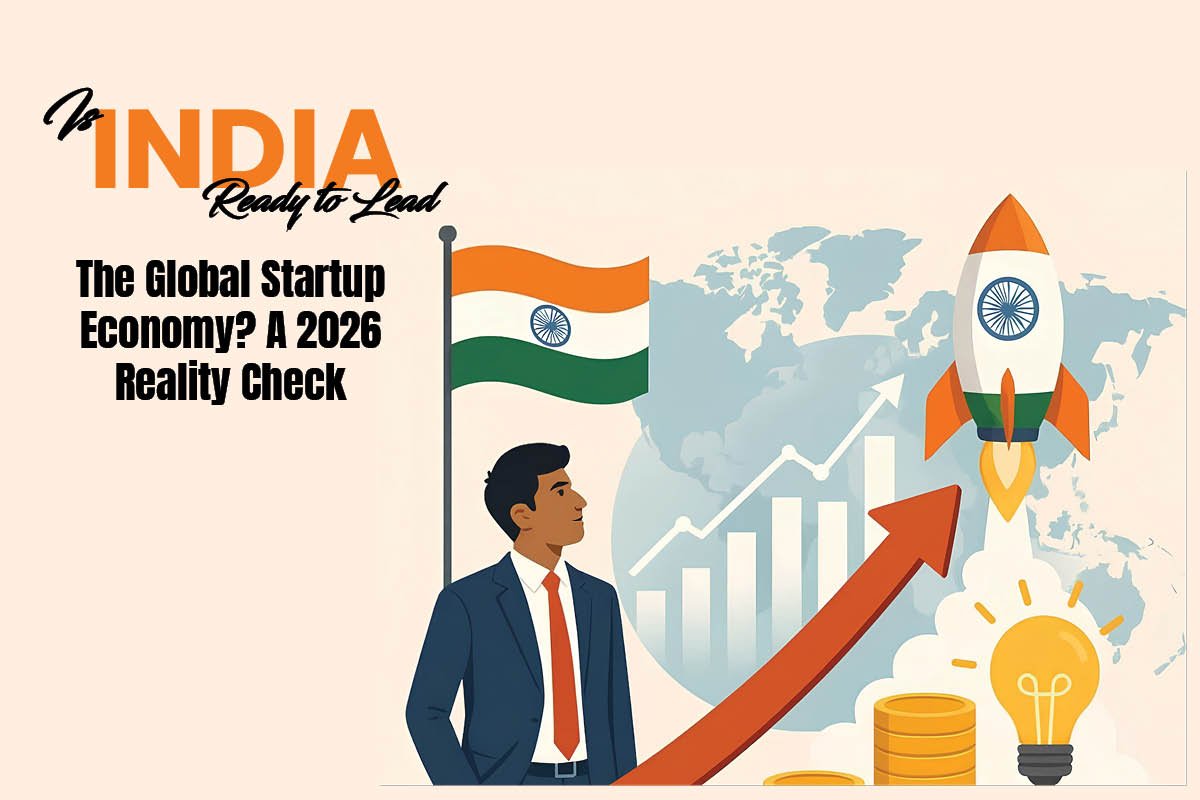



As the Global startup economy order undergoes a significant reshuffle, a critical question emerges from the world’s fastest-growing major economy: Is India poised to lead the global startup ecosystem? With over 125,000 recognized startups and 125+ unicorns valued at more than $365 billion, India has firmly established itself as the world’s third-largest startup hub. Yet, true leadership demands more than impressive numbers; it requires sustainable innovation, global competitiveness, and structural resilience.
This analysis examines India’s startup ecosystem through a multidimensional lens, evaluating its unique strengths, persistent challenges, and strategic positioning in the volatile landscape of 2026. The transformation from a “funding frenzy” to a “profitability paradigm” reveals an ecosystem maturing under pressure, potentially forging a new model of innovation leadership tailored for emerging economies.
The Pillars of India’s Startup Ecosystem Ascent: Structural Advantages

India’s remarkable startup growth rests on foundational advantages that few other ecosystems can replicate at scale.
1. Demographic & Market Fundamentals
- Youthful Digital Population: With 650 million internet users and a median age of 28, India offers a massive, tech-adaptable consumer base for rapid product iteration
- Formalizing Informal Economy: Digital public infrastructure (India Stack) has brought approximately 300 million previously unbanked citizens into the formal economy, creating new market opportunities
- Domestic Demand Scale: Solving problems for 1.4 billion people creates business models with inherent scalability potential for other emerging markets
2. Capital Ecosystem Evolution
- Growing Domestic Participation: Indian limited partners (pension funds, insurance companies, family offices) now contribute approximately 35% of venture capital, reducing historical over-reliance on foreign capital
- Exit Environment Maturation: 42 tech IPOs in 2025 demonstrated robust domestic public market appetite for startup listings, providing crucial exit pathways beyond acquisitions
- Sector-Specialized Funds: Emergence of 80+ funds specifically focused on deep tech, climate solutions, and manufacturing indicates maturing investor sophistication
3. Innovation Infrastructure
- Public Digital Commons: India Stack’s interoperable digital infrastructure (Aadhaar, UPI, OCEN) reduces startup customer acquisition and verification costs by an estimated 40-60%
- Geographic Diversification: 50% of new startups in 2025 originated outside traditional hubs (Bangalore, Mumbai, Delhi-NCR), indicating nationwide entrepreneurial diffusion
- Government-Linked Initiatives: ₹1 trillion ($12 billion) R&D allocation with 50% reserved for private sector collaboration creates unprecedented public-private research partnerships
The 2026 Funding Landscape: Selective Capital in Action
The 2025–26 funding environment reflects a disciplined maturation of the startup ecosystem, with total funding of approximately $11 billion in 2025, signaling a strategic recalibration rather than a simple decline.
Table: The Selective Capital Flow of 2025-26

| Funding Stage | 2025 Trend | Key Investor Priority | Implication for Ecosystem |
| Seed-Stage | Sharp decline (down 30%) | Problem–solution fit, early revenue validation. | Reduced experimentation, validation-focused approach. |
| Early-Stage | Resilient (up 7%) | Clear path to profitability within 3–5 years. | Sustainable scaling prioritized over “growth-at-all-costs.” |
| Late-Stage | Cooled (down 26%) | Proven unit economics, multiple expansion avenues. | Mature companies, public markets, strategic exits. |
| Sovereign & Strategic | Increased 15% | National priorities (Semiconductors, AI, Defense, Space). | Startup innovation, strategic economic alignment. |
Strategic Sector Focus: India’s “Right to Win” Domains
Capital is concentrating in sectors where India holds distinct structural or strategic advantages:
1. Global Capability Centers & Enterprise SaaS
- Talent-Cost Advantage: Indian engineers deliver comparable productivity at approximately 40-50% of Western costs, attracting global capability centers.
- Vertical SaaS Expansion: 60+ Indian SaaS companies achieving $20M+ ARR by solving industry-specific problems in global markets.
- AI-Enabled Services: Leveraging applied AI rather than foundational model development to enhance enterprise productivity solutions.
2. Sustainability & Climate Technology
- Regulatory Catalysis: National Green Hydrogen Mission and renewable energy targets creating a $500B+ addressable market by 2030.
- Circular Economy Models: Waste management, EV infrastructure, and sustainable agriculture startups leveraging India’s density for rapid prototyping.
- Climate Finance Innovation: Green bonds, carbon credit platforms, and climate risk analytics emerging as fintech subsectors.
3. Manufacturing & Hardware Innovation
- Production-Linked Incentives: $26 billion in government incentives attracting startups to electronics, automotive, and semiconductor manufacturing.
- Defense & Space Tech Liberalization: 70% increase in defense tech startups since the sector opened to private investment in 2021.
- Supply Chain Re-engineering: Startups leveraging digital infrastructure to optimize India’s complex, fragmented logistics networks.
Critical Challenges on the Path to Leadership

Despite remarkable progress, India faces structural hurdles that currently preclude undisputed global leadership.
Table: India’s Startup Ecosystem: Competitive Analysis
| Parameter | India (2026) | United States | China | European Union |
| Early-Stage Funding | High | Very High | Moderate | Moderate |
| Late-Stage Capital | Moderate | Very High | High (selectively) | Moderate |
| Deep-Tech/R&D Investment | Low–Moderate | Very High | High | High |
| Domestic Market Scale | Very High | High | Very High | High |
| Regulatory Predictability | Moderate | High | Low–Moderate | High |
| Exit Environment Diversity | Improving (IPO focus) | Excellent (IPO+M&A) | Constrained | Good (M&A focus) |
| Global Product Mindset | Emerging | Dominant | Domestic-First | Strong |
| Talent Cost Advantage | Very High | Low | Moderate | Low |
Persistent Structural Constraints
- Deep-Tech Investment Gap: India’s $1.4 billion AI investment (2023) represents just 2% of U.S. and 18% of Chinese investment, creating foundational technology dependency.
- Regulatory Complexity: Despite improvements, startups navigate an average of 12-15 regulatory touchpoints annually, with fintech and healthtech facing particular compliance burdens.
- Infrastructure Deficits: While digital infrastructure excels, physical logistics costs remain approximately 14% of GDP (versus 8% in developed economies), impacting hardware and manufacturing startups.
- Ecosystem Concentration: 60% of venture capital still flows to just three metropolitan regions, limiting geographic diversification of innovation.
The Sovereign Innovation Pathway: India’s Unique Leadership Proposition
India appears to be forging a distinctive leadership model not through imitation of Silicon Valley but through strategic application of its unique advantages.
Core Strategic Directions for 2026-30
- Sovereign Technology Stack Development: Creating indigenous alternatives in strategic sectors (semiconductors, defense, AI inference engines) with $10B+ government support.
- Global South Solutions Laboratory: Developing frugal innovations in climate adaptation, digital finance, and healthcare delivery with applicability across emerging economies.
- Strategic Sector Coupling: Aligning startup innovation with national priorities in energy transition, manufacturing self-reliance, and space/defense capabilities.
- Diaspora Capital & Expertise Mobilization: Systematically engaging a 32-million-strong diaspora as investors, mentors, and global connectors.
Looking Forward: Scenarios for 2030

Based on current trajectories, three plausible scenarios emerge for India’s startup ecosystem by 2030:
- Sovereign Innovation Leader (Probability: 40%)
- India emerges as the dominant startup ecosystem for Global South solutions.
- Develops competitive capabilities in 2-3 strategic deep-tech domains.
- Accounts for 15-20% of global startup value creation (up from ~8% today)
- Regional Powerhouse with Structural Constraints (Probability: 45%)
- Strong domestic innovation, limited global product leadership.
- Continues dependency on Western foundational technologies.
- Primary destination for global capability centers over product HQs.
- Missed Opportunity (Probability: 15%)
- Regulatory friction and infrastructure gaps constrain scale-up phase.
- Failure to develop a late-stage funding ecosystem limits unicorn creation.
- Talent outflow to mature ecosystems with stronger research infrastructure.
Conclusion
Is India’s startup ecosystem ready to lead the global startup economy today? It is preparing to lead on its own terms, not yet dominating frontier, capital-intensive deep tech, but remaining unparalleled in building scalable, sustainable, and inclusive solutions for its vast, complex domestic market with significant global relevance.
The “gold rush” phase has ended, replaced by a sober, disciplined, and more powerful growth cycle, with India’s startup ecosystem maturing and strategically pivoting to leverage its core strengths. If this trajectory sustains, India is poised to become the definitive global leader in pragmatic, population-scale innovation, setting a new 21st-century template for a leading startup economy.