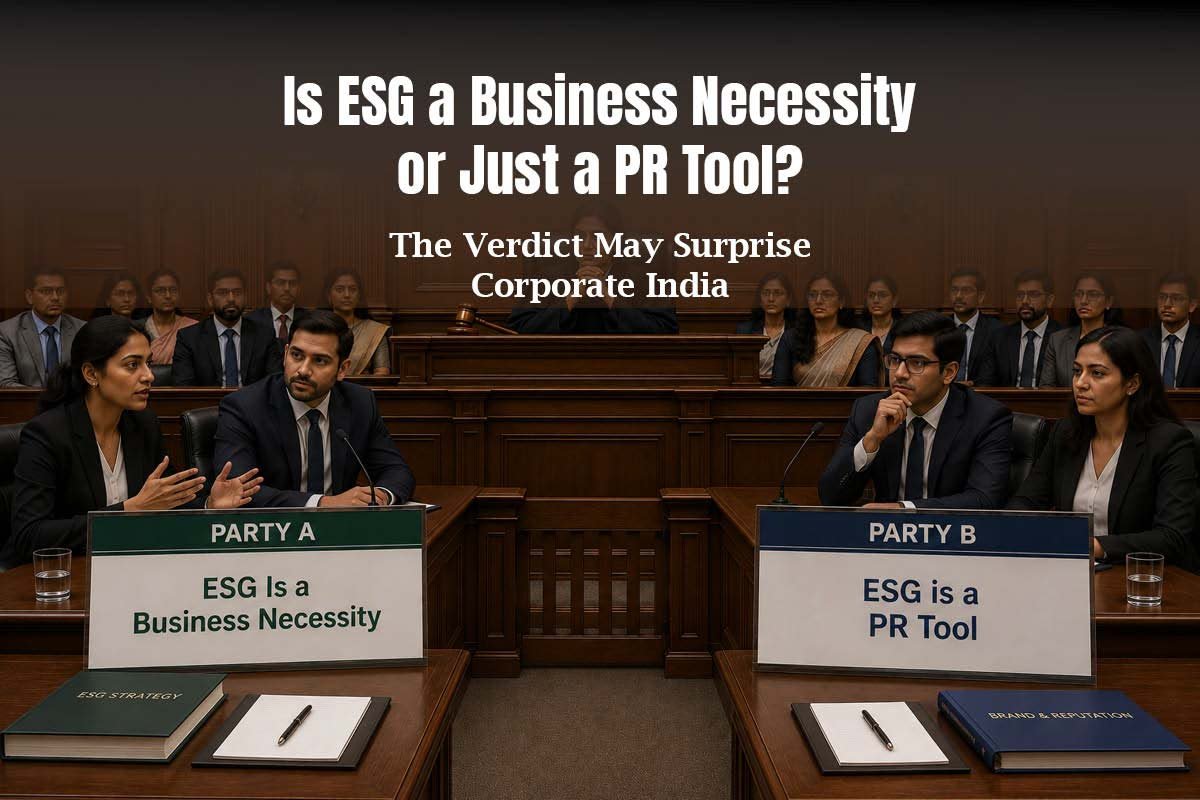



(The theme is a courtroom of 2 two parties: Party A and Party B. Images should be like the courtroom seats of both parties.
Party A – ESG Is a Business Necessity, Party B – ESG is a PR Tool)
The tribunal convenes. The case is called to order.
Few corporate terms attract as much attention today as ESG. It appears in boardroom discussions, investor reviews, and regulatory filings. India’s largest listed companies now face mandatory sustainability disclosures under SEBI’s Business Responsibility and Sustainability Reporting framework.
At the same time, investors are paying closer attention to environmental, social, and governance indicators, while companies continue to commit resources, budgets, and personnel to ESG initiatives.
The question before the tribunal is straightforward. If ESG in Business creates real value, it is a necessity. If it exists mainly for optics, it is a branding exercise.
Both parties will now present their arguments before a verdict is reached.
Exhibit A: ESG in Business is a Necessity
The defence rises and submits its first exhibit.
The argument begins with risk.
Businesses operate in an environment where climate events can disrupt operations, water shortages can affect production, supply chain disruptions can delay deliveries, and governance failures can damage shareholder value. These are ESG in Business risks with financial consequences. The defence argues that ESG provides a structured way to identify such vulnerabilities before they become larger problems.
The second piece of evidence concerns investors.
Global investors increasingly examine ESG performance when assessing companies. Transparency helps investors understand how an organisation manages environmental, social, and governance issues. Strong governance practices, clear disclosures, and credible risk management often contribute to greater investor confidence. In an increasingly competitive capital market, these factors matter.
The final piece of evidence is regulatory reality.
SEBI’s Business Responsibility and Sustainability Reporting framework has made ESG disclosures a formal requirement for India’s largest listed companies. Sustainability metrics now sit alongside other business disclosures that investors and stakeholders review regularly.
The defence, therefore, presents a simple conclusion. ESG is no longer an optional corporate initiative. For many companies, it has become part of operating responsibly within a regulated market.
The defence argues that ESG is not about appearing responsible. It is about remaining investable, compliant, and resilient.
Exhibit B: The Business Case Beyond Compliance
The witness takes the stand.
Statement 1: Reputation Matters
Companies with credible ESG practices often enjoy stronger trust among customers. In an environment where corporate behaviour receives greater attention, reputation can become a competitive advantage.
Statement 2: Talent Pays Attention
ESG can influence employee attraction and retention. Many professionals increasingly consider workplace values and business conduct when evaluating employers.
Statement 3: Efficiency Has Value
Responsible use of resources can reduce waste and improve operational efficiency. Over time, these improvements may contribute to long-term business performance.
Statement 4: Global Markets Are Watching
For Indian companies competing internationally, sustainability expectations continue to rise. Customers, investors, and business partners increasingly examine governance standards and business practices.
The witness concludes.
Businesses that ignore ESG may find themselves at a disadvantage in global markets.
According to Party A, ESG is becoming a commercial reality rather than a corporate trend.
Counter Argument: ESG Is Becoming a PR Industry

The prosecution approaches the witness box.
Question: If ESG is transforming business, why has an entire industry emerged around reporting it?
The prosecution points to a growing ecosystem of consultants, ratings agencies, software providers, auditors, and reporting specialists. ESG has created significant commercial activity beyond the companies being assessed.
Question: Who is spending the money?
Businesses are investing resources in data collection, disclosures, assessments, certifications, and compliance processes. Reporting requirements continue to expand, increasing both administrative effort and cost.
Question: What is being measured?
Here, the prosecution raises its central concern. Companies may become highly proficient at documenting sustainability performance. Yet documentation does not automatically guarantee meaningful change.
Question: What matters more, the report or the result?
A company can publish detailed disclosures and receive favourable assessments while deeper operational challenges remain unresolved.
The prosecution rests its case.
The prosecution argues that visibility often receives more attention than measurable impact.
ESG through the Lens of Indian Business
The witness remains seated. The questioning becomes more direct.
Counsel: Can ESG reporting accurately reflect reality when large portions of the supply chain still face basic operational challenges?
The question goes to the heart of India’s ESG debate.
Large listed companies often have the resources needed to build reporting systems, hire specialists, and manage compliance requirements. Many smaller businesses operate under very different conditions.
India’s vast MSME sector forms a critical part of corporate supply chains. Yet reporting capabilities vary widely across businesses. Some maintain structured records and dedicated compliance processes. Others continue to face challenges in documentation, data collection, and reporting consistency.
The difficulty increases when large corporations seek ESG in business information from hundreds or even thousands of suppliers. Gathering reliable data can be a complex task when readiness levels differ across industries, regions, and business sizes.
The prosecution argues that this creates a gap between what appears in boardroom presentations and what exists on the ground. Ambition may be clear, but implementation remains uneven.
The prosecution argues that reporting standards can move faster than business realities.
The Question that Changes the Case
The tribunal pauses. The judge asks one final question before the verdict.
Would ESG remain a corporate priority if regulations, investor expectations, and disclosure requirements disappeared tomorrow?
- Party A responds: The risks would still exist. Resource pressures, governance concerns, and stakeholder expectations do not disappear because reporting rules vanish. Businesses would still need systems to manage them.
- Party B responds: If that is true, why did ESG gain such momentum after disclosure requirements became mandatory? Many commitments appeared when regulation increased scrutiny and reporting became unavoidable.
The courtroom falls silent.
Both arguments carry weight. Neither side has fully answered the question.
For now, the tribunal records the responses and leaves the matter unresolved.
Final Verdict
After reviewing the evidence presented by both parties, the tribunal delivers its decision.
The tribunal finds that ESG in Business sits somewhere between business necessity and public relations. Regulation has accelerated adoption. Investor scrutiny has increased expectations. Reporting standards have created greater structure and visibility. At the same time, concerns about compliance burdens, reporting quality, and practical implementation remain valid.
The evidence suggests that ESG becomes a business necessity when it influences decisions, operations, governance, risk management, and resource allocation. It becomes a PR tool when its primary purpose is to improve perception rather than performance.
The tribunal therefore declines to deliver a simple guilty or innocent verdict.
Instead, it reaches a different conclusion.
ESG in Business is only as meaningful as the actions that follow the report. Its value is determined not by what companies disclose, but by what they actually do.