



A bidder may seek control of a company, while its board resists the deal. A hostile takeover occurs when an acquirer pursues control against the wishes of the target’s board or management. In India, promoter stakes, shareholder choices, and SEBI takeover rules shape these bids.
Hostile takeover examples show how buyers pursue control, from public offers to share purchases. They also reveal the role of ownership, deal terms, and regulation.
What is a hostile takeover? Understanding its meaning
A hostile takeover occurs when a buyer seeks control without the target leadership’s support. The term describes opposition, not an illegal deal. The buyer may still follow the law and seek shareholder support.
Two common methods can help a bidder pursue control:
- Tender or public offer: The bidder offers to buy shares from shareholders. The offer must meet the rules that apply to the deal.
- Share accumulation: The bidder buys shares through market trades or private deals. The buyer must follow the rules on disclosures and takeover offers.
However, a large stake does not always grant control. Promoters may hold enough shares to block a bid, or other investors may reject the offer.
In a friendly acquisition, the target’s leadership agrees to the deal. A hostile bid moves ahead despite that opposition. For listed Indian companies, the SEBI SAST Regulations, 2011 set key rules for share acquisitions, disclosures, and open offers.
How does a hostile takeover work?
A hostile takeover can follow several steps, depending on the target’s ownership structure. These are the common 6 stages; while not mandatory, they are good to know about.
- Identify the target: The bidder studies the company’s business, shareholding, and control structure.
- Assess the deal: The bidder checks the target’s value, funding needs, and route to control.
- Pursue control: The bidder buys shares or makes a public offer, where permitted.
- Face resistance: The target’s board and promoters may oppose the bid or urge shareholders to reject it.
- Seek shareholder support: Investors decide whether to sell their shares under the offer.
- Meet legal conditions: The deal proceeds only after meeting the relevant legal and regulatory requirements.
The exact route depends on ownership, offer terms, and applicable rules. These steps also fit within the wider stages of an M&A deal process when a bid advances.
7 hostile takeover examples and what they reveal
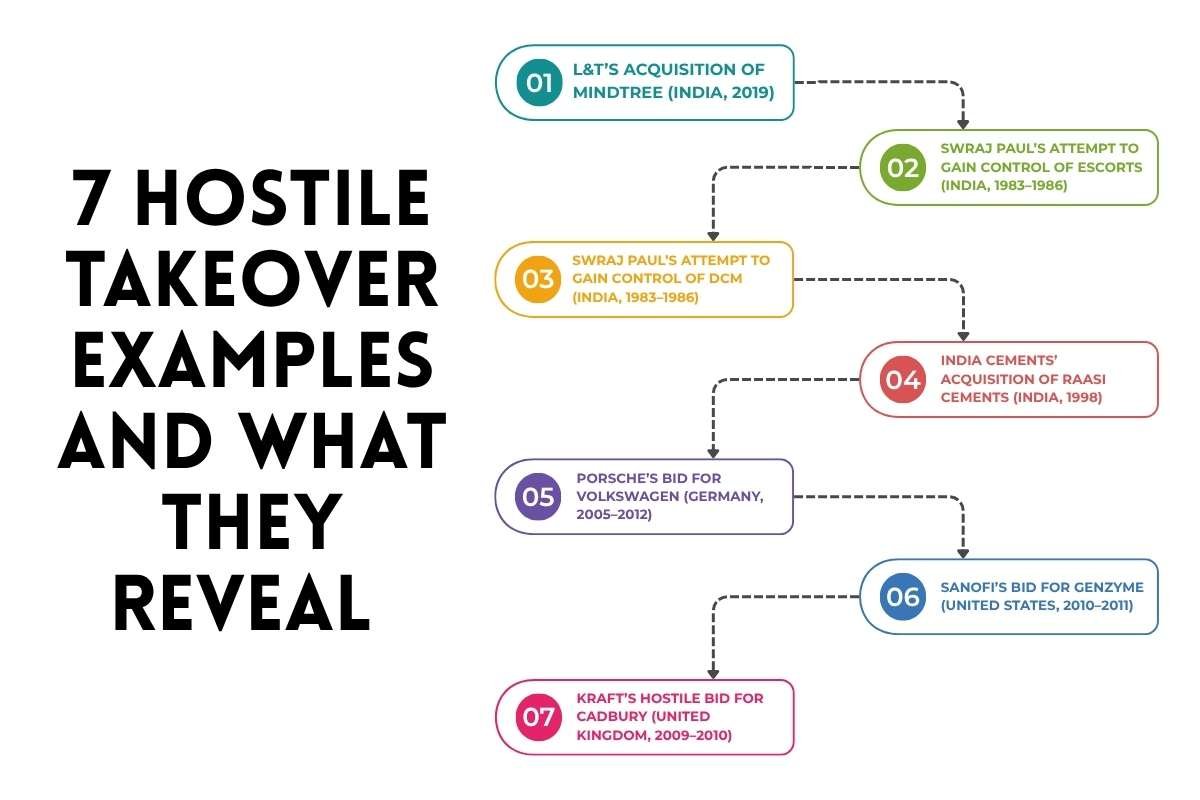
These seven cases span India, Europe, and the United States. Some bidders gained control, while others withdrew or reached a negotiated deal. Together, they show the different paths a takeover contest can take.
In India, promoter ownership often plays a key role in these contests.
1. L&t’s acquisition of mindtree (India, 2019)
Bidder and target: Larsen & Toubro (L&T) and Mindtree.
In March 2019, L&T agreed to buy 20.32% of Mindtree from V.G. Siddhartha’s group. The deal was worth about ₹3,269 crore. Mindtree’s founders opposed the move and raised concerns about its independence. L&T then bought more shares and launched an open offer for another 31%. By July, L&T held 60.06% and gained control.
Lesson: Strong leadership resistance cannot stop a bid when a buyer secures enough shares and meets the rules.
2. Swraj Paul’s attempt to gain control of escorts (India, 1983–1986)
Bidder and target: Swraj Paul and Escorts Ltd.
In 1983, London-based investor Swraj Paul began buying shares in Escorts. The Nanda family, which led the company, opposed his bid for influence. The dispute drew in Indian officials and financial institutions, including LIC and UTI. Paul eventually agreed to sell his shares back to the promoters in 1986. His campaign did not lead to control of Escorts.
Lesson: A bidder may gain a meaningful stake yet fail to win control. Promoter support and institutional votes can shape the outcome.
3. Swraj Paul’s attempt to gain control of dcm (India, 1983–1986)
Bidder and target: Swraj Paul and Delhi Cloth and General Mills (DCM).
Paul also bought shares in DCM, challenging the Shriram family’s hold over the company. The contest ran alongside his separate bid for Escorts, but each company had its own ownership structure. The Shriram family resisted his moves, while the dispute drew government attention. In 1986, Paul agreed to sell his DCM shares back to the family. He did not gain control of DCM.
Lesson: Two bids by the same investor can meet similar resistance. Each outcome still depends on the target’s shareholders and voting power.
4. India cements’ acquisition of raasi cements (India, 1998)
Bidder and target: India Cements and Raasi Cements.
In 1998, India Cements, led by N. Srinivasan, built a stake in Raasi Cements. By January, it held 18.03% through market purchases and a deal with an estranged family group. It then offered ₹300 per share for another 20%, well above the market price. The deal involved shifting shareholder interests and negotiations over key stakes. This case is best treated as a contested acquisition, rather than a clear-cut hostile bid.
Lesson: A major shareholder’s decision to sell can change a control contest. The label hostile takeover needs care when negotiations also shape the deal.
5. Porsche’s bid for Volkswagen (Germany, 2005–2012)
Bidder and target: Porsche SE and Volkswagen AG.
Porsche built its Volkswagen stake over several years. In October 2008, Porsche disclosed a 42.6% holding in Volkswagen’s ordinary shares, plus cash-settled options linked to another 31.5%. Together, these gave Porsche economic exposure equal to 74.1%. Yet options did not mean Porsche owned all those shares. Its plan to secure control faced major financial strain, and Volkswagen later acquired Porsche’s car-making business in 2012.
Lesson: Share ownership, financial exposure, and actual control are different things. This was a complex control struggle, not a simple hostile bid.
6. Sanofi’s bid for Genzyme (United States, 2010–2011)
Bidder and target: Sanofi-Aventis and Genzyme.
Sanofi launched an unsolicited $69-per-share cash offer for Genzyme in October 2010. The offer valued the biotech company at about $18.5 billion. Genzyme’s board resisted, arguing that the bid undervalued its business and future potential. Talks later led to an agreement in February 2011. Sanofi raised its offer to $74 per share, plus a contingent value right tied to future outcomes. The deal then moved forward as an agreed acquisition.
Lesson: An opposed bid can turn into a negotiated deal when both sides agree on value and terms.
7. Kraft’s hostile bid for Cadbury (United Kingdom, 2009–2010)
Bidder and target: Kraft Foods and Cadbury.
Kraft made an unsolicited proposal for Cadbury in 2009, valuing it at about £10.2 billion. Cadbury’s board rejected the offer and urged shareholders not to accept it. Kraft then took its bid directly to shareholders, raising the offer to 840 pence per share in January 2010. Cadbury’s board eventually recommended the revised terms. Kraft completed the acquisition in February 2010.
Lesson: A hostile bid can succeed when shareholders accept the offer. Better terms may also turn board opposition into support.
The cases also highlight key differences between takeover bids in mergers and acquisitions. L&T gained control of Mindtree, while Swraj Paul’s campaigns against Escorts and DCM ended without control. Sanofi and Genzyme reached an agreement after an initial dispute. Porsche’s pursuit of Volkswagen followed a more complex path.
What determines whether a hostile takeover succeeds?

A bidder needs more than money to gain control of a company. Existing promoter stakes, shareholder support, and offer value can shape the outcome.
| Factor | Why it matters |
| Shareholding structure | Sets how many shares the bidder needs to gain control. |
| Offer valuation | Shapes whether shareholders accept the proposed price. |
| Target resistance | Can delay talks or prompt other options. |
| Regulatory compliance | Determines whether the deal can proceed lawfully. |
A strong bid still needs shareholder support and regulatory clearance.
Conclusion:
A hostile takeover occurs when a buyer seeks control against the target’s leadership. These examples show that resistance alone cannot stop a determined bidder. Shareholding, offer terms, shareholder choices, and legal rules all shape the outcome. Understanding these factors helps readers assess contested deals, ownership changes, and the wider field of mergers and acquisitions in India.
Frequently asked questions about hostile takeovers
1. What is a hostile takeover?
A hostile takeover occurs when a buyer seeks control against the target company’s leadership. The bidder may approach shareholders directly or build a stake, subject to applicable rules.
2. Is a hostile takeover legal in India?
Yes, a hostile takeover can be lawful in India. The bidder must follow SEBI takeover rules, disclosure duties, open offer requirements, and applicable competition laws.
3. What is the difference between a hostile and friendly takeover?
A hostile takeover faces opposition from the target’s leadership. In a friendly takeover, the target’s board supports the proposed deal and agrees to its terms.