



A manufacturer wants control over its supply of raw materials. A rival wants to enter a new market and reach more buyers. Both may consider a merger, but their goals differ. Understanding types of mergers helps us see why businesses choose different deal structures. Some mergers link suppliers with buyers, while others bring direct rivals together. Some combine firms with related products or entirely different business lines.
In India, these choices can affect ownership, daily operations, regulatory approvals, and future growth. Let’s look at five key merger types, their examples, benefits, and trade-offs.
What Is a Merger? Understanding the Concept Before the Types
A merger brings two businesses together under a combined business structure. The legal outcome depends on the deal terms and applicable law. The companies may combine assets, teams, operations, management, or ownership. Yet, each deal follows its own path and set of terms.
For example, two regional logistics companies may join their delivery networks. This can help them serve more towns without building duplicate hubs. They may also share staff, warehouses, vehicles, and tech systems.
Business articles often use “merger” as a broad term. Yet, a deal may legally count as an acquisition or amalgamation. The name alone does not tell us why two businesses joined. To understand that, we need to look at their business ties and goals.
Five Types of Mergers Explained Simply
The main types of mergers differ in how businesses relate. Some combine direct rivals, while others link firms across a supply chain. Others bring related or unrelated products under one business group.
These types of mergers, when explained simply, help us see the goal behind each deal.
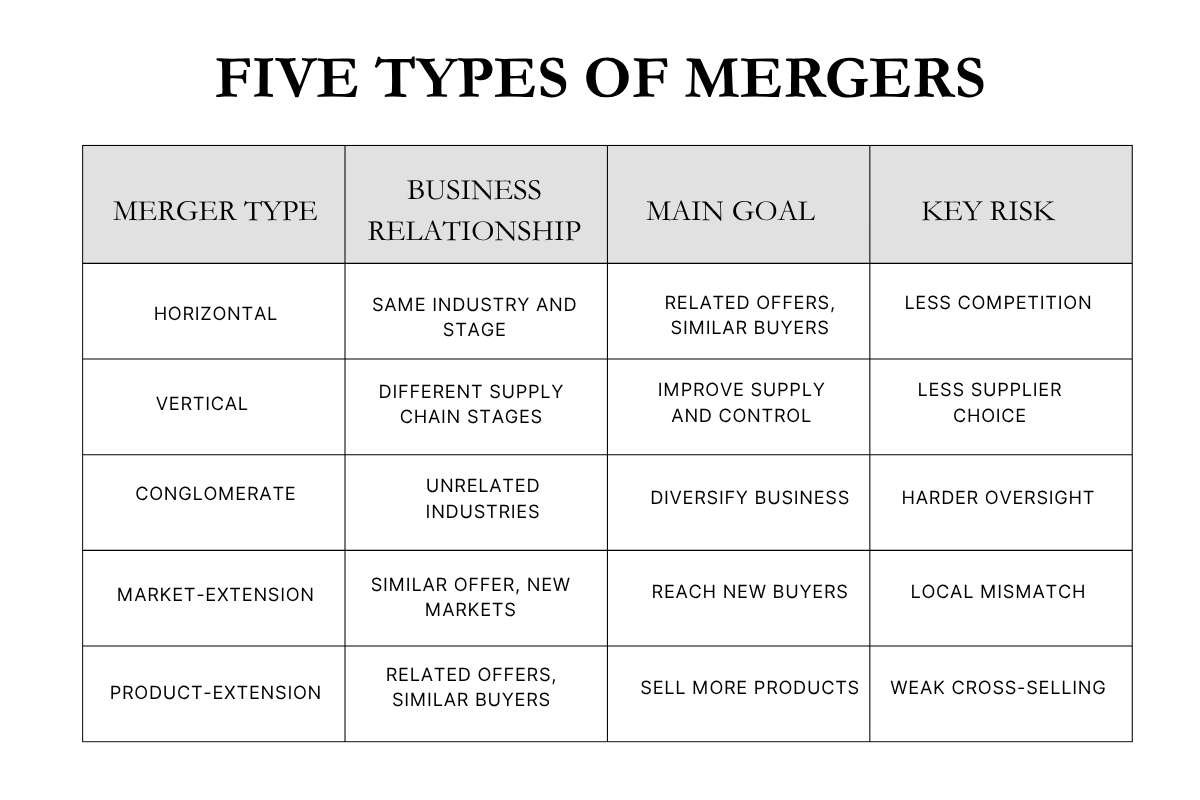
| Merger type | Business relationship | Main goal | Key risk |
| Horizontal | Same industry and stage | Gain scale and reach | Less competition |
| Vertical | Different supply chain stages | Improve supply and control | Less supplier choice |
| Conglomerate | Unrelated industries | Diversify business | Harder oversight |
| Market-extension | Similar offer, new markets | Reach new buyers | Local mismatch |
| Product-extension | Related offers, similar buyers | Sell more products | Weak cross-selling |
These labels explain the business strategy, not always the legal form. Some categories can overlap, so the deal’s purpose matters.
1. Horizontal Merger

A horizontal merger joins two businesses at the same industry stage. For example, two regional cement makers may combine plants and distribution networks. They may reach more buyers, share production capacity, and cut duplicate costs. Yet, a larger business does not always work better. Old systems, weak planning, or high costs can limit savings.
The deal may also reduce competition in a relevant market. In India, the Competition Commission of India (CCI) may review its likely effects. The key question is whether the deal creates real gains without harming competition.
2. Vertical Merger
A vertical merger joins businesses at different supply chain stages. For example, a carmaker may combine with a component supplier. This can improve supply plans, quality checks, and delivery times. Backward integration means moving toward suppliers, while forward integration means moving toward buyers or distribution.
Yet, the deal can raise integration costs and reduce supplier choice. The carmaker may also lose flexibility if its needs change. Better control helps only when the combined chain works well.
3. Conglomerate Merger

A conglomerate merger joins businesses from unrelated industries. For example, a consumer goods company may join an industrial services business. The deal may open new growth paths beyond its core market. It can also spread revenue across different business lines.
However, diversification does not always reduce risk or boost returns. Leaders may lack the skills to manage both businesses well. Extra layers of control can also raise costs. The deal works best when leaders can add value across both businesses.
4. Market-Extension Merger
A market-extension merger joins similar businesses that serve different markets. For example, a lender in western India may join one with strong eastern reach. The combined business may gain new customers, local knowledge,e and sales channels. Yet, regional habits, systems, and rules may differ.
Teams must adapt their sales plans and service models. This strategic category can overlap with a horizontal merger. Both businesses may serve the same industry, but their markets differ.
5. Product-Extension Merger
A product-extension merger joins businesses with related products for similar buyers. For example, a software firm may join an inventory management provider. The combined firm can offer more tools to its current customers. It may also cross-sell products and meet more client needs.
But related products do not guarantee strong demand. Buyers may prefer separate tools, or the systems may not work well together. Unlike a conglomerate merger, this deal links related offers. Its success depends on real customer demand and smooth product fit.
Merger vs Acquisition vs Takeover

These terms often overlap, but each points to a different deal outcome. The key difference lies in control, structure, and the target’s future.
| Term | What happens | Does the target remain separate? |
| Merger | Two businesses combine under an agreed structure | It depends on the legal form |
| Acquisition | One party gains control of another business or its assets | Often, yes |
| Takeover | One party gains control of another company | It may, depending on the deal |
For example, two local banks may combine under one structure. A large bank may instead buy a smaller bank’s business. If a buyer seeks control despite the target board’s opposition, the deal may count as a hostile takeover. You can also review the meaning of a hostile takeover and examples to understand that specific case.
In India, legal treatment depends on the deal structure and parties. The Companies Act, 2013, governs merger schemes, while SEBI’s takeover rules cover relevant listed-company acquisitions. A takeover can be an acquisition, and an acquisition can lead to a merger. These terms therefore do not always mark separate deal types.
How to Identify the Right Merger Structure?
Start with one question: what does the business want to achieve? The answer helps narrow the types of mergers for your needs.
| Business objective | Structure to examine |
| Expand within the same industry | Horizontal |
| Secure supply or distribution | Vertical |
| Enter new regions | Market-extension |
| Add related products | Product-extension |
| Enter an unrelated sector | Conglomerate |
These choices reflect common reasons companies pursue mergers and acquisitions. Yet, no single structure suits every business. A horizontal merger may expand reach, but it can also raise competition concerns. A vertical deal may secure supply, but it can limit supplier choice.
Before choosing, assess the target’s value, funding needs, and ownership terms. Also weigh integration costs, regulatory risks, and the execution plan. The stages of an M&A deal process help teams assess these factors before closing. The strategic label offers a starting point, not a guarantee of success.
What Changes in an Indian Merger?
In India, a sound business case does not ensure a smooth merger. Companies must review legal duties, approval needs, and integration risks. The Companies Act, 2013, sets out procedures for merger schemes and amalgamations. The CCI may review deals that meet the applicable competition rules. SEBI requirements may also apply when listed companies take part.
Not every deal needs every approval. The rules depend on the parties, deal structure, thresholds, and exemptions. A horizontal merger may draw scrutiny over reduced competition. A vertical merger may raise concerns about access to suppliers or buyers. Businesses should check the regulatory approvals needed for M&A in India before they commit.
Approval is only one step in the process. Teams must still align systems, staff, supply chains, and daily operations. Without a clear integration plan, the expected gains may fall short.
Conclusion:
Each merger type reflects a different way to solve a business need. Some help companies gain market share or secure key supplies. Others open new markets, add related products, or spread business risk. Yet, the right fit of mergers and acquisitions depends on more than the deal’s goal.
Companies must weigh costs, competition, legal duties, and their ability to unite operations. In the end, the types of mergers create value when their structure fits the business purpose, and the teams can turn that plan into results.
Frequently Asked Questions
1. What is the difference between a horizontal and vertical merger?
A horizontal merger joins businesses at the same industry stage, such as two cement makers. A vertical merger links supply-chain stages, such as a carmaker and component supplier.
2. Is an acquisition the same as a merger?
No. An acquisition involves gaining control of a business or its assets. A merger generally combines businesses or entities. However, business articles sometimes use both terms broadly.
3. What are the five main types of mergers?
The types of mergers explained simply include horizontal, vertical, conglomerate, market-extension, and product-extension mergers. These are common strategic categories, not a universal legal classification.
4. Which type of merger faces competition concerns?
Horizontal mergers may reduce competition by bringing rivals together. Vertical and conglomerate deals can also raise concerns, depending on market power and their effects. No type faces an automatic ban.
5. Do all mergers in India need CCI approval?
No. CCI review depends on applicable combination rules, thresholds, and exemptions. The parties and deal structure also matter.