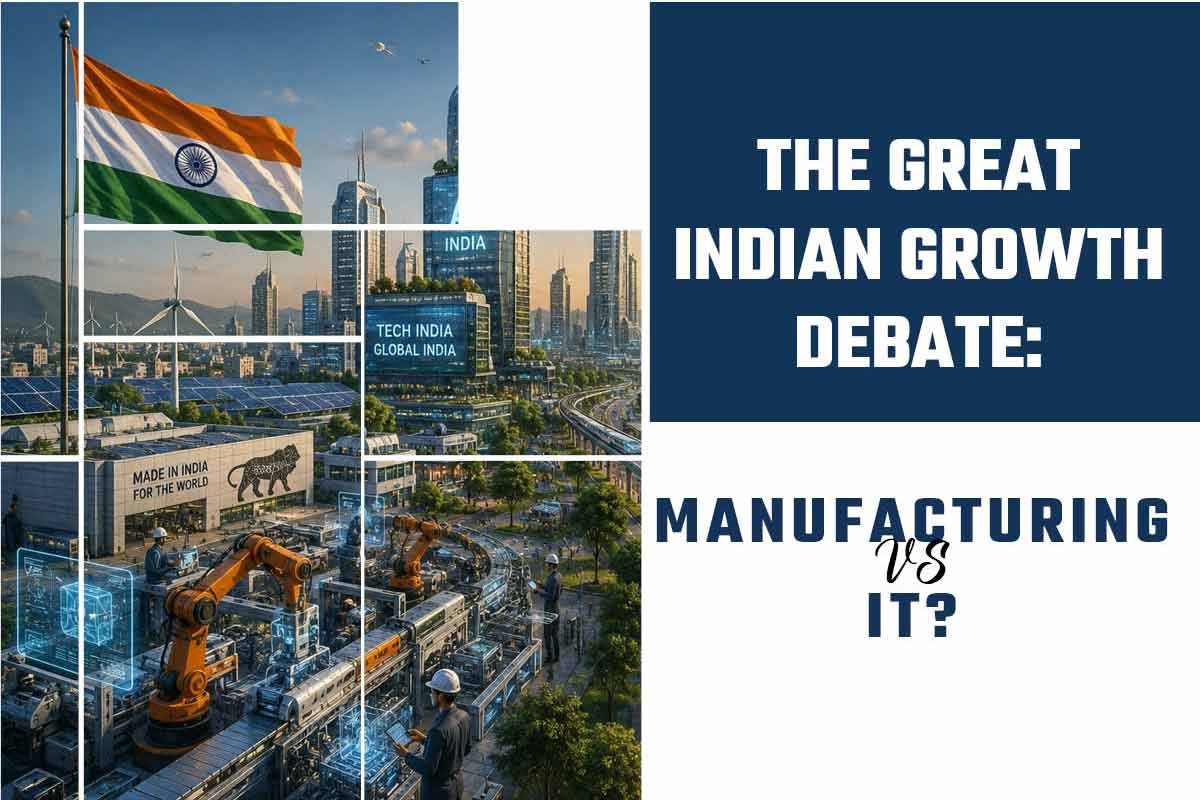



“Welcome to India, 2040.”
The airport is buzzing with activity. One terminal is filled with cargo planes carrying electric vehicles, semiconductor chips, electronics, and precision-engineered products stamped “Made in India.” At another, the world’s biggest technology companies continue to rely on Indian firms for artificial intelligence, cloud computing, cybersecurity, and digital transformation.
This is an India that leads in both factories and software.
But it almost didn’t happen.
Travel back to 2026, and you’ll find a country standing at a crossroads. The great manufacturing vs IT debate was becoming one of India’s biggest economic questions. Should the country continue building on its IT dominance, or double down on manufacturing to power the next phase of economic growth? The answer would shape the decades to come.
Stop 1: the rise of IT
Before India dreamed of becoming a manufacturing powerhouse, it had already conquered the digital world.
Few countries have transformed their economic identity as dramatically as India did through information technology. What began as an outsourcing destination in the late 1990s evolved into one of the world’s most influential technology ecosystems.
The numbers tell the story.
Technology spending in India increased from 1.1% of GDP in 2006 to 2.3% in 2022, reflecting how deeply digital technology became embedded in everyday life. From online banking and digital payments to healthcare, education, logistics, and government services, technology quietly became the backbone of the economy.
The IT industry grew even faster. From accounting for less than 1% of global IT services spending in 1999, India now captures approximately 15% of global IT services spending. Despite global recessions, changing technologies, and shifting client demands, Indian IT companies repeatedly adapted, moving from application maintenance to cloud computing, cybersecurity, data analytics, and now artificial intelligence.
Companies such as TCS, Infosys, Wipro, and HCLTech became trusted partners for businesses across the world, helping enterprises modernize their operations.
Yet success brought a challenge.
India’s IT sector depended heavily on clients in the United States and Europe. Whenever those economies slowed, Indian technology companies felt the impact almost immediately.
The next chapter of India’s growth brought the manufacturing vs IT debate into sharper focus. Could India build an economy powered by both sectors rather than choosing one over the other?
Stop 2: manufacturing vs IT – why manufacturing became the new growth story?
As discussions around manufacturing vs IT intensified in 2026, manufacturing itself had become more than an economic priority; it had become a national ambition.
Finance Minister Nirmala Sitharaman urged Indian industry to focus not just on increasing production but on achieving greater manufacturing sophistication. Her message was clear: competing globally would require India to move beyond low-value manufacturing and build capabilities in advanced industries.
The government backed this vision with massive infrastructure investments and the Production Linked Incentive (PLI) schemes, encouraging companies to manufacture within India.
The shift was becoming visible across industries. Electronics production was growing, electric vehicle manufacturing was gaining momentum, and new investments were pouring into consumer electronics and components. Even semiconductor manufacturing, once seen as an ambitious goal, was finally taking shape through projects led by companies like Tata Electronics and Micron.
Apple offered one of the clearest signs of this transformation, expanding iPhone production in India through partners such as Foxconn, Pegatron, and Tata Electronics, making the country a more important part of its global supply chain. Manufacturing was no longer viewed as just another industry; it was steadily becoming one of India’s biggest strategic strengths.
Stop 3: the global shift
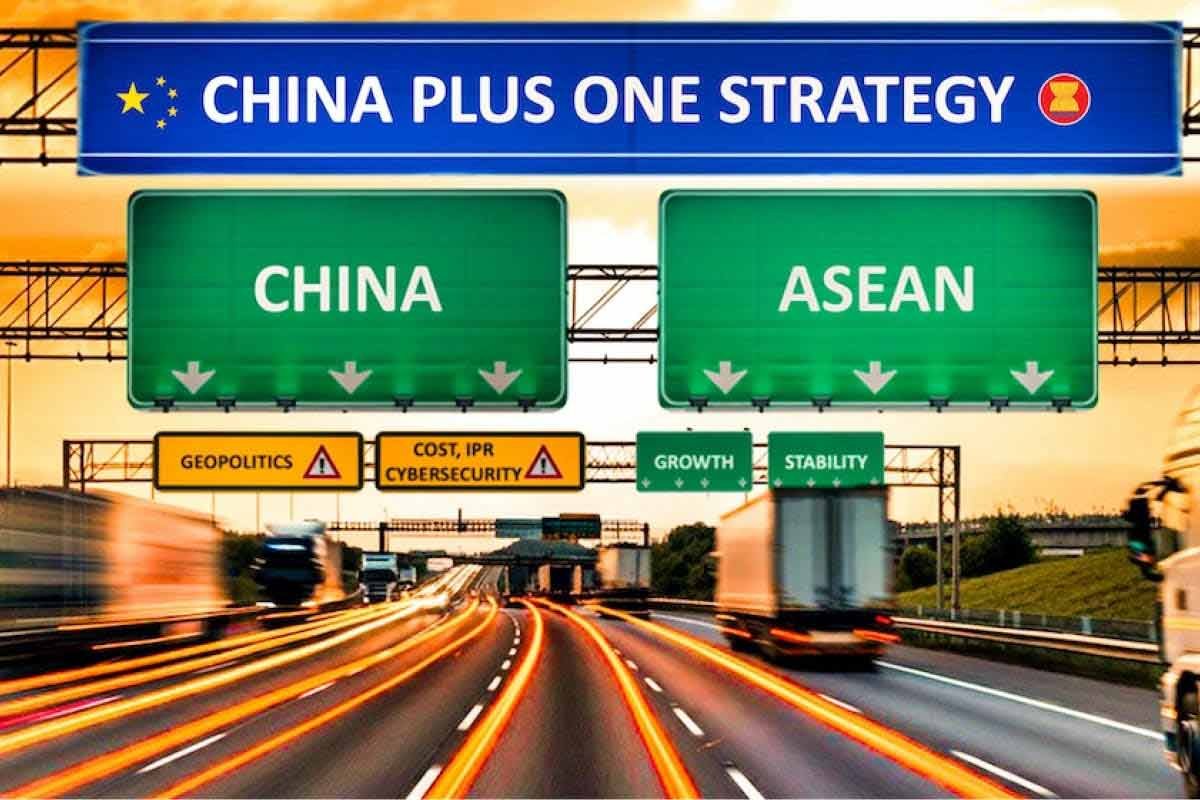
Then the world changed. The pandemic exposed the risks of concentrating global manufacturing in a single geography. Businesses began diversifying their supply chains through what became widely known as the China+1 strategy.
India suddenly found itself in a favourable position. Improving infrastructure, policy reforms, competitive labour costs, and a growing domestic market made the country an attractive alternative for global manufacturers.
An ASSOCHAM study highlighted that India was outperforming global manufacturing growth, supported by shifting supply chains and increasing investor confidence. The stock market reflected this optimism.
Over the previous 18 months, the Nifty India Manufacturing Index delivered a strong and consistent upward trend, supported by infrastructure spending, PLI incentives, and growing investments in EVs, electronics, and semiconductors.
The Nifty IT Index, however, told a different story.
Unlike manufacturing, India’s IT industry remained closely tied to global business sentiment. Rising interest rates, slower economic growth in the US and Europe, and cautious corporate technology spending led to subdued earnings growth and largely sideways market performance. That did not mean the sector had lost its relevance, far from it. Artificial intelligence was opening a new chapter for technology companies, but while AI promised long-term growth, the industry continued to face short-term uncertainty. This made the manufacturing vs IT conversation even more relevant, as each sector was being shaped by a very different set of economic forces.
One was powered by domestic reforms. The other by global demand.
Stop 4: What if India chose only one?
At the heart of the manufacturing vs IT debate was a simple question: what if India chose only one path? If the country focused only on IT, it would continue to lead the world in software and digital services. But millions of people without advanced technical skills would have fewer opportunities, while manufacturing jobs, supply chains, exports, and industrial growth would struggle to keep pace. Now consider the other side. If India focused only on manufacturing, factories would expand, exports would increase, and more industrial jobs would be created. Yet without a strong IT ecosystem, those industries would find it harder to embrace AI, automation, cloud computing, robotics, predictive maintenance, and the smart technologies that are shaping modern manufacturing.
That is why many economists believe this was never a choice between one sector and the other. Economist Noah Smith argues that India’s industrial future will not come from copying China’s model, but from building one that reflects today’s economy, where advanced manufacturing and digital capabilities work hand in hand.
Perhaps the real question was never whether India should choose manufacturing over IT. It was whether the two could grow stronger together.
Return to 2040
The time machine returns to 2040 one final time.
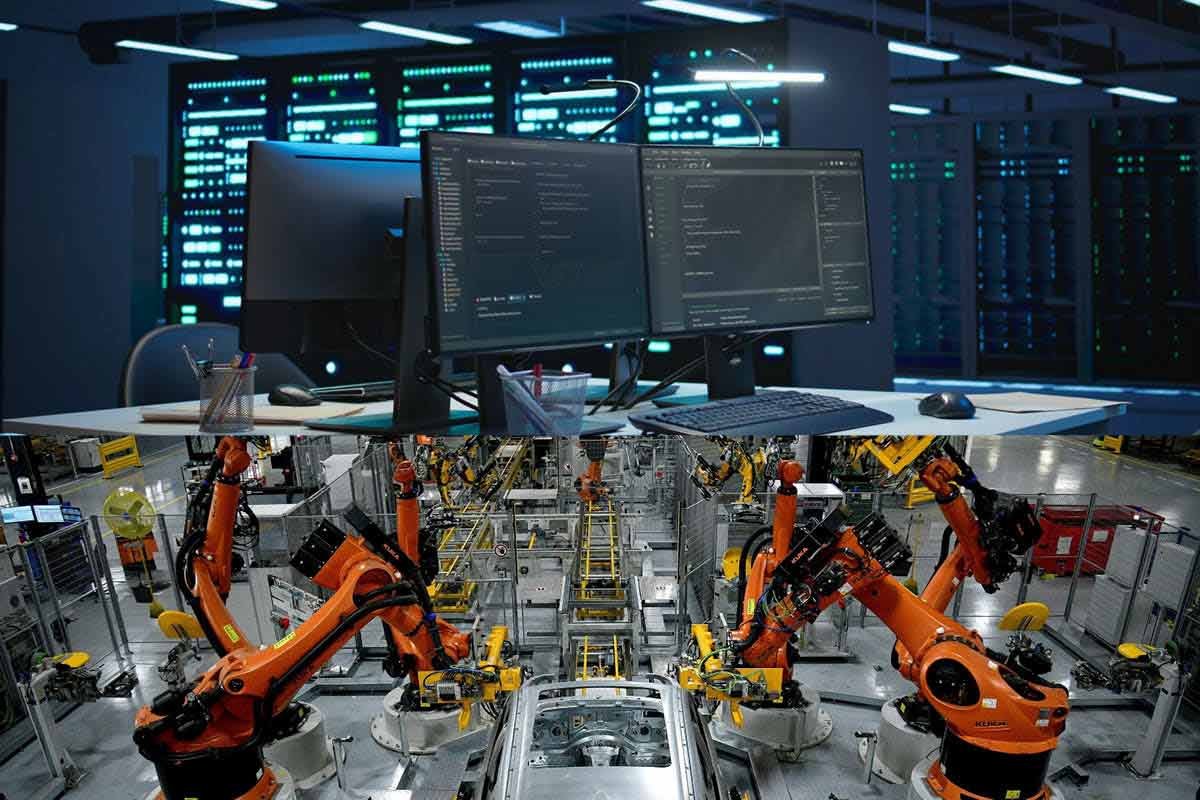
The skyline looks different. Advanced manufacturing hubs stand alongside world-class technology campuses, connected by intelligent logistics networks and powered by AI-driven systems. Factories are no longer just places where products are made; they are data-driven, automated, and deeply connected to India’s digital ecosystem. At the same time, the country’s technology companies have evolved beyond software services, building solutions that power industries, factories, and global supply chains.
Looking back, one thing becomes clear. India’s rise wasn’t the result of choosing manufacturing over IT, nor was it built by relying on technology alone. Its biggest advantage came from recognising that the two were never competing forces; they were complementary strengths.
Manufacturing created jobs, expanded exports, and strengthened industrial capabilities. IT brought intelligence, automation, and innovation to every stage of production. Together, they transformed how India built, designed, and delivered to the world.
Perhaps that is why the great debate: Manufacturing vs IT of 2026 feels different in hindsight. The question was never whether India should back factories or software. The real challenge was learning how to make both industries grow together. Once that happened, the conversation changed, and so did India’s future.