


Two stores sell the same blender. One costs twenty dollars more, yet shoppers still line up for it. Why would anyone knowingly pay more for something identical? The answer often lies in price vs customer experience. While a lower price can attract budget-conscious shoppers, better service, convenience, trust, and a smoother buying experience can make customers willing to pay more.
Price remains one of the strongest reasons people buy anything, so this raises a real question. When does a better buying journey justify spending more, when does price still win, and why might the answer shift depending on the situation? This article looks closely at both sides.
When price beats a better experience?

Not every purchase leaves room for charm to change the outcome.
- Near-identical products. Two bags of rice, two phone chargers, two basic T-shirts. If the item barely changes, why pay extra?
- A strict budget. Some buyers simply cannot stretch further, no matter how smooth the service experience feels.
- A large price gap. A ten-dollar difference is easy to ignore. A hundred-dollar gap is not.
- Low-interaction purchases. Buying batteries or printer paper rarely involves enough contact for customer experience to register at all.
- Equal trust in both brands. When shoppers already trust two sellers the same amount, the cheaper one usually gets the sale.
In each case, comfort or polish matters less than the number on the receipt. Price keeps its grip whenever the product itself does the talking, and no amount of friendly service changes that math.
When experience beats a lower price
Why is customer experience important enough to make buyers skip the cheaper option? Four reasons stand out:
1. They want less effort.
A confusing website or a maze of support menus pushes buyers toward whoever makes the process simple.
2. They want less risk.
Clear return policies and dependable service make an expensive purchase feel safer, not riskier.
3. They want better treatment.
Buyers remember how quickly and respectfully a company handled their request, long after the price fades from memory.
4. They want real convenience.
Research cited by Shep Hyken found that many consumers will pay more for genuine convenience and dependable service, proof that comfort carries real financial weight.
None of this means shoppers ignore cost. It means they rarely judge price alone. Most buyers weigh what they hand over against what they expect to get back, and a strong customer experience often tips that scale even when the sticker price does not favor it.
Price vs. Customer experience: the real trade-off
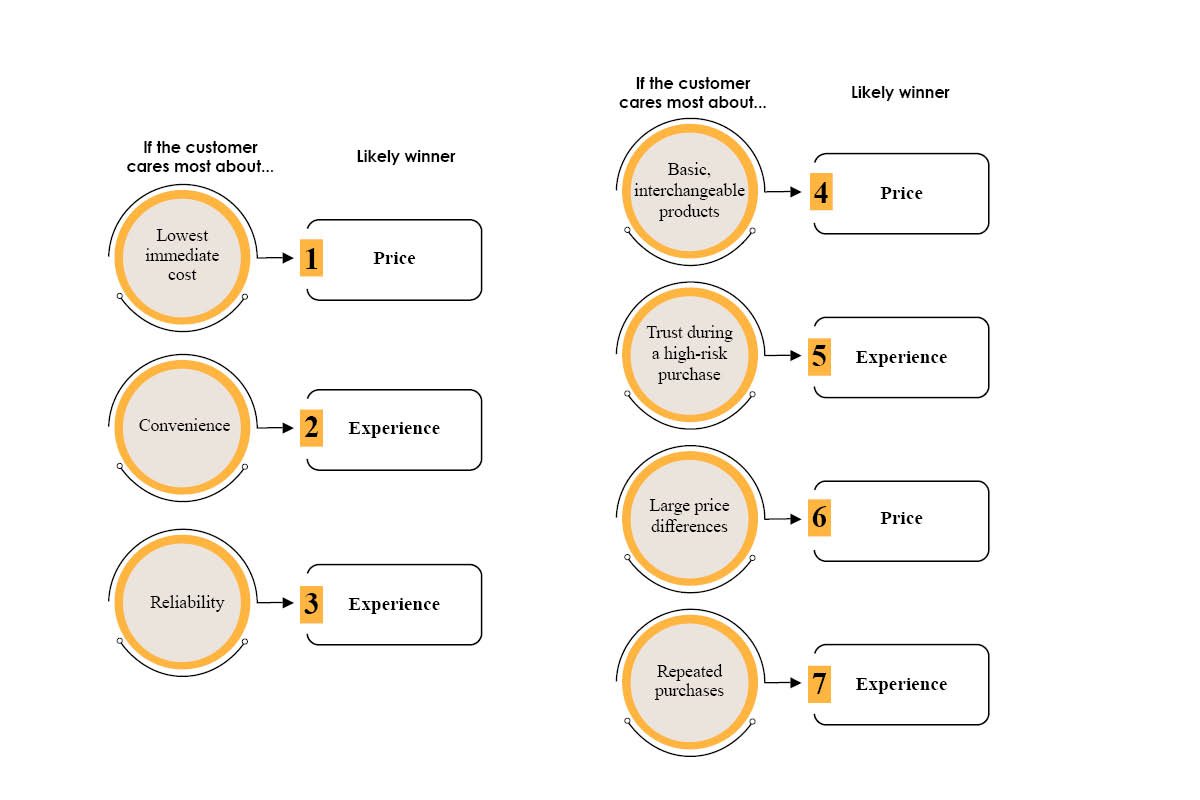
Price vs customer experience ultimately depends on what customers value most.
| If the customer cares most about… | Likely winner |
| Lowest immediate cost | Price |
| Convenience | Experience |
| Reliability | Experience |
| Basic, interchangeable products | Price |
| Trust during a high-risk purchase | Experience |
| Large price differences | Price |
| Repeated purchases | Experience |
The pattern here matters more than any single row. Customers rarely pick the cheapest option available. They pick the option that feels worth the money, and that judgment shifts case by case.
B2B research backs this up. Buyers making business purchases often weigh cost against the quality of the entire interaction, from the first sales call to later. A vendor with a slightly higher quote can still win the contract if the buying process feels smoother and more trustworthy. This shows why calling customer experience “more important” than price is conditional, not absolute. The winner depends entirely on what the buyer values most in that specific decision.
The hidden price of going cheap

The cheapest price tag rarely tells the whole story.
What the receipt shows: a lower number, a quick win, a good deal.
What happens after:
- Slow support eats up the customer’s time.
- Poor communication builds quiet frustration.
- Difficult returns turn a bargain into a headache.
- A disappointing interaction sends buyers straight to a competitor.
- Poor service spreads through word of mouth, reaching people who never even shopped with the brand.
SmartSurvey’s research on poor customer interactions makes the pattern clear. Businesses that cut corners on support often pay for it later, through refunds, lost repeat buyers, and damaged reputation. A weak customer experience carries a cost that never appears on the original invoice, and by the time it shows up, the “savings” are already gone.
So, which one actually wins?
The price vs customer experience debate comes down to three simple truths.
Price wins when products look alike, budgets stay tight, or the price gap is too large to ignore.
Experience wins when buyers value convenience, trust, quick responses, or support that lasts past the sale.
The strongest position sits between both. A business needs a price customers can accept, paired with a customer experience that makes that price feel worth paying. Neither element works well alone.
Over time, experience tends to hold more weight. It builds loyalty, earns repeat business, and turns buyers into people who recommend the brand without being asked. Still, no amount of polish saves a price that feels unreasonable. Get the price fair, and experience decides everything after that.
Final verdict: customers buy value, not just a number

Price answers one question: “How much will I pay?” Experience answers another: “What will this purchase feel like?”
Businesses chasing sales often stop there, but a sharper question decides the outcome: “Why should this customer believe the price is worth paying?”
That question is where the whole debate settles. The cheapest offer can still win a single sale, no argument there. But a strong customer experience gives buyers a reason to return, to trust the next purchase, and to choose the same brand without shopping around again.
In the end, customers are not counting coins alone. They are deciding what those coins actually buy them, and that decision rarely stops at the price tag.