


A commerce career can lead to much more than an entry-level accounting role. When exploring the highest-paying jobs in commerce in India, consider not only salary potential but also the qualifications, experience, career progression, and skills required for each role.
A Chartered Accountant may help a business manage tax, reporting, and financial controls. An investment banker may advise on acquisitions or fundraising, while a data analyst can turn sales and customer data into decisions that improve business performance. These careers use different strengths and offer different routes to growth.
This guide compares 15 commerce-related career options in India, including indicative salary ranges, common qualifications, responsibilities, and experience levels. It also covers pathways after Class 12, B.Com, CA, CFA, and MBA so students can assess the fit, cost, and commitment of each route rather than choosing on salary alone.
Quick salary comparison: highest-paying commerce jobs in India
The following table compares the estimated annual salaries, experience levels, and qualifications associated with the highest-paying jobs in commerce in India in 2026. These are broad planning ranges, not a single-source salary survey. Actual compensation varies by employer, city, qualifications, performance, and industry. When comparing the highest-paying jobs in commerce, remember that senior-level salary ranges generally reflect experienced professionals rather than typical entry-level outcomes.
| Job title | Entry-level (0–3 years) | Mid-level (3–7 years) | Senior-level (7–10+ years) | Common qualification |
| Chartered Accountant (CA) | ₹6–12 LPA | ₹12–25 LPA | ₹25–40+ LPA | CA |
| Investment Banker | ₹8–15 LPA | ₹20–35 LPA | ₹35–60+ LPA | Finance degree; MBA or CFA may help |
| CFA-related Finance Professional | ₹6–12 LPA | ₹12–25 LPA | ₹25–40+ LPA | CFA qualification or progress towards it |
| Management Consultant | ₹8–15 LPA | ₹18–35 LPA | ₹30–50+ LPA | MBA or relevant degree and experience |
| Actuary | ₹6–12 LPA | ₹12–25 LPA | ₹25–40+ LPA | Actuarial examinations and relevant experience |
| Company Secretary (CS) | ₹5–10 LPA | ₹10–20 LPA | ₹20–30+ LPA | CS qualification |
| Marketing Manager | ₹5–10 LPA | ₹10–20 LPA | ₹20–30+ LPA | Degree; MBA may help |
| E-commerce Manager | ₹5–10 LPA | ₹10–20 LPA | ₹20–30+ LPA | Business, commerce, or digital experience |
| Financial Planner | ₹4–8 LPA | ₹8–15 LPA | ₹15–30+ LPA | Finance degree; relevant certifications |
| Stock Market Analyst | ₹5–10 LPA | ₹10–25 LPA | ₹20–35+ LPA | Finance, economics, or related degree |
| Fintech Analyst | ₹5–10 LPA | ₹10–20 LPA | ₹20–35+ LPA | Finance, commerce, or technology skills |
| Business Analyst | ₹5–10 LPA | ₹8–16 LPA | ₹15–25+ LPA | Commerce, business, economics, or analytics |
| Data Analyst | ₹4–8 LPA | ₹8–16 LPA | ₹16–28+ LPA | Relevant degree and analytical skills |
| Risk and Compliance Analyst | ₹4–8 LPA | ₹8–16 LPA | ₹16–30+ LPA | Finance, accounting, law, or risk specialisation |
| ESG/Sustainability Analyst | ₹4–8 LPA | ₹8–16 LPA | ₹16–30+ LPA | Commerce, finance, sustainability, or related field |
How to read the figures: LPA means lakh per annum. Salary estimates for the highest-paying jobs in commerce reflect annual gross pay and may exclude bonuses, commissions, stock awards, and other benefits. Some specialist employers offer substantially more, while smaller firms and entry-level positions may pay less. Salaries across the highest-paying jobs in commerce also vary by experience, location, qualifications, and employer. The ranges for newer or less standardised job titles depend particularly on the role’s responsibilities and the organisation.
For a useful real-world benchmark, the Institute of Chartered Accountants of India reported a highest domestic salary offer of ₹32.33 LPA in its December 2025–January 2026 campus placement programme. This is the highest reported offer, not the average salary of newly qualified CAs. ICAI campus placement information.
Top 15 highest-paying jobs in commerce
1. Chartered accountant (CA)

Chartered Accountancy is one of the career paths to consider when exploring the highest-paying jobs in commerce, particularly for students interested in accounting, taxation, auditing, and financial decision-making. CAs help businesses understand their financial position, meet regulatory obligations, manage tax exposure, and strengthen internal controls.
- Business perspective: A CA can help a company identify unnecessary expenditure, improve cash-flow planning, detect financial irregularities, and make better investment decisions. As professionals gain experience, they may move into financial controller, finance director, chief financial officer, or consulting roles.
- Qualifications: Candidates must complete the prescribed CA pathway through the Institute of Chartered Accountants of India (ICAI), including the applicable examinations, practical training, and other requirements.
- Salary outlook: Earnings depend on qualification, industry, location, employer, and specialisation. Financial services, consulting, large corporations, and specialised advisory roles may offer different compensation levels. ICAI’s campus placement figures are a useful benchmark for selected newly qualified candidates, but should not be treated as a market-wide average.
2. Investment banker
Investment bankers advise companies, governments, and other organisations on major financial transactions. These responsibilities make investment banking one of the career options worth evaluating among the highest-paying jobs in commerce, particularly for those interested in mergers and acquisitions, fundraising, and capital markets. These responsibilities invest banking one of the highest-paying jobs in commerce for professionals with the right skills and experience.
- Business perspective: Their analysis helps a business assess how much it should pay for an acquisition, how to raise capital, and whether a proposed transaction makes financial sense. The role often involves detailed valuation models, market research, financial presentations, and demanding deadlines.
- Qualifications: A degree in commerce, finance, economics, or a related field can provide a starting point. An MBA from a competitive programme may improve access to some positions. A CFA qualification can strengthen financial analysis knowledge, but is not compulsory for every investment banking role.
- Salary outlook: Compensation varies considerably between investment banking divisions, firms, cities, and seniority levels. Bonuses can make total compensation very different from fixed salary, so candidates should compare the two separately.
3. CFA-qualified finance professional
The Chartered Financial Analyst (CFA) qualification is relevant to professionals interested in investment research, portfolio management, equity analysis, and institutional finance. Although the CFA charter is not a job title by itself, it can support access to specialised finance careers when evaluating the highest-paying jobs in commerce.
- Business perspective: CFA-related skills help professionals evaluate securities, assess risk and return, analyse company performance, and support investment decisions. These capabilities can be useful to asset managers, banks, investment research teams, and wealth management firms.
- Qualifications: The CFA Program has examination, practical-skills, and membership requirements. Candidates should check the current eligibility and charter requirements directly with the CFA Institute.
- 2026 insight: CFA Institute’s India impact assessment, based on 2,770 respondents including charterholders and programme candidates, reported average annual compensation of ₹22.1 lakh in 2026, compared with ₹19.3 lakh in 2022. More than 70% of charterholders with over eight years of experience typically earned above ₹40 lakh annually. These findings describe the study’s respondents, not all finance professionals or all CFA candidates. Read the CFA Institute India assessment.
4. Management consultant

Management consultants help organisations solve business problems, improve operations, assess growth opportunities, and implement strategic changes. These responsibilities make management consulting a potential choice among the highest-paying jobs in commerce for professionals interested in cost reduction, market entry, organisational restructuring, and digital transformation. As a result, management consulting can be one of the highest-paying jobs in commerce, particularly at leading strategy consulting firms.
- Business perspective: A consultant might help a retailer improve store profitability, help a manufacturer reduce supply-chain costs, or help a bank redesign a customer service process. The value of the work depends on whether the recommendations lead to measurable improvements.
- Qualifications: A degree in commerce, economics, engineering, or another relevant field can be a starting point. An MBA may be valuable for some consulting firms and strategy roles, but it is not essential for every position. Strong analytical thinking, presentation, and problem-solving skills are critical.
- Salary outlook: Compensation can be higher at certain strategy consulting firms and for professionals with specialised industry knowledge. However, consulting salaries differ widely by firm, role, and level, and should not be generalised from the highest-paying employers.
5. Actuary
Actuaries use mathematics, statistics, probability, and financial modelling to evaluate uncertainty. They commonly work in insurance, pensions, employee benefits, investment risk, and other areas where organisations need to estimate future financial outcomes.
- Business perspective: An actuary can help an insurer price policies, estimate future claims, assess capital requirements, and evaluate the financial effect of changing risks. Their work supports pricing decisions, financial stability, and long-term planning.
- Qualifications: Candidates generally progress through professional actuarial examinations and relevant work experience. The Institute of Actuaries of India sets the professional education pathway. Under its Education Policy 2026, the revised framework is being implemented in phases through 2028. The Institute states that the Associate pathway requires passing or obtaining exemptions in 10 subjects, while Fellowship includes additional specialist examinations, a seminar, and relevant work experience. Candidates should review the current rules before planning their route. Institute of Actuaries of India: Education Policy 2026.
- Salary outlook: Progression depends heavily on examination progress, technical expertise, and the ability to apply models to business decisions. It is a demanding route, but it can suit students who enjoy quantitative problem-solving.
6. Company secretary (CS)
A Company Secretary supports corporate governance, regulatory compliance, board processes, and statutory reporting. It is also a career option to consider when exploring the highest-paying jobs in commerce, particularly for professionals interested in corporate law, compliance, and board-level advisory roles.
- Business perspective: Good governance helps a company make documented decisions, maintain accurate statutory records, meet filing deadlines, and reduce the risk of penalties or disputes. At senior levels, company secretaries may advise boards and management on governance practices.
- Qualifications: The Company Secretary qualification is offered through the Institute of Company Secretaries of India (ICSI). Students should consult the ICSI website for the applicable entry route, examinations, training, and membership requirements.
- Salary outlook: Earnings vary by company size, sector, experience, and whether the position includes senior governance responsibilities. Listed companies and large corporate groups may have different requirements from smaller businesses.
7. Marketing manager
Marketing managers plan campaigns, manage brand positioning, study customer behaviour, and help generate demand for products or services. Their work can cover digital marketing, brand management, market research, pricing, and customer acquisition.
- Business perspective: Marketing is not only about visibility. Effective marketing can improve customer acquisition, strengthen retention, support product launches, and increase revenue. Employers value professionals who connect campaign performance with business outcomes.
- Qualifications: A commerce or business degree can be useful. An MBA in marketing may help with some management-track positions, but relevant experience and measurable campaign results can also be important.
- Skills to build: Market research, customer segmentation, digital analytics, budgeting, communication, and return-on-investment measurement.
- Salary outlook: Pay depends on the size of the business, the marketing budget managed, the channels handled, and the results delivered. Senior roles may include performance-linked incentives.
8. E-commerce manager

E-commerce managers oversee online sales channels, digital storefronts, product listings, promotions, customer experience, and sales performance. As online retail continues to grow, this role can be a career option for commerce graduates exploring the highest-paying jobs in commerce, particularly those interested in digital business and online sales strategy.
- Business perspective: Their decisions can affect conversion rates, average order value, inventory availability, returns, and customer retention. For example, improving product descriptions or checkout design can help reduce abandoned purchases and increase completed orders.
- Qualifications: A degree in commerce, business, marketing, or a related field can be relevant. Practical knowledge of e-commerce platforms, digital advertising, analytics, and inventory systems can be equally important.
- Skills to build: Sales forecasting, product performance analysis, marketplace operations, customer journey analysis, and campaign budgeting.
- Salary outlook: Compensation varies according to the size of the online business, sales responsibility, team size, and whether the role covers strategy as well as day-to-day operations.
9. Financial planner
Financial planners help individuals and families organise their finances, set goals, plan investments, manage risks, and prepare for milestones such as education, home ownership, or retirement.
- Business perspective: Financial planning connects present income and expenditure with future financial commitments. A planner may help clients establish an emergency fund, review insurance needs, structure investments, and understand the trade-offs between risk and potential returns.
- Qualifications: A degree in commerce, finance, or economics may provide a foundation. Relevant certifications can strengthen professional credibility. In India, anyone providing regulated investment advice must understand and comply with the applicable Securities and Exchange Board of India (SEBI) requirements. Certification alone does not automatically authorise every form of financial advice.
- Skills to build: Financial analysis, client communication, risk profiling, ethical judgement, and long-term planning.
- Salary outlook: Income can vary significantly between salaried planners, fee-based practices, and commission-linked roles. Candidates should understand how a role is paid and what regulatory obligations apply before entering the field.
10. Stock market analyst
Stock market analysts study listed companies, financial statements, industry trends, economic indicators, and market developments to assess securities and investment opportunities. For commerce graduates interested in financial markets, this role can be worth considering when evaluating the highest-paying jobs in commerce, especially in investment research and portfolio management.
- Business perspective: Their research can help investors compare companies, understand valuation, assess financial risks, and make informed capital allocation decisions. Within an organisation, analysts may also support portfolio reviews and investment strategy.
- Qualifications: A degree in finance, commerce, economics, or a related discipline is useful. The CFA Program may support investment research skills. In India, research activities covered by SEBI’s rules may require registration and compliance with the relevant framework, so candidates should check the requirements for the specific role.
- Skills to build: Financial statement analysis, valuation, spreadsheet modelling, research writing, and the ability to explain assumptions clearly.
- Salary outlook: Earnings depend on the employer, research coverage, experience, and responsibilities. Roles in institutional research and investment management may have different pay structures from entry-level research positions.
11. Fintech analyst
Fintech analysts work at the intersection of finance, business operations, and technology. They may support digital payments, lending platforms, banking products, financial applications, or technology-led investment services.
- Business perspective: A fintech analyst might study why customers abandon a digital loan application, identify patterns in payment failures, or help evaluate a new product feature. The role connects financial services knowledge with customer behaviour, operational performance, and product decisions.
- Qualifications: Commerce, finance, economics, business, or technology degrees may be relevant, depending on the role. Knowledge of spreadsheets, SQL, dashboards, financial products, and data interpretation can improve employability.
- Skills to build: Process analysis, data literacy, product metrics, customer journey mapping, and risk awareness.
- Salary outlook: Pay varies according to the employer’s size, the technical demands of the role, and whether the position focuses on operations, product analytics, credit, or financial modelling. The term “fintech analyst” covers several different jobs, so candidates should compare actual responsibilities rather than job titles alone.
12. Business Analyst

Business analysts help organisations understand problems, define requirements, assess processes, and recommend changes. For commerce graduates who enjoy problem-solving and data-driven decision-making, this role is worth considering among the highest-paying jobs in commerce, particularly in technology, consulting, and financial services.
- Business perspective: A business analyst might identify why a company’s order processing takes too long, translate customer requirements into system changes, or help management assess the likely benefits of a new software platform. Their contribution is often measured through improved processes, lower costs, and better decision-making.
- Qualifications: A B.Com, BBA, economics degree, or another relevant qualification can be a starting point. Some roles require technical knowledge, while others focus more on business processes and stakeholder communication. An MBA can be advantageous for selected roles but is not universally necessary.
- Skills to build: Requirements gathering, process mapping, Excel, SQL, dashboard tools, documentation, and stakeholder management.
- Salary outlook: Salary depends on industry, location, experience, and whether the role is business-focused, technology-focused, or highly specialised. Candidates should examine the actual job description because titles and salary bands vary between employers.
13. Data analyst
Data analysts collect, clean, interpret, and present data to help organisations make better decisions. Commerce graduates may work in sales analytics, financial reporting, customer insights, operations, or business performance analysis.
- Business perspective: A data analyst can help a company understand which products generate the strongest margins, where customers drop out of a sales funnel, or which branches are underperforming. The work is valuable when it leads to an action, not simply when it produces a dashboard.
- Qualifications: A commerce degree can provide useful business context, but candidates generally need practical analytical skills. Excel, SQL, data visualisation, statistics, and basic programming can be useful depending on the role.
- Skills to build: Data cleaning, trend analysis, visualisation, clear reporting, and the ability to explain findings to non-technical teams.
- Salary outlook: Entry-level pay depends on technical capability and the type of analysis required. Professionals who combine data skills with finance, retail, supply-chain, or customer knowledge may qualify for more specialised roles over time.
14. Risk and compliance analyst
Risk and compliance analysts help organisations identify financial, operational, regulatory, and other business risks. They may work in banking, insurance, fintech, consulting, or large corporate compliance teams.
- Business perspective: Their work can help a lender detect suspicious transactions, assess credit exposure, monitor regulatory obligations, or reduce the chance of financial losses and penalties. Strong risk management protects business continuity and supports responsible growth.
- Qualifications: Commerce, accounting, finance, economics, law, and risk-related qualifications may be suitable, depending on the role. Additional certifications can be helpful where an employer requires specialised knowledge, but they should be selected based on the job’s actual responsibilities.
- Skills to build: Risk assessment, documentation, internal controls, regulatory research, data analysis, and professional judgement.
- Salary outlook: Compensation varies with the complexity of the risks handled, regulatory requirements, sector, and seniority. Specialised roles in financial services may have different salary structures from general corporate compliance positions.
15. ESG and sustainability analyst

Environmental, social, and governance (ESG) analysts help organisations assess sustainability-related risks, gather relevant information, monitor performance, and support disclosures or business decisions. For commerce graduates interested in sustainability and finance, ESG analysis is an emerging career option to consider when exploring the highest-paying jobs in commerce, particularly in consulting, investment research, and risk management.
- Business perspective: ESG analysis can help a company understand exposure to climate-related risks, supplier practices, resource use, governance issues, and investor expectations. Depending on the role, analysts may support sustainability reporting, data collection, risk assessment, or evaluation of business practices.
- Qualifications: Commerce, finance, economics, environmental studies, and related degrees may be relevant. Knowledge of accounting, reporting frameworks, data analysis, and sector-specific risks can help candidates build a credible profile.
- Skills to build: Data verification, reporting, risk analysis, research, communication, and the ability to connect sustainability indicators with business performance.
- Salary outlook: This is a varied job category, and pay depends on whether the role focuses on reporting, consulting, risk, investment analysis, or sustainability strategy. Because job titles and responsibilities differ, candidates should review current vacancies before relying on a single salary estimate.
High-paying career paths for commerce students after Class 12
Students do not need to choose a final job title immediately after Class 12. A better first step is to select a qualification that opens the right pathways.
| Career direction | Possible starting route after Class 12 | What to consider |
| Chartered Accountancy | Begin the applicable ICAI entry route | Suitable for students interested in accounting, audit, tax, and finance |
| Company Secretary | Check the current ICSI entry pathway | Suits students interested in corporate law and governance |
| Actuarial profession | Review IAI eligibility and examination requirements | Requires strong mathematical and analytical ability |
| Investment banking | B.Com, BBA, economics, or finance degree; later specialise | Internships, modelling skills, and employer selection matter |
| Management consulting | Relevant undergraduate degree; gain analytical experience | An MBA can help for some firms and roles |
| Business or data analytics | Commerce or business degree plus technical skills | Build Excel, SQL, statistics, and dashboard experience |
Important: Many of the highest-paying jobs in commerce require further study, professional examinations, relevant work experience, or a combination of these. Completing Class 12 does not automatically qualify someone for a senior-level role.
Students should compare course cost, examination difficulty, training requirements, and the time needed to qualify. A profession that fits a student’s strengths may offer a more sustainable route to higher earnings than choosing a course solely because its top salaries appear attractive.
Best-paying careers after B.Com, CA, CFA, or MBA
A qualification can create opportunities, but it does not guarantee a particular job or salary. The next step depends on the skills and experience a candidate develops.
- After B.Com: Consider accounting, financial operations, business analysis, data analysis, banking, taxation support, or entry-level research roles. Build practical skills through internships and projects.
- After CA: Explore audit, taxation, financial reporting, corporate finance, risk, transaction advisory, and finance leadership pathways. Specialisation and industry experience can influence progression.
- After or during the CFA Program: Consider investment research, asset management, portfolio analysis, equity research, and related finance roles, subject to employer requirements and the applicable professional rules.
- After an MBA: Roles may include management consulting, corporate strategy, marketing management, financial services, business operations, and product-related positions. The relevance of the institution, specialisation, prior experience, and recruiting employer all matter.
The practical lesson is to choose the qualification that matches the work you want to do. An MBA is not essential for every business analyst role, and a CFA charter is not a universal requirement for every finance job. Conversely, regulated professions have specific qualification and registration requirements that cannot be replaced by short courses.
Emerging commerce careers to watch in 2026
The highest-paying jobs in commerce now extend beyond traditional accounting and banking. Businesses increasingly seek professionals who can combine financial knowledge with technology, data analysis, regulatory compliance, and strategic decision-making. This creates career opportunities for commerce graduates across finance, consulting, digital business, and emerging fields such as ESG analysis.
| Career | Why businesses hire for it | Useful skills |
| Fintech analyst | To improve digital financial products, payments, lending, and customer experience | Finance knowledge, data analysis, product metrics |
| Business analyst | To improve processes and translate business needs into practical changes | Requirements gathering, process mapping, communication |
| Data analyst | To interpret performance data and support evidence-based decisions | Excel, SQL, statistics, visualisation |
| Risk and compliance analyst | To manage regulatory obligations, financial exposure, and operational risk | Risk assessment, documentation, controls |
| ESG/sustainability analyst | To assess sustainability-related information, risks, and disclosures | Reporting, research, data quality, risk analysis |
These roles should be treated as career options to investigate, not as a guaranteed list of the fastest-growing or highest-paying jobs. Hiring demand and compensation depend on sector, employer, location, and the candidate’s capabilities. Review current vacancies and employer requirements before investing in a specialisation.
How to increase your earning potential in commerce?
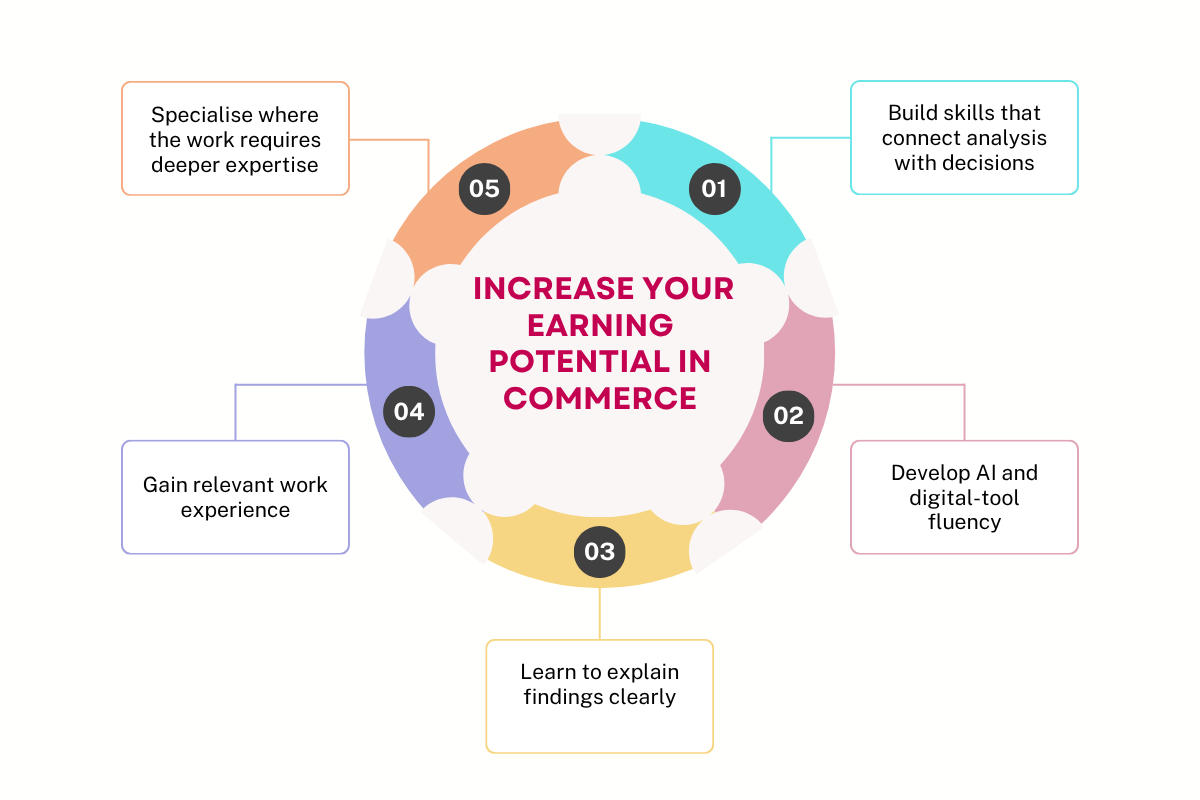
A qualification can open doors, but building the right skills and applying them effectively can help professionals progress towards the highest-paying jobs in commerce.
1. Build skills that connect analysis with decisions.
Financial modelling, data analysis, budgeting, forecasting, and risk assessment can help professionals move beyond reporting what happened to explaining what a business should do next. Learn the tools relevant to the target role rather than collecting software certificates without practical application.
2. Develop AI and digital-tool fluency.
AI-enabled tools can support research, summarisation, spreadsheet work, and routine analysis. Professionals still need to validate outputs, protect confidential information, check calculations, and exercise judgement. Employers benefit most when technology improves the quality or speed of work without weakening accuracy or accountability.
3. Learn to explain findings clearly.
A strong analysis has limited business value if decision-makers cannot understand it. Practise presenting findings, documenting assumptions, explaining risks, and communicating recommendations to colleagues who may not have a finance or technical background.
4. Gain relevant work experience.
Internships, live projects, practical case studies, and entry-level responsibilities help candidates demonstrate that they can apply their knowledge. Experience also helps professionals understand the commercial realities behind textbook concepts.
5. Specialise where the work requires deeper expertise.
Specialisation can help distinguish a candidate, especially in areas such as valuation, taxation, actuarial analysis, regulatory compliance, financial planning, or data analytics. Choose a specialisation based on real job requirements and long-term interest.
What determines salary growth in commerce careers?
Salary progression is rarely determined by a degree or certification alone. Several factors influence how much an employer may be willing to pay.
| Industry | Financial services, consulting, technology, and large corporate groups can have different compensation structures from smaller organisations. |
| Location | Salary levels may differ across Mumbai, Bengaluru, Delhi NCR, Hyderabad, Pune, Chennai, and other markets. Higher nominal pay may also come with higher living costs. |
| Experience and responsibility | Professionals who manage larger budgets, complex projects, clients, teams, or business-critical decisions may qualify for higher pay. |
| Technical skills | Modelling, analytics, regulatory knowledge, and specialised tools can be valuable when they directly support the job. |
| Employer and role | A finance analyst at an investment firm may have a different compensation structure from an analyst at a small business, even if the job titles sound similar. |
| Performance-linked pay | Bonuses, commissions, incentives, and stock awards can affect total compensation. They should be distinguished from fixed salary. |
| Professional credibility | Qualifications and relevant experience can help demonstrate competence, particularly in fields with formal examination or regulatory requirements. |
When comparing job offers, review fixed pay, variable pay, benefits, working hours, learning opportunities, and promotion pathways. The highest advertised package is not always the best overall career choice.
Conclusion:
Commerce offers several career paths, from chartered accountancy and investment banking to business analytics, actuarial science, and fintech. While the highest-paying jobs in commerce can offer strong earning potential, salary alone should not determine the right career choice.
Start by identifying the work you enjoy, the qualifications required, and the skills employers expect. Compare realistic entry-level opportunities, the cost and duration of further study, and the responsibilities that support career progression. The strongest long-term choice combines marketable skills, practical experience, professional credibility, and a clear understanding of how your work contributes to business performance.
FAQs:
1. Which is the highest-paying job in commerce in India?
Investment banking, management consulting, actuarial work, and senior finance roles can offer high salaries. The highest-paying jobs in commerce depend on experience, employer, location, and skills.
2. Which commerce career is best after Class 12?
CA, CS, actuarial studies, and degrees in finance, business, or analytics are popular options. Choose based on your interests and strengths.
3. Can commerce students earn ₹20 lakh per year?
Yes, experienced professionals in specialised or senior roles can earn ₹20 lakh or more annually, but this is not guaranteed.
4. Is CA better than CFA for salary?
Neither guarantees a higher salary. CA focuses on accounting, audit, and taxation, while CFA focuses on investment analysis and portfolio management.
5. Is an MBA necessary for a high-paying commerce job?
No. An MBA helps in some management and consulting roles, but many careers value specialised qualifications, practical skills, and experience. Compare the highest-paying jobs in commerce based on your career goals.