

Choosing the best investment apps in India is a financial decision, not just a technology preference. A platform with low brokerage may suit a long-term stock investor, while someone investing monthly through mutual fund SIPs may benefit more from goal tracking, fund comparisons, and automated payments.
The best investment apps in India should match an investor’s financial goals, experience, preferred investment products, and budget. They should also disclose their charges clearly and provide access to regulated investment services. A simple interface is useful, but it cannot replace sound financial planning or protect an investor from market losses.
This comparison examines 10 investment apps available to Indian investors in 2026. It covers their main use cases, key features, potential costs, and limitations. If you are looking for the best investment apps in India, use these comparisons to shortlist platforms rather than treating the ranking as a universal recommendation. The goal isn’t to declare one app the winner for everyone, but to help investors choose a platform that supports their financial decisions.
Top 10 investment apps in India: compare features, fees, and benefits
| Investment app | Best suited for | Main investment focus | Cost considerations |
| 1. Zerodha Kite | Long-term stock investors and active traders | Stocks, ETFs, derivatives, and mutual funds through its investment ecosystem | Zero brokerage on equity delivery; other trading and account-related charges may apply |
| 2. Groww | Beginners and multi-product investors | Stocks, mutual funds, ETFs and IPOs | Account opening and AMC are listed at ₹0; brokerage and statutory charges apply to eligible trades |
| 3. Upstox | Cost-conscious traders | Stocks, derivatives, mutual funds and IPOs | Brokerage varies by transaction type; AMC may apply after promotional periods |
| 4. Angel One | Investors seeking research and trading tools | Stocks, derivatives, mutual funds and other supported products | Brokerage, AMC and statutory charges depend on the service used |
| 5. ET Money | Mutual fund and goal-based investors | Direct mutual funds, SIPs and personal finance tools | Check scheme expenses and any applicable product-specific fees |
| 6. Millions | Investors looking for multiple investment options in one app | Stocks, mutual funds, SIPs, ETFs and other listed products | Verify the current brokerage schedule and charges for each product |
| 7. Dhan | Active traders and market-focused investors | Stocks, ETFs, derivatives, mutual funds and trading tools | Zero brokerage on equity delivery is advertised; intraday and derivatives have separate charges |
| 8. INDmoney | Investors tracking multiple financial products | Indian stocks, mutual funds and other supported financial products | Brokerage and product-specific costs vary; check the latest tariff |
| 9. Paytm Money | Digital-first investors | Stocks, mutual funds and other available investment products | Check current brokerage, AMC and product-specific charges |
| 10. 5paisa | Investors comparing discount-broker services | Stocks, derivatives, mutual funds and other supported products | Review the applicable brokerage plan, AMC, and additional charges |
10 best investment apps in India for 2026: features and charges
1. Zerodha Kite: best for stock investors and active traders
Zerodha Kite is a strong option for investors who want a trading-focused interface, charting tools, and access to listed securities. Its broader ecosystem includes educational resources through Varsity and mutual fund investing through Coin.
Key features
- Stock trading, ETFs, and supported derivatives.
- Charting, watchlists, and market-monitoring tools.
- Access to direct mutual funds through Coin.
Business perspective: For an investor building a long-term equity portfolio, zero brokerage on eligible equity delivery transactions can help reduce one part of the transaction cost. For this type of investor, the best investment apps in India for stock trading are those that combine suitable investment access with transparent charges and useful portfolio tools. However, investors must still account for statutory charges, depository participant fees on applicable transactions, and other account-related expenses.
Potential limitation: The platform may feel more technical to a first-time investor who wants extensive hand-holding or a highly guided financial planning experience.
Best suited for: Investors who understand basic market concepts and want to manage stock investments with research and charting tools.
2. Groww: Best for beginners and multi-product investing

Groww offers a relatively straightforward interface for investors who want to manage different investments through one app. Its supported products include stocks, mutual funds, ETFs, and IPO applications, subject to current availability and eligibility.
Key features
- A beginner-friendly interface for exploring investments.
- Access to stocks and mutual funds.
- SIP options for regular mutual fund investing.
Business perspective: Investors who are starting with small amounts may value a platform that makes it easier to understand their holdings and monitor investments. Groww lists account opening and annual maintenance charges at ₹0, while its published stock brokerage schedule includes a charge of ₹20 or 0.1% per executed order, whichever is lower, subject to a minimum charge and applicable terms.
A zero account maintenance fee does not mean every transaction is free. Brokerage, taxes, statutory levies and depository charges may still apply.
Potential limitation: Investors who need advanced trading features or personalised financial advice should assess whether the platform provides the depth of tools and support they require.
Best suited for: New investors and people who want a single interface for stocks, mutual funds, and related investment activities. Beginners comparing the best investment apps in India should also check how clearly the platform explains orders, holdings, and charges.
3. Upstox: Best for cost-conscious traders
Upstox provides online trading and investment services for users who want access to multiple market segments. Its platform supports stock trading, derivatives, and other investment products, including mutual funds and IPOs where available.
Key features
- Access to stocks and supported derivatives.
- Trading tools and market information.
- Mutual fund and IPO-related features.
Business perspective: Active investors should compare the cost per executed order and the quality of trading tools rather than choosing a broker based only on an advertised maximum brokerage fee. The best investment apps in India for active traders may differ from the best investment apps for beginners or long-term investors. A small difference in transaction costs can matter more to a frequent trader than to someone who makes a few long-term investments each year.
Upstox advertises brokerage of up to ₹20 per order for relevant segments, while mutual fund and IPO services may have different fee structures. Eligible new customers may receive promotional account maintenance terms, so investors should confirm what applies after the promotional period.
Potential limitation: Investors need to understand the complete pricing schedule and should not assume every product has the same fee structure.
Best suited for: Investors and traders who want digital access to multiple market segments and are prepared to compare trading costs.
4. Angel One: Best for investors who value research tools
Angel One combines online trading with market information and research-oriented features. It may suit investors who want to review stocks and market movements while managing their investments through a single platform.
Key features
- Stock and derivatives trading.
- Market information and research tools.
- Access to additional investment products, subject to current availability.
Business perspective: Research tools can support a better decision-making process, but they do not guarantee that an investment will perform well. Research features alone do not make an app the best investment app in India; investors should assess the quality, limitations, and suitability of the information provided. Investors should evaluate the assumptions behind recommendations, compare them with their own research, and understand the risks before acting.
Angel One’s published brokerage schedule includes charges linked to transaction type and value. Investors should also check the applicable annual maintenance charge, statutory levies, and depository fees before comparing it with other platforms.
Potential limitation: Investors may need time to distinguish educational information, market commentary, and research recommendations from personalised financial advice.
Best suited for: Investors who want trading access and research-oriented features in one platform.
5. ET Money: Best for mutual fund and goal-based investors
ET Money is worth considering for investors whose primary objective is to build a mutual fund portfolio rather than trade stocks frequently. The platform provides mutual fund information, direct-plan investment options, and tools that can help users monitor their investments.
Key features
- Direct mutual fund investment options.
- SIP and lump-sum investment features.
- Mutual fund information and portfolio tracking.
Business perspective: For an investor contributing a fixed amount every month, consistency,
fund selection, and the total cost of ownership may matter more than advanced stock charts. For SIP-focused investors, the best SIP investment apps in India are those that make regular investing, mutual fund selection, and portfolio reviews straightforward. Comparing direct mutual fund plans can also help investors understand the difference between fund expenses and platform-related charges.
A direct plan does not mean a mutual fund has no cost. The scheme’s expense ratio, exit load where applicable, and taxes can affect the investor’s outcome.
Potential limitation: ET Money’s features vary by product, and investors seeking advanced stock trading capabilities should compare its current offering with dedicated stockbroking platforms.
Best suited for: Long-term investors who prioritise mutual funds, SIPs and portfolio monitoring.
6. Millions: Best for investors seeking multiple products in one app
Millions offers a range of investment products through its digital platform, including stocks, mutual funds, SIPs, and other market-linked options listed in its app information. Investors should confirm the exact availability of each product before opening an account.
Key features
- Stocks and ETF-related investment options.
- Mutual funds and SIP features.
- IPO-related access and other supported products.
Business perspective: A multi-product app can reduce the effort involved in managing different investments across separate platforms. Still, the best investment apps in India should make the provider behind each product and its applicable charges easy to verify. However, convenience should not be the only selection criterion. Investors should confirm which regulated entity provides each service, how their assets are held, and what fees apply to different transactions.
Millions’ published app information advertises features such as zero annual maintenance charges and specific brokerage terms for certain transactions. These claims should be checked against the latest official tariff and applicable conditions.
Potential limitation: Investors should pay particular attention to the identity of the regulated intermediary, the app’s verified status where available, and the full fee schedule.
Best suited for: Investors who prefer a consolidated interface and are willing to verify product terms before investing.
7. Dhan: Best for active traders and market-focused investors
Dhan focuses on trading and investing tools for users who want to monitor markets and manage different types of transactions. Its published offering includes stocks, ETFs, derivatives, and mutual fund investment options.
Key features
- Trading tools and charting features.
- Stocks, ETFs, and supported derivatives.
- Mutual fund investment options.
Business perspective: Active traders should evaluate execution tools, order management, risk controls, and the total cost of trading. These practical checks are more useful when comparing low-brokerage investment apps in India than relying on a promotional claim alone. Dhan advertises zero brokerage on equity delivery and a charge of ₹20 or 0.03% of trade value, whichever is lower, for eligible intraday and margin trading facility transactions. Derivatives have separate pricing terms.
A low brokerage charge does not make frequent trading automatically profitable. Trading decisions should account for volatility, transaction costs, and the possibility of losses.
Potential limitation: The platform’s trading-oriented features may be more than a passive investor needs. Investors should also understand the costs and risks of leveraged products before using them.
Best suited for: Experienced market participants and investors who want a trading-focused platform.
8. INDmoney: Best for investors managing multiple financial products
INDmoney offers access to several financial products, with its current range including Indian stocks, mutual funds, and other investment or savings products. The platform can appeal to investors who want to review multiple holdings through a single interface.
Key features
- Indian stock investing.
- Mutual fund access.
- Portfolio monitoring across supported products.
Business perspective: Consolidated portfolio tracking can help investors understand their overall allocation instead of reviewing each account separately. Investors seeking the best investment apps in India for portfolio tracking should check supported holdings, valuation updates, and the availability of consolidated financial reports. This can be useful when assessing concentration risk, monitoring financial goals, or reviewing how much of a portfolio is exposed to equities.
INDmoney publishes product-specific pricing. Investors should verify brokerage, account maintenance charges, and the costs associated with each additional product rather than assuming all services follow the same fee model.
Potential limitation: A broad set of features can create complexity. Investors should use only the products they understand and verify the regulatory status of the specific service they intend to use.
Best suited for: Investors who want to monitor different financial products from one digital platform.
9. Paytm Money: Best for digital-first investors comparing investment options
Paytm Money provides digital investment services, including products such as stocks and mutual funds, subject to its current offering. Investors familiar with app-based financial services may find the digital account and portfolio management process convenient.
Key features
- Digital access to supported investment products.
- Stock and mutual fund services, subject to availability.
- Online portfolio monitoring and account management.
Business perspective: An investor should evaluate Paytm Money on the same criteria as other platforms: the products available, applicable charges, research tools, ease of transferring or tracking holdings, and the quality of customer support. Familiarity with a digital interface should not replace due diligence.
Because prices and services can change, investors should consult the platform’s current pricing and disclosures before deciding whether it is more cost-effective than alternatives.
Potential limitation: The suitability of the platform depends on the investor’s specific needs and the current availability of the required products and features.
Best suited for: Digital-first investors comparing online access to stocks, mutual funds, and related services.
10. 5paisa: Best for investors comparing discount-broker services

5paisa offers online investment and trading services across supported market segments. It is an option for investors who want to compare brokerage plans, trading features, and access to different investment products.
Key features
- Stock and derivatives trading.
- Mutual fund and other investment services, subject to current availability.
- Digital account and portfolio management.
Business perspective: Investors comparing discount brokers should calculate their expected annual cost based on their actual behaviour. Someone making occasional delivery investments may have a very different cost profile from someone placing several intraday or derivatives orders each day.
Before opening an account, investors should examine the current brokerage plan, annual maintenance charges, depository fees, statutory levies, and any paid add-on services. They should also assess whether the app’s tools meet their needs without encouraging unnecessary trading.
Potential limitation: Pricing plans and features can change. Investors should use the current official tariff rather than relying on older comparisons or promotional claims.
Best suited for: Investors who want to compare discount-broker pricing and trading services.
Which investment app should you choose based on your needs?
The best investment app in India depends on your financial goals. Long-term investors may prefer low fees and easy portfolio tracking, while active traders may need advanced charts, quick order controls, and reliable market access.
| Investor type | Apps worth comparing | What matters most |
| First-time investor | Groww, Millets | Clear interface, transparent fees, and accessible learning resources |
| Long-term SIP investor | ET Money, Groww, Zerodha Coin | Direct mutual fund access, SIP management and fund-level costs |
| Long-term stock investor | Zerodha, Groww, Dhan | Equity delivery costs, portfolio tracking and research |
| Active trader | Zerodha, Upstox, Angel One, Dhan | Brokerage, order tools, risk controls and execution experience |
| Investor seeking research features | Angel One, Zerodha | Research quality, market information and analytical tools |
| Investor managing multiple products | INDmoney, Groww, Millions | Product availability, consolidated tracking and total costs |
These options are a starting point, not personal investment advice. Choose an app based on your goals, risk tolerance, and experience, and check its latest fees, features, and regulatory details. Even apps offering zero brokerage may have other charges, so compare the total cost before deciding.
| Charge | What it means | Why it matters |
| Account-opening fee | Cost of creating an eligible account | May be zero, but confirm the current terms |
| Annual maintenance charge (AMC) | Fee for maintaining a demat account | Can add to long-term costs even when trading is infrequent |
| Brokerage | Fee charged for executing certain transactions | Depends on the broker, product, and transaction type |
| Securities Transaction Tax (STT) | Statutory tax on specified securities transactions | Varies by transaction and instrument |
| Exchange transaction charges | Charges levied in connection with exchange transactions | Added to the total trading cost |
| GST | Tax on applicable services and charges | Applies to specified charge components |
| Stamp duty | Statutory duty on applicable transactions | Depends on the transaction type and applicable rules |
| Depository participant (DP) charges | Charges on specified demat-related transactions | May apply when securities are sold or transferred |
| Mutual fund expenses | Costs charged within the mutual fund scheme | Affect returns even when the platform charges no commission |
| Optional service fees | Fees for certain add-ons or special services | Can increase the total cost if used |
Business perspective: Consider two investors. One makes a few long-term investments every year, while the other trades frequently. The second investor may be more affected by brokerage and transaction-related charges, whereas the first may pay closer attention to annual account fees and mutual fund expenses. The cheapest platform on paper may not be the cheapest for both.
Before placing a transaction, compare investment app charges in India using each broker’s official calculator or pricing schedule. Review the contract note after execution to understand what was deducted.
How to choose the best investment app in India?
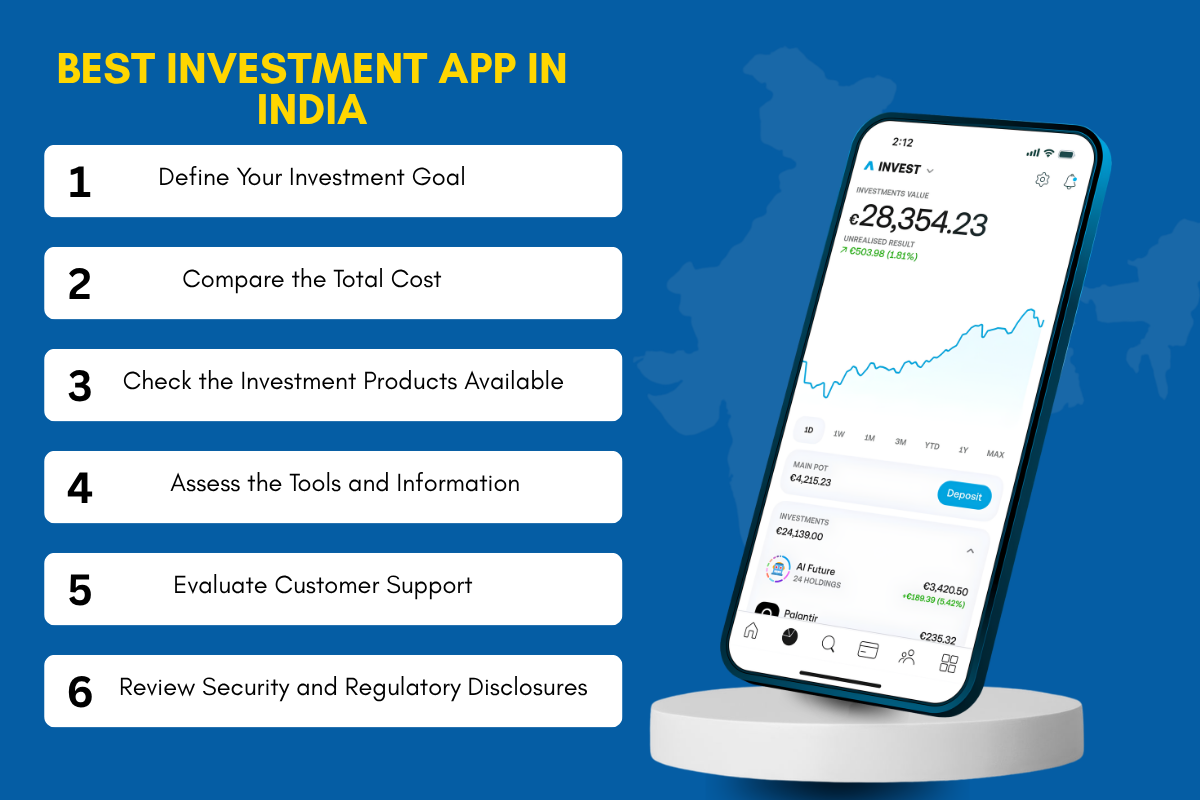
Use the following checklist to choose the best investment app in India before opening an account. These checks can help you decide whether a platform is genuinely suitable rather than simply popular among people searching for the best investment apps in India.
1. Define your investment goal
Decide whether you want to invest in direct mutual funds, build a stock portfolio, apply for IPOs, or trade actively. A platform should support your intended activity without pushing you towards products you do not understand.
2. Compare the total cost
Check account-opening fees, AMC, brokerage, statutory charges, and any product-specific costs. For mutual funds, compare direct plans and scheme expenses rather than looking only at the app’s fee.
3. Check the investment products available
Confirm that the app offers the stocks, funds, ETFs, or other products you need. Availability can differ by platform, account type, eligibility, and regulatory conditions.
4. Assess the tools and information
Review whether the app provides the tools you need, such as fund comparisons, portfolio tracking, charts, research reports, or educational material. More features are not automatically better if they make decisions harder.
5. Evaluate customer support
Check the available support channels, grievance process, and instructions for resolving account or transaction issues. A clear escalation process matters when an investor needs help with an order, payment, or account access.
6. Review security and regulatory disclosures
Verify the regulated entity behind the service, its relevant registration, and the app’s listing on official exchange or regulatory resources. Do not rely solely on advertisements, ratings, or recommendations from social media.
SEBI registration and investment app safety checks
Before transferring money or linking a bank account, investors should confirm that the app and the service provider are genuine. Safety checks are essential when comparing the best investment apps in India because a familiar brand name or polished interface does not prove that a platform is legitimate. This is particularly important because fraudulent apps can imitate legitimate brokers and use fake investment claims to attract deposits.
In March 2026, the Securities and Exchange Board of India (SEBI) introduced a Verified label on Google Play for stock trading apps offered by SEBI-registered brokers. The initiative is intended to help investors distinguish genuine apps from impersonators. Investors should still verify the regulated entity and the specific service they plan to use.
Before investing, follow these steps:
| Verify registration | Check the broker or intermediary using SEBI’s official recognised-intermediary resources. |
| Check authorised apps | Consult SEBI’s investor support page for links to exchange-maintained lists of authorised mobile apps. |
| Check the verified label. | Where applicable, look for the SEBI-related verified label on Google Play and confirm the developer’s identity. |
| Verify payment details | Use SEBI Check to verify relevant bank account details or UPI handles before transferring funds. |
| Avoid guaranteed-return claims | No genuine investment platform can guarantee market-linked returns. |
| Protect account access | Never share passwords, PINs, or OTPs. Avoid installing trading apps from unfamiliar links or files. |
| Review disclosures | Read the broker’s tariff sheet, risk disclosures, grievance process, and account terms. |
Official resources:
| SEBI Investor Support | https://investor.sebi.gov.in/Investor-support.html |
| SEBI Recognised Intermediaries | https://www.sebi.gov.in/sebiweb/other/OtherAction.do?doRecognised=yes&intmId=3 |
| SEBI Check | https://www.sebi.gov.in/redirect_sebi_check.html |
Pros and cons of using investment apps
| Advantages | Limitations |
| Convenient access to investment services | Easy access can encourage frequent, unnecessary trading |
| Easier monitoring of holdings and transactions | Features and fees differ across platforms |
| Digital account opening for eligible investors | Account opening still requires verification and documentation |
| Access to mutual funds, stocks, and other products through supported apps | Not every app offers every investment product |
| Tools for tracking investments and reviewing market information | Research tools cannot guarantee returns or remove market risk |
| Online records and transaction history | Investors must still protect their credentials and verify payment requests |
Conclusion:
There is no single best investment app in India for every investor because financial goals, experience, and preferred investment products vary. The best investment apps in India for a beginner may prioritise simplicity, while an experienced trader may care more about execution tools, pricing, and risk controls. Groww may appeal to beginners who value a straightforward interface, Zerodha and Dhan may suit investors who want trading tools, and ET Money may be worth comparing for mutual fund-focused investing. Upstox, Angel One, Millions, INDmoney, Paytm Money and 5paisa offer alternatives that should be assessed against the same criteria.
The business decision is to choose a platform that supports your financial goals at a transparent cost. Compare the full fee schedule, confirm product availability, check regulatory details, and understand the risks before investing. An app can make investing more convenient, but it cannot guarantee profits or replace a well-considered financial plan.
Frequently asked questions
1. Which investment app is best for beginners in India?
Groww and Millions are options to compare when searching for the best investment apps in India for beginners, particularly for ease of use, pricing transparency, and available investment options. Consider ease of use, transparent pricing, learning resources, and customer support.
2. How can investors verify whether an investment app is legitimate?
Check the provider’s SEBI registration, authorised-app lists, and verified Google Play label where applicable. Verify payment details and avoid apps promising guaranteed returns.
3. What charges should investors compare before choosing an app?
Compare brokerage, account maintenance fees, statutory charges, taxes, depository fees, and optional service costs. Mutual fund investors should also check expense ratios and exit loads.
4. Are zero-brokerage investment apps completely free?
No. Taxes, statutory charges, demat fees, account maintenance charges, and mutual fund expenses may still apply. Check the latest pricing schedule.
5. Can one investment app support every financial goal?
Not necessarily. Some apps focus on stocks, while others specialize in mutual funds or portfolio tracking. Compare the best investment apps in India based on your financial goals, preferred investment products, fees, and required services.
Thank You For Reading!
Know More
15 Best Trading Apps in India of 2026 Ranked by Serious Investors