

Why do some great startup ideas fail before they get started?
Imagine spending six months building an app and using your savings. You launch, only to learn customers do not want it.
What is a lean startup? It is a business approach that helps founders test ideas, learn from customers, and improve products through small experiments. They build a basic version, study how people respond, and use that evidence to decide what comes next.
Many ideas begin with guesses about real customer needs. Testing those guesses early can save time and money. This guide explains how to test ideas, measure learning, and make better decisions. The method reduces risk, but cannot promise success today.
What is a Lean Startup, and how does it work?
This approach tests its ideas before spending heavily on building and growth. Entrepreneur Eric Ries made the approach known through his 2011 book, The Lean Startup.
This approach draws on lean manufacturing, which aims to reduce waste, and customer development, which puts customer needs at the centre of business building. Instead of treating a business plan as fixed, founders treat it as ideas to test. They build a simple version, study customer responses, and improve it based on what they learn.
Imagine you want to start a healthy meal delivery service. Rather than opening a restaurant, you could:
- Speak with customers.
- Share a menu and test demand.
- Take a few trial orders.
- Ask for feedback and check repeat orders.
- Improve the service before expanding.
This does not mean running a business on the smallest budget. It means avoiding spending on features, staff, or equipment before you have evidence that customers need them.
“The only way to win is to learn faster than anyone else.”
Eric Ries, The Lean Startup (2011)
This idea captures the heart of the method. Founders gain an advantage not by building everything first, but by learning what customers actually need and responding quickly.
What is the main goal of a Lean Startup?
To test assumptions, learn from customers, and build a business model that works before spending heavily on growth over the long term.
How does the Lean Startup Methodology work?
The Build-Measure-Learn loop is the core of this method. It turns a business idea into a test and uses the results to guide decisions. At the heart of the approach is one rule: learn from customer behaviour, not just opinions.
1. Build
Start with a customer problem. Create a minimum viable product (MVP), a basic version with enough features to test your main idea. It does not need every feature you may want later.
2. Measure
Put the product in front of users. Watch what they do, ask for feedback, and track useful numbers. Do shop owners use the app, or leave after one visit?
3. Learn
Compare the results with your assumption. Keep what works, improve what does not, or change direction if the evidence points elsewhere.
For example, a founder thinks small retailers need an inventory app. They build a stock tracker, test it with shop owners, and check how often they use it. Feedback may show that low-stock alerts matter more than sales reports.
The Lean Startup Methodology turns uncertain ideas into testable experiments. Founders move through the Lean Startup Stages, from idea testing to improvement and growth. However, this is not a straight path. New evidence may send them back to an earlier step.
What are the core Lean Startup Principles and Models?
A startup needs more than a good idea. It needs rules for testing that idea and deciding what to do next. Eric Ries sets out five principles that guide this work:
| Principle | What it means |
| Entrepreneurs are everywhere | Innovation can happen in any organisation. |
| Entrepreneurship is management | New ventures need systems for uncertainty. |
| Validated learning | Test ideas with customer evidence. |
| Innovation accounting | Track progress with useful measures. |
| Build-Measure-Learn | Turn ideas into tests, results, and decisions. |
These ideas work together to guide everyday startup decisions. The principles behind the Lean Startup approach help founders decide what to test, how to learn from customers, and when to change direction. The different startup models provide a structure for putting those ideas into practice, from testing a basic product to reviewing the business model.
Remember: You do not need every model at once. Start with a clear problem, one testable assumption, and a way to learn from the result.
How does the Lean Startup Business Model work for Indian Founders?
Building a business in India means serving customers with very different needs. Spending habits vary across Tier 1, Tier 2, and Tier 3 cities. Buyers may be price-sensitive, prefer local languages, or have different regional tastes.
Founders also face limited early funding, high customer acquisition costs, strong competition, and regulatory or operational barriers.
This is where this approach becomes useful. Instead of assuming one idea will work across India, founders can test it with a small group of customers before investing more money.
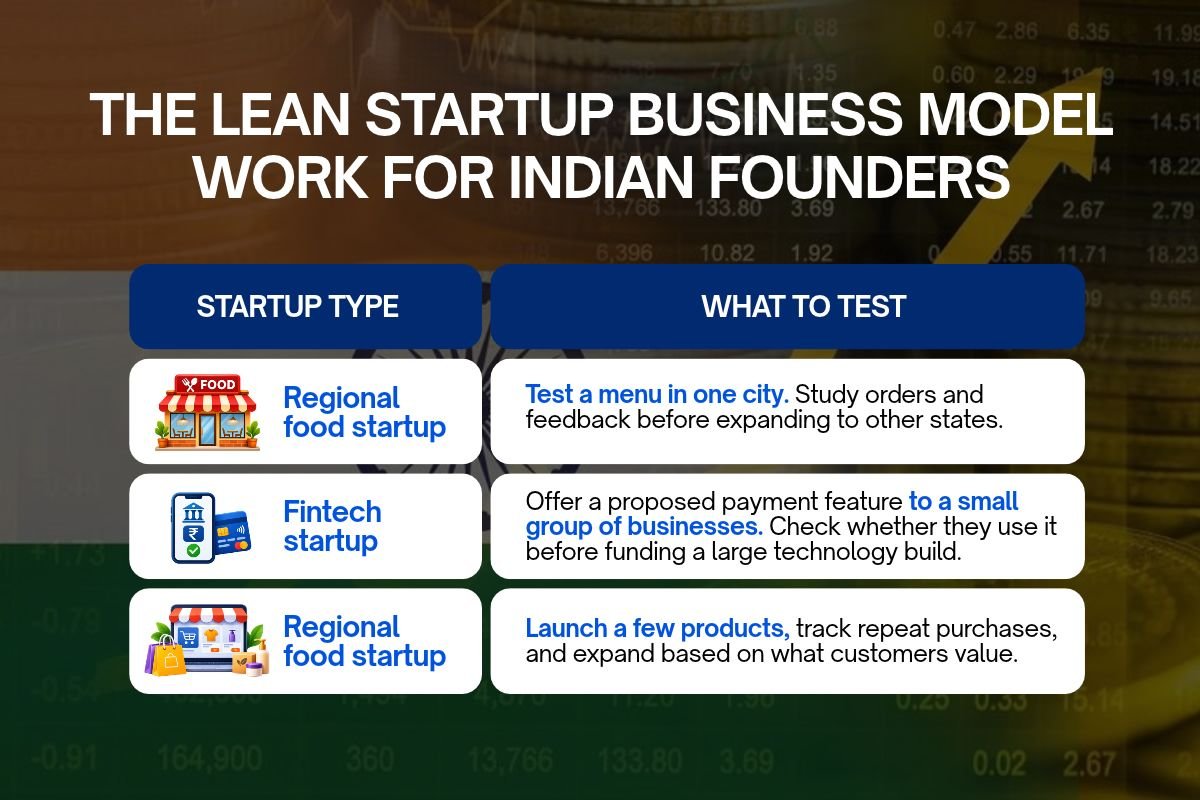
How can Indian founders apply this approach?
| Startup type | What to test |
| Regional food startup | Test a menu in one city. Study orders and feedback before expanding to other states. |
| Fintech startup | Offer a proposed payment feature to a small group of businesses. Check whether they use it before funding a large technology build. |
| D2C brand | Launch a few products, track repeat purchases, and expand based on what customers value. |
Where does the 80/20 rule fit in?
Founders can use the 80/20 rule to identify the few customers, features, or activities that create most of the value. Treat it as a guide for setting priorities, not a fixed mathematical promise.
India’s growing startup ecosystem
DPIIT had recognised 2,40,092 startups as of 30 June 2026, the latest official count, given in a Lok Sabha reply on 28 July 2026.
With India’s startup ecosystem growing beyond its largest cities, testing ideas across different markets is becoming even more important.
Which Learning Metrics should Indian Startups track?
A startup can have thousands of downloads and still struggle to make money. The trick is knowing which numbers show real customer interest and which simply look good on a dashboard.
Vanity metrics may look impressive, but they rarely tell the full story:
- App downloads
- Social media followers
- Website visits
- Total registrations
Useful learning metrics show how customers behave and whether the business is improving. A lean startup should choose these measures based on what it wants to test.
| Metric | What it tells you |
| Customer activation | Are people using the product after signing up? |
| Retention rate | Do customers return? |
| Repeat purchase rate | Are customers buying again? |
| Conversion rate | Are visitors becoming paying customers? |
| Customer acquisition cost | How much does gaining a customer cost? |
| Churn rate | How many customers stop using the product? |
| Revenue per customer | How much value does each customer bring? |
Example: A grocery delivery startup
Imagine an app gets thousands of downloads, but most users place only one order. Downloads look promising, yet repeat orders tell a different story. Delivery costs, customer retention, and contribution margins can reveal whether the business is actually working.
A simple framework for choosing metrics
Measure three things:
- Customer behaviour: What are people doing?
- Business performance: Is the model making money?
- Learning: What did each experiment teach you?
A useful metric answers a clear question. Do not track another number just because your dashboard has room for it.
How does Lean Startup compare with Agile and Traditional Business Planning?
These three approaches help businesses make better decisions, but they solve different problems. One tests business ideas, another improves product development, and the third helps organise business activities. This framework helps founders check whether their idea can work before they invest heavily.
How do the three approaches differ?
| Factor | Lean Startup | Agile | Traditional Business Plan |
| Main focus | Testing business ideas | Improving product delivery | Planning business activities |
| Customer feedback | Tests assumptions | Guides development | Informs research and reviews |
| Work style | Experiment-driven | Iterative development | Structured planning |
| Main output | Validated learning | Working product increments | Plans and forecasts |
| Best suited for | Uncertain business ideas | Changing product needs | Funding and operations |
Lean Startup vs. Agile Methodology
Lean Startup helps answer whether a business idea and model can work. Agile helps teams build and improve products through short development cycles. They are not direct replacements. Founders can use both to test an idea and improve the product.
Lean Startup vs. Traditional Business Plan
A traditional business plan helps founders prepare budgets, financial forecasts, and long-term goals. Lean Startup adds a way to test the assumptions behind those plans with real customers.
Do you need to choose just one?
Not always. A business can use traditional planning for finances, Lean Startup for market validation, and Agile for product development. The right mix depends on what the business needs to solve.
Why Do Most Indian Startups Fail? Lessons from Real Cases

Startup failure rarely comes from one bad decision. It often follows weak demand, rising costs, or poor planning. A lean startup approach helps founders test assumptions while watching cash and operations.
Read More: How Bootstrapped Startups in India Use Lean Team Scaling Models to Grow Profitably?
Why do startups struggle?
Common reasons include:
- Poor product-market fit and weak customer research.
- Running out of money or facing high costs.
- Unclear revenue models and expensive customer acquisition.
- Poor leadership, premature expansion, or regulatory barriers.
In Inc42’s 2024 investor survey, 61% of 75+ Indian startup investors cited products not meeting market needs as a reason for failure. Respondents could select multiple reasons, so this is not a startup failure rate.
What can founders learn from real cases?
These famous startups that failed [Famous Indian startups that failed | Supporting] faced different challenges:
- Doodhwala: The milk delivery startup stopped operations in 2019 amid funding and low-margin delivery challenges. Lesson: Check delivery costs before scaling.
- Koo: The social platform shut down in 2024 after partnership talks failed. Its founders cited funding gaps and high technology costs. Lesson: User interest must support a sustainable business.
- BluSmart: In 2025, the electric mobility company faced cash pressure and planned to exit ride-hailing. Lesson: Growth needs sound finances and reliable operations.
These cases had different causes. A Parliamentary Standing Committee noted that an overall startup failure rate is difficult to calculate because startups operate at different stages.
What can founders learn from Lean Startup Examples and Indian Unicorn Leaders?
Companies do not always begin with perfect products. Often, they start by noticing a problem and finding a solution.
These examples show how Indian businesses responded to customer needs. Their journeys offer lessons from founders [Lean lessons from top Indian Unicorn founders | Supporting], especially about customer understanding and financial discipline. These are practices that align with Lean Startup thinking, not proof that each company formally followed the full method.
1. Zomato: Start with a real customer problem
Deepinder Goyal began by scanning restaurant menus and making them available online. The business later expanded into other services.
Lesson: A simple solution to a real problem can become something bigger.
2. Razorpay: Listen before building
Harshil Mathur and Shashank Kumar focused on the difficulties businesses faced when accepting online payments. They worked to make payment integration easier.
Lesson: Listening to users can reveal problems worth solving.
3. Zerodha: Build with financial discipline
Nithin Kamath started Zerodha as a bootstrapped brokerage after seeing problems in the trading industry.
Lesson: Outside funding is not the only path to a lasting business. Careful spending matters, too.
The common thread: understand the problem, test a solution, and grow when ready.
Is The Lean Startup book worth reading for new founders?
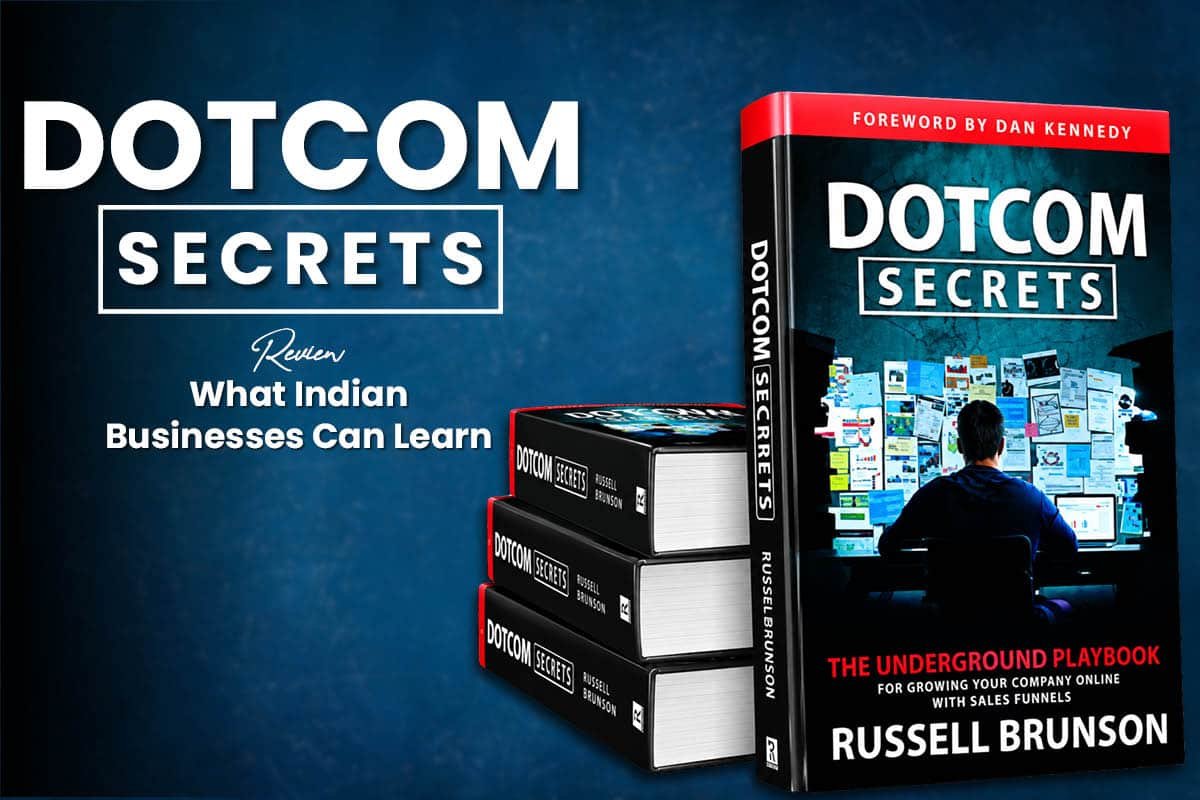
Published in 2011, The Lean Startup by Eric Ries explains how entrepreneurs can build businesses through experiments, customer feedback, and validated learning. It remains a useful starting point for understanding this framework.
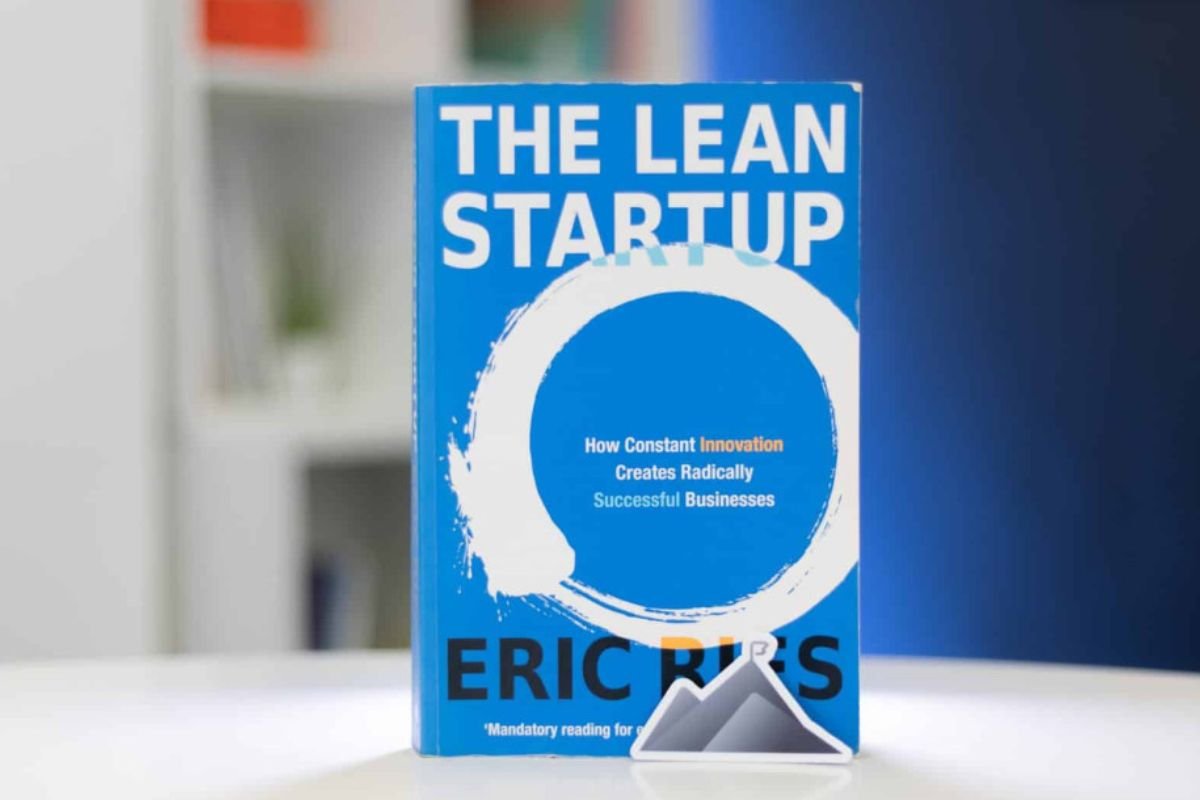
The Lean Startup by Eric Ries
- Author: Eric Ries
- Published: 2011
- Main focus: Building businesses through experimentation and customer feedback.
- Best for: New founders, entrepreneurs, and product teams.
The book explains the Build-Measure-Learn cycle and shows why testing assumptions matters more than blindly following a business plan. Its core ideas still apply to early-stage businesses.
However, Indian readers may need newer, local examples to understand how these ideas work across today’s markets. For a deeper look at its strengths and limits, read this book’s review.
Conclusion: Build less on assumptions and more on evidence
A successful business does not grow by guessing what customers want. It grows by testing ideas, listening to people, and making better decisions as new information comes in. The lean startup approach gives founders a practical way to do this without wasting time or money.
Start with a real problem, test your riskiest assumptions, build only what you need to learn, and track meaningful customer behaviour. Keep spending under control and change direction when the evidence calls for it.
Your first idea does not have to be perfect. It just has to be good enough to test. The real skill lies in knowing what to do after customers give you their answer.
Frequently Asked Questions
1. What is a lean startup?
It is a business approach that tests ideas, gathers customer feedback, and improves products through small experiments.
2. What are the five principles of this framework?
The five principles are entrepreneurship, management, validated learning, innovation accounting, and the Build-Measure-Learn cycle.
3. What is the Build-Measure-Learn cycle?
It is a process where founders build a basic product, measure customer responses, and use the results to improve or change direction.
4. How does this process reduce business risk?
It helps founders test assumptions early, understand customer needs, avoid unnecessary spending, and make decisions using real feedback.
5. Can established businesses use this method?
Yes. Established businesses can use it to test new products, improve services, explore markets, and reduce the risk of new ideas.