
Two Indian textile manufacturers export garments worth ₹20 lakh to the same market. One benefits from preferential customs duties under a trade agreement, while the other pays standard tariffs. The difference can mean significant savings and higher profit margins.
This highlights why global trade alliances matter to Indian businesses. Trade agreements help exporters reduce customs costs, access new markets, simplify cross-border trade, and strengthen competitiveness.
With India’s merchandise and services exports reaching a record $863.1 billion in FY 2025–26, understanding these partnerships is increasingly important for turning trade benefits into business growth.
Global Trade Alliances Explained Through Four Major Trade Agreement Types
To understand how international trade partnerships work, businesses must first recognise the different types of agreements and their commercial objectives.
| Agreement | Meaning | Business Benefits |
| PTA(Preferential Trade Agreement) | Offers reduced tariffs on selected products | Lower import costs on eligible goods |
| FTA (Free Trade Agreement) | Reduces or eliminates tariffs across agreed product categories | Better market access and export competitiveness |
| CEPA/CECA/CETA/TEPA | Covers goods, services, investment, and other economic cooperation areas | Wider business and professional opportunities |
| Customs Union/Single Market | Establishes deeper economic integration between members | Common trade rules and easier regional movement |
With global trade alliances explained through their different structures and objectives, exporters can better identify agreements that support their products, services, and international expansion plans.
Major Regional Trade Blocs Creating Opportunities for Indian Exporters
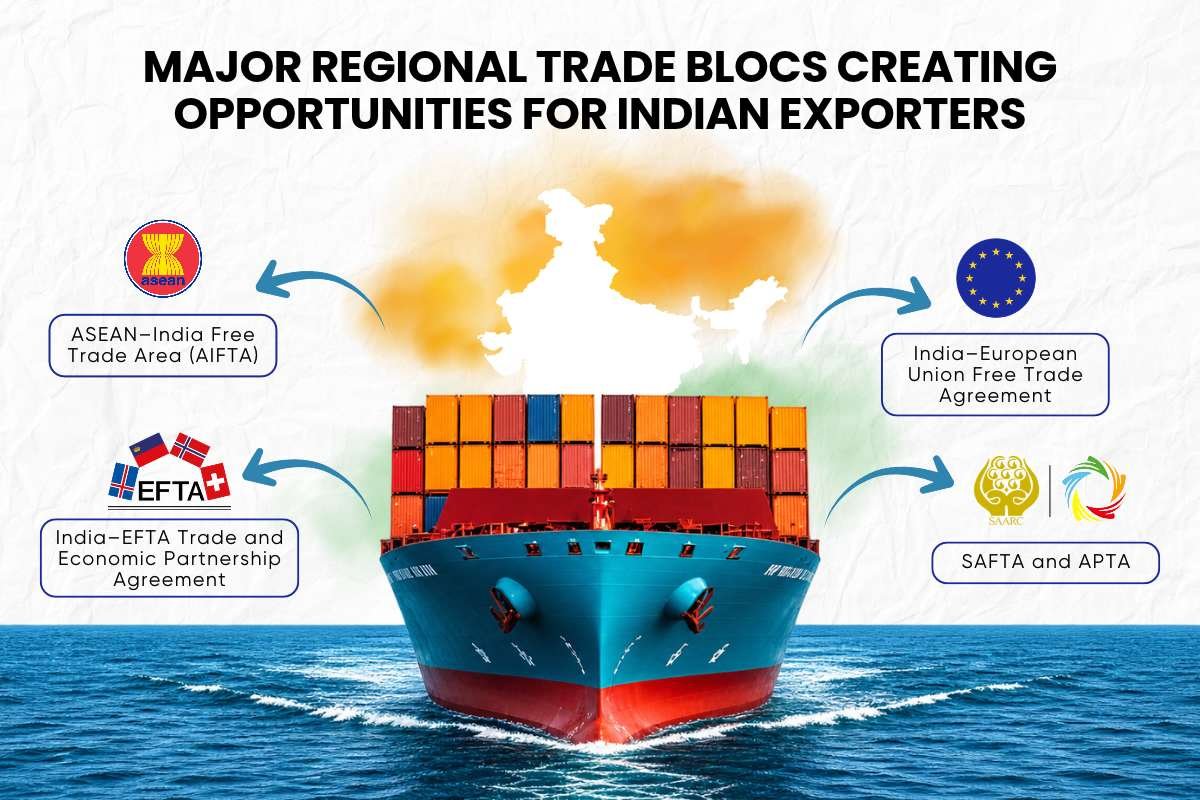
Regional trade alliances connect multiple economies through common trade arrangements. They can help Indian businesses access several markets while reducing trade barriers.
1. ASEAN–India Free Trade Area (AIFTA)
Connecting India with 10 Southeast Asian countries, AIFTA creates opportunities across pharmaceuticals, chemicals, engineering goods, textiles, and agricultural products. Its preferential tariff structure supports regional supply chains and strengthens India’s commercial relationships with Southeast Asia.
2. India–EFTA Trade and Economic Partnership Agreement (TEPA)
Operational since October 1, 2025, the agreement connects India with Switzerland, Norway, Iceland and Liechtenstein.
Its most significant commitment includes an investment objective of $100 billion over 15 years, alongside provisions for employment generation and improved market access. Indian exporters in pharmaceuticals, textiles, engineering and processed foods can benefit from the agreement’s concessions.
3. India–European Union Free Trade Agreement
India and the European Union concluded FTA negotiations on January 27, 2026. However, the agreement must complete its legal and ratification processes before entering into force.
The proposed agreement creates opportunities for Indian exporters across textiles, footwear, pharmaceuticals, engineering, and services. Businesses should distinguish negotiated concessions from benefits that are already operational.
4. SAFTA and APTA
The South Asian Free Trade Area (SAFTA) and Asia-Pacific Trade Agreement (APTA) facilitate preferential trade across participating economies. These arrangements offer opportunities for Indian businesses dealing in textiles, agricultural commodities, chemicals, and manufactured products.
Understanding global trade alliances explained through regional partnerships shows how Indian exporters can diversify their markets, reduce trade barriers, and participate in wider international supply chains.
Key Bilateral Trade Agreements Indian Businesses Should Know
While regional blocs offer access to multiple markets, bilateral agreements create targeted opportunities between two trading partners.
Having global trade alliances explained through India’s bilateral agreements helps exporters identify commercially relevant destinations, assess tariff advantages, and plan international expansion.
| Agreement | Current Status | Key Business Opportunities |
| India–UAE CEPA | In force since May 2022 | Gems, jewellery, textiles, pharmaceuticals |
| India–Australia ECTA | In force since December 2022 | Apparel, leather, furniture, engineering |
| India–EFTA TEPA | In force since October 2025 | Pharmaceuticals, machinery, textiles |
| India–Oman CEPA | In force since June 2026 | Food processing, engineering, wellness |
| India–UK CETA | In force since July 15, 2026 | Textiles, footwear, marine products, services |
| India–New Zealand FTA | In force since October 20, 2026 | Apparel, leather, pharmaceuticals, engineering |
These bilateral partnerships can help Indian companies diversify export destinations, build stronger international relationships, and improve their competitiveness in overseas markets.
What Do Modern Trade Alliances Actually Cover?
The benefits of international trade agreements extend beyond customs duty reductions. Modern agreements generally address four important areas.
- Tariff reductions: Eligible products receive reduced or zero customs duties, depending on the agreement’s schedules and implementation timelines.
- Services and professional mobility: Agreements can improve access for IT, healthcare, consulting, engineering, and other service industries.
- Regulatory cooperation: Provisions addressing technical standards, certifications, and mutual recognition can reduce compliance-related obstacles.
- Customs facilitation: Digital documentation, simplified procedures, and transparent customs processes can reduce administrative delays.
With India’s services exports reaching approximately $421.3 billion in FY 2025–26, businesses must also consider broader economic developments, including how global interest rate shifts affect business financing, investment decisions, and cross-border expansion.
How Trade Alliances Can Support Women-Led Indian Businesses

International trade partnerships also create opportunities for women entrepreneurs looking to expand beyond domestic markets.
Women-led MSMEs are active across textiles, handicrafts, food processing, apparel, and other export-oriented industries. However, accessing international buyers, affordable trade finance, and complex customs procedures remain challenging for many smaller businesses.
Among the emerging global business trends is the growing importance of inclusive supply chains and broader participation in international markets, creating opportunities for women-led enterprises to reach overseas buyers and build export networks.
Trade agreements can help address these barriers through improved market access, digital trade provisions, investment opportunities, and cooperation on women’s economic participation.
The World Bank has also highlighted the relationship between export growth and women’s employment. Its research indicates that doubling manufacturing exports in developing economies could increase women’s share of manufacturing wages from 24% to 30%.
For women entrepreneurs, access to international markets can create opportunities to expand distribution networks, connect with overseas buyers, and participate in global supply chains.
How Indian Exporters Can Claim Trade Agreement Benefits
For Indian companies expanding globally, understanding the commercial advantages of trade agreements is only the first step. Businesses must also know how to claim preferential tariffs and meet the documentation requirements for accessing these benefits.
Here are four essential steps:
1. Identify the Correct HSN Code
Determine your product’s eight-digit HSN classification and check the applicable preferential tariff against the standard Most-Favoured-Nation (MFN) rate.
2. Verify Rules of Origin
Products must satisfy the agreement’s specific Rules of Origin (RoO). These may require domestic value addition, a change in tariff classification, or other qualifying production criteria.
3. Obtain a Certificate of Origin
Apply for the relevant Preferential Certificate of Origin through India’s Trade Connect ePlatform. Ensure the documentation meets the agreement’s requirements.
4. Coordinate With the International Buyer
Share the required origin documentation and shipping records with your buyer so the importer can claim the applicable tariff preference during customs clearance.
Businesses should also verify product exclusions, documentation requirements, and destination-country standards before shipping.
Common Mistakes That Can Reduce Export Benefits
Even with global trade alliances explained in terms of their commercial benefits, exporters can make mistakes that prevent them from claiming available trade concessions.
- Assuming every product automatically qualifies for zero-duty treatment.
- Ignoring Rules of Origin and product-specific eligibility requirements.
- Overlooking destination-market regulations, technical standards, and environmental compliance obligations.
Avoiding these mistakes helps businesses make better use of available trade preferences while reducing unnecessary compliance costs.
Conclusion:
For Indian exporters, trade agreements are more than international policy arrangements. They can influence pricing, sourcing decisions, market expansion, and profitability.
Having global trade alliances explained in practical business terms helps companies identify relevant agreements, evaluate tariff advantages, and prepare for international competition.
As India expands its trade partnerships, businesses that understand eligibility requirements and actively use available concessions will be better positioned to convert international market access into sustainable export growth.
Frequently Asked Questions:
1. What is the difference between an FTA and a CEPA?
An FTA primarily focuses on reducing trade barriers in goods and may also cover services. A CEPA generally has broader coverage, including investment, services, and economic cooperation.
2. Can small Indian businesses benefit from trade agreements?
Yes. MSMEs can access preferential tariffs, expand into international markets, and improve export competitiveness, provided their products meet the relevant agreement requirements.
3. Do all exports automatically qualify for zero customs duty?
No. Benefits depend on product eligibility, tariff schedules, Rules of Origin, and the required documentation.