


Turning a networking event into multi-million dollar contracts starts with identifying the right people and building relationships that lead to genuine business opportunities.
For Indian founders, business owners, sales teams, and executives, networking can open doors to new clients, investors, partners, distributors, and international markets. Events in India, Dubai, and other global business hubs can bring decision-makers together, but the opportunity does not end when the event does.
Turning a networking event into multi-million dollar contracts means moving beyond collecting business cards or LinkedIn connections. You need to identify the right people, understand what they actually need, establish a reason to continue the conversation, and follow up with a clear next step.
The event creates the introduction. What you do afterward determines whether that introduction becomes a business relationship.
Why networking events help businesses turn connections into multi-million dollar contracts?
A room full of business leaders can shorten a sales journey by connecting you with the right decision-maker and problem. Turning networking into major contracts starts with finding the right fit, not pitching.
The scale of these events matters too. In 2025, business events brought together 1.65 billion participants worldwide and generated US$1.3 trillion in direct spending, according to the Events Industry Council and Oxford Economics.
In a market such as Dubai, where international conferences, trade shows and networking events bring together businesses from different markets, the room can be even more diverse. Business Events in Dubai can offer access to companies, decision-makers, and potential partners from a much wider business landscape.
The opportunity is there. The contract, however, still has to be earned.
Networking and deal-making strategies that go beyond small talk
Understanding how to turn a networking event into multi-million dollar contracts requires moving beyond small talk and identifying genuine business needs.
A useful conversation can follow a simple path:
Context → Problem → Relevance → Next step
Ask what brought them to the event and what they are working on. Listen for expansion, partnerships, or operational needs. If there is a genuine fit, move toward a next conversation rather than another pitch.
What should you look for in a conversation?
- Context: What does their business do?
- Problem: What are they trying to solve?
- Relevance: Can you genuinely help?
- Next step: Is there enough potential for another conversation?
Not every person is a lead, and treating everyone that way can make networking feel like speed dating with business cards.
The setting still matters. Freeman’s 2025 research found that 82% of working professionals surveyed consider in-person settings the best environment for building crucial job relationships.
Your credibility matters too. Building Executive Authority and Personal Branding can help establish trust, but the conversation still has to prove there is a genuine business fit.
Before the event, know who you actually want to meet
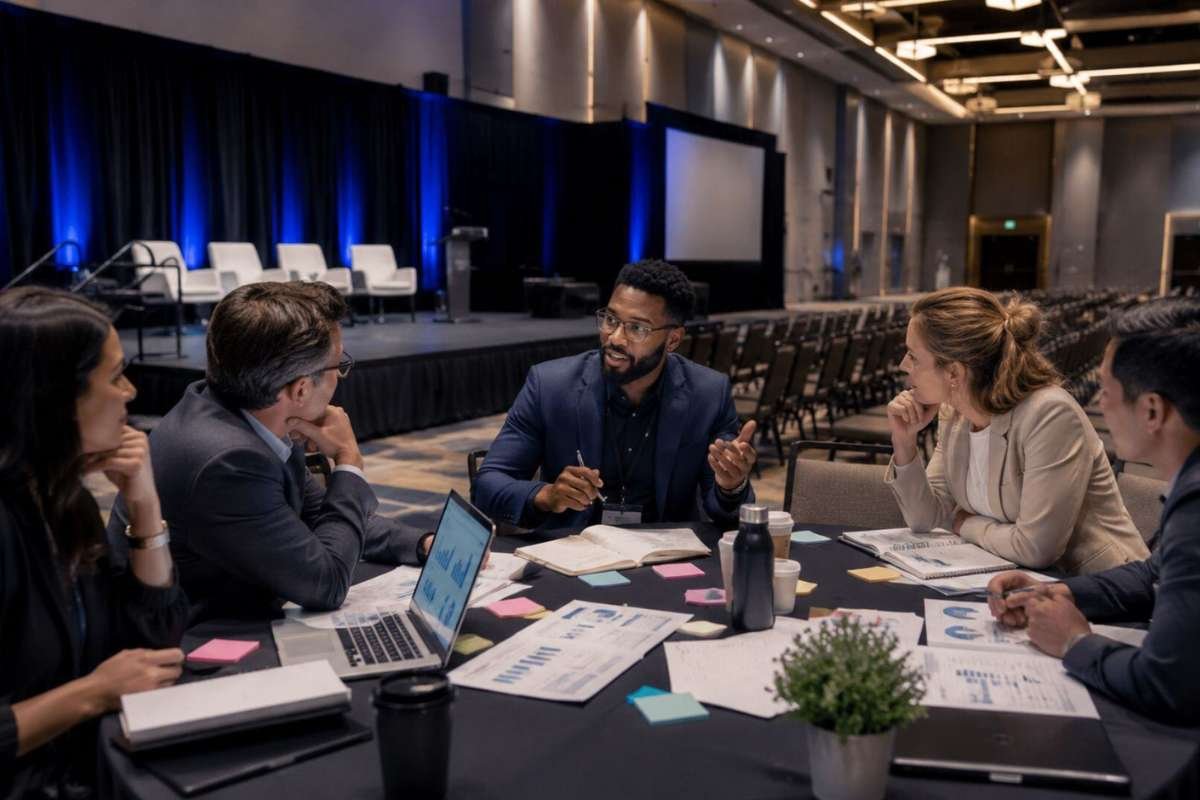
Walking into a business event without a plan and hoping to meet the right person is not much of a strategy. Some of the work needs to happen before you reach the venue.
Start with five simple questions:
- What is the commercial goal? More clients, partnerships, investment, or market access?
- Who can help you reach it? Buyers, investors, distributors, founders, or decision-makers?
- Who is likely to be there? Research companies, speakers, and priority attendees beforehand.
- What will you ask? Prepare two or three conversation starters that feel natural.
- What would make the event worthwhile? Set a result you can actually measure.
There is a big difference between saying, “I want to meet important people,” and “I want to meet three companies entering markets where our solution already works.” The second gives you something to work toward.
Looking at Key Takeaways from past Leadership Conclave can also help you understand the kinds of conversations, people and opportunities that tend to emerge from leadership-focused gatherings.
During the event, turn conversations into qualified opportunities
Once you are in the room, resist the urge to pitch. Start with curiosity. Ask what they do, what brought them there, and what they are working on. Good conversations often reveal more than a polished pitch.
Then listen for commercial signals:
- Expansion into a new market
- An operational problem
- A technology requirement
- A potential partnership
- A need for investment or expertise
If there is no clear fit, move on. Not every conversation needs to become a sales opportunity.
This is also where the difference between a Business Summit vs. a Trade Show becomes useful. A trade show may give you more product-focused conversations, while a business summit can create space for broader discussions around partnerships, strategy, and growth. Your approach should match the room.
Turning a networking event into multi-million dollar contracts means identifying commercial signals and earning the next serious conversation.
That could mean a 20-minute call, product demonstration, partnership meeting, or commercial discussion.
What Indian business leaders can expect from a closed-door conclave?
A closed-door conclave feels different from walking around a packed exhibition hall, collecting brochures and trying to explain your business to whoever stops nearby. The conversations are usually smaller and more focused.
You may find:
- Senior decision-makers and business leaders
- More focused, industry-specific discussions
- Curated introductions
- Greater room for candid conversations
- Potential strategic partnerships
That does not mean every closed-door gathering is automatically valuable. Who is in the room matters just as much as the format. If the participants have no relevance to your goals, exclusivity alone will not create a deal.
For brands, Business Summit Sponsorship can also provide a more focused setting for visibility and relationship-building without turning the event into a giant sales pitch.
After the event, follow up before the opportunity goes cold

The event is over. The deal-making is not.
To understand how to turn a networking event into multi-million dollar contracts, focus on specific follow-ups that move promising conversations toward a business opportunity.
Avoid the usual:
“Great meeting you. Let’s connect.”
It is polite, but it gives the other person no real reason to respond.
Instead, make the follow-up specific:
- You discussed: the problem, opportunity, or goal they mentioned.
- You identified: where there could be a genuine fit.
- You propose: one useful next step.
- You offer: a clear time, call, or action.
If you discussed entering a new market, suggest a short call. If you discussed a partnership, bring the relevant teams into the next conversation.
And do not treat every contact equally. Prioritise the people where there is a clear business fit, a genuine need and a realistic path forward.
A practical guide on how to follow up after a business summit can take this process further, but the principle is simple: make it easy for the other person to know what happens next.
From first conversation to contract: build the commercial path
A good conversation is only the starting point. The path to a major contract usually looks something like this:
| Stage | What happens |
| Conversation | You discover whether there is a reason to keep talking. |
| Qualification | You check whether the opportunity, budget, and decision-making process make sense. |
| Discovery | You understand the problem, requirements and desired outcome. |
| Proposal | You show what you can offer and the value it could create. |
| Negotiation | Both sides work through scope, pricing, risks, and terms. |
| Decision | The buyer decides whether to move forward. |
| Contract | The agreed terms are formalised, and the relationship moves into delivery. |
The sequence matters. If you are exploring scaling a Business in the UAE, for example, the relationship may first develop through local partnerships, market knowledge, and a clearer expansion strategy.
That is why turning a networking event into multi-million dollar contracts is not about finding a clever closing line. Large deals are built through a series of credible business decisions. The handshake starts the process. It does not finish.
When networking becomes a growth engine, not just an event expense
A successful event is not measured by how many people you meet or LinkedIn requests you collect. Look at what happens afterward: relevant conversations, qualified opportunities, follow-up meetings, partnerships, pipeline, and revenue influences.
There is some evidence behind that shift in focus. EIC and Oxford Economics found that respondents attributed 22% of new customer acquisition to participation in in-person events.
That longer-term value is also where how past winners have scaled brand influence becomes relevant. The right event can keep working for your business through stronger relationships, reputation, and visibility long after everyone has gone home.
Conclusion
A networking event can open the door, but it cannot build the relationship or close the contract for you.
For Indian businesses, the value of networking lies in turning the right conversations into qualified opportunities, partnerships, customer relationships, and new avenues for growth. That requires preparation before the event, genuine conversations during it, and focused follow-up afterward.
The goal should not be to collect the most contacts. It should be to identify the few relationships that have a genuine commercial fit and give them a clear path forward.
Understanding how to turn a networking event into multi-million dollar contracts requires moving beyond small talk and identifying genuine business needs.
Whether you are looking for customers in India, exploring international markets, building partnerships, or entering markets such as the UAE, a strong networking strategy can turn an event from a calendar commitment into a real business-development channel.
The wider NEXT Conclave 2026 experience can be the room where those conversations begin.
Frequently asked questions
1. What should you do before a networking event?
Define your commercial goal, research attendees, identify priority contacts, prepare conversation starters, and decide what success looks like.
2. How do you identify a valuable networking opportunity?
Look for clear business needs involving expansion, partnerships, technology, investment, operational challenges, or other areas your business can address.
3. How should you follow up after a networking event?
Reference your conversation, identify the potential fit, suggest one useful next step, and offer a specific time or action.
Thank You For Reading!
Know More
The 10 Benefits of Business Awards at the NEXT Conclave For Indian Businesses