

Many new founders assume they need green energy business licenses. In India, that is not how the rules work. Green Energy Business Licenses depend on the type of work. A rooftop solar installer faces different rules than a power generator. A battery seller also faces a different compliance path. The same applies to equipment makers and waste handlers.
The Electricity Act, 2003 forms a key part of this framework. Yet, Section 7 allows generating companies to set up stations without a licence, subject to technical grid rules.
So, the real question is not which one license you need. It is which approvals your exact business activity triggers. This guide maps those key registrations, licenses, and approvals.
Do green energy businesses need a special license?
No, Green Energy Business Licenses are not the same for every business. The rules depend on your activity and your state. A business registration proves that your company exists legally. Sector rules then govern what your business can actually do. These may include electrical licenses, vendor registration, or waste approvals. Project rules can add more approvals for certain energy projects. The Electricity Act, 2003 forms a key part of this framework.
Use this table as a screening guide, not a legal checklist.
| Business activity | Regulatory requirement to investigate |
|---|---|
| Solar installation or EPC | Electrical contractor rules and DISCOM processes |
| Solar equipment manufacturing | Factory rules and product-specific compliance |
| Solar equipment trading | Product standards and business registrations |
| Power generation | Electricity-sector and project approvals |
| Battery business | Battery Waste Management and EPR rules |
| Solar-panel waste handling | Applicable waste-management rules |
| Government-scheme installation | Scheme and vendor eligibility rules |
For example, battery producers need CPCB registration and EPR duties. Solar businesses may also face product rules in certain projects. MNRE’s ALMM rules show why activity matters here.
So, before you start a green energy business, map your activity first. That step can prevent costly compliance gaps later.
Licenses and approvals by green energy business model
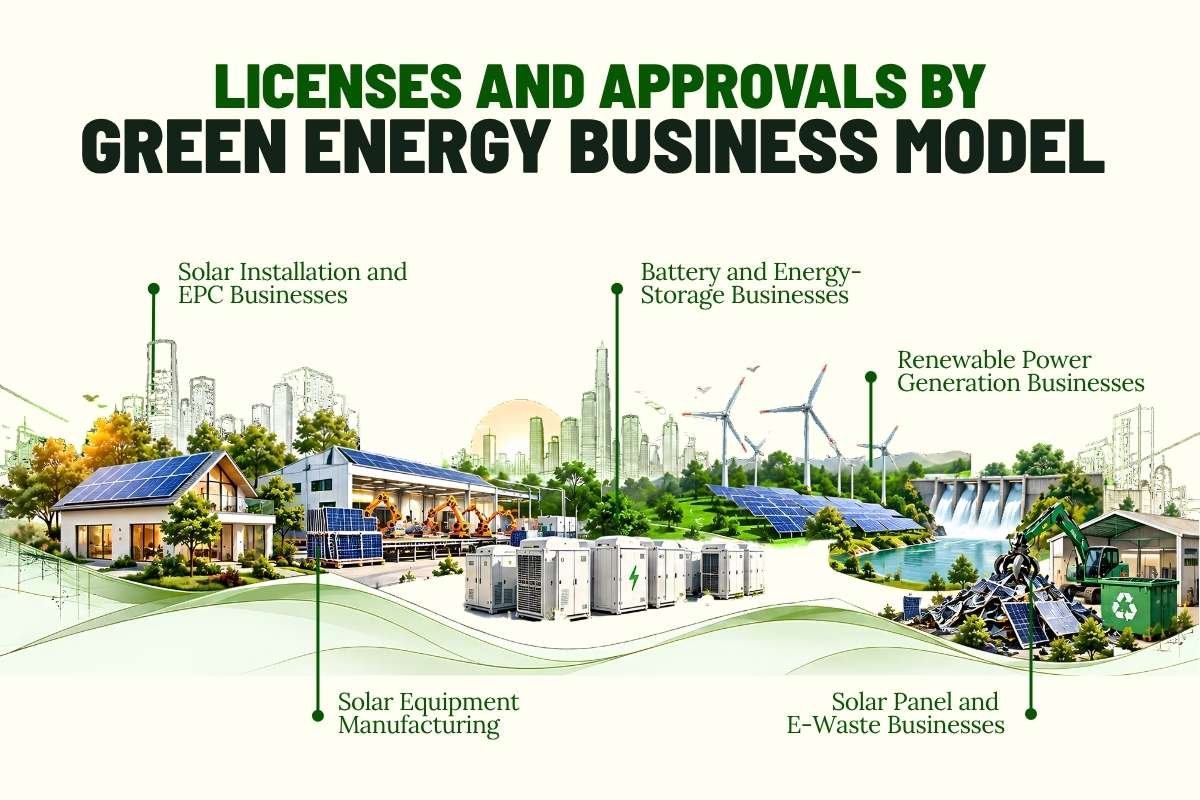
The right approval path starts with your business activity. A solar installer needs different checks than a battery maker. So, Green Energy Business Licenses vary widely.
1. Solar installation and EPC businesses
Solar EPC work can involve electrical contracting rules. State Electrical Inspectorates often govern these contractor requirements. The exact process can differ across Indian states. Grid-connected rooftop work can also involve DISCOM procedures. Those steps can cover connection, net metering, and system checks.
Green Energy Business Licenses for solar EPC work can vary by state and project type.
Government-backed work adds another layer for eligible vendors. For PM-Surya Ghar, MNRE has a vendor registration process.
2. Solar equipment manufacturing
Manufacturers need more than a basic company setup. Product quality and technical rules can also apply. Some solar projects need products from approved manufacturer lists.
MNRE’s ALMM rules show why project type matters. ALMM List-I covers eligible solar PV module makers. These rules apply to specified government and scheme-linked projects. They also cover certain open-access and net-metering projects. That does not make ALMM a blanket rule for all sales. A private buyer may face a different product compliance path.
3. Battery and energy-storage businesses
Battery businesses can trigger waste rules and EPR duties. These duties depend on the business’s role in the chain. Producers, manufacturers, and importers can face different obligations. So, calling EPR a simple Green Energy Business Licenses requirement gives poor guidance.
Instead, check the applicable Battery Waste Management Rules first. Then check CPCB requirements for registration and EPR compliance. The same approach helps avoid gaps in later waste duties.
4. Solar panel and e-waste businesses
Solar waste needs special care in India’s regulatory system. CPCB guidance brings solar PV panels under e-waste rules. That includes solar PV modules, panels, and cells.
However, not every business role creates the same duty. Your role can determine which registration or record duties apply. Check the E-Waste Management Rules before handling such waste.
5. Renewable power generation businesses
Power generation follows a different regulatory path altogether. Grid projects can need electricity-sector and connectivity approvals. Open-access projects can also face state-specific regulatory processes. Land, environmental, and local project rules may also apply.
The key point remains simple: no universal checklist exists. Project size, location, technology, and grid use can matter. That is why founders should map approvals before spending capital.
Which approvals depend on your business activity?
Your business model should guide your Green Energy Business Licenses compliance check first. Use this quick screen before you apply for anything.
If you install solar systems →
Check state electrical contractor rules and DISCOM requirements. Government schemes may add vendor eligibility rules. For scheme participation, review government incentives for green businesses too.
If you manufacture equipment →
Check product, quality, factory, and environmental requirements. Some products may need specific technical approvals or tests.
If you sell or import equipment →
Check product standards and import-related compliance. The rules can change based on the product category.
If you generate electricity →
Check electricity-sector and project-specific approvals. Grid links, open access, land, and local rules may matter.
If you make or place batteries on the market →
Check the EPR duties that apply to your role. CPCB rules can require registration and other compliance steps.
If you handle solar or electronic waste →
Check CPCB and State Pollution Control Board requirements. Applicable waste rules can create separate duties.
A company registration does not grant activity approval.
It does not permit regulated electrical work by itself. It also does not permit power generation or waste handling. That distinction can save founders from costly compliance mistakes.
Central vs state-level compliance
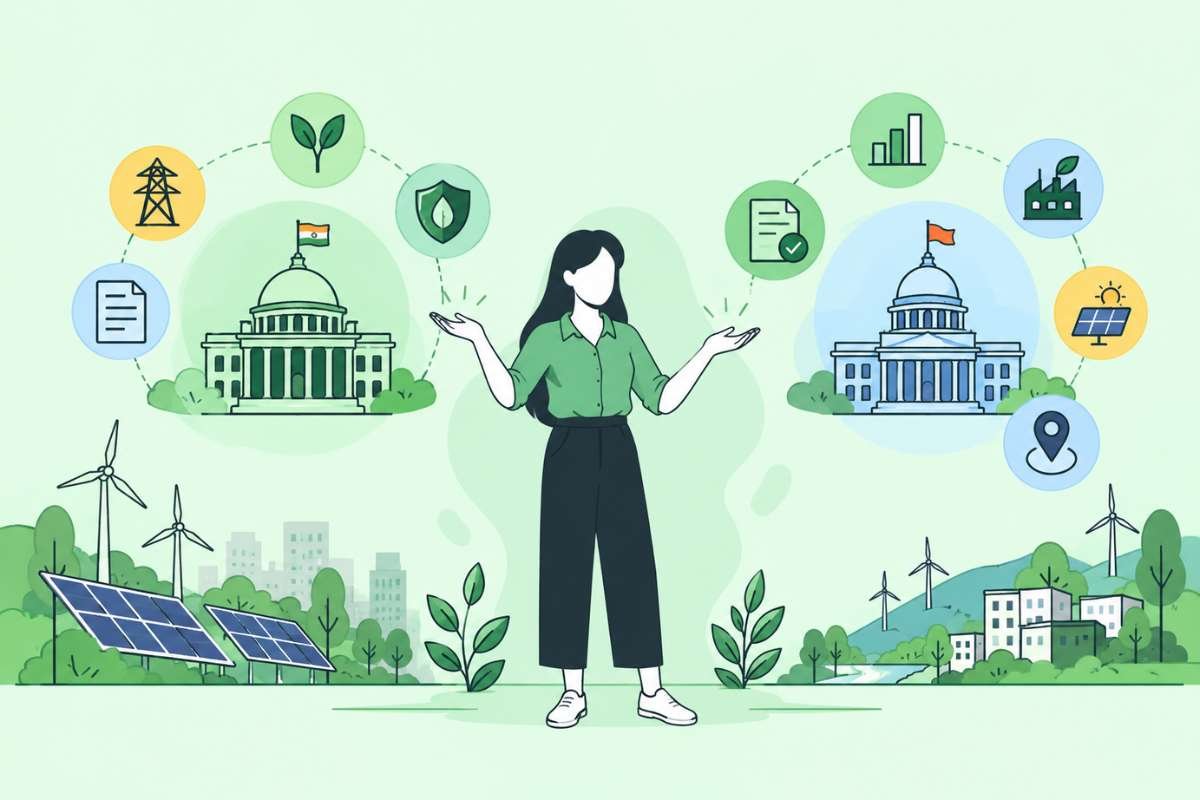
Green-energy compliance does not sit with one central agency. Different rules can come from central and state bodies. MNRE, CPCB, CEA, regulators, DISCOMs, and state bodies matter. Their role depends on your business and project type.
State variation can change your approval path quite a lot. For example, a Maharashtra installer may follow state processes. Another installer may face different steps in Gujarat or Karnataka. Electrical contractor licensing shows this gap quite well. CEA flagged these differences in its 2023 advisory. The advisory discussed the idea of “One Nation, One License.”
So, never copy another state’s compliance checklist blindly. First, map your activity, location, and project type. Then check each central and state authority that applies.
A practical compliance checklist before starting
Before you spend on equipment, map your compliance path first. This sequence can help you avoid costly gaps.
- Define the exact business activity.
Know what you will make, sell, install, or handle. - Map the electricity role.
Check if you generate, supply, install, or sell equipment. - Check state electrical requirements.
State rules can affect electrical contracting work. - Check DISCOM requirements.
Grid-connected projects can need separate DISCOM processes. - Check MNRE scheme rules.
Government programmes can set vendor and product conditions. - Check CPCB and SPCB requirements.
Batteries, panels, electronics, and waste can trigger specific duties. - Check product standards.
Manufacturers and importers may face product-specific rules. - Verify current rules before starting operations.
Rules can change, so confirm them with the right authority.
Compliance costs deserve early planning. A clear approval map can also prevent costly project delays.
Licenses vs registrations vs approvals: what is the difference?
These terms sound alike, but they serve different roles. Knowing the difference helps you ask the right questions.
| Term | What it generally means |
|---|---|
| License | Permission to conduct a regulated activity |
| Registration | Formal entry into a regulatory or scheme system |
| Approval | Permission for a project, product, connection, or activity |
| Authorization | Formal permission for a defined regulated function |
For example, registration does not always grant operating permission. Likewise, one approval may cover only one project. Calling all these steps “licenses” can mislead new founders. It can also hide key duties that come after registration.
That matters when checking Green Energy Business Licenses. The right question should always match your exact business activity.
Conclusion:
India has no single license for every green-energy business. Your compliance path starts with your exact business activity. Electrical work and power generation can trigger different approvals. Manufacturing, batteries, and waste handling add other rules. Government schemes can also set their own vendor conditions. So, map your activity before you seek any approval. Then confirm the current rules with each relevant authority.
Frequently asked questions:
1. Do all green energy businesses need a license?
No. India has no single green-energy license for every business. Requirements depend on your activity, state, products, electrical work, power generation, and environmental duties.
2. Does a solar installation business need an electrical contractor license?
It can, depending on the work and state rules. Check your State Electrical Inspectorate for the contractor license or other requirements that apply to your work.
3. Do solar businesses need DISCOM approval?
Grid-connected rooftop projects can involve DISCOM processes for connection and related services. Off-grid solar businesses usually follow a different compliance path, based on their activities.