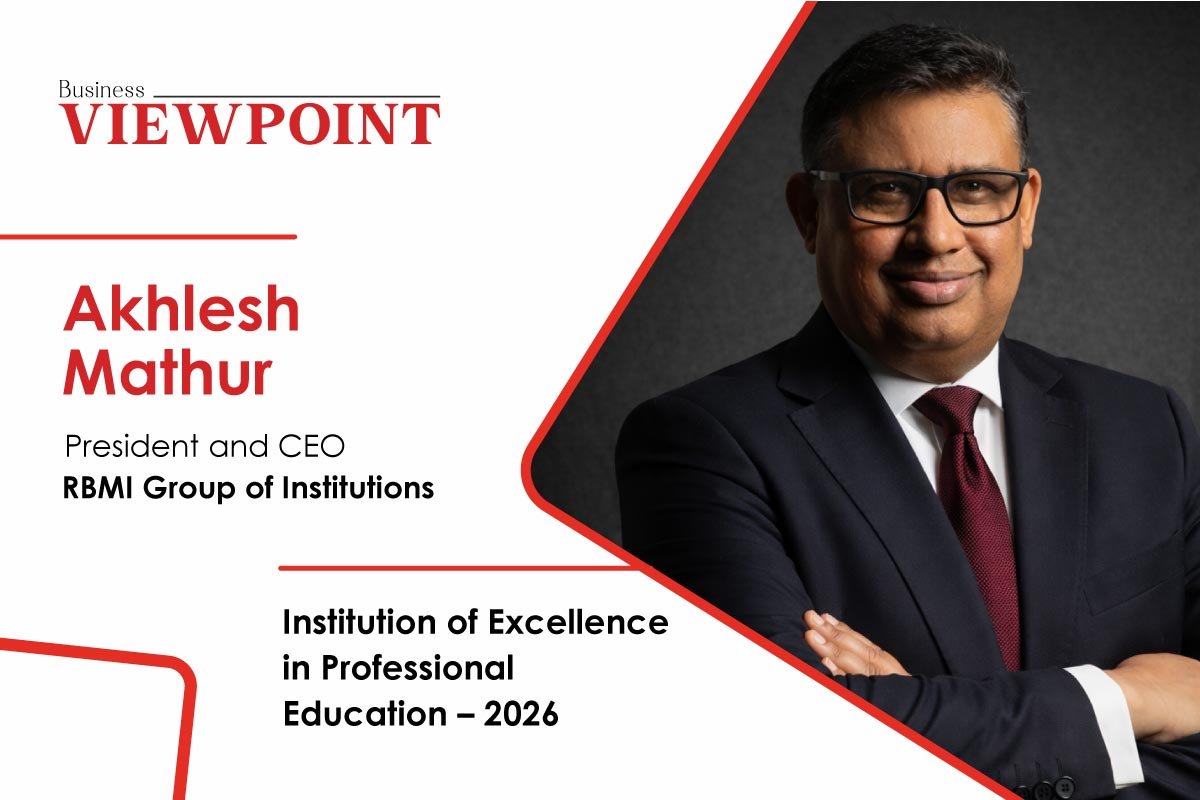



The RBMI Group of Institutions has developed from a stand-alone management institute into a seven-college, multidisciplinary academic group with a well-defined systems model under the direction of President and CEO Akhlesh Mathur. From a single MBA school, an integrated professional education network has expanded to include undergraduate and graduate programs in engineering, pharmacy, management, information technology, nursing, and education.
Today, the organisation supports over 3,000 students and has over 25,000 alumni worldwide. This scale represents structured growth controlled by policy discipline, academic calibration, and consistent corporate engagement rather than opportunistic expansion.
With the Founder’s Honour, FICCI acknowledged RBMI’s commitment to professional education in India. More recently, the title “Institution of Excellence in Professional Education” at the Bharat 2.0 forum affirmed the institution’s data-driven governance and employability-oriented outcomes. For leadership, the recognition signals external validation of an operating model that integrates academic rigour with measurable workforce relevance.
Institutional Evolution: Scale with Structure
RBMI Group of Institutions’ growth reflects calibrated scaling supported by infrastructure development, faculty capacity building, digital integration, and corporate partnerships. From its origin as a single MBA college, the institution has built a diversified academic footprint aligned with workforce demand patterns. This transformation illustrates structured progression anchored in operational discipline rather than rapid proliferation. Infrastructure expansion, faculty recruitment standards, and governance protocols were aligned before program diversification occurred.

| Institutional Growth Trajectory (1996–2026) | |||
|---|---|---|---|
| Metric | 1996 | 2026 | Strategic Interpretation |
| Colleges | 1 | 7 | Multi-campus academic network |
| Programs | MBA | UG & PG across 6 disciplines | Cross-sector professional integration |
| Student Enrollment | ~100 | 3,000+ | Sustainable enrollment expansion |
| Alumni Network | Founding cohort | 25,000+ global | Long-term professional capital |
| Institutional Recognition | Regional presence | National recognition incl. FICCI honour | Brand consolidation |
Leadership at RBMI – The Four Foundational Anchors
RBMI’s academic ecosystem is guided by four institutional values:
- Ambition – Encouraging students to pursue upward professional mobility through measurable goal-setting.
- Curiosity – Promoting inquiry, analytical reasoning, and evidence-based learning.
- Courage – Supporting innovation, problem-solving, and responsible experimentation.
- Community – Creating collaborative engagement between students, faculty, alumni, and industry partners.
The institutional doctrine of “Degree + Skills” operationalizes these principles. Professional mobility is engineered through applied competence, while academic credentials serve as the foundational capital.
Program structures incorporate corporate case engagements, live projects, internships, and on-the-job training modules. Instead of depending only on theoretical proficiency, students are expected to demonstrate competency before graduating.
RBMI uses information from industry roundtables, HR consultations, structured surveys, and LinkedIn Insights data to stay in line with labor market changes. Updates to the curriculum are guaranteed to align with the current sectoral skill demand through collaboration with CII, FICCI, and NASSCOM.
This feedback-driven ecosystem places graduates in appropriate hiring pipelines and lessens curriculum obsolescence.
Academic Integration Model: Structured Employability

RBMI Group of Institutions’ academic distinction rests on integration rather than isolated initiatives. Certification pathways, industry-led modules, and corporate case exposure are embedded into core curricula.
Students complete LinkedIn Learning modules and NASSCOM-aligned certifications in parallel with academic coursework. AI-enabled interview simulation platforms prepare students for competency-based evaluation frameworks increasingly adopted by employers. Campus-hosted HR summits and corporate conferences facilitate sustained exposure to industry expectations.
Monitoring mechanisms include GAP analysis matrices, internal assessment dashboards, and recruiter feedback loops. These systems provide quantitative visibility into student readiness metrics. This four-stage framework converts academic progression into structured employment readiness.

| Employability Architecture Framework | |||
|---|---|---|---|
| Phase | Core Objective | Implementation Tools | Quantifiable Output |
| Demand Mapping | Identify sectoral skill requirements | LinkedIn Insights, HR Surveys, Industry Forums | Curriculum adjustment reports |
| Skill Development | Build technical & behavioural competencies | LinkedIn Learning, NASSCOM Certifications, Internships, OJT | Certified skill benchmarks |
| Corporate Engagement | Connect graduates with employers | Live Projects, Case Competitions, Industry Conferences | Placement pipeline strengthening |
| Performance Audit | Evaluate preparedness | GAP Analysis Systems, Recruiter Reviews | Continuous curriculum refinement |
Faculty Development as Institutional Multiplier
RBMI recognises faculty capability as a primary driver of student outcomes. Annual Faculty Development Program (FDP) targets are mandated across departments. Weekly in-house training sessions ensure pedagogical standardisation and interdisciplinary knowledge exchange.
Faculty members receive LinkedIn Learning subscriptions to upgrade proficiency in emerging technologies, AI integration, and advanced disciplinary frameworks. Industry-led workshops enhance applied research orientation, enabling faculty to translate market developments into curriculum adaptation. Investment in faculty strengthens institutional credibility and ensures classroom instruction remains aligned with evolving professional standards.

Technology Integration Across Academic Systems
The governance model of the RBMI Group of Institutions is organized digitally. Academic calendars, course materials, attendance logs, certification pathways, and performance dashboards are all accessible through the Learning Management System (LMS). These systems are used by teachers and students on laptops and mobile devices, allowing for real-time academic monitoring.
Research tools with AI support, such as OpenAI-created programs like ChatGPT, improve analytical abilities and promote interactive learning settings.
To maintain integrity and transparency, assessment procedures are administered via safe digital platforms run by third parties. Centralized dashboards are used to combine performance analytics, internship evaluation, and attendance tracking. Digital integration promotes evidence-based decision-making, lowers administrative burden, and improves accountability.

| Digital Governance & Academic Systems | ||
|---|---|---|
| Academic Function | Digital Infrastructure | Strategic Outcome |
| Curriculum Delivery | LMS Platform | Transparent academic tracking |
| Assessment | Secure Online Evaluation Tools | Standardised and auditable exams |
| Career Analytics | GAP & Performance Dashboards | Data-backed employability tracking |
| Research Support | AI-enabled Tools | Enhanced analytical depth |
| Student Access | Cloud & Mobile Platforms | Flexible learning continuity |
Strategic Partnerships and Global Benchmarking
RBMI’s sector-focused Centers of Excellence (COEs) enhance professional alignment. Important partnerships include Fronius for welding technologies, Euro Bio UK for pharmaceutical specialization, Softpro for IT and AI skills, Jungleberry for FMCG exposure, and 2COM & ACCEL for workforce readiness.
International connections with ICT UK, London Metropolitan College (UK), and Project Control Institute Australia enable internationally recognized exposure pathways and certifications.

Governance, Quality Assurance, and Strategic Direction
Institutional governance is process-oriented and metric-driven. Standardised academic calendars, internal audits, faculty benchmarking systems, LMS analytics, and structured student feedback maintain operational consistency across campuses.
Over the next five years, RBMI Group of Institutions aims to deepen AI-led instructional frameworks, expand global collaborations, strengthen placement metrics, and pursue Deemed or Private Skill University status through strategic international joint ventures. The long-term objective is to institutionalise skill-integrated education at scale while preserving governance discipline.
Recognition at Bharat 2.0
The “Institution of Excellence in Professional Education” recognition at Bharat 2.0 symbolises validation of RBMI’s integrated operating model. For leadership, it confirms that structured governance, faculty investment, corporate alignment, and measurable employability outputs can coexist within a scalable higher-education framework.
Leadership Principles for Professional Education
Akhlesh Mathur articulates three principles for emerging institutional leaders:
- Build resilient systems rather than personality-dependent models.
- Maintain continuous alignment with industry ecosystems.
- Prioritise faculty capability and governance accountability.
For students, expectations remain explicit. A degree establishes academic grounding; sustained employability requires certification, internship exposure, project execution, and ethical discipline.
Institutional Identity
From a single MBA college in 1996 to a diversified seven-college group, RBMI’s progression reflects structured expansion grounded in accountability. Its operational model integrates curriculum with certification pathways, faculty development with digital systems, and ambition with measurable outcomes.
Within India’s competitive higher education environment, the RBMI Group of Institutions demonstrates that employability can be engineered through disciplined governance, data analytics, corporate alignment, and institutional purpose operating in cohesion.