



Why India’s Fertility Challenge is No Longer a Medical Issue—It’s a National Infrastructure Challenge.
By William Angelo, Chennai
From population control to fertility sustainability
India’s demographic priorities are highly evolving. The challenge is no longer merely controlling population growth but ensuring demographic sustainability. If India seeks to preserve a healthy young workforce without allowing economic inequality to determine who can become parents, fertility care must become an integral component of national healthcare planning. Just as family planning once became a nationwide public health movement, the Government of India should now consider launching a National Fertility Access Mission one that expands fertility treatment infrastructure, strengthens state-wise access to Assisted Reproductive Technology (ART), promotes fertility preservation, supports research, and ensures that every eligible couple has equitable access to scientifically driven fertility care, irrespective of geography or income.
A National Fertility Access Mission would not only strengthen India’s reproductive healthcare ecosystem but also advance the United Nations Sustainable Development Goals (SDGs), particularly SDG 3.7, which promotes universal access to sexual and reproductive healthcare services, and SDG 3.8, which advocates Universal Health Coverage (UHC) with equitable access to quality healthcare for all.
Every year, India records nearly 23 million births. Yet, despite an estimated 300,000 IVF cycles being performed annually, assisted reproductive technologies account for only a small fraction of these births, approximately 0.5%, based on industry estimates. In contrast, around 2.8% of babies born in the United States are conceived through Assisted Reproductive Technology (ART), reflecting a far deeper integration of fertility services into mainstream healthcare. Based on current U.S. ART penetration rates, India would require well over 1.5 million ART treatment cycles annually to achieve a comparable level of accessibility. This gap highlights not merely a shortage of IVF centres, but the absence of a comprehensive national fertility infrastructure.
This gap is not simply about numbers. It reflects a structural weakness in India’s fertility ecosystem. The question therefore is no longer, “How do we build more IVF centres?” The real question is, “How do we build India’s fertility infrastructure?”
IVF is not fertility
One of the biggest strategic mistakes made over the past two (2) decades has been equating IVF with fertility care. They are not the same. IVF is merely one advanced treatment within fertility medicine.
Fertility care begins much earlier. It includes..
- fertility assessment
- reproductive endocrinology
- male infertility
- ovulation disorders
- PCOS management
- tubal disease
- recurrent pregnancy loss
- fertility preservation
- IUI
- IVF
- ICSI
- donor programs
- reproductive genetics
- counselling
- psychological care
Unfortunately, India has invested predominantly in IVF laboratories instead of building comprehensive fertility infrastructure. As a result, IVF has become “real estate” rather than healthcare infrastructure.
Parallel investment in neonatal critical care

Expanding fertility services cannot be viewed in isolation. Studies have shown that infants conceived through Assisted Reproductive Technology (ART) have a higher likelihood of NICU admission, largely due to increased rates of prematurity, multiple pregnancies, and high-risk maternal factors. Therefore, the expansion of fertility treatment must be accompanied by parallel investments in Level III and Level IV NICUs, high-risk obstetric care, and maternal-fetal medicine services. Building fertility infrastructure without strengthening neonatal critical care would create an incomplete reproductive healthcare ecosystem. The Government of India must therefore pursue both initiatives simultaneously to ensure healthier outcomes for mothers and newborns.
Why investors love IVF?
The private sector deserves credit for introducing advanced fertility technologies into India.
However, investors naturally view IVF differently. An IVF centre offers
- a single super-specialty model
- standardized clinical workflow
- high-value procedures
- relatively predictable scalability
- attractive returns on investment
This has encouraged rapid urban expansion. But expansion has largely concentrated in metropolitan markets. Tier-2 and Tier-3 India remain significantly underserved. The country’s fertility infrastructure has therefore grown vertically rather than geographically.
Why can India become the global fertility capital?
Ironically, India possesses every advantage needed to become the world’s fertility destination.
Medical tourism continues to expand because India offers
- internationally trained specialists
- comprehensive treatment pathways
- lower pharmaceutical costs
- affordable laboratory consumables
- significantly lower treatment costs
An IVF cycle in the United States may cost nearly five (5) times more than in India, while treatment in developed Asian countries costs approximately three (3) times more. Despite offering world-class fertility care at a fraction of these costs, India already enjoys a significant competitive advantage. What it lacks, however, is an organized national fertility infrastructure.
Why India reach this stage?
Several structural realities shaped today’s situation.
1. Government never became the pioneer
Unlike many developed nations, IVF in India evolved almost entirely through the private sector.
Government medical colleges and public hospitals did not establish themselves as early leaders in assisted reproduction. Consequently, fertility care became concentrated in private institutions.
2. Shortage of trained specialists
IVF remains one of the most specialized branches of medicine. Certified reproductive endocrinologists, embryologists, andrologists, and trained fertility nurses remain insufficient to meet national demand. Scaling centres without scaling talent only widens the quality gap.
3. Population masked the fertility crisis
India’s historically large population delayed national attention toward infertility. When births remain high, fertility treatment rarely becomes a policy priority. Today, however, delayed marriages, changing lifestyles, environmental factors, and declining fertility rates have transformed infertility into a significant public health issue.
4. Financial accessibility remains poor
Neither Ayushman Bharat nor most insurance products adequately support fertility treatment.
Three (3) IVF cycles may cost between ₹5–6 lakh, making treatment unaffordable for a large section of Indian households. When affordability determines parenthood, healthcare becomes unequal.
5. Research took a back seat
Much of India’s IVF industry competes primarily on cost. Relatively fewer institutions compete on scientific research, innovation, publication, or technology development. The world’s leading fertility nations became leaders because they invested in research before commercialization.
6. Transparency remains inconsistent
Patients frequently encounter
- inconsistent pricing
- varying treatment protocols
- unclear success-rate reporting
- misleading promotional claims
Without standardized reporting, patient trust inevitably declines.
The seven national challenges
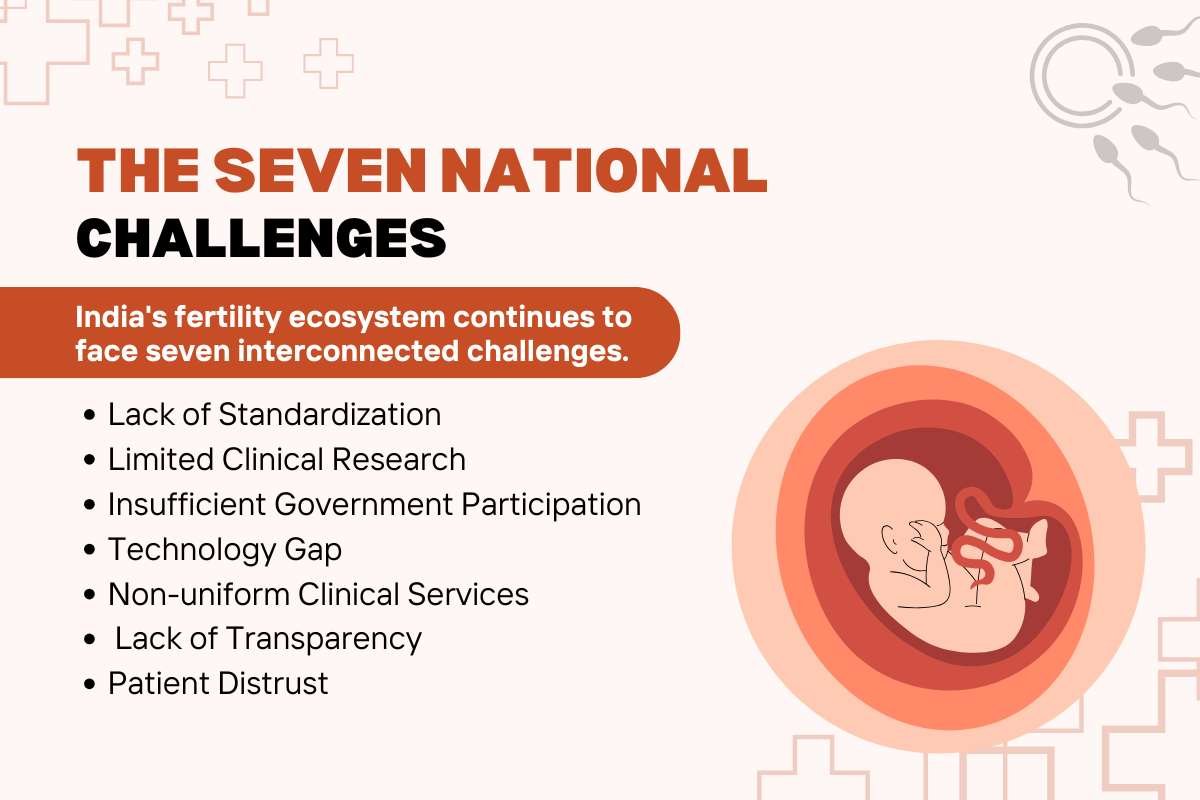
India’s fertility ecosystem continues to face seven interconnected challenges.
1. Lack of standardization
Treatment protocols vary considerably between centres.
2. Limited clinical research
India possesses one of the world’s largest patient populations but contributes relatively less high-impact fertility research.
3. Insufficient government participation
Public-sector fertility programs remain limited despite increasing demand.
4. Technology gap
Advanced AI, reproductive genetics, digital embryology and predictive analytics have yet to achieve widespread adoption.
5. Non-uniform clinical services
Patient experience differs significantly across institutions.
6. Lack of transparency
Outcome reporting, pricing and quality metrics require greater openness.
7. Patient distrust
Years of exaggerated marketing claims have created skepticism among patients, often causing delays in seeking treatment. Trust has become one of the industry’s biggest clinical challenges.
The way forward
India’s next phase of fertility development requires structural reform rather than incremental expansion. The priorities should include:
Build comprehensive fertility centres
Instead of establishing standalone IVF clinics, India should develop integrated fertility institutions capable of delivering the entire continuum of reproductive care.
Government participation
Every government medical college and tertiary public hospital should gradually establish Assisted Reproductive Technology services, improving accessibility and reducing dependence on private providers.
Mandatory outcome transparency
Hospitals should publicly disclose standardized data on:
- IUI outcomes
- IVF outcomes
- live birth rates
- age-wise success rates
- complication rates
Transparency builds credibility.
Research-driven growth
Every major fertility institution should actively publish peer-reviewed clinical research.
India must aspire not only to perform treatments but also to shape global reproductive science.
National standardization
Uniform treatment guidelines, quality benchmarks, and reporting standards can significantly improve patient confidence while reducing unnecessary variations in care.
Beyond IVF: Building India’s fertility ecosystem
Nearly 30% of Indians reportedly prefer private hospitals for medical treatment, underscoring the private sector’s important role in healthcare delivery. Yet fertility care cannot remain solely a private-sector responsibility if equitable access is the goal. Public and private institutions must evolve together to create a balanced fertility ecosystem. India stands at a defining moment. The conversation must shift from building more IVF clinics to building better fertility infrastructure.
Nations are not transformed by increasing procedure volumes. They are transformed by creating systems that make healthcare accessible, affordable, transparent, and research-driven. The future of Indian fertility will not be determined by the number of embryology laboratories we build. It will be determined by whether we have the vision to create a comprehensive fertility ecosystem that every Indian couple can access irrespective of geography, income, or social status. That is how India can move beyond becoming the world’s affordable IVF destination and emerge as the world’s most trusted fertility nation.
—William Angelo
Strategist | Business Development Leader