


An inquiry into leadership longevity, organisational evolution, and the delicate balance between vision and governance
Walk into any boardroom debate or investor roundtable, and one question reliably sparks a lively exchange: Should founders remain CEOs forever? On one side are those who believe founders are irreplaceable, the original visionaries, the cultural anchors, the risk-takers who built something out of nothing. On the other side sit governance purists and seasoned operators who argue that companies, like organisms, outgrow their creators.
This discussion is not merely academic. It affects market performance, innovation trajectories, investor confidence, and even employee morale. As organisations scale, the founder-CEO dilemma becomes one of the most consequential decisions a company will ever make.
So, let’s unpack this question not with monotony, but with a structured, conversational exploration of what truly defines effective leadership over time.
Visionaries at the Helm
Founders bring something that no hired executive can replicate: founder energy, which is a mix of conviction, resilience, and personal stakes.
They understand the “why” of the company with unparalleled clarity. Bureaucratic instincts or legacy processes do not weigh down their decisions; instead, they are often fueled by bold intuition. History is full of examples: Steve Jobs, Jeff Bezos, Mark Zuckerberg, and Melanie Perkins. Their imprint is not only strategic but cultural.
When a founder remains CEO, they often deliver:
- Continuity of Vision: Founders ensure that the company’s purpose is not diluted during growth. Their long-term thinking protects the organisation from short-termism that often creeps in with external leadership.
- Higher Risk Appetite: Founders are more willing to make unconventional bets. They innovate not because strategy demands it, but because they cannot imagine doing anything else.
- Cultural Authenticity: Employees tend to rally behind a founder. The story feels real. The mission feels lived, not inherited.
- Founder-Led Market Confidence: Public markets often reward founder-led companies. Research repeatedly shows that founder-run firms outperform peers in innovation and long-term returns. Yet, the founder advantage is not without expiration risks.
When Founders Hold On Too Long?
Here is where the conversation gets uncomfortable. Founders excel at building. But managing a global supply chain? Navigating international regulations? Scaling operational complexity? That requires a different skill set, one often dominated by operators, not inventors.
When founders overstay, the company can face:
- Operational Bottlenecks: The founder becomes the ceiling. Decisions are slow. Scaling becomes inefficient because every choice loops back to one individual.
- Emotional Bias: Founders may cling to ideas because they feel personal, even when the market is screaming otherwise.
- Resistance to Governance: As companies mature, governance must tighten. Some founders find this suffocating. Others may ignore guardrails altogether, leading to disastrous outcomes.
- Burnout and Blind Spots: Leading a company through every phase of growth demands reinvention. Many founders simply don’t have the bandwidth or desire to transform themselves at the pace the organisation requires.
This tension leads to one critical realization: the capabilities that make a founder extraordinary at inception are often not the same capabilities needed to run a billion-dollar organisation.
Lessons from Both Sides
The debate around Should founders remain CEOs forever is rarely a question of capability alone. It is a question of alignment between a leader’s strengths, the company’s stage of growth, and the evolving demands of the market. Some founders scale themselves at the same pace as their organisations; others create greater value by handing over the reins at the right moment. The most instructive insights come from observing those who chose to stay, those who chose to step aside, and most importantly, why those decisions worked. The leaders reinvented themselves in sync with their companies, not after the fact.
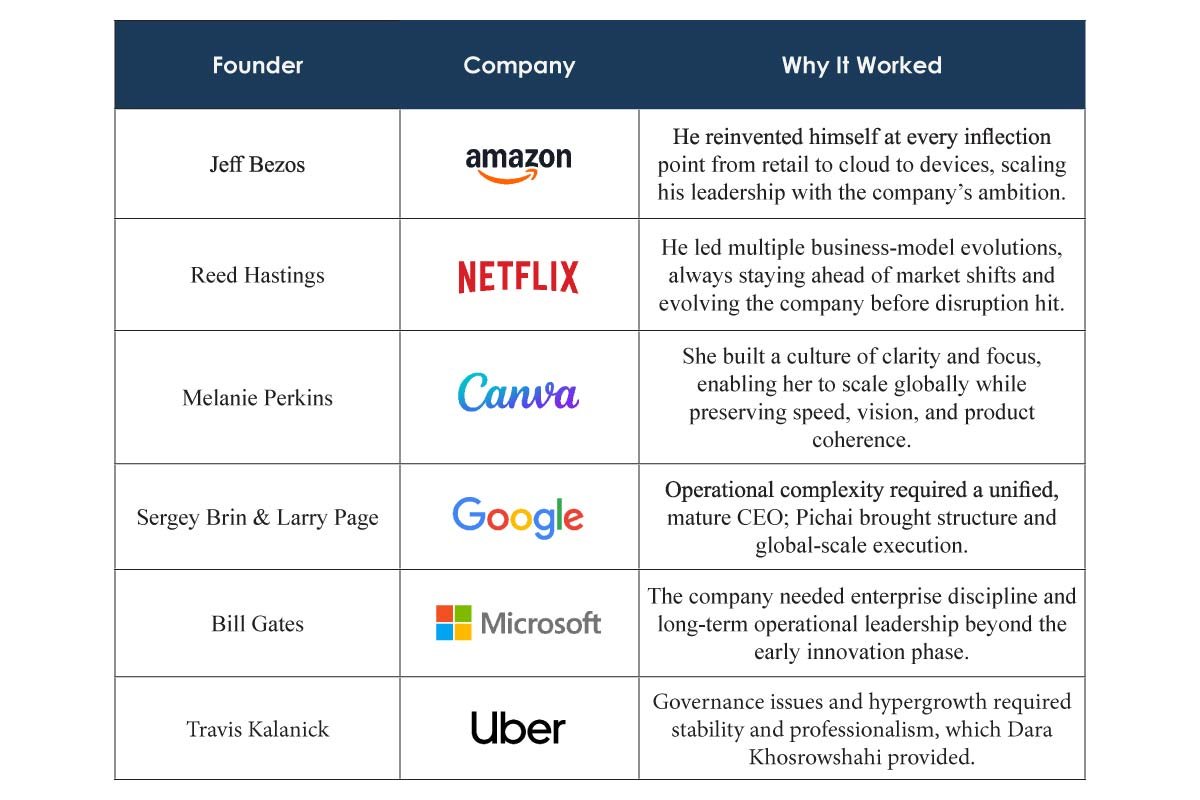
| Founder | Company | Why It Worked |
| Jeff Bezos | Amazon | He reinvented himself at every inflection point from retail to cloud to devices, scaling his leadership with the company’s ambition. |
| Reed Hastings | Netflix | He led multiple business-model evolutions, always staying ahead of market shifts and evolving the company before disruption hit. |
| Melanie Perkins | Canva | She built a culture of clarity and focus, enabling her to scale globally while preserving speed, vision, and product coherence. |
| Founder | Company | Why Stepping Aside Helped |
| Sergey Brin & Larry Page | Operational complexity required a unified, mature CEO; Pichai brought structure and global-scale execution. | |
| Bill Gates | Microsoft | The company needed enterprise discipline and long-term operational leadership beyond the early innovation phase. |
| Travis Kalanick | Uber | Governance issues and hypergrowth required stability and professionalism, which Dara Khosrowshahi provided. |
Can Founders Evolve as Fast as Their Companies?

This is the crux. The founder–CEO debate isn’t binary. It depends on the founder’s ability to shift from insurgent to institutional leader, from scrappy builder to strategic allocator, from product obsessive to organisational architect.
Ask any seasoned board member, and they will tell you:
- The best founders adapt.
- The stubborn ones get replaced.
- The self-aware ones decide before they are asked.
So the real determinant isn’t whether should founders remain CEOs forever. It’s whether they can grow faster than the company’s needs.
A Three-Stage Evolution Framework: Founder to CEO

To make this exploration more interactive, it helps to begin with a simple self-assessment, one that any founder can apply to understand where they truly stand in their leadership journey. Every company, regardless of industry or scale, moves through three distinct phases. The real question is whether the founder evolves in parallel.
Stage 1: Builder-in-Chief
- Role: Create the product, validate the need, and win the first wave of customers.
- Key Traits: Speed, intuition, and relentless passion.
- CEO Fit: Highly suitable, this stage rewards the founder’s raw energy and closeness to the problem.
Stage 2: Scale Architect
- Role: Operationalise the business, hire senior leaders, and establish scalable systems.
- Key Traits: Delegation, systems thinking, and financial discipline.
- CEO Fit: Mixed. This stage demands reinvention; many founders rise to it, while others resist its structure.
Stage 3: Institutional Leader
- Role: Set global strategy, drive governance, and make long-term capital allocation decisions.
- Key Traits: Maturity, diplomacy, and broad cross-functional oversight.
- CEO Fit: Strong only if the founder has transcended the start-up identity and embraced a more institutional form of leadership.
Ultimately, the most important question for any founder is simple yet profound:
Am I evolving ahead of my organisation, or is my organisation evolving ahead of me?
Why Governance Matters?
Investors typically champion founder-CEOs in the early stages, when vision, velocity, and authenticity matter most. However, as companies enter hypergrowth or approach the public markets, investors and boards often advocate for seasoned executives who can bring operational rigor and governance maturity. This shift is not adversarial; it is a natural evolution of responsibility.
Boards assess a founder’s readiness through several lenses:
- Decision-making quality
- Ability to attract and retain senior talent
- Governance and compliance maturity
- Crisis management capability
- Scalability of leadership
When progress stalls in any of these areas, leadership transitions become not just likely but necessary to protect the company’s trajectory. Yet, the most forward-thinking boards today take a more balanced view: they continue to back the founder for as long as the role fits and simultaneously prepare for the moment when the organisation may require a different kind of leader. This approach respects the founder’s contribution while safeguarding the company’s long-term resilience.
Founder Influence Without Founder Dependency

The most effective modern organisations strike a thoughtful balance:
- The founder remains the vision owner,
- The CEO (founder or otherwise) becomes the institution builder,
- The board becomes the stability anchor.
In many cases, founders thrive as Executive Chairs, Chief Product Officers, or strategic advisor roles that preserve their genius without burdening them with operational fatigue.
This hybrid leadership model respects the founder’s DNA while ensuring the company does not stagnate under the weight of nostalgia.
So, Should Founders Remain CEOs Forever?
The honest answer: Only if they continue to be the best CEO for the company’s next stage, not its last one.
A founder can stay indefinitely if they show:
- the humility to learn,
- the discipline to delegate,
- the wisdom to evolve,
- and the courage to step aside when the time is right.
Companies that thrive are those where leadership transitions, founder-led or otherwise, are driven not by ego, sentiment, or external pressure, but by what the business truly needs. Because in the end, this debate isn’t about founders or CEOs. It’s about longevity, stewardship, and designing companies that outlive their creators.