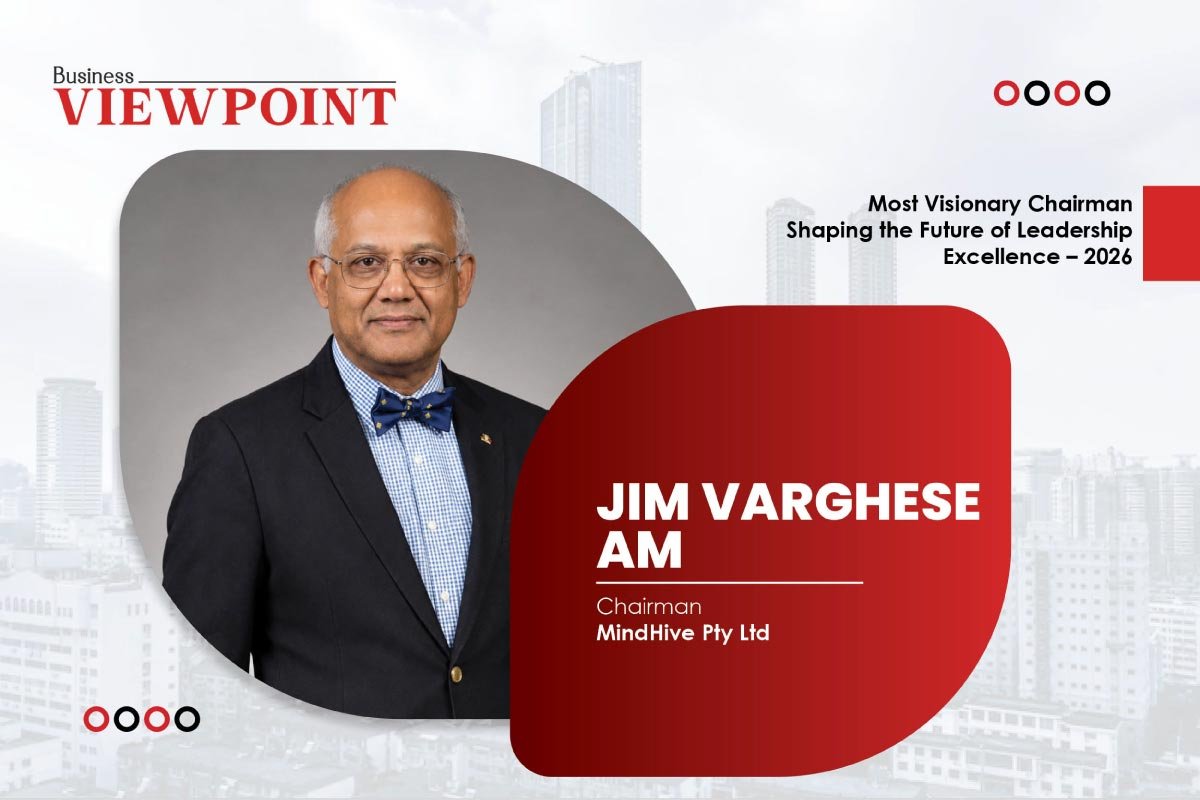



The leadership landscape is evolving, and with change comes opportunity. Industries worldwide are recognising that success is no longer a one-dimensional pursuit; it demands a richer, more integrated approach. Jim Varghese AM, Chairman of MindHive Pty Ltd, an artificial intelligence company he has led since its inception six years ago, is at the forefront of this transformation. A seasoned leader across business, advisory, and board environments, he has spent more than three decades refining a framework he calls the Three Frames for Success: Performance, Relationships, and Alignment, a model he has applied across varied fields with remarkable consistency.
His credibility is not merely theoretical: it includes a near-clean-sweep election victory at the University of Queensland in 1974 and a lifelong commitment to adding value at the individual and corporate level. Now 75, he no longer works for a living but for a purpose: making a positive difference to individuals, government, and non-government organisations, including community organisations. His vision for leadership excellence is not just about outcomes; it is about nurturing spiritual direction and energy to drive humanity toward better communities and motivated individuals, combining artificial intelligence with relationships in a way that promises a brighter future for leadership everywhere.
Unlearning the single-lens mindset: the case for three-dimensional leadership
The leadership assumption that businesses need to unlearn today, according to Jim Varghese AM, is the belief that success can be achieved through a narrow, one-dimensional focus. What should replace it is a three-dimensional focus and interaction on what you want to achieve the Performance Frame, the key relationships needed to deliver what you want the Relationship Frame), and the alignment of organisational structure the Alignment Frame, which synchronises with performance and relationships, inclusive of receiving authentic feedback and believing in your own capabilities.
Varghese explains that if an individual, including their team if they have one, scores at least a 3 on a 5-point scale for each of the Performance, Relationship, and Alignment Frames, success in delivering their outcomes is virtually guaranteed. He grounds this conviction in experience, noting that in over 30 years of application of the Three Frames for success in varied fields, there has never been any failure.
Balancing the long term and the immediate, a three-dimensional approach
Extending this framework further, Jim Varghese AM applies the same three-dimensional thinking to the challenge of balancing long-term institutional thinking with the pressure for immediate results, explaining that as a chairman he outlines the long term by converting it into a clear and articulate three-dimensional focus and interaction on what you want to achieve the Performance Frame the key relationships needed to deliver what you want the Relationship Frame and the alignment of organisational structure, which synchronises with performance and relationships, receiving authentic feedback, and believing in your own capabilities, while noting that immediate results are achievable as long as you strictly implement the Three Frames for Success in any immediate results that you are trying to achieve.
Why structure matters as much as strategy?
The one contrarian leadership principle Jim Varghese AM has backed that challenged conventional thinking but proved valuable is his strong emphasis on using the alignment of organisation structure synchronising with performance and relationships, receiving authentic feedback, and believing in your own capabilities.
He explains that this is seen by some as contrarian leadership because it is not readily seen when you only focus on what you want to deliver the Performance Frame and the key relationships needed to deliver what you want the Relationship Frame.
The less-visible quality that sets exceptional leaders apart
While outcomes often measure leadership excellence, Jim Varghese AM argues that the less-visible quality that truly distinguishes exceptional leaders is the strong emphasis on using the alignment of organisation structure, which synchronises with performance and relationships, receiving authentic feedback, and believing in the alignment of organisation structure, which synchronises with performance and relationships, receiving authentic feedback, and believing in your own capabilities.
Two sides of the same leadership coin

Reflecting on his experience across leadership, business, and advisory environments, Jim Varghese AM has learned that there is not a black and white difference between authority and influence, as the two are interconnected and require implementation using The Three Frames of Performance, Relationships, and Alignment.
A purpose-driven approach to value creation
Viewed through the lens of purpose rather than transaction, the question of strategic partnerships or acquisitions takes on new meaning for Jim Varghese AM, who explains that his role is to add value that makes a positive difference at both the individual and corporate level, and that the fine-tuning of the Three Frames for Success is delivering beyond this expectation, having also assisted in adding value to a number of boards that he serves on.
He notes that as he has turned 75 years old, he can add unbeatable value at the individual and corporate level, as he no longer has to work for a living but can focus on making a positive difference to the lives of individuals, government and non-government organisations, including community organisations.
Leveraging AI in daily operations, tools, applications, and impact
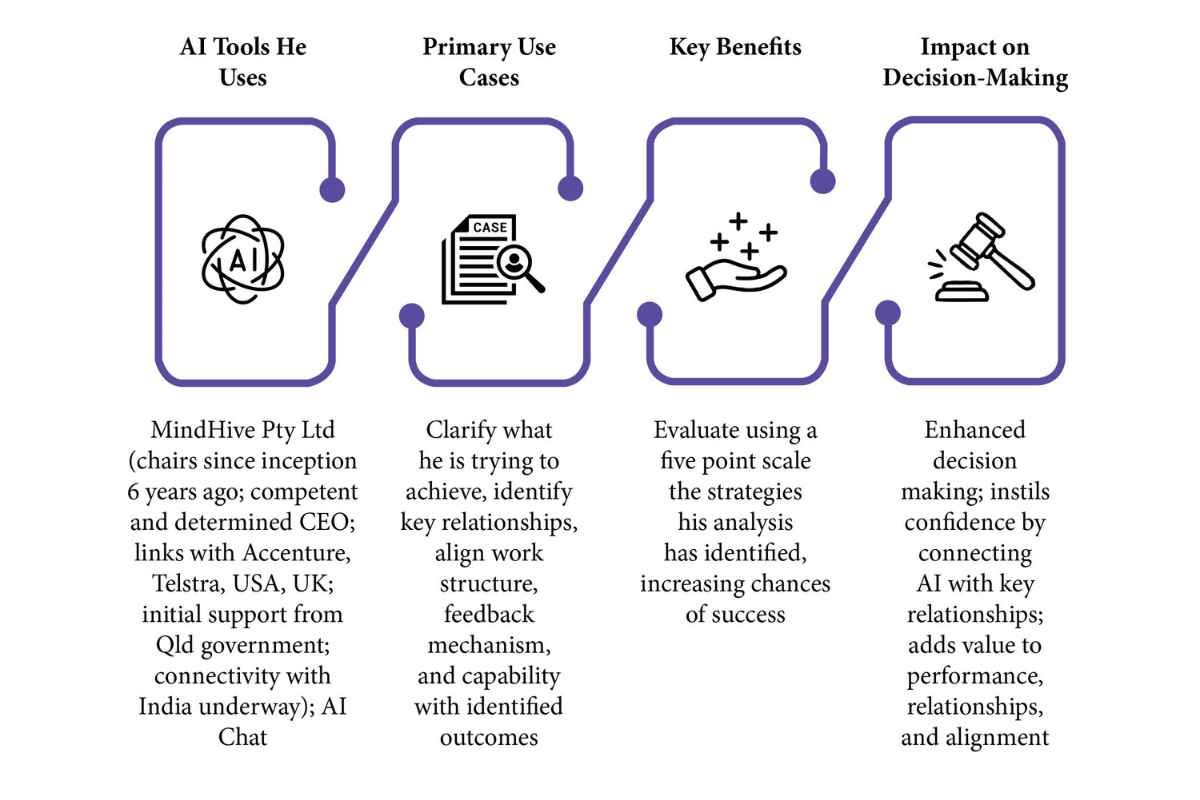
Technology serves as a powerful ally in this purpose-driven mission, with Jim Varghese AM leveraging AI in his daily operations through the following tools, applications, benefits, and impact on decision-making:
| Category | Details |
| AI Tools He Uses | MindHive Pty Ltd (chairs since inception 6 years ago; competent and determined CEO; links with Accenture, Telstra, USA, UK; initial support from Qld government; connectivity with India underway); AI Chat |
| Primary Use Cases | Clarify what he is trying to achieve, identify key relationships, align work structure, feedback mechanism, and capability with identified outcomes |
| Key Benefits | Evaluate, using a five-point scale, the strategies his analysis has identified, increasing chances of success |
| Impact on Decision-Making | Enhanced decision-making; instils confidence by connecting AI with key relationships; adds value to performance, relationships, and alignment |
The turning point, from campus crisis to a landslide victory
Every leader has a moment that shapes everything that follows, and for Jim Varghese AM, that pivotal moment presented in three simple parts remains foundational to his career today:
- Challenge:
- Union’s State: Since 1967, the University of Queensland Union was a confused melting pot of division, power struggles, general mal-administration, and half-baked experimentation, with Presidents hampered by Union Council and vice versa, and 1973 the high point of these forces.
- Crisis: Financial and administrative aspects needed overhaul, Refectory staff were in almost complete demoralisation, and credibility with students and the wider community was at an all-time low.
- C.A.T. Response: The Community Action Team was formed for the 1974 Union Council elections, demanding bold and imaginative policies with sound and practical administration, more support to student groups and groups outside, and a re-thinking of motives, not geared to any ideological or intellectual viewpoint (Varghese, J, 1974 August 15, Cat didn’t pussyfoot, Semper Floreat, p6).
- Personal Challenge: To contest the university student leader elections, securing a seat on the university Senate.
- Action: He formed an election team called Community Action Ticket (CAT) and ran against several popular candidates, including a team called Radical Action Ticket (RAT).
- Outcome: The election result was almost a clean sweep, with CAT winning 21 of the 22 seats on the Student Union Council.
The success code, an enduring lesson
My enduring lesson from all my experiences on my journey to date is to nurture spiritual direction and energy to achieve excellence to drive humanity to create better communities, and to motivate individuals to make a positive difference. The future for a better humanity rests with this type of leadership, which can be facilitated by combining artificial intelligence with relationships. This can be easily achieved by using the Three Frames for Success.
The overlooked capability: why alignment will define leadership by 2030
Looking toward 2030, Jim Varghese AM believes that the leadership capability organisations are currently underinvesting in is the alignment of structure, feedback, and capability, as organisations appear to be focusing only on performance and relationships, with little or no commitment to following this critical third dimension.
He warns that the failure to do this will result in serious failures because of the lack of matched machinery and talent, and the interactive systems that catch failures early.