


“Why am I working so hard for this?” It’s the question that surfaces during late-night study sessions, right after a failed exam, or when academic burnout sets in. Sharing inspirational stories for students provides the concrete proof young learners need to see that temporary setbacks are simply stepping stones to long-term mastery. These inspirational stories for students highlight real-world examples of perseverance, practical takeaways for overcoming exam anxiety, and actionable strategies to stay motivated through challenging coursework.
These inspirational stories for students can change their perspective, strengthen their resilience, and encourage them to believe in their ability to overcome challenges.
8 inspirational stories for students to overcome setbacks
Many inspirational stories for students begin with a problem, a setback, or an idea that others overlook. The people in these stories took different paths, but their experiences offer practical lessons in persistence, problem-solving, and decision-making. Each of these inspirational stories for students shows how they can turn valuable lessons into action in their academic and entrepreneurial lives. It shows how learning through failure can lead to building a business around a real customer need.
1. Thomas Edison: Learn Through Testing and Failure

Thomas Edison’s journey is one of the inspirational stories for students that demonstrates how experimentation, persistence, and learning from failure can lead to progress. His success came through repeated experiments, teamwork, and the development of inventions that could work outside the laboratory. The familiar claim that Edison failed exactly 10,000 times while inventing the light bulb is often repeated, but it should not be treated as a verified count. The Smithsonian has documented how popular accounts of Edison’s failures can leave out important details about his work.
Business lesson: Treat mistakes as information. A failed test can show which part of an idea needs to change.
A student who wants to start a small business can use the same approach. Instead of spending money on a large stock of products, they can make a few samples, ask potential customers what they think, and improve the offer before investing more. Testing early can reduce waste and help students make decisions based on evidence rather than guesswork.
2. Malala Yousafzai: build around a clear purpose
Malala Yousafzai spoke out for girls’ right to education in Pakistan. In 2012, she survived an attack by the Taliban, and she continued her education advocacy after recovering. In 2014, at age 17, she became the youngest Nobel Peace Prize laureate. Among inspirational stories for students, Malala Yousafzai’s journey highlights the importance of education, courage, and building a life around a meaningful purpose.
Business lesson: A clear purpose can guide decisions and help people understand why your work matters.
For a student founder, purpose should connect to a real need. A tutoring service might help students who struggle with a particular subject. A campus project could make affordable study materials easier to access. The idea needs more than a good cause, however. It also needs a practical plan, a clear audience, and a way to measure whether it is helping.
3. Stephen Hawking: Adapt when conditions change

Stephen Hawking was diagnosed with motor neuron disease at age 21. Doctors initially expected him to live for only a few more years. Stephen Hawking’s journey offers one of the inspirational stories for students about adapting to challenges while continuing to pursue ambitious academic goals. His biography records how he continued his academic work despite major changes to his mobility and speech.
Business lesson: When your original plan no longer works, look for another way to reach the goal.
Students may face limited time, a small budget, poor early results, or a lack of experience. Instead of abandoning a project at the first obstacle, they can change the method. A student who struggles with a subject could try a study group or a different learning tool. A young founder could offer a service online before paying for a physical shop.
4. J.K. Rowling: Keep improving your work
J.K. Rowling’s journey is among the inspirational stories for students that show how patience, consistent effort, and responding to rejection can help people pursue their goals. She has described writing the book while raising her daughter and working in spare moments. After she finished the manuscript, her literary agent took about a year to find a publisher. Bloomsbury published Harry Potter and the Philosopher’s Stone in 1997.
Business lesson: Rejection is feedback, but it is not always a final judgment on your work.
Students can use this lesson when they apply for internships, pitch an idea, or present a project. When someone says no, they should try to understand why. Was the idea unclear? Did it solve a problem the audience cared about? Was the timing wrong? Learning from specific feedback gives students something useful to improve before trying again.
5. Abraham Lincoln: Learn from setbacks
Abraham Lincoln had limited access to formal schooling as a child and spent much of his early life working. He taught himself through reading and later trained as a lawyer. His early career included a failed business partnership and unsuccessful election campaigns. The US National Park Service records these setbacks as part of his path before he became the 16th president of the United States.
Business lesson: One setback does not define your ability. Review what happened and decide what to do next.
Students do not need to succeed at every exam, competition, or interview to make progress. They can review a poor result, identify the gaps in their preparation, and set a plan to address them. The same process applies to business: if a product does not sell, investigate the price, quality, audience, and demand before deciding whether to improve it or try a different idea.
6. Melanie Perkins: Solve a problem people have

Melanie Perkins began working on the idea behind Canva after seeing how difficult design software could be for students. While at university, she taught classmates to use programs such as InDesign and Photoshop. She saw an opportunity to make design easier for people without advanced technical skills. Before Canva launched in 2013, she and co-founder Cliff Obrecht built a school yearbook business called Fusion Books. Canva later grew into an online design platform used around the world. In its 2025 year in review, Canva reported 260 million monthly users and $3.5 billion in revenue.
Business lesson: Start with a problem you understand, then build a solution people can use.
Perkins did not begin by trying to serve everyone. She first worked on a specific problem involving school yearbooks and design tools. This example makes Melanie Perkins one of the useful inspirational stories for students interested in entrepreneurship, innovation, and solving everyday problems. They could help local clubs make better posters, build a simple website for a family business, or create a tool that makes a common school task easier. Early projects can help them learn what people need before they invest heavily in an idea.
7. Aadit Palicha and Kaivalya Vohra: Test a need in the market
Aadit Palicha and Kaivalya Vohra co-founded Zepto in 2021, entering India’s fast-growing quick commerce market. The company built a service around a simple customer need: getting groceries and daily essentials delivered quickly. In October 2025, Zepto raised $450 million in a funding round that valued the company at $7 billion. The company’s growth also reflects a highly competitive market, where speed, stock availability, delivery costs, and customer loyalty all matter.
Business lesson: A promising idea must solve a real problem and work as a business.
Students should not assume that an idea will succeed simply because it sounds exciting. They can begin by interviewing potential customers, comparing existing options, and testing a small version of their service. If they want to sell snacks on campus, for example, they could first check what students want, how much they will pay, and whether the costs leave room for profit.
Zepto’s story also offers a caution: growth alone does not guarantee lasting success. A business must keep customers satisfied while managing costs and competing with other providers.
8. Inspirational Stories for Students: IIT Delhi founders solve real problems
Students do not need to wait until graduation to work on a business idea. In 2022, four student-led startups at the Indian Institute of Technology Delhi received grants of ₹50 lakh each through the institute’s Endowment Nurture Fund initiative. Their ideas addressed different needs: Circle focused on financial wellness for employees, Bag-It aimed to digitize parts of the jewellery supply chain, Onpery worked on menstrual health, and I-Stem developed digital accessibility solutions for people with disabilities.
Business lesson: A useful business can begin with a narrow problem that people need help solving.
These projects show that entrepreneurship is not limited to shopping apps or social media platforms. Students can build services for local businesses, create tools for people with disabilities, or find ways to improve access to everyday products. They can also seek help from university incubators, mentors, and startup grants where available.
The first goal is to understand the problem well. Students should speak with the people affected, learn how they manage it now, and test whether a proposed solution makes their lives easier.
How can students apply these lessons?
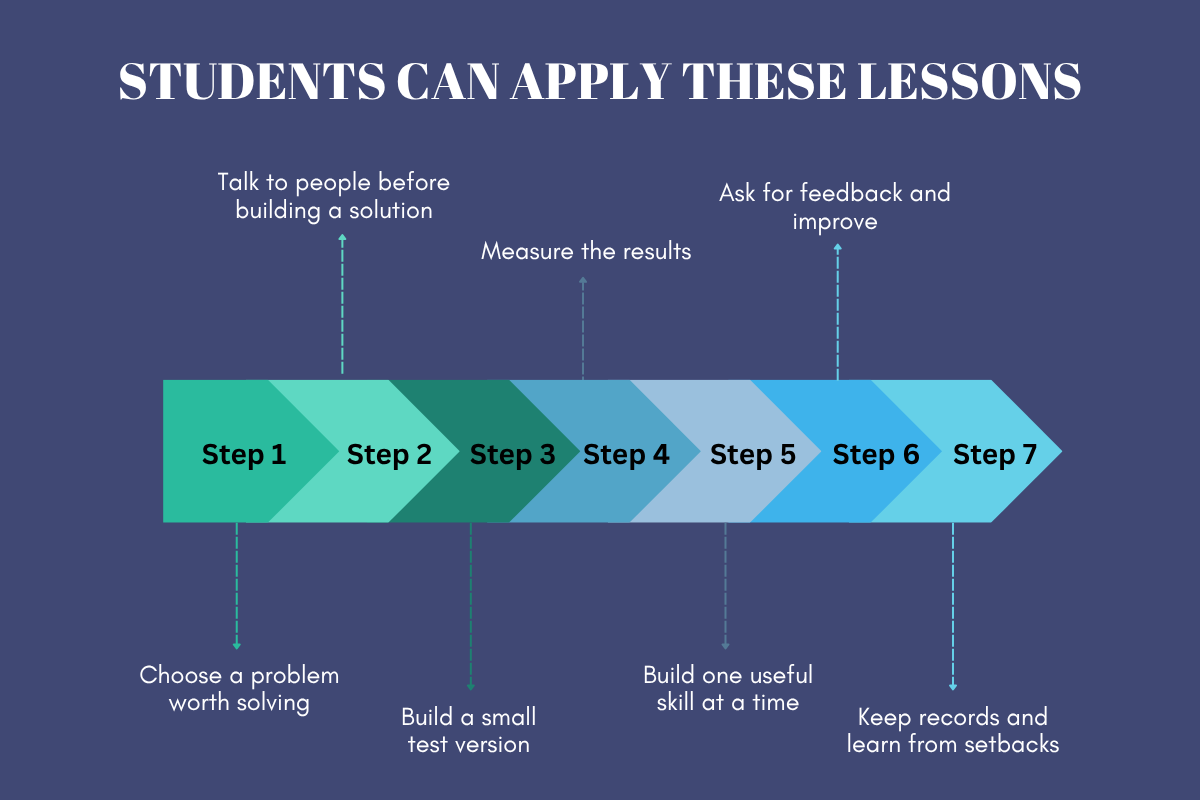
Reading about successful people is a useful start, but students gain more when they turn a lesson into action. These steps can help them build skills, test ideas, and make steady progress.
Step 1: Choose a problem worth solving
Look at everyday tasks in your school, college, home, or community. Notice where people waste time, face extra costs, or struggle to find a service. Write down a few problems and choose one that you can study with the time and resources you have.
Step 2: Talk to people before building a solution
Ask five to ten people who face the problem how they deal with it today. Find out what frustrates them, what they already use, and whether they would try another option. Do not ask only whether they like your idea. Ask about their real needs and past actions.
Step 3: Build a small test version
Start with the simplest useful version of your idea. That could be a sample product, a basic website, a tutoring session, or a service offered to a few people. Keep costs low so you can learn without taking on too much risk.
Step 4: Measure the results
Set a clear goal before the test. You could track how many people try the service, how many return, how much it costs to deliver, or how much time it saves. Use the results to decide what to change.
Step 5: Build one useful skill at a time
Choose a skill that supports your goal, such as writing, design, coding, sales, budgeting, or public speaking. Set aside regular time to practise it and use small projects to show what you can do. A finished project often teaches more than passive study alone.
Step 6: Ask for feedback and improve
Show your work to a teacher, mentor, customer, or experienced friend. Ask what is clear, what is confusing, and what should change first. Make one or two improvements, then test the updated version again.
Step 7: Keep records and learn from setbacks
Maintain a simple record of your goals, spending, feedback, and results. If a project fails, review the evidence before you decide whether to continue, change direction, or stop. Persistence matters, but it works best when paired with learning and sound judgment.
Conclusion:
Inspirational stories for students cannot replace hard work, but they can provide the motivation needed to overcome academic challenges and keep working toward long-term goals. When educators, parents, and mentors weave real-world inspirational stories for students into study routines, abstract goals transform into tangible paths toward personal growth. By pairing these stories with clear habit frameworks, daily study goals, and structured reflection, students build the internal grit required to turn temporary academic challenges into lasting achievements.
FAQs
1. How do inspirational stories for students help improve academic performance?
Inspirational stories for students encourage a growth mindset by showing how people learn from mistakes, handle academic setbacks, and continue working toward their goals.
2. What makes a story truly impactful for modern students?
The most effective inspirational stories for students describe real struggles, early failures, practical lessons, and specific actions students can apply to their own lives.
3. How can teachers integrate motivational stories into daily lesson plans without losing instructional time?
Educators can use short 2-minute real-world case studies as warm-up hooks at the start of class or connect historical figures directly to the core subject matter being taught.
4. At what age or grade level do students benefit most from motivational narratives?
While applicable at all ages, middle school and early high school students benefit most as they navigate increased academic pressure, identity formation, and career planning.
5. How Can Inspirational Stories for Students Help Measure Learning Progress?
Track qualitative indicators such as classroom engagement, assignment completion rates during tough units, and student self-reflection responses during academic goal-setting.