


Words can travel across centuries. A poem written hundreds of years ago can still make someone smile, cry, or pause for a quiet moment of thought. That is the magic of poetry. A few lines on a page can hold emotions, stories, and wisdom that never grow old. India holds one of the richest poetic traditions in the world, filled with deep feeling, cultural beauty, and timeless ideas.
Think about this for a moment. A saint once wrote a couplet on devotion. A king wrote a verse about loss. A young writer described the beauty of rain. Centuries later, readers still repeat those lines. For example, a famous couplet by Kabir says:
“काल करे सो आज कर, आज करे सो अब
पल में परलय होएगी, बहुरि करेगा कब”
It reminds people not to delay good work. Simple words. Powerful meaning.
From ancient Sanskrit verses to modern free-flowing poetry, many brilliant writers shaped this tradition. These writers are not just literary figures; they are voices of philosophy, devotion, protest, and imagination. When we talk about famous poets in India, we talk about storytellers who captured the emotions, beliefs, and dreams of an entire civilization.
Their poems speak about love, devotion, nature, struggle, and hope. Some describe rivers and forests. Some question society. Others express deep spiritual thoughts. Many famous indian poets turned simple words into timeless art that still influences writers, readers, and thinkers across the world.
That is the real power of poetry. A few lines written long ago can still feel fresh today. And the voices of famous indian poets continue to echo through generations.
Brief History of Indian Poetry
Indian poetry has a long and vibrant history that stretches back more than three thousand years. Early poetry appeared in the Vedas, sacred Sanskrit texts that blended spirituality with rhythmic expression. These verses formed the foundation of Indian literature and philosophy.
During the classical period, Sanskrit poetry reached great heights. Scholars and poets wrote epic stories, lyrical verses, and dramatic compositions. Some of the earliest famous poets in India came from this period and created works that scholars still study today.
Over time, poetry spread across regional languages such as Tamil, Kannada, Hindi, Bengali, and Marathi. Each region developed its own style, themes, and poetic forms. Devotional poetry also became powerful during the Bhakti movement, where poets expressed love and devotion to God in simple language.
Later, Persian and Urdu influences added new styles and themes. Ghazals, romantic verses, and philosophical poetry became popular. Several famous indian poets blended Indian thought with Persian poetic elegance.
In modern times, poetry began addressing social issues, freedom struggles, identity, and human emotions. Contemporary writers continue this tradition and prove that famous indian poets still shape literature and culture today.
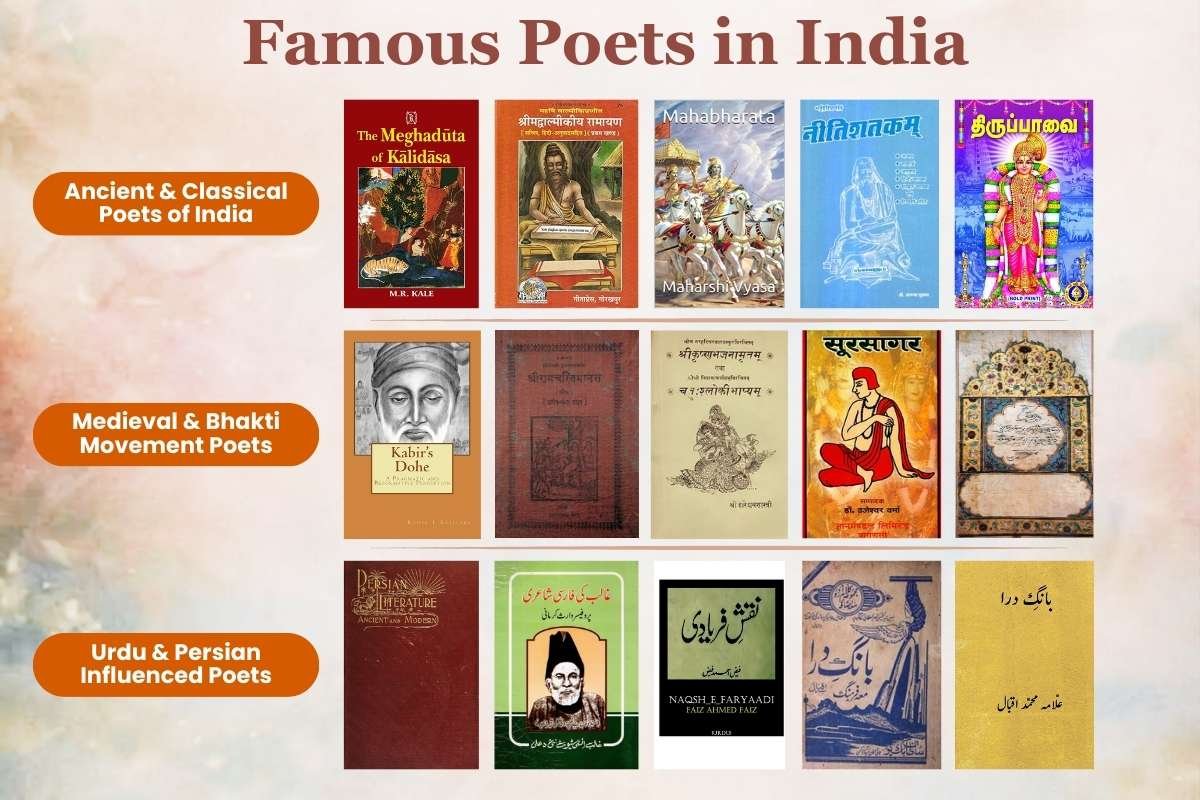
✦ Ancient & Classical Poets of India
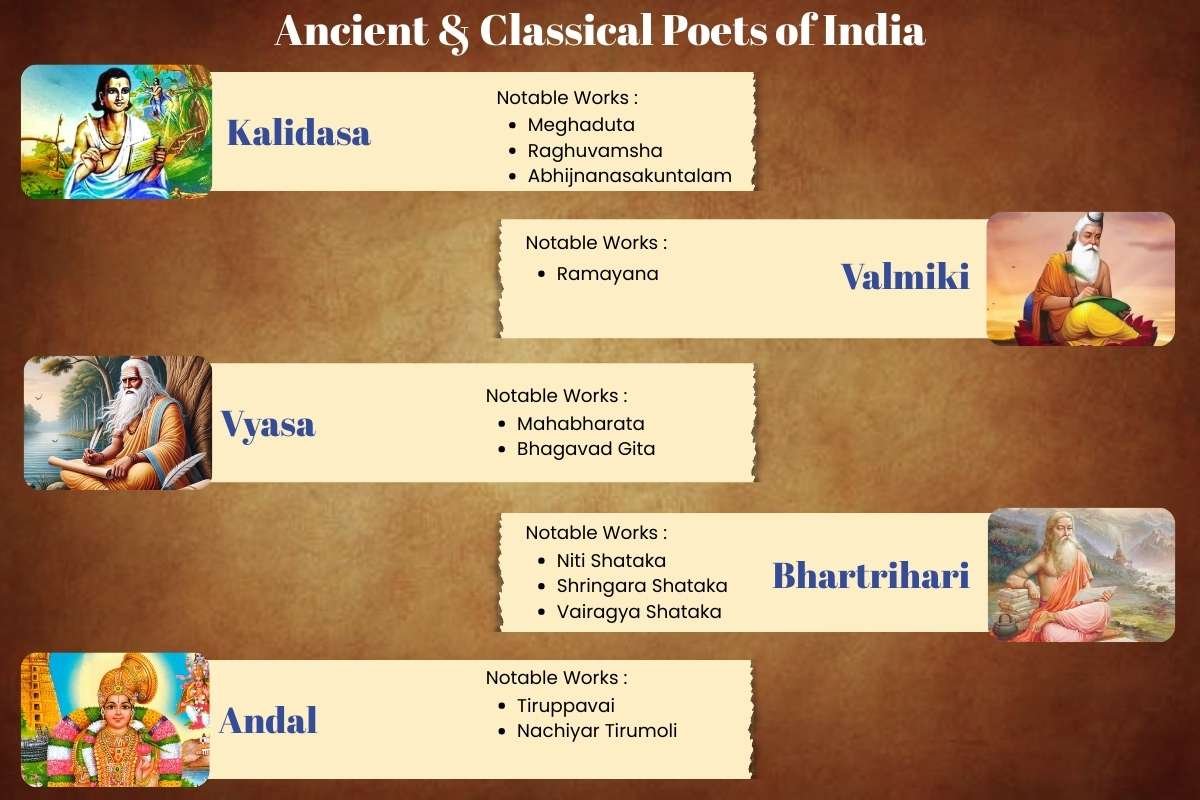
Ancient literature created the foundation of Indian poetry. Many early writers shaped philosophy, religion, and storytelling through powerful verses. These writers became some of the earliest famous poets in India, and their works still influence literature, education, and culture today.
Their poems often mixed storytelling, spirituality, nature, and deep human emotions. Even after many centuries, readers still admire their wisdom and creativity.
1. Kalidasa
- Born: Around 4th-5th century CE
- Type of Writing: Classical Sanskrit poetry and drama
- Notable Works:
- Meghaduta
- Raghuvamsha
- Abhijnanasakuntalam
- Journey
According to the Sahitya Akademi, Kalidasa is widely considered the greatest classical Sanskrit poet. His life story contains many legends. Some traditional stories say he started life with little education. Later, through dedication and divine inspiration, he became one of the most brilliant writers in Indian history.
His poetry shows deep observation of nature and human emotions. He wrote about love, separation, seasons, beauty, and spiritual ideas. His words paint pictures so clearly that readers feel they are standing inside the scene.
One of his famous works, Meghadūta, tells the story of a Yaksha who sends a message to his wife through a passing cloud. The poem describes mountains, rivers, forests, and cities in beautiful detail.
A well-known line from Meghadūta shows Kalidasa’s poetic elegance:
- Original Sanskrit:
“कश्चित् कान्ता विरहगुरुणा स्वाधिकारात् प्रमत्तः”
- Meaning:
A lover, deeply troubled by separation from his beloved, loses focus on his duties.
Kalidasa’s works also inspired theater and drama. His play Abhijnanasakuntalam became famous worldwide and was translated into many languages. Because of his ability to combine nature, emotion, and storytelling, Kalidasa holds a permanent place among the most famous poets in India.
2. Valmiki
- Born: Ancient era (traditionally before 500 BCE)
- Type of Writing: Epic poetry
- Notable Works:
- Ramayana
- Journey
Valmiki is widely known as the first poet of Sanskrit literature. Many traditions call him Adi Kavi, which means the first poet.
According to legend, Valmiki once lived as a hunter or robber. A spiritual awakening changed his life. He turned toward meditation and learning. This transformation shaped his spiritual and literary journey.
One day, he saw a hunter kill a bird while it was flying with its partner. The pain of that moment moved him deeply. A verse came out of his heart spontaneously. This became the first Sanskrit shloka, marking the beginning of poetic expression in classical literature.
The verse is still remembered today:
- Original Sanskrit:
“मा निषाद प्रतिष्ठां त्वमगमः शाश्वतीः समाः
यत्क्रौंचमिथुनादेकम् अवधीः काममोहितम्”
- Meaning:
You will never gain peace, because you killed one of the birds while it was united with its mate.
This emotional moment led Valmiki to compose the Ramayana, one of the most important epics in world literature.
The Ramayana tells the story of Lord Rama, Sita, Lakshmana, and Hanuman. It teaches values such as truth, loyalty, courage, and righteousness.
For thousands of years, this epic influenced literature, religion, theater, and culture across Asia. Because of this impact, Valmiki stands proudly among the earliest famous poets in India.
3. Vyasa
- Born: Ancient era
- Type of Writing: Epic and philosophical poetry
- Notable Works:
- Mahabharata
- Bhagavad Gita
- Journey
Vyasa is one of the most respected sages in Indian literary history. He is believed to have composed the Mahabharata, the longest epic poem ever written.
The Mahabharata contains more than 100,000 verses. It tells the story of a royal family conflict between the Pandavas and Kauravas. The story includes politics, family struggles, moral choices, and deep philosophical teachings.
Inside this epic lies the Bhagavad Gita, a sacred dialogue between Lord Krishna and the warrior Arjuna. The conversation addresses duty, faith, and the purpose of life.
One of the most famous verses from the Bhagavad Gita says:
- Original Sanskrit:
“कर्मण्येवाधिकारस्ते मा फलेषु कदाचन”
- Meaning:
Focus on your actions, not on the results.
This simple yet powerful idea has guided millions of people for centuries.
Vyasa’s writings are not only stories. They are lessons about life, ethics, leadership, and spirituality. Because of his deep influence on philosophy and religion, he remains one of the most respected poets in India.
4. Bhartrihari
- Born: Around the 5th century CE
- Type of Writing: Sanskrit philosophical poetry
- Notable Works:
- Niti Shataka
- Shringara Shataka
- Vairagya Shataka
- Journey
Bhartrihari is known for writing short, powerful verses that capture deep life lessons. His works are divided into three main collections.
- Niti Shataka – wisdom about ethics and good behavior
- Shringara Shataka – poems about love and beauty
- Vairagya Shataka – reflections on detachment and spiritual life
His poetry often speaks about human weakness, ambition, desire, and wisdom. Many of his verses remain popular in moral education.
One famous verse from Niti Shataka says:
- Original Sanskrit:
“विद्या नाम नरस्य रूपमधिकं प्रच्छन्नगुप्तं धनम्”
- Meaning:
Knowledge is the true beauty of a person and the most secure wealth.
This idea shows Bhartrihari’s belief that learning and wisdom matter more than material success.
His poetry is simple yet powerful. Each verse carries a lesson about life and society. Because of this clarity and wisdom, Bhartrihari remains one of the most respected poets in India.
5. Andal
- Born: 8th century CE
- Type of Writing: Tamil devotional poetry
- Notable Works:
- Tiruppavai
- Nachiyar Tirumoli
- Journey
Andal is one of the most beloved female poet saints in Tamil literature. She is also the only female Alvar saint among the twelve Alvars of the Vaishnava tradition.
According to tradition, she was found as a baby in a garden by a devotee named Periyalvar. He raised her with love and devotion to Lord Vishnu.
As she grew older, Andal began writing poems expressing deep spiritual love for Lord Krishna. Her devotion was so intense that she imagined herself as the bride of the divine.
Her famous work Tiruppavai contains thirty devotional songs that people still sing during the Tamil month of Margazhi.
One famous line from Tiruppavai reads:
- Original Tamil:
“மார்கழித் திங்கள் மதிநிறைந்த நன்னாளால்”
- Meaning:
On this beautiful full-moon day of the Margazhi month, we begin our sacred devotion.
Her poetry blends devotion, joy, and spiritual longing. Andal’s songs remain part of temple traditions and cultural celebrations even today.
Because of her powerful spiritual voice, Andal stands proudly among the most inspiring poets in India.
✦ Medieval & Bhakti Movement Poets
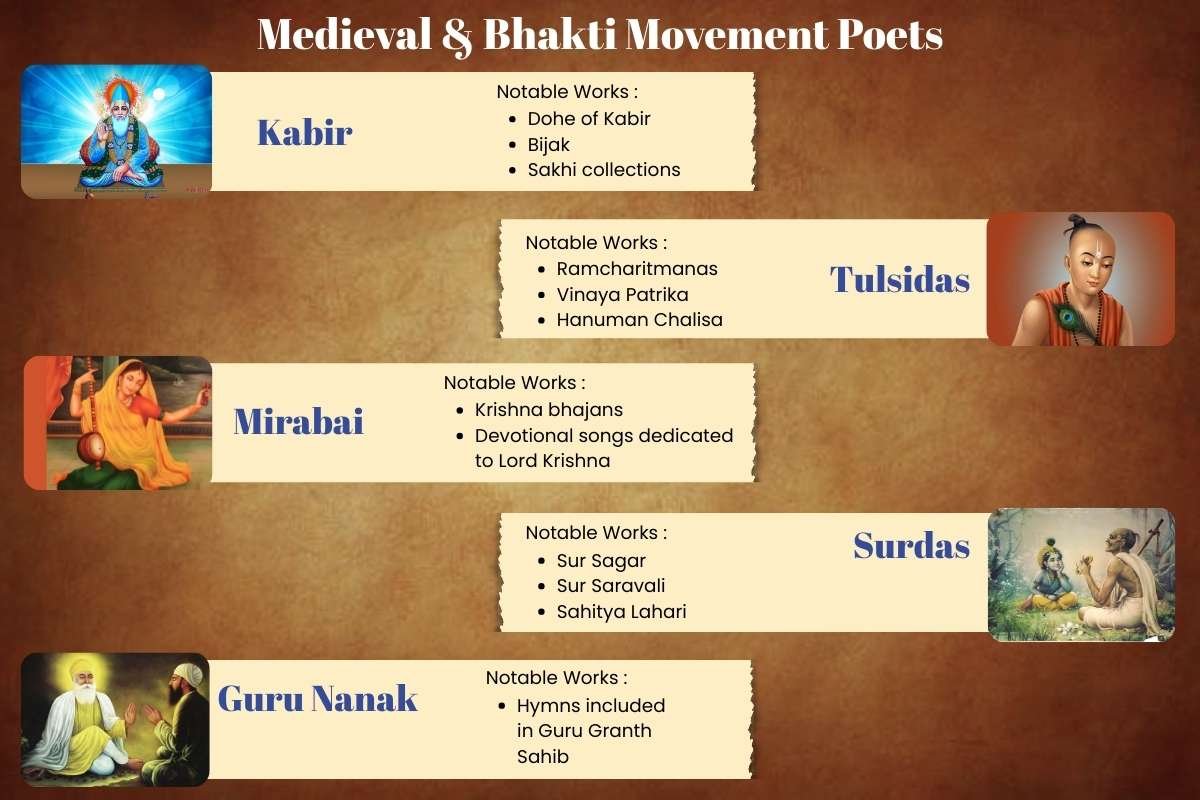
The Bhakti movement changed the direction of Indian literature and spirituality. Before this period, much religious writing existed in Sanskrit, which many ordinary people could not understand. Bhakti poets changed that pattern. Historians note that the Bhakti movement between the 12th and 17th centuries helped democratize spiritual literature by shifting poetry from Sanskrit to regional languages. They wrote in simple local languages and spoke directly to people about devotion, humanity, and truth.
Many famous poets in India from this period focused on love for God instead of rituals and social divisions. Their poems carried strong emotional power and deep wisdom. Even today, their verses appear in prayers, songs, and cultural traditions across India.
Below is a detailed journey of five important poets from the Bhakti era.
6. Kabir
- Born: 1440 | Died: 1518
- Type of Writing: Devotional and philosophical poetry
- Notable Works:
- Dohe of Kabir
- Bijak
- Sakhi collections
- Journey
Kabir lived during a time when religion often divided people. Many communities followed strict rituals and traditions. Arguments between religious groups created tension in society.
Kabir rejected these divisions. He believed that truth and God existed beyond labels like Hindu or Muslim. His poetry encouraged people to focus on inner spirituality instead of outer rituals.
According to tradition, Kabir grew up in a family of weavers in Varanasi. His parents earned a living through simple work. This humble background helped Kabir understand the struggles of ordinary people. Because of this experience, he wrote in simple language so everyone could understand his message.
Kabir became famous for his dohe, short two-line poems that contain deep meaning. These verses speak about ego, ignorance, truth, and the search for God.
One of his most famous dohe says:
“बुरा जो देखन मैं चला, बुरा न मिलिया कोय
जो दिल खोजा आपना, मुझसे बुरा न कोय।”
- Meaning:
When I searched for evil in others, I found none.
When I looked inside my own heart, I discovered my own faults.
Another well-known verse teaches patience:
“धीरे धीरे रे मना, धीरे सब कुछ होय
माली सींचे सौ घड़ा, ऋतु आए फल होय।”
- Meaning:
Everything in life happens slowly and naturally. Even if a gardener pours water every day, fruit appears only in the right season.
Kabir travelled across many regions sharing his ideas through songs and spoken poetry. His followers came from both Hindu and Muslim communities. Many of his teachings later formed spiritual traditions such as the Kabir Panth.
His fearless voice and simple wisdom still inspire readers today. For this reason, Kabir remains one of the most famous indian poets.
7. Tulsidas
- Born: 1532 | Died: 1623
- Type of Writing: Devotional poetry
- Notable Works:
- Ramcharitmanas
- Vinaya Patrika
- Hanuman Chalisa
- Journey
Tulsidas became one of the most influential spiritual poets in Indian history. He lived in an era when Sanskrit texts dominated religious learning. However, most people could not read or understand Sanskrit.
Tulsidas wanted to change this. He believed that spiritual knowledge should reach everyone, not only scholars. Because of this vision, he chose to write in Awadhi, a language spoken by common people in North India.
His greatest creation is Ramcharitmanas, a poetic retelling of the story of Lord Rama. The poem explains values such as duty, kindness, courage, and devotion. Villagers, families, and storytellers across India began reading and singing this work.
One of the famous lines from the text expresses faith in Lord Rama:
“सिया राममय सब जग जानी
करउँ प्रनाम जोरि जुग पानी।”
- Meaning:
The whole world is filled with the presence of Rama and Sita.
With folded hands, I bow to everything around me.
Another popular creation by Tulsidas is the Hanuman Chalisa, a devotional hymn that millions of people recite daily.
- Example verse:
“जय हनुमान ज्ञान गुण सागर
जय कपीस तिहुँ लोक उजागर।”
- Meaning:
Victory to Hanuman, ocean of wisdom and virtue. Victory to the leader of the monkeys who brings light to the three worlds.
Tulsidas travelled widely and shared stories of Rama through public recitations and poetry gatherings. His storytelling style made spiritual teachings easy to understand.
Through his devotion and literary brilliance, Tulsidas became one of the most beloved famous indian poets.
8. Mirabai
- Born: 1498 | Died: 1546
- Type of Writing: Devotional poetry
- Notable Works:
- Krishna bhajans
- Devotional songs dedicated to Lord Krishna
- Journey
Mirabai stands among the most inspiring women in Indian literary history. She was born into a royal Rajput family in Rajasthan. Despite the comfort of royal life, her heart belonged completely to Lord Krishna.
From childhood, Mirabai believed Krishna was her spiritual companion. Her devotion grew stronger as she grew older. She wrote poems that describe love for Krishna with deep emotion and surrender.
Society expected royal women to follow strict traditions and political responsibilities. Mirabai chose a different path. She openly sang devotional songs and joined gatherings of saints and devotees.
Many people criticized her actions. Some even tried to stop her spiritual practices. However, Mirabai remained fearless and continued writing poetry.
One of her famous verses expresses her devotion:
“मेरे तो गिरधर गोपाल, दूसरो न कोई।”
- Meaning:
Krishna alone belongs to me.
I accept no one else as my guide.
Another well-known line reflects her spiritual longing:
“पायो जी मैंने राम रतन धन पायो।”
- Meaning:
I have found the priceless jewel of devotion.
Mirabai’s poetry speaks about love, separation, surrender, and faith. Her songs still appear in devotional music, classical performances, and temple prayers.
Her courage and devotion secured her place among the most famous poets in India.
9. Surdas
- Born: 1478 | Died: 1583
- Type of Writing: Devotional poetry
- Notable Works:
- Sur Sagar
- Sur Saravali
- Sahitya Lahari
- Journey
Surdas became one of the most famous devotional poets dedicated to Lord Krishna. Tradition says he was blind from childhood. Despite this challenge, his imagination created vivid and beautiful poetic images.
Surdas became a follower of the Vallabhacharya tradition within the Bhakti movement. This spiritual path focused on loving devotion to Krishna, especially the playful child form of the deity.
His most famous work, Sur Sagar, contains thousands of verses describing the childhood of Krishna. These poems show Krishna playing with friends, stealing butter, and bringing joy to the village of Vrindavan.
One popular verse describes the playful child Krishna:
“मैया मोरी मैं नहीं माखन खायो।”
- Meaning:
Mother, I did not eat the butter.
This simple line captures the innocent charm of Krishna while also showing Surdas’s storytelling skill.
Surdas possessed an extraordinary ability to describe emotions and scenes. His poetry paints pictures through sound, rhythm, and feeling.
People loved his verses because they felt warm and joyful. Devotees still sing Surdas’s poetry in temples and classical music traditions.
His creative imagination and devotion made him one of the most beloved poets in India.
10. Guru Nanak
- Born: 1469 | Died: 1539
- Type of Writing: Spiritual poetry
- Notable Works:
- Hymns included in Guru Granth Sahib
- Journey
Guru Nanak was a spiritual teacher, philosopher, and poet. He founded the Sikh faith and shared teachings that focused on equality, compassion, and devotion to one God.
During his lifetime, society faced divisions based on religion, caste, and wealth. Guru Nanak strongly opposed these divisions. He taught that every human being holds equal value.
Instead of long philosophical speeches, he used poetic hymns to communicate spiritual wisdom.
These hymns combined music, rhythm, and powerful ideas.
One of his famous lines expresses the unity of God:
“इक ओंकार सतनाम।”
- Meaning:
There is one universal creator whose name is truth.
Another famous hymn says:
“ना कोई हिंदू ना मुसलमान।”
- Meaning:
No one is purely Hindu or Muslim.
All belong to the same divine truth.
Guru Nanak travelled widely across India, Tibet, Arabia, and Central Asia. These journeys are called Udasis. During these travels, he spoke with people from different cultures and beliefs.
His hymns later became part of the Guru Granth Sahib, the sacred scripture of Sikhism. Millions of people still sing these verses every day in Gurudwaras around the world.
Because of his spiritual vision and poetic wisdom, Guru Nanak remains one of the most influential famous indian poets.
✦ Urdu & Persian Influenced Poets
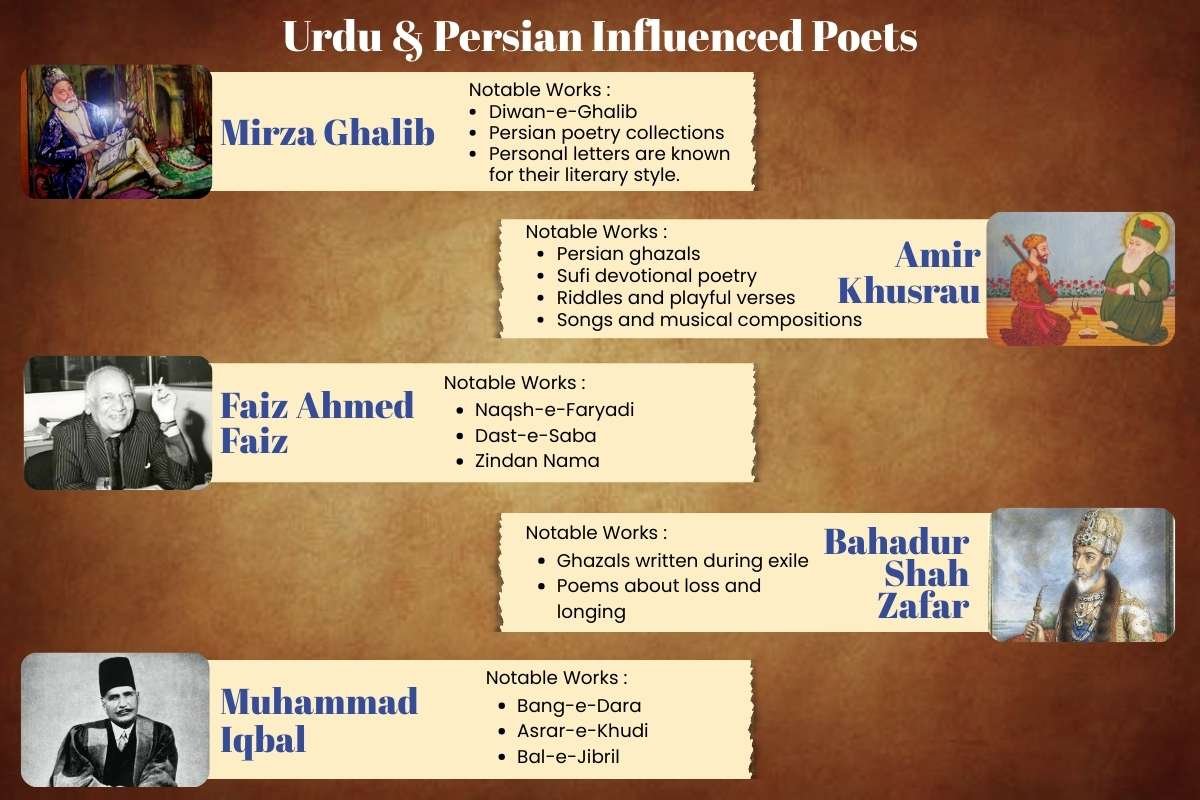
Persian culture played a powerful role in shaping literary traditions across the Indian subcontinent, especially during the Delhi Sultanate and Mughal periods. Poetry written in Persian and later Urdu became highly popular among scholars, royal courts, and common people. These traditions introduced elegant poetic forms such as ghazals, qasidas, and rubaiyat.
Many famous poets in India used these styles to express love, philosophy, spirituality, and social concerns. Their words carried deep emotion and artistic beauty. Even today, their poetry remains widely read, quoted, and sung across India and beyond.
Below are some of the most influential poets who helped build this rich tradition.
11. Mirza Ghalib
- Born: 1797 | Died: 1869
- Type of Writing: Urdu ghazals and Persian poetry
- Notable Works:
- Diwan-e-Ghalib
- Persian poetry collections
- Personal letters are known for their literary style.
- Journey
Mirza Ghalib stands among the most celebrated literary figures in South Asian history. His poetry reflects deep thinking about life, love, destiny, and human weakness. Because of this emotional depth, he remains one of the most respected poets in India.
Ghalib was born in Agra during the final years of Mughal influence. His childhood was not easy. His father died when he was only five years old. Soon after, he also lost his uncle, who had been caring for the family. These early tragedies shaped his personality and later appeared in his poetry.
At the age of thirteen, Ghalib married and moved to Delhi. During that time, Delhi was still a center of culture and literature. Many poets gathered there to exchange ideas and recite poetry.
Ghalib first wrote extensively in Persian because it was considered the language of scholars.
However, his Urdu ghazals later brought him greater fame.
His poetry often questions life in a playful yet thoughtful way. He loved wordplay, irony, and philosophical reflection.
One of his most famous couplets says:
“हज़ारों ख़्वाहिशें ऐसी कि हर ख़्वाहिश पे दम निकले
बहुत निकले मेरे अरमान लेकिन फिर भी कम निकले”
Hazaaron khwahishen aisi ke har khwahish pe dam nikle
Bahut nikle mere armaan lekin phir bhi kam nikle
- Meaning in simple words:
A person can have thousands of desires, yet even when many come true, the heart still wants more.
This verse reflects Ghalib’s deep understanding of human nature.
Ghalib also lived through the Revolt of 1857, which destroyed much of old Delhi. The Mughal court collapsed, and many artists lost their support. Ghalib’s letters written during this time show sadness for the cultural world that had disappeared.
Despite hardship, his poetic genius survived. His ability to combine humor, sorrow, philosophy, and beauty keeps him firmly among the most famous indian poets.
12. Amir Khusrau
- Born: 1253 | Died: 1325
- Type of Writing: Persian and Hindavi poetry
- Notable Works:
- Persian ghazals
- Sufi devotional poetry
- Riddles and playful verses
- Songs and musical compositions
- Journey
Amir Khusrau is often called the Parrot of India because of his musical and poetic brilliance. His work connects Persian literary traditions with Indian cultural life. Because of this creative blend, he remains one of the earliest famous poets in India to build a shared literary identity.
He was born in present-day Uttar Pradesh. His father came from Central Asia, while his mother belonged to an Indian family. This mixed cultural background shaped his worldview.
Khusrau showed remarkable talent during childhood. He began writing poetry at a very young age. His creative skills soon attracted attention in royal courts.
Several rulers of the Delhi Sultanate invited him to become their court poet. His poetry entertained kings, scholars, and ordinary people.
However, Khusrau’s life was not limited to royal circles. His spiritual journey deeply influenced his work. He became a devoted follower of the great Sufi saint Nizamuddin Auliya.
His love and respect for his spiritual teacher appear in many poems. One famous verse expresses his devotion:
“छाप तिलक सब छीनी रे मोसे नैना मिलाइके”
Chaap tilak sab cheeni re mose naina milaike
- Meaning in simple words:
A single glance of love has taken away my identity and ego.
This line expresses the Sufi idea that divine love removes the ego and connects the soul with God.
Khusrau also wrote playful riddles and folk-style verses that people still enjoy today. One famous riddle goes like this:
“एक थाल मोती से भरा
सबके सिर पर औंधा धरा”
- Meaning:
A plate full of pearls was placed upside down above everyone’s head. The answer is the sky full of stars.
Beyond poetry, Khusrau influenced Indian classical music. Many historians believe he helped shape musical forms such as qawwali and khayal.
Because of his enormous cultural impact, he remains one of the most admired poets in India.
13. Faiz Ahmed Faiz
- Born: 1911 | Died: 1984
- Type of Writing: Revolutionary and progressive poetry
- Notable Works:
- Naqsh-e-Faryadi
- Dast-e-Saba
- Zindan Nama
- Journey
Faiz Ahmed Faiz brought a powerful new voice to Urdu poetry in the twentieth century. His work blends romance, political awareness, and human compassion. Because of this unique style, he became one of the most influential modern poets in India and South Asia.
Faiz was born in Sialkot, a city known for its intellectual culture. His father was a respected scholar who encouraged reading and discussion at home.
Faiz studied English literature and Arabic, which exposed him to global literary traditions. His early poems reflected classical ghazal influences.
However, Faiz soon began writing about social injustice and political struggle. He believed poetry should not only describe beauty but also speak for oppressed people.
One of his most famous lines expresses this belief:
“बोल कि लब आज़ाद हैं तेरे
बोल ज़ुबाँ अब तक तेरी है”
Bol ke lab azaad hain tere
Bol zubaan ab tak teri hai
- Meaning in simple words:
Speak, because your lips are free. Speak while your voice still belongs to you.
This poem became a powerful symbol of freedom and resistance.
Faiz also faced imprisonment because of his political views. During his time in jail, he wrote some of his most moving poetry. His prison poems express hope even during suffering.
One touching line from his prison poetry says:
“मताए-लौह-ओ-क़लम छिन गई तो क्या ग़म है
कि ख़ून-ए-दिल में डुबो ली हैं उँगलियाँ मैंने”
- Meaning:
Even if my pen and paper are taken away, I will write with the blood of my heart.
Faiz’s poetry continues to inspire readers who believe in justice and human dignity. Because of this lasting influence, he remains among the most admired poets in India and the wider region.
14. Bahadur Shah Zafar
- Born: 1775 | Died: 1862
- Type of Writing: Urdu ghazals
- Notable Works:
- Ghazals written during exile
- Poems about loss and longing
- Journey
Bahadur Shah Zafar is remembered both as the last Mughal emperor and a deeply emotional poet. His poetry reflects the sadness of a fading empire and the pain of personal loss.
Zafar was born in the Mughal royal family in Delhi. His childhood took place inside a palace filled with music, art, and poetry. The Mughal court supported many poets and artists.
Although he eventually became emperor, real political power had already shifted to the British. Still, Delhi remained an important literary center.
Zafar himself loved writing poetry. He often participated in mushairas, gatherings where poets recited their work.
The most tragic part of his life came after the Revolt of 1857. The rebellion failed, and the British captured Delhi. Zafar was removed from the throne and sent into exile in Rangoon.
Far from his homeland, he spent his final years in loneliness.
One of his most famous couplets expresses this sorrow:
“लगता नहीं है दिल मेरा उजड़े दयार में
किसकी बनी है आलम-ए-नापायेदार में”
- Meaning:
My heart does not feel at home in this ruined land.
After all, nothing in this world lasts forever.
Another heartbreaking verse says:
“कितना है बदनसीब ज़फ़र दफ़्न के लिए
दो गज़ ज़मीन भी न मिली कू-ए-यार में”
- Meaning:
How unfortunate is Zafar that even for burial
He did not receive two yards of land in his beloved homeland.
These verses show deep personal grief and historical tragedy. Because of this emotional power, Zafar remains one of the most memorable famous indian poets.
15. Muhammad Iqbal
- Born: 1877 | Died: 1938
- Type of Writing: Philosophical and inspirational poetry
- Notable Works:
- Bang-e-Dara
- Asrar-e-Khudi
- Bal-e-Jibril
- Journey
Muhammad Iqbal was a poet, philosopher, and thinker whose work focused on human potential and self-awareness. His poetry encouraged individuals to rise above fear and weakness.
Iqbal was born in Sialkot and showed strong intellectual ability from a young age. His teachers quickly recognized his talent for language and philosophy.
He later studied in England and Germany, where he encountered Western philosophical ideas. These experiences influenced his thinking about society, identity, and spiritual strength.
Iqbal believed that every human being holds powerful inner potential. He expressed this idea through the concept of Khudi, which means self-respect and inner strength.
One of his famous verses says:
“ख़ुदी को कर बुलंद इतना
कि हर तक़दीर से पहले
ख़ुदा बंदे से खुद पूछे
बता तेरी रज़ा क्या है”
- Meaning:
Develop your character so strongly that destiny itself asks you what future you desire. This verse encourages confidence, courage, and self-belief.
Iqbal’s poetry also reflects cultural identity and spiritual awakening. His philosophical depth gave his work global recognition.
Because of his intellectual influence and poetic brilliance, he remains one of the most respected poets in India and the broader literary world.
✦ Modern & Contemporary Indian Poets
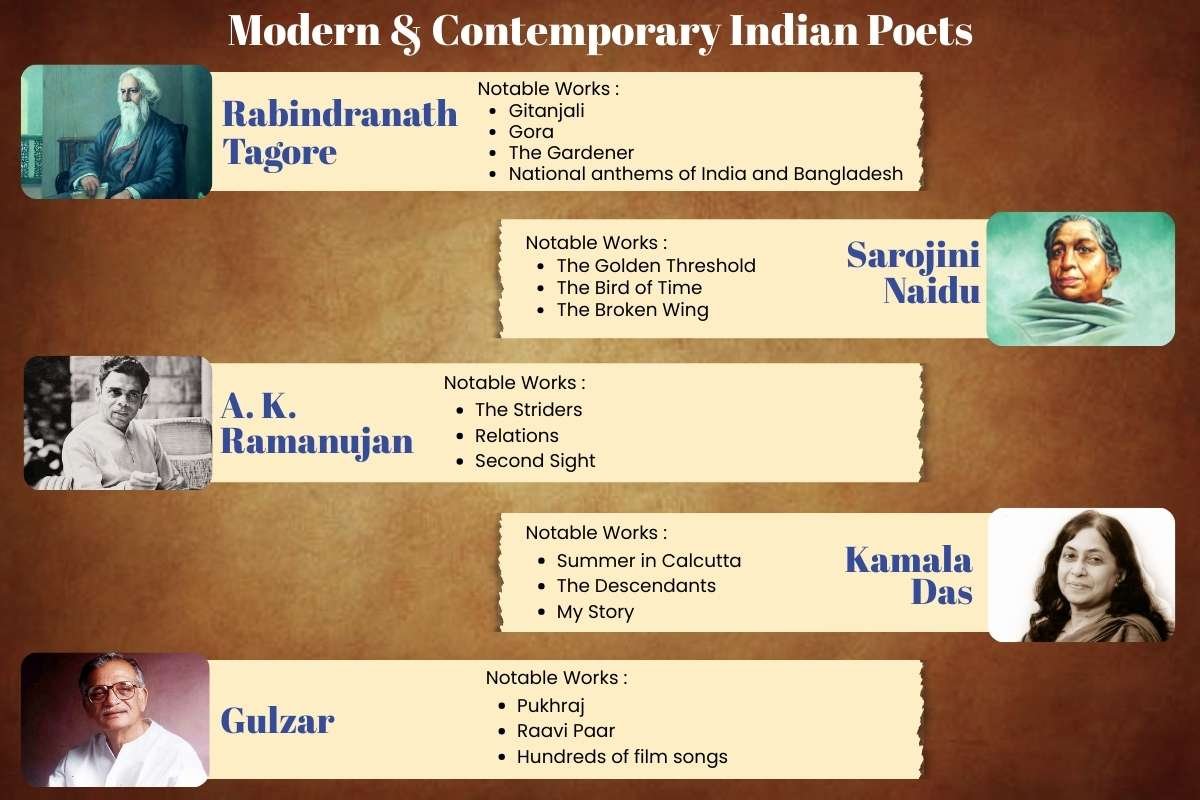
Modern literature in India introduced fresh voices and new thinking. Writers no longer focused only on mythology or devotion. They began writing about identity, society, freedom, and personal emotions.
Many famous poets in India from this era combined traditional ideas with modern experiences. Their poems reflect daily life, political change, love, loneliness, and the search for meaning.
These poets helped Indian poetry reach global audiences. Their work continues to influence readers, writers, and artists.
16. Rabindranath Tagore
- Born: 1861 | Died: 1941
- Type of Writing: Bengali poetry, songs, philosophy, essays
- Notable Works:
- Gitanjali
- Gora
- The Gardener
- National anthems of India and Bangladesh
- Journey
Rabindranath Tagore was born in a wealthy and culturally rich family in Kolkata. His home was full of music, poetry, and discussions about art and philosophy. Because of this environment, Tagore began writing poems at a very young age.
He wrote his first poem when he was only eight years old. By the time he was sixteen, his poems were already getting published in literary magazines.
Traditional schooling did not appeal to him. Tagore believed that classrooms often limit creativity. He preferred learning from nature, books, music, and conversations.
This idea later inspired him to create Santiniketan, a unique school where students studied under trees and learned through creativity and observation.
Tagore’s poetry carries deep spiritual thought. Many poems speak about the relationship between humans, nature, and the universe. His writing style feels calm, reflective, and philosophical.
One of his most famous poems from Gitanjali expresses this spiritual connection.
- Example (Bengali original)
“চিত্ত যেথা ভয়শূন্য, উচ্চ যেথা শির
জ্ঞান যেথা মুক্ত…”
- Translation
“Where the mind is without fear, and the head is held high.”
This poem became a symbol of intellectual freedom and national pride.
In 1913, Tagore received the Nobel Prize in Literature for Gitanjali. He became the first Asian writer to receive this award. This moment introduced Indian poetry to global readers.
Tagore also supported India’s independence movement. His songs and poems inspired courage and unity.
His song “Jana Gana Mana” later became the national anthem of India.
Because of his global influence and deep philosophical writing, Tagore remains one of the most celebrated famous indian poets.
17. Sarojini Naidu
- Born: 1879 | Died: 1949
- Type of Writing: Lyric poetry
- Notable Works:
- The Golden Threshold
- The Bird of Time
- The Broken Wing
- Journey
Sarojini Naidu grew up in Hyderabad in a family that valued education and creativity. Her father was a scientist, and her mother was a poet.
From a very young age, Sarojini showed remarkable intelligence. At the age of thirteen, she wrote a long poem called “The Lady of the Lake.”
Her talent impressed many scholars. Because of this, she received the opportunity to study in England. She attended King’s College London and Girton College, Cambridge.
During this time, she met many writers who encouraged her to focus on Indian themes in her poetry. She began writing about Indian culture, traditions, and daily life.
One of her famous poems describes a lively Indian market.
- Example from “In the Bazaars of Hyderabad”
“What do you sell, O ye merchants?
Richly, your wares are displayed.”
This poem beautifully captures the colors, sounds, and energy of Indian markets.
Her poetry uses musical rhythm and vivid imagery. Because of her melodious writing style, people called her the Nightingale of India.
But Sarojini Naidu was not only a poet. She was also deeply involved in the Indian freedom movement. She worked closely with leaders such as Mahatma Gandhi.
Her speeches and poems motivated people to support independence.
After India gained independence, she became the first woman governor of Uttar Pradesh.
Her life shows that art and leadership can exist together. Her courage and poetic beauty placed her among the most inspiring famous indian poets.
18. A. K. Ramanujan
- Born: 1929 | Died: 1993
- Type of Writing: Modern English poetry, translation, folklore research
- Notable Works:
- The Striders
- Relations
- Second Sight
- Journey
A. K. Ramanujan was born in Mysore in a family that valued education and intellectual discussion. His father was a mathematician and astronomer.
Growing up in this environment encouraged Ramanujan to develop curiosity about many subjects. He became interested in literature, languages, folklore, and philosophy.
He studied English literature but always remained connected to Indian traditions.
His poetry often blends modern experiences with ancient myths and family memories. Many poems describe childhood moments, cultural identity, and relationships.
One of his famous poems reflects on family memories.
- Example from “Obituary”
“Father, when he passed on,
left dust on a table of papers.”
This poem shows how Ramanujan could turn ordinary family experiences into meaningful reflections.
Later, he moved to the United States and became a professor at the University of Chicago. There, he taught literature and Indian studies.
Ramanujan also translated classical Tamil and Kannada poems into English. These translations introduced Indian literature to international readers.
His famous translation collection “Speaking of Siva” helped global audiences understand ancient Kannada poetry.
Because he successfully connected traditional Indian literature with modern global writing, Ramanujan holds an important place among famous indian poets.
19. Kamala Das
- Born: 1934 | Died: 2009
- Type of Writing: Confessional poetry and autobiographical writing
- Notable Works:
- Summer in Calcutta
- The Descendants
- My Story
- Journey
Kamala Das was born in Kerala in a family deeply connected with literature. Her mother was a respected Malayalam poet, and her home environment encouraged creativity.
She started writing poetry during her teenage years. Her writing style quickly stood out because of its honesty and emotional depth.
At a time when many writers avoided personal topics, Kamala Das openly wrote about love, loneliness, relationships, and the emotional struggles of women.
Her poetry is simple but very powerful. It speaks directly from personal experience.
One of her most famous poems talks about identity and independence.
- Example from “An Introduction”
“I speak three languages, write in two, dream in one.”
This simple line shows the complexity of identity in modern India.
Kamala Das wrote in both English and Malayalam, reaching readers across different cultures.
Her autobiographical book “My Story” created a strong public discussion because of its honest portrayal of personal life.
Many readers admired her courage because she challenged traditional expectations about women’s voices. Her work helped open conversations about women’s emotions, independence, and individuality.
Because of her fearless writing and unique voice, Kamala Das remains one of the most influential poets in India in modern literature.
20. Gulzar
- Born: 1934
- Type of Writing: Poetry, lyrics, storytelling, film writing
- Notable Works:
- Pukhraj
- Raavi Paar
- Hundreds of film songs
- Journey
Gulzar was born in pre-partition India. During his childhood, he experienced the emotional turmoil of the Partition of India in 1947. This historical moment deeply affected his thinking and later influenced his writing.
As a young man, he moved to Mumbai and began working in the Indian film industry.
He started as a lyricist and soon gained attention for his poetic style. His songs felt different from typical film lyrics. They used simple words but carried deep meaning.
One of his famous lines beautifully expresses the passage of time.
- Example
“तुझसे नाराज़ नहीं ज़िंदगी
हैरान हूँ मैं”
- Translation
“I am not angry with life.
I am simply surprised by it.”
This line became widely loved because it captures complex emotions in simple language.
Gulzar writes about everyday moments. His poetry often focuses on memories, relationships, loneliness, and quiet reflections.
Apart from writing poetry and lyrics, he also worked as a film director and screenwriter. His storytelling connects literature, cinema, and music.
Many people admire his ability to turn ordinary life experiences into meaningful poetry.
Even today, his work continues to inspire young writers and readers. His creative influence across literature and cinema ensures his place among famous poets in India.
Regional Language Poets of India
India speaks hundreds of languages, and each language carries its own poetic tradition. Because of this diversity, poetry in India grew in many directions. Many writers chose to write in their regional language so that common people could understand their thoughts and emotions. This approach helped many writers become famous poets in India.
Regional poetry often reflects daily life, culture, and faith. For example, Tamil Sangam poetry from ancient South India describes nature, love, and bravery in simple yet powerful lines. One famous Sangam verse says:
“யாதும் ஊரே யாவரும் கேளிர்”
(Yaadhum Oore Yaavarum Kelir)
Meaning: Every place is my home, and all people are my family.
In Karnataka, poets from the Vachana tradition wrote short spiritual poems about devotion and equality. Basavanna, one of the respected voices in this tradition, wrote:
“The rich build temples for Shiva.
What shall I, a poor man, do?
My legs are pillars,
The body of the shrine,
The head a cupola of gold.”
Marathi devotional poetry also became very popular through Abhangas written by saints like Tukaram. His poetry spoke directly to the hearts of ordinary people. One of his famous lines says:
“जे का रंजले गांजले त्यासी म्हणे जो आपुले”
Meaning: The one who helps the suffering truly understands humanity.
These regional poets preserved culture, faith, and traditions through simple language. Many of them later gained national recognition after translations brought their work to wider audiences. Because of this influence, regional writers remain an important part of the story of famous poets in India.
Even today, poets continue writing in languages such as Malayalam, Punjabi, Assamese, and Gujarati. Their poems show that regional voices still keep the tradition of famous indian poets alive and evolving.
Women Poets Who Shaped Indian Literature
Women poets played a powerful role in Indian literature. Many of them wrote during times when society rarely allowed women to speak freely. Yet their courage and creativity helped them earn a respected place among famous poets in India.
One early example is Andal, the Tamil poet-saint known for her devotional songs. Her famous lines from Tiruppavai express deep spiritual love:
“மார்கழித் திங்கள் மதிநிறைந்த நன்னாளால்”
Meaning: On this bright and sacred winter morning, devotion fills the heart.
Another beloved poet is Mirabai, whose songs show pure devotion to Lord Krishna. One of her famous lines says:
“मेरे तो गिरधर गोपाल, दूसरो न कोई”
Meaning: Krishna alone is mine; there is no one else.
In modern times, Sarojini Naidu brought lyrical beauty to English poetry. Her famous poem Palanquin Bearers includes the graceful lines:
“Lightly, O lightly we bear her along,
She sways like a flower in the wind of our song.”
Another bold voice was Kamala Das, who wrote openly about identity and emotions. Her poetry often reflected personal truth and courage.
Women poets wrote about devotion, love, freedom, and identity. Their work inspired future generations of female writers. Today, many contemporary women continue to write powerful poetry and expand the legacy of famous poets in India.
Their voices remind readers that poetry is not only about the beauty of words but also about courage, truth, and expression. Because of them, the tradition of famous indian poets continues to grow stronger with every generation.
Famous Award-Winning and Recognized Indian Poets
Recognition in literature does more than give a writer a trophy. It highlights powerful ideas, meaningful stories, and voices that shape culture. Many famous poets in India received national and international awards because their poetry connected with readers across languages, regions, and generations.
One historic moment in Indian literary history came in 1913 when Rabindranath Tagore won the Nobel Prize in Literature for his poetic work Gitanjali. This achievement brought global attention to Indian poetry. Tagore’s verses carried spiritual depth, emotion, and simple beauty.
His recognition proved that poetry from India could influence readers around the world. After this moment, the works of many famous indian poets gained international curiosity and respect.
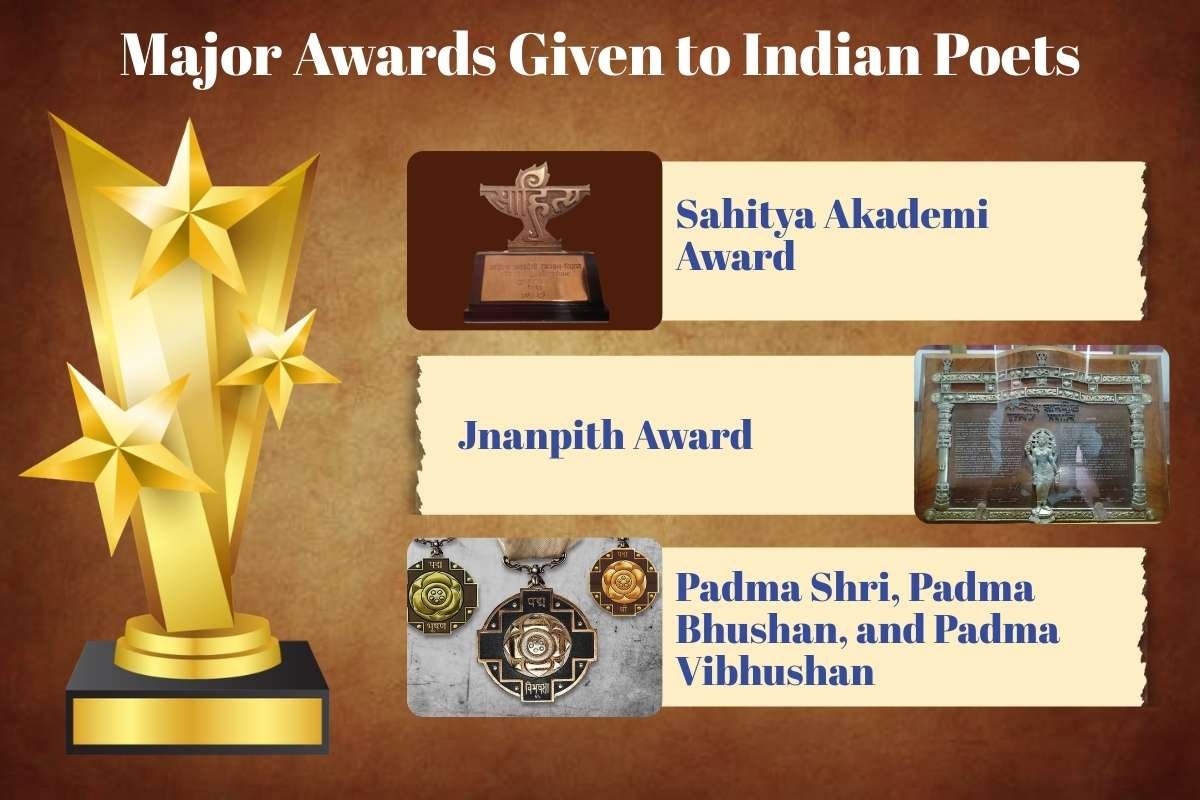
India also celebrates poets through several prestigious literary awards. These honors recognize talent, encourage creativity, and protect the rich tradition of poetry.
- Major Awards Given to Indian Poets
- Sahitya Akademi Award
Presented by the Sahitya Akademi, India’s National Academy of Letters.
Recognizes outstanding literary works in more than 20 Indian languages.
Many famous poets in India received this award for exceptional poetry collections.
- Jnanpith Award
Considered one of the highest literary honors in India.
Given to writers who make extraordinary contributions to Indian literature.
Poets who receive this award often influence generations of readers and writers.
- Padma Shri, Padma Bhushan, and Padma Vibhushan
National civilian awards presented by the Government of India.
Celebrate individuals who contribute to art, literature, and culture.
Several famous indian poets received these honors for strengthening the country’s literary identity.
Why These Awards Matter?
Awards do more than celebrate talent. They help literature grow and inspire new writers. Key reasons these recognitions are important:
- Encourage poets to continue writing meaningful work
- Promote Indian literature on global platforms.
- Inspire young writers and students.s
- Preserve cultural traditions and languages.
- Highlight social issues through poetic expression.
Award-winning poets represent the living tradition of famous poets in India. Their work reflects emotions, society, identity, and creativity. Every recognition of poetry’s value strengthens it in Indian culture.
Today, universities, literary festivals, and cultural events often celebrate the achievements of these poets. Their works appear in textbooks, poetry readings, and research studies. Through such recognition, the legacy of famous indian poets continues to inspire new generations of readers and writers.
Influence of Indian Poetry on Culture and Society
Poetry in India has always lived beyond books. It appears in temples, festivals, songs, speeches, and everyday conversations. For centuries, famous poets in India shaped how people think about life, spirituality, justice, and culture.
Many poets used simple words to express powerful ideas. Their poems often spoke about equality, compassion, and human dignity. Devotional poets like Kabir and Mirabai created verses that crossed religious and social boundaries. Their poetry encouraged love, unity, and faith.
How Poetry Influenced Indian Society?
Poetry often acted as a voice for change. Many famous indian poets wrote verses that questioned injustice and inspired reform.
Major ways poetry influenced society include:
- Social reform: Poets raised awareness about discrimination, inequality, and injustice.
- Spiritual guidance: Devotional poetry helped people connect with faith through simple language.
- National identity: Patriotic poems strengthened the spirit of unity during difficult times.
- Cultural preservation: Poetry preserved traditions, folklore, and local languages.
Poetry During the Freedom Movement
Poetry played a powerful role during India’s struggle for independence. Freedom fighters and leaders often quoted poems during public speeches to inspire courage and unity.
Impact of poetry during the freedom movement:
- Motivated people to stand against colonial rule
- Created an emotional connection with the idea of freedom
- Spread patriotic feelings through songs and verses.
- Encouraged hope during difficult times
Because of this influence, many famous poets in India became cultural icons whose words symbolized national pride.
Influence on Art and Entertainment
Poetry also shaped many creative fields in India.
Areas influenced by poetry include:
- Music: Many classical and devotional songs come from poetic verses.
- Cinema: Film lyricists often draw inspiration from traditional poetic styles. Writers like Gulzar combine poetry with storytelling in film songs.
- Theater: Plays often include poetic narration and lyrical dialogue.
- Education: Schools teach poems to develop creativity, imagination, and emotional understanding.
- Poetry in the Modern Era
Today, poetry continues to evolve. Social media, poetry slams, and spoken word events give young writers new platforms to share their voices.
Modern poets often write about:
- Identity and culture
- Mental health
- Gender equality
- Climate and social change
This new wave proves that the legacy created by famous poets in India continues to influence storytelling and creative expression.
Poetry still acts like a mirror of society. It reflects emotions, questions traditions, and celebrates hope. Because of this deep connection with human life, the influence of famous indian poets remains strong, meaningful, and timeless.

12 Best Life-Changing Books That Will Shift Your Perspective Forever
Here’s Our List of the 12 Best Life-changing Books You’ll Want to Read in Your Lifetime: 1. The Alchemist by Paulo Coelho 2. Atomic Habits by James Clear, and more.
Conclusion
A poem is a strange kind of time machine. One small verse can travel hundreds of years and still touch a heart today. That is the quiet power of poetry. A line written long ago can still whisper wisdom, courage, or comfort.
That is why the legacy of famous poets in India never fades. From the spiritual depth of ancient epics to the bold voices of modern writers, their words continue to guide readers and spark imagination.
Think about one simple line:
“Where the mind is without fear…”
It still inspires people even today.
The truth is simple. Great poetry never retires. The voices of famous indian poets keep echoing through classrooms, books, songs, and conversations. And somewhere, a new reader discovers a poem and feels the same spark that began centuries ago.