


Missiles are built for very different jobs. Some are made for long-range strategic deterrence. Others are designed for naval strikes, air combat, or fast precision attacks.
That makes the phrase best missiles in the world difficult to define with one simple list. A missile can stand out because of its guidance, speed, range, launch platform, survivability, or proven service record.
This updated guide replaces older claims and outdated program status with current public information. It also separates operational weapons from systems still being tested. Public data can be limited, especially for newer strategic weapons, so uncertain details are clearly marked.
What Makes a Missile One of the Best?
The best missiles in the world are not defined by speed alone. A missile needs to do its job well and work as part of a larger military system.
The main factors include:
- Mission: What is the missile built to do?
- Guidance: Can it stay on course and track its target?
- Survivability: Can it cope with radar, jamming, or defenses?
- Launch options: Can it be fired from land, sea, air, or a submarine?
- Maturity: Is it proven in service or still a test program?
- Reliability: Has it performed well through repeated testing?
A very fast missile is not automatically the most useful. Production, maintenance, sensors, launch systems, and command networks also matter.
There is also no official global ranking of missile quality. So this list groups major systems by role rather than claiming one missile is the universal winner.
Which Missile Types Matter Most?
The term becomes clearer when you see how different the best missiles in the world can be by class.
| Missile type | Main role | Simple explanation |
| Ballistic missile | Strategic or long-range strike | Uses rocket power, then follows a ballistic path |
| Cruise missile | Precision strike | Flies through the atmosphere on a guided route |
| Hypersonic weapon | High-speed strike | Combines very high speed with advanced flight control |
| SLBM | Sea-based deterrence | Ballistic missile launched from a submarine |
| Air-to-air missile | Fighter combat | Used by aircraft against other aircraft |
These groups can overlap. An air-launched ballistic missile, for example, is still different from a cruise missile.
How Did Modern Missiles Develop?
The history behind today’s best missiles in the world goes back to early rocket weapons and changed sharply during the Second World War.
Germany’s V-2 was a major step in ballistic missile development. NASA notes that the V-2 later influenced postwar rocket work in both the United States and the Soviet Union. Captured hardware, designs, and specialists helped speed up rocket research after the war.
The Cold War brought longer-range ballistic missiles and submarine-launched systems. Cruise missiles later added more controlled flight inside the atmosphere.
Modern designs now combine digital control, advanced sensors, better navigation, electronic protection, and new propulsion systems. That history explains why the best missiles in the world today are defined by a mix of technologies, not one feature.
Which Ballistic Missiles Stand Out in 2026?
In the ballistic group, several systems often appear in discussions of the best missiles in the world because of their strategic role, mobility, maturity, or new technology.
| Missile | Country | Status | Why it matters |
| RS-28 Sarmat | Russia | Development | Heavy ICBM program designed for strategic deterrence; Russia says deployment plans continue, while CSIS still lists it as in development. |
| LGM-30G Minuteman III | United States | Operational | Long-serving U.S. land-based ICBM that remains in service while Sentinel is being developed. |
| DF-41 | China | Operational | Mobile Chinese ICBM and a key part of China’s growing strategic missile force. |
| Agni-V | India | Fielded | India’s major long-range strategic missile system, with the wider Agni family still gaining new capabilities. |
| Hwasong-17 | North Korea | Operational | Large road-mobile ICBM with a very long estimated range, according to CSIS. |
One important update is the U.S. transition from Minuteman III to Sentinel. The change has faced schedule problems, so Minuteman III remains important today.
Which Cruise Missiles Matter in 2026?
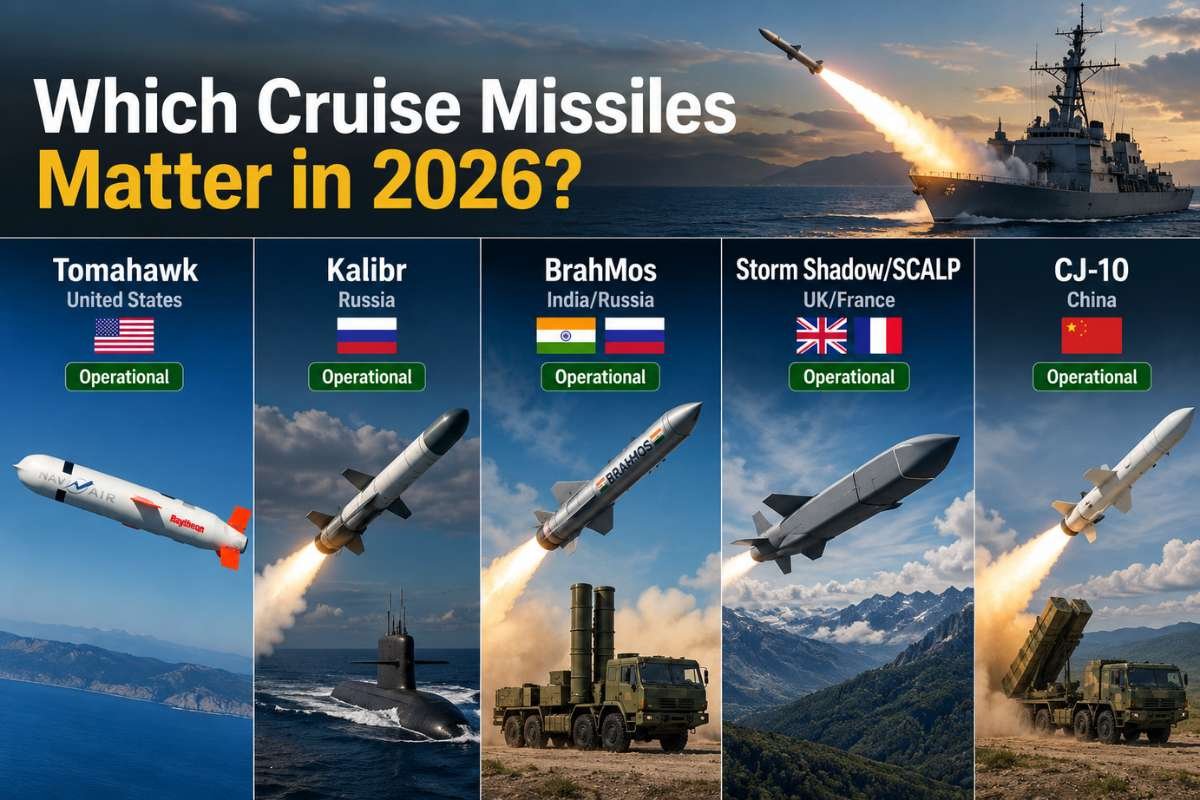
Cruise missile designs also account for several of the best missiles in the world because they combine guided flight, flexibility, and precision.
| Missile | Country | Status | Why it matters |
| Tomahawk | United States | Operational | Mature naval cruise missile with repeated upgrades and a major focus on production in 2026. |
| Kalibr | Russia | Operational | Family of sea-launched cruise missiles used for different missions. |
| BrahMos | India/Russia | Operational | Supersonic system that can be launched from land, ships, and aircraft. |
| Storm Shadow/SCALP | UK/France | Operational | Air-launched cruise missile built for long-range precision strikes. |
| CJ-10 | China | Operational | Part of China’s land-attack cruise missile family, with some details still restricted. |
Tomahawk stands out for another reason. It is not simply an old missile that stayed unchanged. Continued upgrades and new production show how a mature system can remain relevant.
BrahMos also remains important because it combines speed with several launch options. That flexibility gives the system a wider role across India’s armed forces.
Which Hypersonic Systems Are Leading?
The newest entries in the best missiles in the world discussion often come from hypersonic programs. These weapons focus on very high speed, difficult flight paths, or both.
| System | Country | Status | Why it matters |
| Avangard | Russia | Public status limited | Hypersonic glide vehicle linked to Russia’s strategic force; public information remains limited. |
| DF-17 | China | Operational | Chinese boost-glide system designed for maneuvering flight. |
| Zircon | Russia | Operational use reported | Hypersonic cruise missile designed for naval launch; its use has been reported in 2026. |
| Dark Eagle | United States | Fielding and training | U.S. Army long-range hypersonic weapon using a common glide body. |
| Indian Hypersonic Cruise Missile Program | India | Development | Indigenous program focused on scramjet propulsion and sustained hypersonic flight. |
A key correction from the older article is the AGM-183 ARRW. It should not be presented as an active U.S. hypersonic program in this list.
Dark Eagle is a better current example. The U.S. Army is already training with the system, showing that the program has moved beyond early laboratory work.
Which Submarine-Launched Missiles Are Most Important?
For sea-based deterrence, the best missiles in the world include submarine-launched ballistic missiles because submarines can provide a hidden launch platform.
| Missile | Country | Status | Why it matters |
| Trident II D5 | United States/UK | Operational | Core sea-based strategic missile for U.S. and UK ballistic missile submarines. |
| Bulava | Russia | Operational | Main SLBM linked to Russia’s Borei-class ballistic missile submarines. |
| JL-3 | China | Testing/development | Newer Chinese SLBM; public reporting cannot always confirm the exact missile used in tests. |
| K-4 | India | Operational validation | Indian SLBM developed for nuclear-powered ballistic missile submarines. |
| M51 | France | Operational | Main sea-based strategic missile in France’s nuclear deterrent. |
The JL-3 is a good example of why open-source missile data needs care. CSIS reported a Chinese SLBM test in 2026 but said public evidence could not confirm whether the launch involved JL-2 or JL-3.
Trident II D5 is also entering another modernization phase through the future D5LE2 system.
Which Air-to-Air Missiles Lead Modern Fighter Combat?
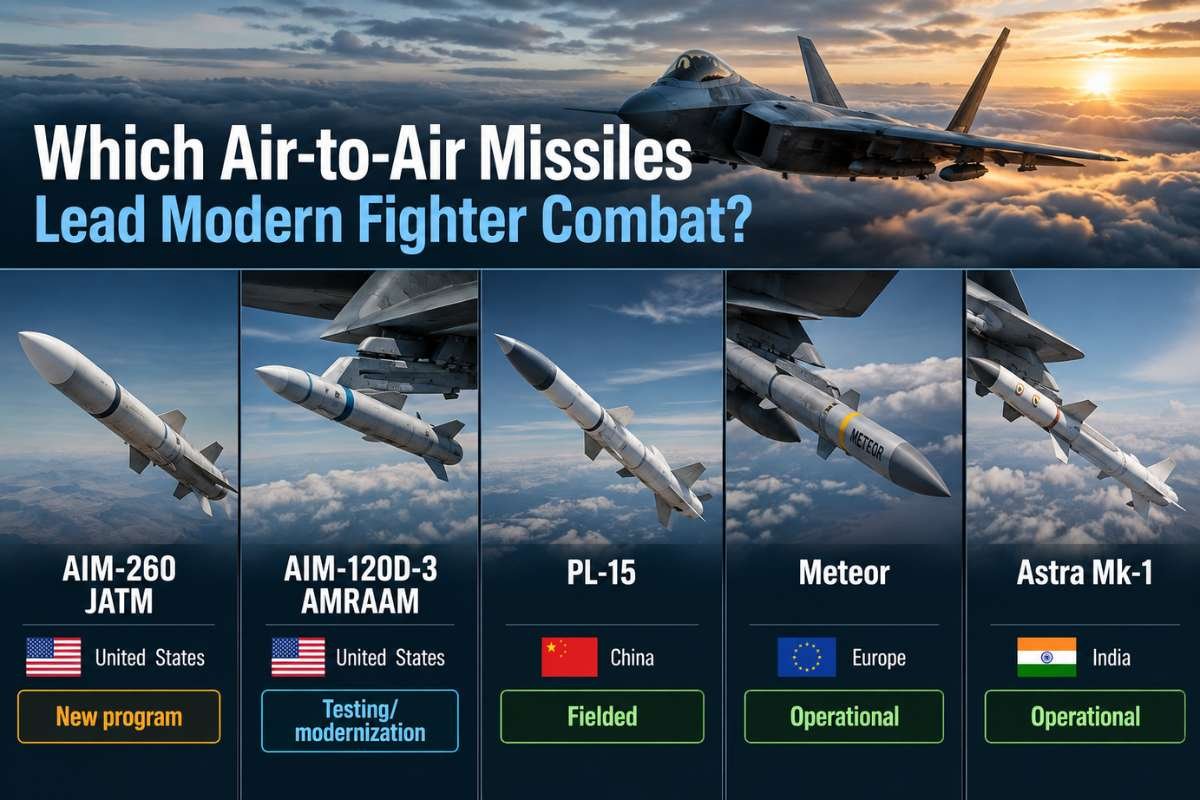
Air combat adds another set of weapons to the best missiles in the world list. Here, seekers, data links, maneuverability, and electronic protection are especially important.
| Missile | Country/Region | Status | Why it matters |
| AIM-260 JATM | United States | New program | Next-generation U.S. air-to-air missile with key specifications still classified. |
| AIM-120D-3 AMRAAM | United States | Testing/modernization | Updated AMRAAM variant with new guidance hardware. |
| PL-15 | China | Fielded | Long-range air-to-air missile linked to modern Chinese fighter aircraft. |
| Meteor | Europe | Operational | Ramjet-powered beyond-visual-range missile used by several European air forces. |
| Astra Mk-1 | India | Operational | India’s first indigenous beyond-visual-range air-to-air missile, now in service production. |
The biggest 2026 change here is the AIM-260. The program was publicly revealed in September, while detailed performance data remains classified.
Meteor also remains important because it combines a modern seeker, data link, and ramjet propulsion in one air-to-air system.
What Technologies Make These Missiles Advanced?
What makes some best missiles in the world so capable is the way several technologies work together.
Guidance
Modern missiles can combine inertial navigation, satellite updates, radar seekers, infrared sensors, and onboard computers. Different systems use different mixes based on their missions.
Propulsion
Solid rockets are common in strategic missiles because they are reliable and easier to store. Cruise missiles often use turbine engines. New hypersonic systems are testing ramjets and scramjets for sustained high-speed flight.
Survivability
Stealth shaping can reduce radar detection. Low flight can cut warning time. Electronic protection can help against jamming. Maneuvering can also make a flight path harder to predict.
The missile itself is only one part of the system. Aircraft, ships, submarines, sensors, launchers, software, and maintenance all affect how well a missile works.
What Changed in Missile Technology in 2026?
The best missiles in the world changed quickly in 2026 as several major programs moved from testing toward deployment or larger production.
India’s Defence Ministry said an Advanced Agni missile was flight-tested with a MIRV system in May. The test used multiple payloads aimed at different target areas in the Indian Ocean region.
2026 data point: DRDO said its full-scale, actively cooled scramjet combustor ran for more than 1,200 seconds during a May 2026 ground test. The test supports India’s wider hypersonic cruise missile program.
The United States also pushed to expand production of established systems.
2026 data point: The U.S. Navy awarded a $22.9 billion Tomahawk production contract in August 2026. The move shows that missile power also depends on industrial capacity and supply.
The U.S. Sentinel program remains another major update.
2026 data point: A February 2026 GAO review said the first Sentinel flight is now planned for March 2028, following major schedule problems. Minuteman III therefore remains an important part of the current U.S. force.
The year also brought new public attention to the AIM-260 program and a fresh North Korean missile test described by Pyongyang as hypersonic. Outside experts have questioned parts of that hypersonic claim.
How Do These 25 Missiles Compare?
A fair look at the best missiles in the world needs more than a speed chart. Mission and maturity matter just as much.
| Category | Examples | Main strength |
| Ballistic | Sarmat, DF-41, Minuteman III, Agni-V, Hwasong-17 | Strategic reach and deterrence |
| Cruise | Tomahawk, Kalibr, BrahMos, Storm Shadow, CJ-10 | Controlled flight and precision |
| Hypersonic | Avangard, DF-17, Zircon, Dark Eagle, India’s program | Speed and complex flight paths |
| Submarine-launched | Trident II, Bulava, JL-3, K-4, M51 | Hidden sea-based launch capability |
| Air-to-air | AIM-260, AMRAAM, PL-15, Meteor, Astra | Air combat and target tracking |
A strategic ballistic missile should not be judged in the same way as a fighter missile. Each is built for a different task.
Conclusion
Missile technology has moved far beyond simple rocket weapons. Today’s best missiles in the world include strategic ballistic missiles, precision cruise missiles, submarine-launched systems, advanced air-to-air weapons, and maneuvering hypersonic weapons.
The biggest lesson from 2026 is that missile strength is about more than speed. Guidance, testing, launch platforms, survivability, production, and reliability all matter.
Some of the systems in this list are mature and operational. Others are still being tested. That difference is important, especially when public claims about new weapons are stronger than the evidence available to independent analysts.
Frequently Asked Questions
The best missiles in the world cover a wide range of systems, so the answers depend on what “advanced” means.
1. What is the most advanced missile tested in 2026?
There is no official global answer.
The newest widely reported test in September 2026 involved a North Korean missile that Pyongyang described as hypersonic. South Korean reporting identified the launches as short-range ballistic missiles, while outside experts questioned how well the weapon met the hypersonic label.
India’s Advanced Agni MIRV trial and the U.S. Dark Eagle program are also major 2026 developments.
2. Are hypersonic missiles always faster than ballistic missiles?
No. Ballistic missiles can also reach very high speeds during flight. What makes many newer hypersonic weapons different is the way they maneuver while moving at extreme speed.
3. What is the difference between a cruise missile and a ballistic missile?
A cruise missile normally stays in the atmosphere and follows a guided route. A ballistic missile uses rocket-powered boost and then follows a ballistic flight path.
4. Why are submarine-launched missiles important?
Their main value comes from the submarine. A hidden submarine can provide a secure launch platform and support a second-strike capability.
5. Is the AIM-260 fully public?
No. The program is now public, but many technical details remain classified. The 2026 disclosure confirmed the program and its intended role, not a complete specification sheet.