

From the very beginning of its history, the Indian subcontinent was a collection of separate kingdoms, ruled by various dynasties. Before 1947, there was no unified Indian country or identity. But when the British left, India became a single entity and a unified identity.
Through the efforts of Sardar Vallabhbhai Patel and the government, they united all these princely states under a single banner—India.
But what happened to the rulers and their families? Did they vanish? Did they disappear in the rusty pages of our history books? Today, we will take a look at the royal families of India, where they are and what they are doing today.
Tracing the 12 Royal Families of India and Their Impact on Modern Society
We will go through all the royal dynasties that still exist in India today. We will explore the royal families of every region of India and learn about their history and culture.
Here are 12 of the royal families in India:
| State | Royal Family | Dynastic Origin | Current Heir |
|---|---|---|---|
| Rajasthan | Jaipur Royal Family | Kachwaha Rajput | Maharaja Sawai Padmanabh Singh (12th Maharaja) |
| Jodhpur Royal Family | Rathore rulers of Marwar | Maharaja Gaj Singh II, custodian of Umaid Bhawan | |
| Bikaner Royal Family | Rathore branch | Princess Rajyashree Kumari | |
| Alsisar Royal Family | Khetri Dynasty | Abhimanyu Singh | |
| Mewar Dynasty | Sisodia Rajputs | Lakshyaraj Singh and Vishvaraj Singh | |
| Gujarat | Rajkot Royal Family | Jadeja Rajputs | Thakore Saheb Mandhatasinhji Manoharsinhji Jadeja |
| Bhavnagar Royal Family | Gohil Rajputs | Maharaja Raol Shri Krishnakumarsinhji Gohil | |
| Maharashtra | Kolhapur Royal Family | Bhonsle/Maratha lineage | Sambhaji Raje |
| Satara Royal Family | Bhonsle/Maratha lineage | Udayanraje Bhosale | |
| Karnataka | Wadiyar Royal Family | Wadiyar dynasty | Yaduveer Krishnadatta Chamaraja Wadiyar |
| Kerala | Travancore Royal Family | Kulasekhara dynasty | Sree Padmanabhadasa Sree Moolam Thirunal Rama Varma |
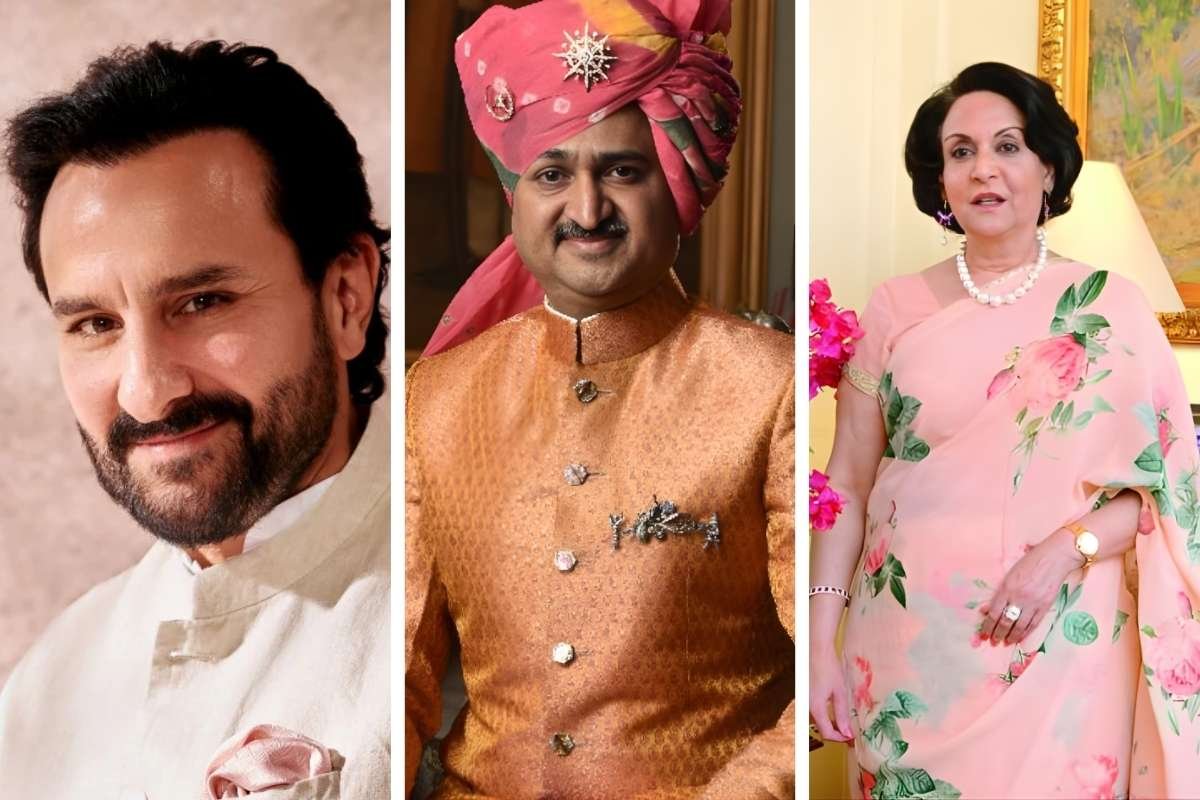
| Haryana | Pataudi Royal Family | Nawabs of Pataudi (Lodi-era roots) | Saif Ali Khan |
Rajasthan’s Royal Families: Their Roles, Legacies, and Lives Today
When we talk about the royal families of India, there is only one image that pops up in our mind—The Rajputs. Before Independence, the state of Rajasthan comprised 22 princely states, each with its own unique history and culture.
Here’s what happened to the rulers of these states post-Independence:
1. Jaipur Royal Family

- Dynasty: Kachwaha Rajput
- Current Heir: Maharaja Sawai Padmanabh Singh (12th Maharaja)
The Kachwaha Rajput clan established its rule in the 12th century, with its capital initially at Amber. They claim to be Suryavanshi and the direct descendants of Lord Ram, himself. For most of their history, they were close allies with the Mughals. The family is worth ₹20,000 crores, thanks to their properties and hotels.
2. Jodhpur Royal Family

- Dynasty: Rathore rulers of Marwar
- Current Heir: Maharaja Gaj Singh II
The Rathore clan of Rajputs claims its lineage from the Solar Dynasty. This clan founded the state of Marwar with its capital at Jodhpur. Rao Jodha established the city and the formidable Mehrangarh Fort in 1459. Their warrior traditions, magnificent architecture, such as Umaid Bhawan Palace, and the iconic ‘Blue City’ houses have been central to their culture.
3. Bikaner Royal Family

- Dynasty: Rathore branch
- Current Heir: Princess Rajyashree Kumari
The Rathore clan’s Rao Bika founded the kingdom of Bikaner in 1488 AD, separating from his father’s Marwar state. Soon, the state flourished as a centre of trade. Their culture is known for the unconquered Junagarh Fort, the iconic Lalgarh Palace, and the revered Karni Mata Temple. As of 2025, the current heir is worth ₹15,000 crore.

History, Science, and Culture Intertwine Through Fascinating, Interesting Facts About India
There are many such hidden, interesting facts about India that you must know about. We are talking about the Chola Empire, the Bengal tiger population, the Western Ghats, and many more!
4. Alsisar Royal Family

- Dynasty: Khetri Dynasty
- Current Heir: Abhimanyu Singh
The Alsisar Royal Family descends from the Shekhawat Rajputs, who ruled the Shekhawati region for over 500 years. Their 17th-century Alsisar Mahal showcases grand Rajput architecture with rich frescoes. The current generation preserves this legacy by converting their palaces into heritage hotels and hosting the contemporary Magnetic Fields Festival.
5. Mewar Dynasty

- Dynasty: Sisodia Rajputs
- Current Heirs: Lakshyaraj Singh and Vishvaraj Singh
The Sisodia Rajputs are among the oldest royal families of India, tracing their lineage back to the 7th century. They are celebrated for their fierce Rajput valour and resistance against the Mughals, most famously under Maharana Pratap. Thanks to Udaipur’s art, customs, and stunning architecture, we can still enjoy the family’s culture.
Gujarat’s Royal Families: Their Roles, Legacies, and Lives Today
Gujarat has a rich history of royalty as well. The Maitraka Dynasty, Western Satraps, Gurjara-Pratihara Dynasty, and Chalukyas all have contributed to the rich history of Gujarat. While most of them don’t exist anymore, here are the royal families that still exist in Gujarat:
6. Rajkot Royal Family

- Dynasty: Jadeja Rajputs
- Current Heir: Thakore Saheb Mandhatasinhji Manoharsinhji Jadeja
The Rajkot Royal Family belongs to the Jadeja Rajput clan. Their progressive rulers, such as Lakhajiraj III, developed Rajkot into a centre for education. Their culture is deeply rooted in Kathiawadi/Gujarati traditions. Recently, Ajay Jadeja, a former cricketer, declared heir (Yuvraj Saheb) to the Jamnagar royal family, which is the senior branch of the Jadeja clan.
7. Bhavnagar Royal Family

- Dynasty: Gohil Rajputs
- Current Heir: Maharaja Raol Shri Krishnakumarsinhji Gohil
The Gohil Rajput clan, from the Suryavanshi lineage, founded Bhavnagar in 1723 AD on the coast of Gujarat after migrating from Marwar. The city became a major centre for maritime trade, driving its prosperity. The progressive rulers of this clan, such as Maharaja Krishnakumar Sinhji, were the first rulers to merge their state with India.
Maharashtra’s Royal Families: Their Roles, Legacies, and Lives Today
The Marathas cannot be left out of the conversation, especially when we are discussing the royal families of India. Their valour and bravery are a topic of pride for every citizen. The founder of the Maratha Dynasty, Chhatrapati Shivaji Maharaj, was the birthgiver of the concept of Self-rule (Swarajya) and the originator of unified identity.
Even today, the descendants of Chhatrapati Shivaji Maharaj live among us. Here’s what they are doing today:
8. Kolhapur Royal Family

- Dynasty: Bhonsle/Maratha lineage
- Current Heir: Sambhaji Raje Bhosale
The Bhonsle Kolhapur Branch was established in 1710 AD by Tarabai, the widow of Chhatrapati Rajaram, following a split in the Maratha Empire. They ruled the southern part of the empire, centred at Kolhapur. They have a legacy of patronage of social reformers. The current heir of the dynasty, Sambhaji Raje, is upholding the legacy of Chhatrapati Shivaji.
9. Satara Royal Family

- Dynasty: Bhonsle/Maratha lineage
- Current Heir: Chhatrapati Udyanraje Bhosale
As mentioned above, following the death of Chhatrapati Shivaji Maharaj, the Maratha Empire was split into two. The Bhonsle Satara Branch was founded by Chhatrapati Shahu I in 1707 AD, making Satara the de jure seat of the Maratha Empire. Satara remained the ceremonial capital, upholding the core Maratha warrior traditions.
Karnataka’s Royal Families: Their Roles, Legacies, and Lives Today
Since 345 AD, when Mayurasharma laid the foundation of the Kadamba dynasty, Karnataka has witnessed the emergence of numerous royal families in India. Sadly, today, only one of them lives on. The British reinstated the Wadiyar Dynasty after the death of Tipu Sultan.
Here’s what you need to know:
10. Wadiyar Royal Family

- Dynasty: Wadiyar dynasty
- Current Heir: Yaduveer Krishnadatta Chamaraja Wadiyar
The Wadiyar Dynasty ruled the Kingdom of Mysore from 1399 to 1950. Among the numerous royal families of India, they are the longest ruling house. They ushered in a “Golden Age” of progressive reforms and state modernisation. Culturally, they are renowned patrons of art, architecture, and for making the Mysore Dasara festival a grand spectacle.
Kerala’s Royal Family: Their Roles, Legacies, and Lives Today
Kerala is considered one of the most beautiful states in India. It is the most educated state, one of the richest and happiest states in the country. But do they have a royal family? Yes, they do!
Here’s what you must know about Kerala’s royal family:
11. Travancore Royal Family

- Dynasty: Kulasekhara dynasty
- Current Heir: Sree Padmanabhadasa Sree Moolam Thirunal Rama Varma
The Travancore Royal Family, descended from the Kulasekhara, established the modern kingdom in 1729. They followed matrilineal succession and famously dedicated their realm to the deity Padmanabhaswamy, ruling as his “servants” (Sree Padmanabhadasa). The royal family was also a pioneer of significant social reforms in Kerala.
Haryana’s Royal Family: Their Roles, Legacies, and Lives Today
Let’s talk about the most famous royal family of India—The Pataudis. Haryana was the home to the princely state of Pataudi. Thanks to its current heir, Saif Ali Khan, the royal family is very influential and relevant to Indian culture.
12. Pataudi Royal Family

- Dynasty: Nawabs of Pataudi (Lodi-era roots)
- Current Heir: Saif Ali Khan
The Nawabs of Pataudi were established in 1804 by Faiz Talab Khan, an Afghan Pashtun, in the modern state of Haryana. Their culture is a unique blend of Persian, Afghan, and Indian influences. Their legacy spans from cricket with Iftikhar Ali Khan and Mansoor Ali Khan, “Tiger” Pataudi, to Bollywood with Saif Ali Khan.
The Lost Royal Families of India: A Look at India’s Royal Dynasties and Their Impact
Now, these are the royal families of India that still have an heir and influence, but what about dynasties that ended?
There were families and dynasties in the country that no longer exist, but they had a long-lasting impact on the country’s history. Here’s a list of families that ruled India:
- Haryanka Dynasty (c. 544–413 BC): Early Magadha rulers under Bimbisara who laid political foundations for large empires.
- Shunga Dynasty (c. 181–73 BC): Succeeded the Mauryas, known for reviving Hinduism and defending northern India.
- Kanva Dynasty (c. 73–28 BC): Ruled briefly after the Shungas, maintaining control in central India.
- Satavahana Dynasty (c. 1st century BC – 3rd century AD): Dominated the Deccan, promoting trade and cultural integration between north and south.
- Kushan Empire (c. 30–375 AD): Under Kanishka, expanded northern India, fostering Buddhism and Silk Road trade.
- Gupta Dynasty (c. 320–550 AD): Known for a cultural golden age, major advances in arts, sciences, and political stability.
- Rashtrakuta Dynasty (c. 753–982 AD): Powerful Deccan rulers noted for architecture and literature, including Ellora caves.
- Pratihara Dynasty (c. 730–1036 AD): Defended northern India from Arab invasions and established strong regional rule.
- Pala Dynasty (c. 750–1174 AD): Bengal rulers who promoted Buddhism and educational institutions like Nalanda.
- Chola Dynasty (c. 850–1279 AD): South Indian naval empire famous for temple architecture and cultural patronage.
- Hoysala Dynasty (c. 10th–14th century AD): Karnataka rulers known for distinctive temple architecture and Kannada literature.
- Delhi Sultanate (1206–1526 AD): Islamic rulers who introduced new governance structures and architecture in northern India.
- Vijayanagara Empire (1336–1646 AD): A Hindu kingdom promoting arts, literature, and resisting northern invasions.
- Mughal Dynasty (1526–1857 AD): Established India’s largest empire, notable for cultural synthesis and monumental architecture.
Conclusion:
India has been the land of kings and queens since ancient times. The long-lasting legacies of these dynasties go beyond the existing royal families of India. Their contribution to India’s history, culture, and tradition is invaluable. The forts of Sahyadri, the palaces of Jaipur, the towers of Delhi, and the temples of Travancore are witnesses to the work of these families.
Their wealth, culture, tradition, and history are ingrained in India. The families that still exist and the families that ruled aeons ago equally played an important role in shaping the nation. Their current heirs play the role of carrying the torches, set ablaze by their ancestors.
FAQs
1. Do these royal families of India still hold political power?
No, they lost all political and constitutional powers after India abolished privy purses and titles in 1971.
2. What is a ‘privy purse’?
It was an annual payment made by the Indian government to the former rulers after independence for their continued support.
3. Is succession still determined by primogeniture?
Yes, for ceremonial titles and properties, but these are now subject to Indian civil inheritance laws.
Thanks for Reading!
See More
Top 10 Richest Monarchs in the World (2025)