



An Indian manufacturer importing machinery from Germany can face a higher purchase cost even without taking a new domestic loan. Why? Global interest rate changes shift currency values, capital flows, and business costs. Understanding how global interest rate shifts affect business matters because the US Federal Reserve, the European Central Bank, and major central banks influence the rupee, funding costs, and investor sentiment. Between March 2022 and July 2023, the US Federal Reserve raised its federal funds rate target from near zero to 5.25%–5.50% to control inflation. These increases tightened global financial conditions and influenced borrowing costs, investment decisions, and currency movements in emerging markets, including India. Learn the direct and indirect effects through practical business examples.
Table of Contents:
- What causes global interest rates to rise or fall?
- How do global interest rate shifts affect Indian businesses?
- Rising vs falling interest rates and their business impact
- How interest rate changes influence global expansion vs domestic growth
- Which Indian businesses are most exposed to global rate changes?
- How businesses can manage interest rate uncertainty
- Conclusion
- FAQ
What Causes Global Interest Rates to Rise or Fall?
Central banks raise or cut interest rates to manage inflation, growth, and financial stability. Borrowing is like renting money: higher rates make that rental more expensive, discouraging loans and spending; lower rates make credit cheaper and can support investment.
The US Federal Reserve, RBI, and European Central Bank change benchmark policy rates when inflation is too high, growth is weak, or credit demand shifts. The Fed uses the federal funds rate. The RBI’s repo rate is what it charges commercial banks. The ECB sets key euro-area rates.
How global interest rate shifts affect business: higher rates raise financing costs, while lower rates can make expansion and borrowing easier. But rates do not move together or automatically follow the Fed, because each economy faces different inflation, growth, and financial conditions.
A central bank’s policy rate is not the same as the rate a business actually pays: commercial banks set lending rates based on the policy rate, credit risk, loan term, and market conditions.
How Do Global Interest Rate Shifts Affect Indian Businesses?
Global interest-rate shifts affect Indian businesses through borrowing costs, cash flow, demand, currency, and investment. A Fed hike can tighten global conditions and strengthen the dollar, but it doesn’t automatically raise every Indian business loan.
| Business area | When rates rise | When rates fall |
| Borrowing costs | New and floating-rate debt becomes costlier | Financing gets cheaper |
| Cash flow | More cash goes to interest | Debt-servicing pressure eases |
| Investment | Equipment purchases postponed | Expansion accelerates |
| Customer demand | Credit-dependent spending weakens | Cheaper credit encourages spending |
| Currency and trade | Capital flows and exchange rates shift | Import/export margins shift |
How it reaches India
How global interest rate shifts affect business depends on RBI policy, lending benchmarks, banks’ funding costs, and loan terms. An MSME on a cash-credit facility may pay more interest if its lending rate rises, squeezing cash for inventory and payroll. The RBI cites interest-rate and exchange-rate channels as key transmission routes.
Higher global rates can pull capital toward US assets, weakening the rupee. Importers paying suppliers in USD face higher rupee costs. Exporters earning USD may benefit.
Consider an Indian business with a floating-rate loan of ₹1 crore at an annual interest rate of 8.5%. If its lending rate increases by 1 percentage point to 9.5%, the annual interest cost on the full outstanding principal rises from ₹8.5 lakh to ₹9.5 lakh. This means an additional ₹1 lakh in interest over a year. For a business operating on tight margins, this increase could reduce working capital, delay equipment purchases, or affect expansion plans.
Investment and demand
Costly financing can delay machinery, hiring, or expansion, while higher EMIs reduce demand for cars, homes, and appliances. Lower rates improve affordability.
Rising vs Falling Interest Rates and Their Business Impact
Rising and falling rates create different opportunities and risks. The impact depends less on the direction of rates alone and more on a company’s debt structure, cash reserves, pricing power, and customer demand.
| Factor | Rising interest rates | Falling interest rates |
| Business loans | Higher interest burden on repricing debt | Potential refinancing opportunities |
| Expansion | More cautious capital spending | Potentially stronger investment activity |
| Consumer spending | May slow down | May improve if credit becomes affordable |
| Currency | May attract capital, depending on economic conditions | May reduce yield attractiveness |
| Business risk | Debt and liquidity pressure | Overborrowing and demand uncertainty |
How global interest rate shifts affect business is not uniform. Falling rates don’t always signal better conditions: central banks often cut when economic activity is weakening, which can reduce customer demand even as borrowing gets cheaper.
Winners and losers also differ by balance sheet. A company with fixed-rate debt and strong cash reserves may gain an edge when rivals face higher financing costs, letting it invest, acquire, or compete on price. A highly leveraged firm with floating-rate loans, which react most to policy-rate changes, may see interest payments rise and liquidity tighten.
How Interest Rate Changes Influence Global Expansion vs Domestic Growth

Interest-rate conditions shape whether an Indian company expands overseas or grows domestically. The better strategy depends on revenue sources, financing structure, currency exposure, and market demand, not interest rates alone.
Financing
- Global expansion: Overseas borrowing costs and currency exposure
- Domestic growth: Indian lending rates and local credit conditions
Demand
- Global expansion: International customer demand and market access
- Domestic growth: Local purchasing power and domestic inflation
Operations
- Global expansion: Supplier financing and foreign investment conditions
- Domestic growth: Domestic operating expenses and supply chains
How global interest rate shifts affect business becomes clear when an Indian manufacturer chooses between an overseas facility and expanding its existing Indian plant. Overseas expansion may offer new customers and trade partnerships. But adds foreign borrowing, supplier-financing, and currency risks. Domestic expansion depends more on Indian lending rates, local demand, inflation, and operating costs.
A stronger rupee makes imported machinery cheaper but reduces the INR value of overseas earnings. A weaker rupee raises import costs but can improve the rupee value of export revenue.
Indian companies expanding globally can use trade alliances for market access. For example, India’s concluded EU trade agreement is designed to provide preferential access across 97% of tariff lines, creating opportunities for Indian exporters once implemented.
Which Indian Businesses Are Most Exposed to Global Interest Rate Changes?
Indian businesses are exposed differently because their revenue, debt, and supply chains differ. The same rate move can help one firm while hurting another.
- Import-dependent manufacturers: They face foreign-exchange movements and imported raw-material costs; a weaker rupee can raise input costs even if Indian rates are unchanged.
- IT and service exporters: They are exposed to currency conversion, overseas client spending, and demand in foreign markets.
- MSMEs and startups: Limited liquidity and reliance on credit make them more vulnerable to higher financing costs.
- Infrastructure and real estate: Long investment cycles and large borrowings make them sensitive to borrowing costs.
- Multinationals: They face international borrowing, currency movements, and geopolitical uncertainty.
How global interest rate shifts affect business is amplified by geopolitical risk: political instability, trade restrictions, and capital outflows can increase exchange-rate volatility and tighten financial conditions.
How Can Businesses Manage Global Interest Rate Uncertainty?
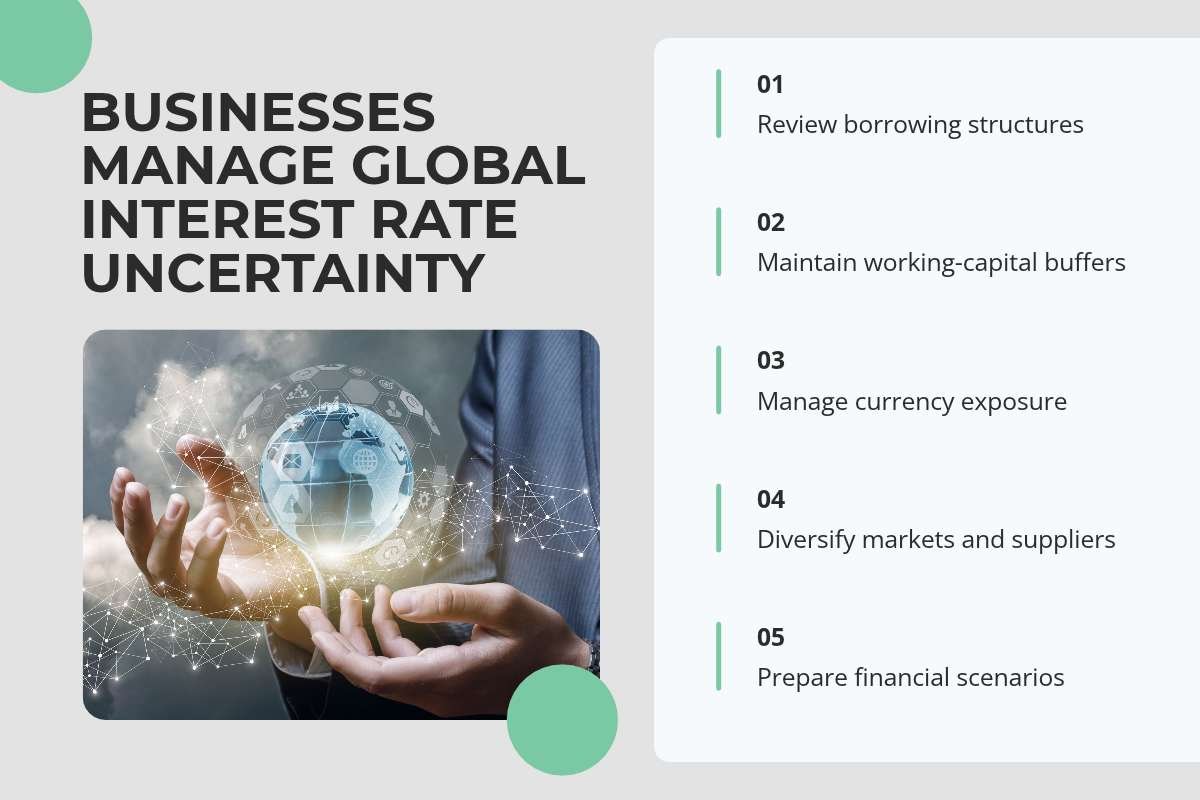
Businesses can manage global interest-rate uncertainty by making financing, liquidity, currency, and demand risks visible before a shock occurs.
- Review borrowing structures. Identify fixed versus floating loans, reset dates, prepayment terms, and refinancing conditions; floating-rate debt reprices as rates change.
- Maintain working-capital buffers. Keep liquidity for supplier payments, payroll, and unexpected financing needs; liquidity risk can affect solvency.
- Manage currency exposure. Match foreign-currency revenues and costs where possible, and use suitable hedging instruments for contracted exposures.
- Diversify markets and suppliers. Reduce dependence on one country, currency, customer group, or overseas market.
- Prepare financial scenarios. Test profit, cash flow, and debt service under higher rates, a weaker rupee, and weaker demand.
How global interest rate shifts affect business is clearest when recession warning signs appear: slowing orders, tighter credit, falling investment, and rising defaults. Businesses should prepare for weaker demand and tighter financial conditions rather than assume lower rates will quickly restore growth.
Conclusion:
Global interest rate changes don’t hit every Indian business equally. The impact depends on your debt structure, currency exposure, cash reserves, and customer demand. Knowing how global interest rate shifts affect business helps you spot risks early, such as costlier floating-rate loans or a weaker rupee raising import costs, while still using cheaper financing when it arrives. Falling rates can also signal weaker demand, so preparation matters more than prediction.
Take one step this week: check which of your loans are floating-rate and when they next reset.
FAQ:
1. How do global interest rate changes affect Indian businesses?
How global interest rate shifts affect business comes down to borrowing costs, currency movements, import expenses, export earnings, consumer demand, and expansion decisions.
2. Why do US interest rate changes matter to Indian businesses?
Changes in US interest rates can influence global capital flows, the rupee’s value, foreign investment, and demand for Indian exports.
3. Do falling global interest rates always benefit businesses?
No, lower rates can reduce borrowing costs but may also signal economic weakness and declining customer demand
Thank You For Reading!
See More
Global Business Trends Creating New Opportunities Worldwide