
Game Start
Imagine running an MSME in India in 2026. Your customers search, compare, buy, pay, and communicate online. Competitors are using software to manage routine work, while artificial intelligence is moving from boardroom conversations into everyday business operations. You now face a deceptively simple question: should MSMEs go digital immediately or gradually? The answer is less about choosing speed or caution and more about knowing where each belongs.
The stakes are significant. MSMEs contribute approximately 31.1% of India’s GDP, 35.4% of manufacturing, and 48.58% of exports, with 7.47 crore enterprises employing 32.82 crore people. Yet that economic scale does not translate into uniform digital readiness. A 2025 India SME Forum survey of 7,835 MSMEs found that 53.8% had adopted at least one digital tool, while 46.2% remained fully offline. The numbers suggest that the question is no longer whether digitalisation matters, but how an MSME should approach it.
The smartest strategy sits between the two extremes. Should MSMEs go digital all at once or take a measured route? They should start digitalisation now, but they do not need to transform every part of the business at once. Think of it as a game where the first move matters, but so does knowing which moves to make next.
Round 1: Should MSMEs Digitize Immediately or Gradually?
Going digital immediately does not mean buying every available software package. It means identifying the business processes where technology can solve an immediate problem and beginning there. A small manufacturer might start with digital payments and inventory management. A retailer may focus on e-commerce and customer communication. A service business could begin with CRM, online bookings, or automated invoicing. The first move should respond to a real operational need rather than technology for its own sake.
This is where the question of whether MSMEs should go digital becomes more practical. Moving too slowly can leave a business struggling with manual processes while customers and competitors move ahead. Going too fast can create another problem: expensive tools, poorly trained employees, disconnected systems, and technology that nobody uses properly. For businesses navigating digital transformation in India, the better approach is to begin immediately, test what works, build employee capability, and expand gradually.
Round 2: Why Is MSME Digital Adoption Uneven in India?
Not every MSME starts from the same square. A digitally active enterprise in a metro, for example, may have better access to internet connectivity, technology providers, skilled employees, and finance than a micro enterprise operating in a smaller city or rural market. Even within the same region, business size, sector, workforce capability, and the owner’s familiarity with technology can create very different levels of digital readiness. This makes whether MSMEs go digital a question with different starting points for different businesses.
The India SME Forum research suggests that basic digital adoption is advancing faster than deeper digital integration. Email, CRM, and e-commerce are relatively common among digitised enterprises, but more integrated technologies such as ERP, analytics, and cloud systems remain less widespread. This distinction matters because having a WhatsApp Business account or an online listing is not the same as connecting inventory, logistics, customer data, finance, and decision-making through a digital system.
Digital Transformation Scoreboard
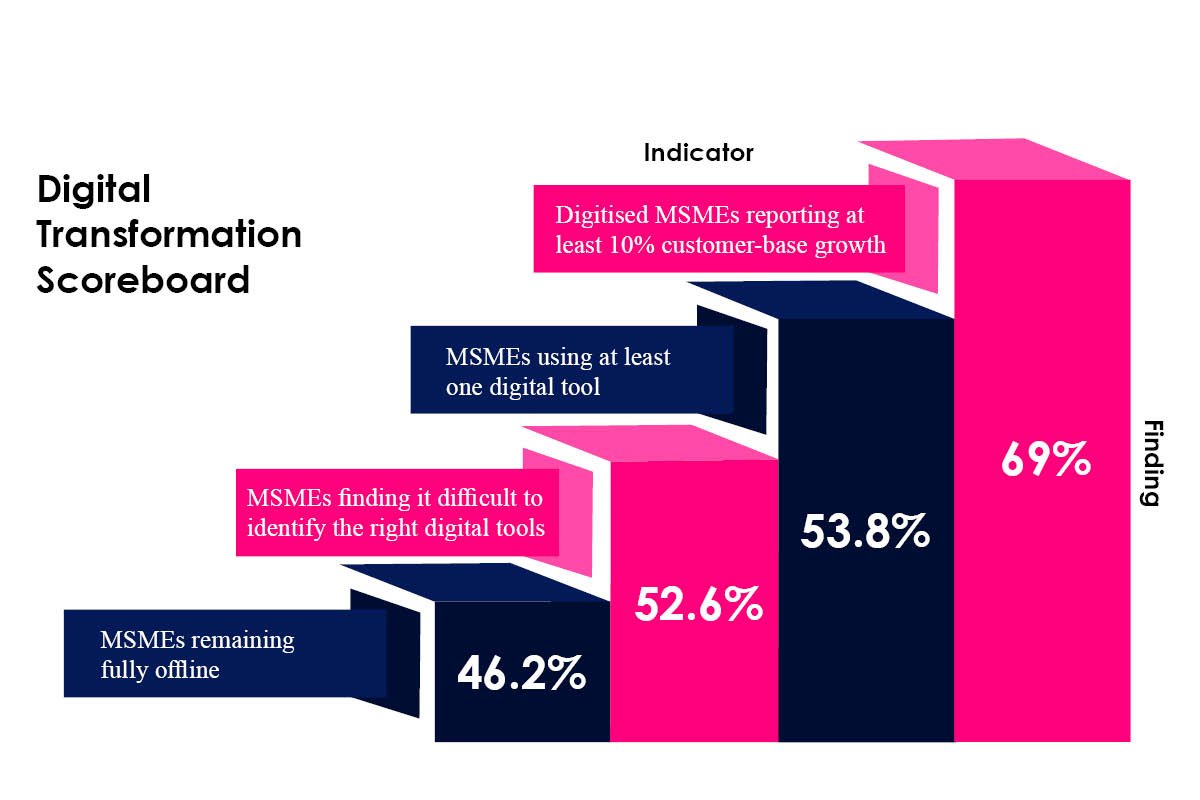
| Indicator | Finding |
| MSMEs using at least one digital tool | 53.8% |
| MSMEs remaining fully offline | 46.2% |
| Digitised MSMEs reporting at least 10% customer-base growth | 69% |
| MSMEs finding it difficult to identify the right digital tools | 52.6% |
The scoreboard explains why India’s MSMEs cannot follow a single timetable for digital adoption. Some businesses are still deciding whether to take their first digital step, while others are already exploring automation and AI. For the latter, the question is no longer whether to begin, but how far and how quickly to advance.
Round 3: What’s Holding Back MSME Digital Transformation?
The biggest obstacle is often not the absence of technology, but the difficulty of deciding what technology is actually needed. MSME owners face an expanding list of platforms for accounting, payments, customer management, inventory, marketing, cybersecurity, analytics, and automation. Without a clear roadmap, choosing between them can become a burden of its own. The India SME Forum survey found that 52.6% of respondents considered finding the right digital tools somewhat or very difficult.
Skills create another barrier. A new system only creates value when people know how to use it and understand why it matters. Cybersecurity, data privacy, cyber fraud, legacy systems, weak data management, limited technical capacity, and the difficulty of scaling successful pilots can further slow progress. Cost also matters, particularly for micro enterprises, where an unclear return on investment can make experimentation difficult.
There is also a less visible barrier: habit. Businesses that have survived for years through familiar manual processes may see little reason to change until a problem becomes urgent. That makes ‘should MSMEs go digital’ less a technology question than a business-priority question. Digital adoption becomes easier when the owner can connect each tool to a measurable improvement in sales, efficiency, customer retention, or cost control.
Bonus Round: The Technology FOMO Trap
There is a difference between digital ambition and technology FOMO. An MSME does not need to adopt a tool simply because a competitor has adopted it. The better question is whether that technology solves a problem the business actually has. For an owner still asking should MSMEs go digital, the answer should begin with the business problem, not the newest technology.
This matters especially in MSME digital transformation in India, where businesses are operating at very different levels of maturity. A strategic approach begins by identifying business needs, choosing relevant technologies, building employee capability, measuring results, and expanding what works. The goal is to build a digital system that grows with the business rather than creating a collection of disconnected tools.
Round 4: How Are Indian MSMEs Adopting AI in 2026?
AI is becoming the next power-up, but it cannot compensate for weak foundations. In 2026, Indian MSMEs are exploring AI for customer interactions, automation, predictive analytics, demand forecasting, and data-driven decision-making. AI can help a business respond faster, reduce repetitive work, understand customers, and make better use of the information it already has.
Yet adoption remains selective. Indian MSMEs are increasingly exploring AI for business practices and operational workflows, but adoption should still follow business readiness. The direction is clear, but an enterprise struggling to maintain accurate inventory data may gain more from fixing its digital foundation than immediately deploying a sophisticated AI system. In other words, should MSMEs go digital should be answered before deciding how much AI they actually need.
Final Round: Choose Your Strategy
There are three players in this game. The Sprinter adopts everything at once, hoping technology will create instant growth. The Waiter delays until digital adoption feels completely safe, risking a widening gap with customers and competitors. Neither approach is ideal.
The Strategist starts now and chooses carefully. This business identifies its most pressing problems, adopts the tools that address them, trains its people, measures the results, and expands only when the previous step works. It treats AI as an accelerator rather than a substitute for sound processes. For most MSMEs, this is the strongest answer to should MSMEs go digital: move immediately where digital tools can create value, but build the larger transformation gradually.
Game Over? Not Quite.
Digital transformation does not have a finish line. An MSME that begins with digital payments may later move to CRM, cloud systems, analytics, automation, and AI as its needs and capabilities grow. The important step is to avoid both extremes: waiting indefinitely for the perfect moment or adopting technology without a clear purpose.
So, should MSMEs go digital immediately or gradually? The answer is both. Start immediately, but scale thoughtfully. For MSME digital transformation in India, progress will depend less on how many tools a business adopts and more on whether those tools solve real problems, strengthen the workforce, and produce measurable results. The winning move is not to chase every new technology. It is to know which move the business needs next.