


A company need not seek buyers to attract acquisition interest. Strong finances help, but they do not tell the full story. Buyers may value its customers, technology, market reach, or assets. Ownership shifts and industry consolidation can also create openings.
In 2025, India recorded 221 large-ticket strategic deals worth $95.4 billion, up 21.5% in value, EY reports.
Understanding why a Company Might Be an Acquisition Target can help identify potential deal opportunities and buyer interest.
What makes a company an acquisition target?
An acquisition target is a company that another business or investor may seek to buy. Buyers assess its financial health, strategic fit, ownership, and growth potential. However, an attractive target may never receive an offer.
A Company might be an acquisition Target when it shows signs of buyer interest, ownership changes, or potential sale activity.
| Attractive acquisition target | Likely acquisition candidate |
| Strong financial performance | Receives buyer enquiries |
| Valuable assets or technology | Owners consider an exit |
| Growth opportunities | Operates in a consolidating sector |
| Strong customer base | Enters sale discussions |
| Competitive advantage | Appoints transaction advisers |
10 signs a company might be an acquisition target
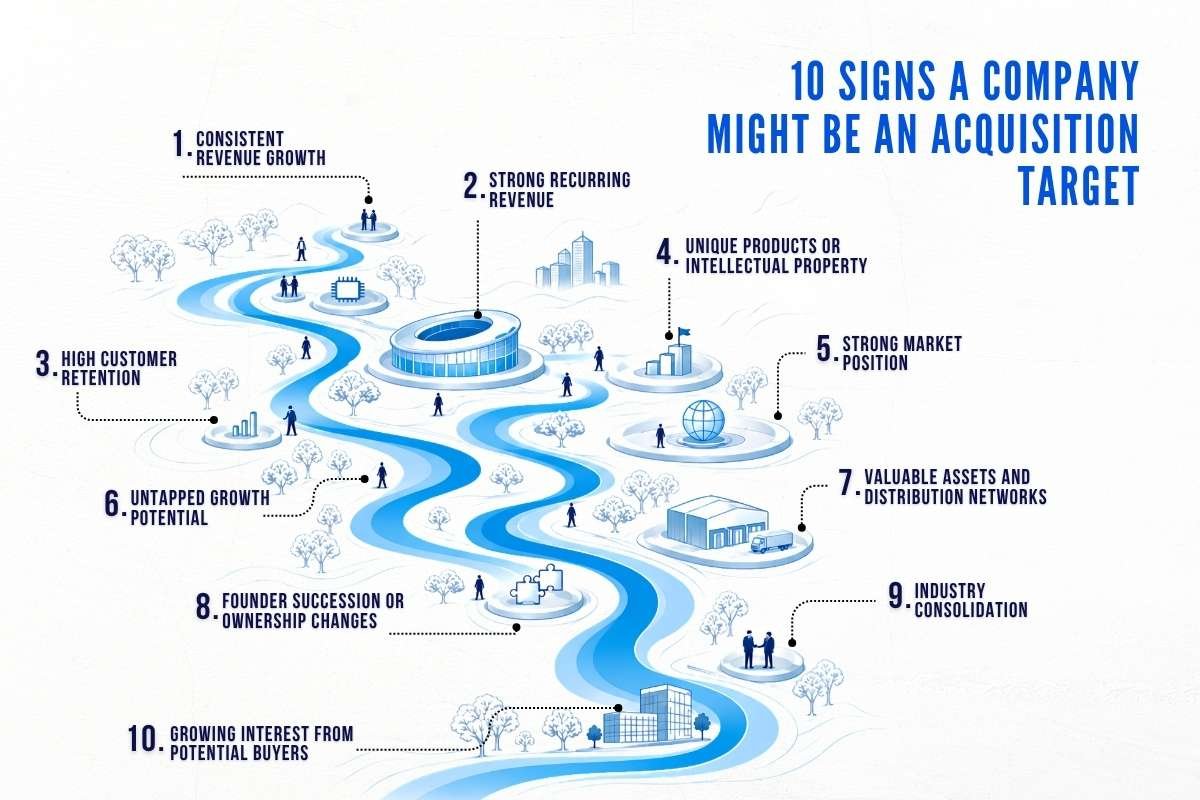
Buyers look beyond profits when they assess a potential target. They also weigh strategic value, ownership changes, and market activity. These ten indicators explain why a company might be an acquisition Target and how buyers assess its potential. No single sign confirms that a deal will happen.
1. Consistent revenue growth
Steady revenue growth can show strong demand and business stability. Growth above the industry average can signal a stronger position. Buyers may view a company as a potential acquisition Target as more attractive when it has a proven revenue growth record. Check its revenue across three years, not one strong quarter. Compare that trend with peers and the wider sector.
2. Strong recurring revenue
Subscriptions, repeat orders, and annual contracts create predictable income. Long-term customer deals can help buyers forecast future cash flows. This makes the business easier to assess and plan around. Still, recurring revenue does not ensure healthy profits. Check renewal rates, contract terms, and the revenue share from repeat customers.
3. High customer retention
Low churn and repeat purchases point to loyal customers. A strong customer base can save buyers time and marketing costs. It can also give an acquirer a ready market. However, one large client can create risk. Check retention, churn, customer lifetime value, and revenue concentration.
4. Unique products or intellectual property
Patents, proprietary tools, and specialist know-how can set businesses apart. Buyers may acquire these assets instead of building them, making the company might be an acquisition Target for strategic investors. This can save time and speed up product development. Check who owns the IP and its legal status. A licence alone may not give buyers lasting control.
5. Strong market position
A strong brand or niche lead can attract strategic buyers. An acquisition can give buyers faster access to customers. It may also strengthen their reach in a key market. For example, JSW Paints agreed to acquire a controlling stake in Akzo Nobel India in 2025. The deal aimed to strengthen JSW’s position in paints.
6. Untapped growth potential
Some businesses have room to grow but lack capital. They may have unused capacity, new products, or untapped markets. A buyer can use its own funds and network to expand. This can make a smaller business a valuable target. Check demand, capacity use, expansion costs, and access to new regions.
7. Valuable assets and distribution networks
Plants, warehouses, supply chains, and dealer networks can attract buyers. These assets may cut the cost of entering new markets. Nearby facilities can also help combine operations and lower costs. Delhivery’s 2025 acquisition of Ecom Express shows this logic. It added scale in India’s parcel delivery market.
8. Founder succession or ownership changes
A founder’s retirement or unclear succession can open a path. Promoters may also seek partial or full exits. HSBC found that 45% of surveyed Indian entrepreneurs did not expect their children to take over. This may create succession pressure, but it does not prove sale plans.
9. Industry consolidation
Rising deal activity can signal a sector-wide shift. Buyers may acquire smaller players to gain scale, technology, or reach. India recorded 221 large strategic deals worth $95.4 billion in 2025. Infrastructure led deal value, while industrials and autos saw sharp growth. This activity can raise buyer interest across related sectors.
10. Growing interest from potential buyers
Direct buyer enquiries offer a stronger signal than business performance. Watch for requests for financial data or early deal talks. A strategic review or adviser appointment may also signal sale plans. But informal interest is not an offer. An indicative offer or formal sale process points to stronger intent.
How to assess whether a company is an acquisition target?

Spotting signs a company might be an acquisition target starts with these 3 questions:
- Does the company offer value to potential buyers?
- Does its ownership or business situation create an opportunity?
- Is there evidence of actual buyer interest or sale activity?
Then check public records and company updates for proof.
| Evidence to check | Where to find it |
| Financial performance | Annual reports and financial statements |
| Ownership changes | MCA filings and company disclosures |
| Buyer interest | Company announcements and credible deal reports |
| Industry consolidation | Sector M&A reports |
| Strategic reviews | Public statements and NSE or BSE filings |
Editorial note: The strongest signs are not always financial. A company may have strong assets and growth potential, but no buyer interest. Conversely, succession gaps or sector consolidation may create an opening. Treat these signs as evidence to assess, not proof of an upcoming deal.
The data points above use recent published research and deal examples. The revenue, retention, IP, and capacity checks are assessment measures; I have not added unsupported industry benchmarks for them.
What can prevent a company from becoming an attractive acquisition target?
Strong performance cannot remove every deal risk. Buyers may reduce their offer or walk away due to:
- Heavy debt and weak cash flow: Raise repayment and funding concerns.
- Major pending litigation: Creates legal costs and future uncertainty.
- Unclear ownership rights: Can delay or block a deal.
- High customer concentration: Makes revenue less stable.
- Founder or key employee dependence: Creates risks after the sale.
- Poor financial records: Make due diligence harder.
- Regulatory and compliance issues: Can delay approval or increase deal costs.
These issues can reduce buyer interest and lower valuation.
Conclusion:
Understanding why a company might be an acquisition Target involves looking beyond strong financial performance. Buyers also value strategic assets, market position, and growth potential. Ownership changes and direct buyer interest may signal deal activity.
No single sign confirms an upcoming acquisition. Assess several indicators together to judge both buyer appeal and deal likelihood.
Frequently asked questions
1. Can a company become an acquisition target without making a profit?
Yes, buyers may value its technology, market access, or strategic assets despite losses.
2. Does industry consolidation increase acquisition chances?
Yes, rising competitor acquisitions can create demand for suitable businesses.
3. Where can investors find signs of a potential company acquisition?
Investors can check annual reports, exchange filings, company announcements, and credible transaction reports.
4. Does a company need to be publicly listed to become an acquisition target?
No, private companies can also attract acquisition offers from businesses and investors.