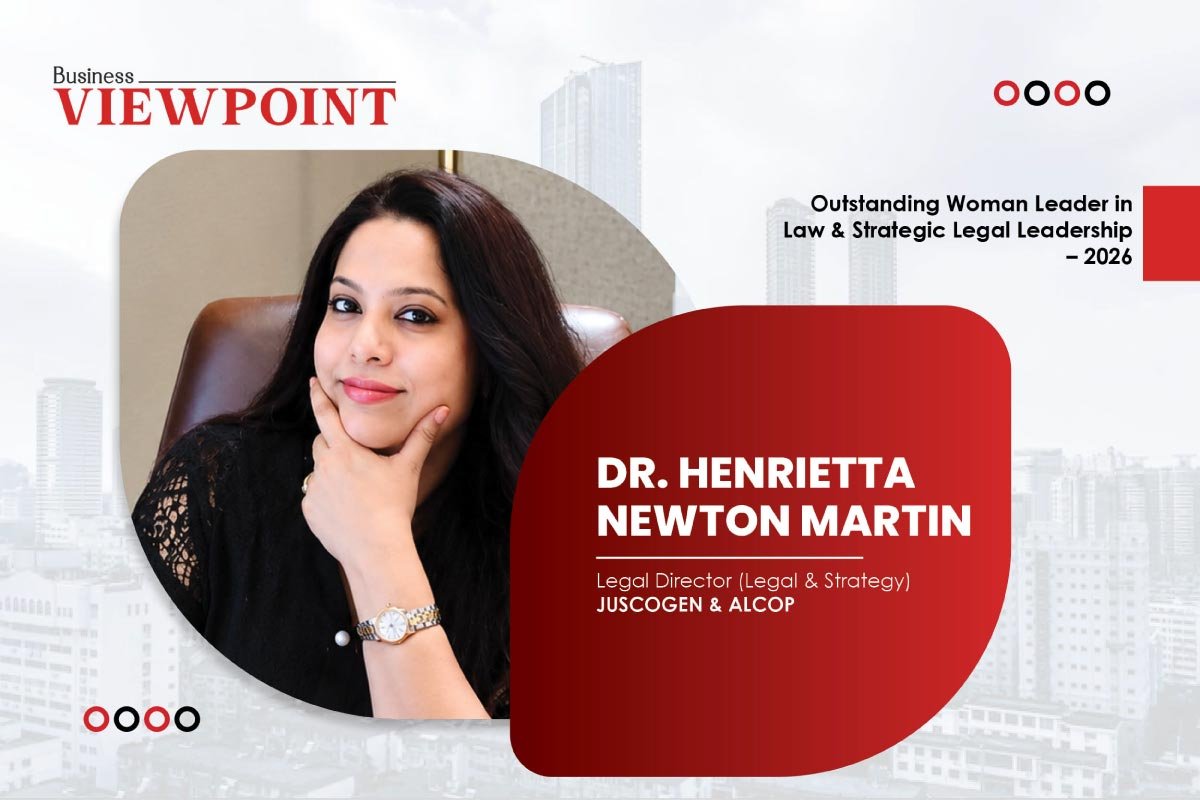



The legal industry is evolving rapidly, bringing extraordinary opportunities as regulation becomes a strategic business issue, AI transforms competition, geopolitical shifts open new markets, and businesses move faster than ever with legal leaders vital to enabling that momentum. In this landscape, the most valuable legal leaders are not gatekeepers but architects: visionaries who sit at the decision table early, translate complexity into clarity, and turn legal insight into competitive advantage. Dr. Henrietta Newton Martin is one such leader, and as Legal Director (Legal & Strategy) at JUSCOGEN & ALCOP, she is redefining what it means to lead in law by positioning Legal not as the function that slows the business down, but as one that gives it the confidence and structure to move faster.
Her journey from legal counsel to trusted strategic business partner reflects how legal expertise drives organisational value, and with international mandates, senior strategic responsibilities, and recognition across multiple jurisdictions, she has earned her place at the decision table, advising executives, boards, and cross-functional teams on high-stakes business and technology decisions. What sets her apart is not just her credentials but her philosophy that legal leadership is about helping organisations take the right risks with their eyes open, turning complexity into clarity, and legal insight into better business decisions. Her’s is a story of character, courage, and a legacy that outlasts every title one Business ViewPoint is honoured to share.

The case against conflict avoidance, why legal leaders should embrace disagreement
There is a widely accepted assumption about legal leadership that Dr. Henrietta Newton Martin firmly disagrees with that a good legal leader should avoid conflict. In her experience, the opposite is true. Healthy disagreement, she has found, is often where the best decisions come from. Legal teams are frequently brought into situations where the business wants speed, commercial teams want flexibility, and the lawyer sees risks that others may not. Avoiding difficult conversations may keep things comfortable in the short term, but it can prevent the organization from confronting important issues early.
What has her experience taught her instead? That effective legal leadership is not about eliminating disagreement, it is about making disagreement productive. The goal is to challenge assumptions, understand different perspectives, and ultimately help the organization reach a decision that everyone understands, even when they don’t all initially agree. And as she always says, “epistemic humility is the key.” Dr. Henrietta Newton Martin’s definition of epistemic humility, one that needs to be there in professionals, is -“perspicacity without assumptions and without drawing abrupt presumptions”.
From gatekeeper to architect, transforming legal counsel into strategic advantage
The real shift, Dr. Henrietta Newton Martin believes, is from being a gatekeeper to being an architect. As Legal Director (Legal & Strategy), her starting point would be to deeply understand the company’s strategic priorities growth, market expansion, partnerships, investments, and transformation and then position Legal alongside those priorities, rather than operating behind them.
That means bringing Legal into strategic decisions early, translating complex legal and regulatory issues into clear commercial choices, and designing structures that let the business move quickly without uncontrolled risk while building scalable legal infrastructure such as playbooks, governance frameworks, contracting standards, and decision-making principles so the business does not need Legal to reinvent the answer every time, though she adds that the human touch of legal personnel remains essential for swift decisions on the spot.
Most importantly, Dr. Henrietta Newton Martin would measure Legal not by how many risks were identified, but by the value enabled: transactions successfully executed, markets entered, opportunities accelerated, disputes avoided, and strategic decisions made with greater confidence. At the leadership level, her philosophy is simple: Legal should not be the department that slows the business down. It should be one of the functions that gives the business the confidence and structure to move faster. That is how she would turn Legal from a cost and control function into a genuine strategic competitive advantage.
Underestimated regulatory developments in the UAE
Dr. Henrietta Newton Martin believes that businesses in the UAE are still underestimating the extent to which regulation is moving from being a compliance exercise to becoming a strategic business issue, and she highlights several key areas where this gap is most pronounced.
- Tax and international regulatory alignment: The UAE’s corporate tax framework is maturing, with Pillar Two, the 15% global minimum tax, domestic top-up tax for in-scope multinational enterprises, and clarified Pillar Two reporting obligations now being very real considerations for multinational groups.
- Data, technology, and AI governance: Businesses are adopting AI faster than building legal frameworks for data ownership, privacy, cybersecurity, IP, automated decisions, and accountability, making governance increasingly critical as the UAE positions itself as a global technology and AI hub.
- Regulatory fragmentation: The UAE’s multi-layered regulatory landscape requires businesses to determine which federal, emirate-level, or free zone framework applies to each activity, entity, transaction, and data flow.
- Regulatory change as a board-level risk: As the UAE deliberately evolves its legal and regulatory framework to remain competitive globally, regulatory monitoring cannot sit only with Legal or Compliance; it must feed directly into strategy, investment decisions, operating models, and risk appetite.
Her approach as Legal Director would be to build a function that anticipates regulatory change and translates it into business opportunity creating real strategic value not by reacting to regulation after it arrives, but by positioning the company ahead of it.
When Safe Is Not the Same as Right, A Difficult Decision That Shaped Her Leadership
The lesson for Dr. Henrietta Newton Martin was simple: being safe is not always the same as being right. She faced a decision where the legally conservative choice would have delayed a strategic opportunity until every risk was eliminated, but she recognised that waiting carried its own significant risks of losing the opportunity, weakening the negotiating position, and allowing a competitor to move first. She therefore recommended a different approach, identifying which risks were genuinely unacceptable, which could be mitigated, and which the business could consciously accept, then putting clear contractual protections, governance measures, and escalation points around the decision.
The outcome reinforced that good legal leadership is not about eliminating risk but helping the organisation take the right risks with its eyes open. It taught her that leadership sometimes means challenging the instinctively conservative answer especially when everyone expects Legal to say no and that a senior legal leader must provide independent judgment while understanding its commercial consequences. The best decision, she believes, protects the organisation while still allowing it to pursue its strategic ambitions, and that is where Legal creates real strategic value: not by reacting to regulation after it arrives, but by helping the business understand where the regulatory environment is heading and positioning the company ahead of it.

Balancing legal protection with speed, innovation, and calculated risk
Dr. Henrietta does not believe Legal’s role is to eliminate risk in a competitive business; that is neither realistic nor desirable. Instead, Legal must ensure the business understands the risk, knows how to manage it, and decides consciously. She thinks about this balance in three categories:
- What we cannot accept: Non-negotiable – if a proposed course of action creates unacceptable legal, regulatory, ethical, or reputational exposure, Legal has to be prepared to say no.
- What we can mitigate: Where Legal creates significant value – instead of stopping an initiative, the focus is on restructuring it, strengthening contractual protections, introducing appropriate governance, or creating safeguards that allow the business to proceed.
- What we can consciously take for a commercial return: Calculated risk – Sometimes the commercially right decision involves accepting a degree of legal risk, and her responsibility is not to make that decision for the business but to ensure management understands the consequences and that the risk aligns with the organisation’s overall risk appetite.
She sees Legal as a strategic enabler, with early involvement, clear frameworks, playbooks, approval thresholds, and principles preventing bottlenecks, helping the business understand boundaries, manage risks, and find commercially viable solutions that balance protection with competitive advantage.
The capability future legal leaders must develop
The most important capability future legal leaders need beyond traditional legal expertise, according to Dr. Henrietta Newton Martin, is strategic judgment. Legal knowledge will always be the foundation, but the real value comes from understanding the broader business context and knowing how to apply that knowledge to complex commercial decisions. A strong legal leader, she explains, needs to understand where the business is going, what is driving growth, where the real risks sit, and where calculated risk can create opportunity, which means being able to move beyond simply identifying legal issues and instead provide a clear view of the options, the consequences, and the recommended path forward.
She also emphasises influence and communication explaining complex issues simply, challenging assumptions constructively, and bringing stakeholders toward a decision is becoming as important as technical legal expertise. Technology and AI will reshape the profession, but she sees them as enablers, because the real differentiator remains human judgment: knowing what matters, what can be challenged, what can be accepted, and when to move decisively. Ultimately, she believes the future of legal leadership is about turning complexity into clarity and legal insight into better business decisions that is what keeps Legal commercially relevant.
Partnerships and acquisitions as tools for growth
Dr. Henrietta Newton Martin would assess any partnership or acquisition opportunity across three key considerations. She views such opportunities as tools to accelerate growth, build capabilities, and create long-term value rather than simply increase scale:
- Strategic Fit: Strengthens core priorities, opens new markets, deepens customer relationships, or adds capabilities faster than organic development.
- Differentiated Capability: Adds technology, intellectual property, specialist talent, distribution, data, market access, or sustainable competitive advantages.
- Quality and Risk: Ensures rigorous diligence across regulatory exposure, contracts, IP, data, governance, people, and liabilities to protect and realise value.
She emphasizes post-acquisition integration, ensuring people, culture, technology, and capabilities translate the transaction thesis into measurable value, while pursuing opportunities that accelerate strategy, create differentiated capabilities, and support long-term growth.
Leveraging AI as a productivity and decision-support capability
Given the nature of their work, Dr. Henrietta Newton Martin and her team cannot disclose specific platforms or certain use cases due to confidentiality and information security considerations, but they use AI extensively as a productivity and decision-support capability across their operations.
- AI Tools You Use: Specific platforms cannot be disclosed due to confidentiality and information security considerations, but AI is used extensively as a productivity and decision-support capability across operations.
- Primary Use Cases: Information analysis, document intelligence, research support, workflow automation, summarising complex materials, identifying patterns and potential risks, and supporting strategic analysis.
- Key Benefits: AI allows the team to process and analyse information significantly faster, reduce repetitive work, and focus time on matters that require deeper legal, commercial, and strategic judgment.
- Impact on Decision-Making: From a decision-making perspective, AI helps compare scenarios, test assumptions, and identify areas that require further investigation, improving the speed and efficiency of analysis while allowing more informed decisions.
At the same time, Dr. Henrietta Newton Martin prioritizes confidentiality, data governance, accuracy, and human oversight, using AI to support rather than replace judgment, enabling faster analysis and better-informed decisions while maintaining appropriate controls.
Being right vs. being effective, a lesson that reshaped strategic thinking
One of the biggest lessons Dr. Henrietta Newton Martin has learned is that being right and being effective are not the same thing. Early in her career, a situation where the legal position was clear but pursuing it to its logical conclusion was not the best outcome for the organisation taught her that strategy is not about proving a point but about understanding what the organisation ultimately needs to achieve. Since then, she has become far more deliberate about separating the issue from the objective, looking at the legal position but also at commercial impact, relationships, timing, reputation, and what success looks like three steps ahead.
That experience shifted her mindset from “How do we win this?” to “What outcome creates the most value, and what is the smartest way to get there?” It is a distinction that has shaped how she negotiates, advises senior leadership, and makes decisions under pressure. For Dr. Martin, the real measure of strategy is not winning the argument; it is creating an outcome that stands the test of time.
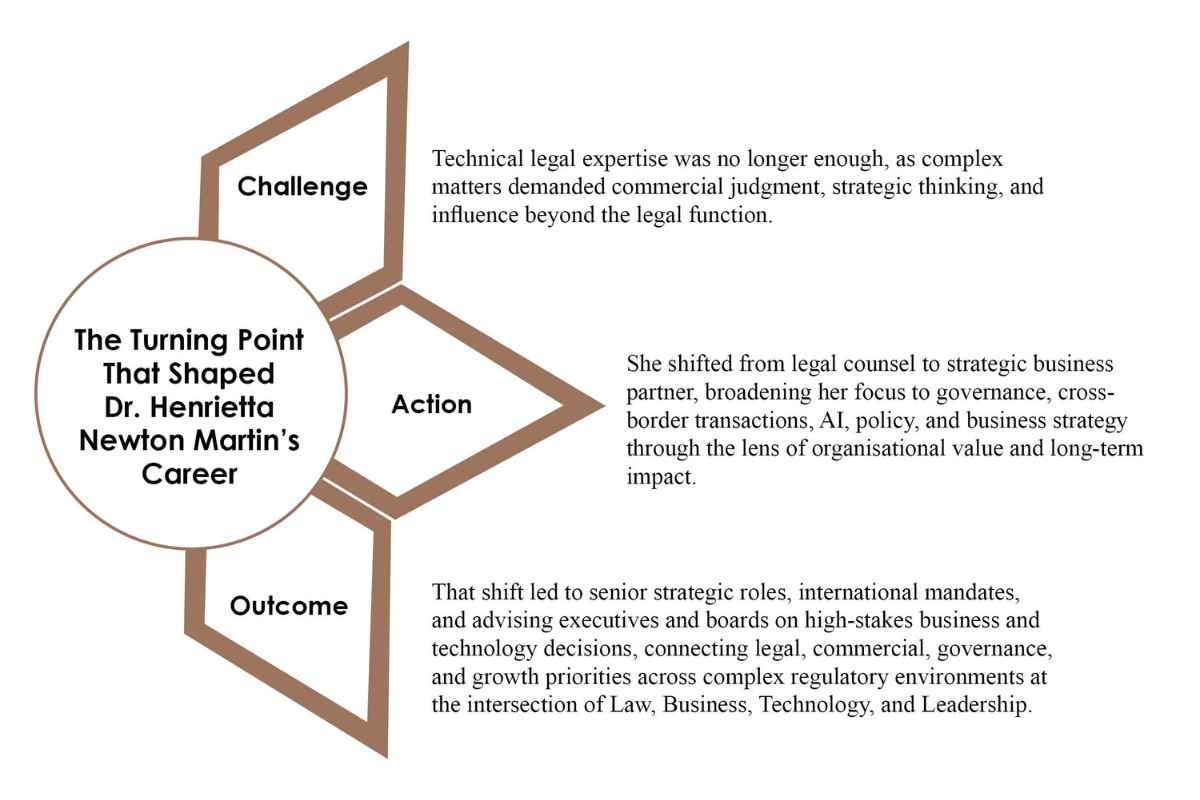
The turning point that shaped Dr. Henrietta Newton Martin’s career
| Element | Details |
| Challenge | Technical legal expertise was no longer enough, as complex matters demanded commercial judgment, strategic thinking, and influence beyond the legal function. |
| Action | She shifted from legal counsel to strategic business partner, broadening her focus to governance, cross-border transactions, AI, policy, and business strategy through the lens of organisational value and long-term impact. |
| Outcome | That shift led to senior strategic roles, international mandates, and advising executives and boards on high-stakes business and technology decisions, connecting legal, commercial, governance, and growth priorities across complex regulatory environments at the intersection of Law, Business, Technology, and Leadership. |
The defining shift, as Dr. Henrietta Newton Martin describes it as moving from advising on decisions to helping shape them, and from protecting the business from risk to helping it move forward with confidence.
The greatest opportunity: AI, geopolitical realignment, and enterprise strategy
The greatest opportunity for strategic legal leaders, according to Dr. Henrietta, will be at the intersection of AI, geopolitical realignment, and enterprise strategy. At the management or even C-suite level, she explains, these are no longer separate issues; AI is changing how companies compete, geopolitics is reshaping markets and supply chains, and regulation is increasingly influencing where organisations can invest, operate, and scale.
This creates a new mandate for strategic legal leaders. The opportunity is to sit at the decision table early, connect regulatory and geopolitical signals with commercial priorities, and help leadership teams make better decisions about where to invest, where to expand, and where to take calculated risk. The most valuable legal leaders of the future, she believes, will therefore not simply protect the enterprise; they will help shape where the enterprise goes next. For Dr. Martin, the real opportunity is to turn uncertainty into strategic clarity and strategic clarity into competitive advantage.
The success code: Dr Henrietta Newton Martin’s enduring principle
My enduring lesson is this: never allow circumstances to negotiate your standards, because throughout my journey I have learned that while talent can create an opportunity, character determines what you build with it. I have faced moments that demanded patience, courage, and the discipline to keep moving without compromising what I believe is right, and I do not measure success by titles, applause, or how quickly I arrive but by the trust I earn, the value I create, and the legacy I leave through my work. My success code is simple: stay grounded, think boldly, deliver with excellence, and build a character that outlasts every title, achievement, and accolade. As I have reflected, even if you reach the treetop in life, know that the tree is a tree because it is deeply rooted in the earth.