


Buying a business takes more than agreeing on its price. Buyers must fund the purchase without straining their own finances or the target’s cash flow. The right financing options for a business acquisition can help buyers balance cost, control, and future growth.
Unlike working-capital loans, acquisition funding supports a change in ownership and control. Lenders and investors assess more than the buyer’s need for money. They also examine the target’s cash flow, assets, debt, and ability to repay.
In India, buyers can combine personal equity, bank or NBFC loans, seller financing, and investor funds. Each route brings different costs, risks, and control terms. The best fit depends on the target’s value, earnings, buyer’s finances, and deal structure.
This blog compares funding sources, their suitability, and key risks. It also covers lender checks, due diligence, deal terms, and Indian legal and tax rules.
What do financing options for a business acquisition actually cover?
Acquisition financing is the capital a buyer uses to purchase a business or controlling stake. It covers more than the price paid to the seller. Buyers must also plan for deal costs and future cash needs.

Three funding needs matter most:
- Purchase consideration: The money paid to the seller for ownership.
- Transaction costs: Fees for legal advice, valuation, due diligence, and deal support.
- Post-acquisition funding: Cash for daily needs, integration, or debt repayment after closing.
The funding need also changes with the deal structure. A share acquisition transfers ownership of shares, while an asset acquisition covers selected assets. A slump sale transfers an undertaking as a going concern. These structures affect liabilities, tax, and funding needs.
| Funding need | Typical purpose |
| Purchase consideration | Paying the seller |
| Transaction expenses | Legal, advisory, and due diligence fees |
| Refinancing | Replacing existing target debt |
| Integration funding | Aligning systems, teams, and operations |
| Working capital | Supporting daily business needs |
A sound plan covers the full deal, not just the sale price.
What are the main financing options for a business acquisition?
Most acquisitions use one funding source or a blend of several. The right mix depends on the buyer’s funds, the target’s earnings, and the seller’s terms. Here are the main financing options for a business acquisition in India.
| Financing route | How it works | Main consideration |
| Buyer’s own funds | Buyer pays with available capital | Limits liquidity |
| Bank acquisition debt | A lender funds part of the purchase | Repayment capacity and security |
| NBFC/private credit | A non-bank lender provides debt | Cost and loan terms |
| Equity investors | Investors provide purchase capital | Ownership dilution |
| Seller financing | Seller accepts payment at a later date | Negotiated terms and seller risk |
| Earn-out | Part of the price depends on future results | Clear performance measures |
| Mezzanine/hybrid funding | Debt combines with equity-like features | Higher cost and complexity |
| Blended financing | Several sources fund one deal | Careful coordination |
1. Buyer equity and internal funds
Buyers can use savings, company reserves, or promoter capital. This reduces reliance on lenders and cuts interest costs. It can also help buyers negotiate from a stronger position.
However, paying too much upfront can strain cash reserves. The acquired business may need funds for stock, wages, repairs, or new systems. Buyers should keep enough cash for these needs after closing.
2. Bank or institutional debt
Banks and other institutional lenders may fund part of an acquisition. Yet ordinary business loans do not suit every purchase. Buyers must check whether the lender permits the intended use of funds.
Lenders may assess:
- The target’s cash flow and existing debt.
- The buyer’s financial strength and repayment record.
- Available collateral and other security.
- The deal structure and expected repayment source.
Buyers should match loan payments with the business’s expected cash flow. High debt can leave little room for weak sales or delayed payments. A sound deal must support both loan payments and daily operations.
3. NBFC and private credit
NBFCs and private credit providers may suit deals that banks cannot fully fund. Some may offer more flexible terms or tailored repayment plans. This can help when a deal has unusual needs.
But flexibility may come at a higher cost. Buyers should compare interest, fees, security terms, and loan covenants. They must also check the cost of early repayment and any default penalties.
4. Equity investors
Strategic investors and private investors can fund part of the purchase. Unlike conventional debt, equity does not require fixed loan payments. However, buyers give up part of their ownership and may share control.
The buyer and investor must agree on valuation, voting rights, and future exits. These terms matter when investors expect board seats or a say in key decisions. A lower cash burden may come with less freedom.
5. Seller financing, deferred consideration, and earn-outs
Seller financing lets the buyer pay part of the price later. This can lower the cash needed at closing. It may also help bridge a gap between the buyer’s offer and the seller’s price.
Deferred consideration means the buyer owes an agreed amount later. An earn-out links part of the payment to future results. For example, the seller may receive more if sales reach an agreed target.
Both methods need clear terms. Buyers and sellers should define payment dates, performance measures, and dispute rules. Strong negotiation strategies in mergers and acquisitions can help both sides agree on fair terms.
6. Blended acquisition financing
Buyers often combine several sources to meet the purchase price. A blended structure can spread risk and reduce upfront cash needs.
Consider a hypothetical ₹10 crore acquisition:
| Funding source | Share | Amount |
| Buyer equity | 30% | ₹3 crore |
| Acquisition debt | 50% | ₹5 crore |
| Seller-financed payment | 20% | ₹2 crore |
| Total | 100% | ₹10 crore |
These figures serve as an example, not market benchmarks. The buyer still needs funds for deal costs and future operations. The seller’s deferred payment terms must also fit the business’s cash flow.
The best financing mix does not always mean borrowing more. It means funding the purchase while keeping enough cash to run the business.
How to choose between acquisition financing options?
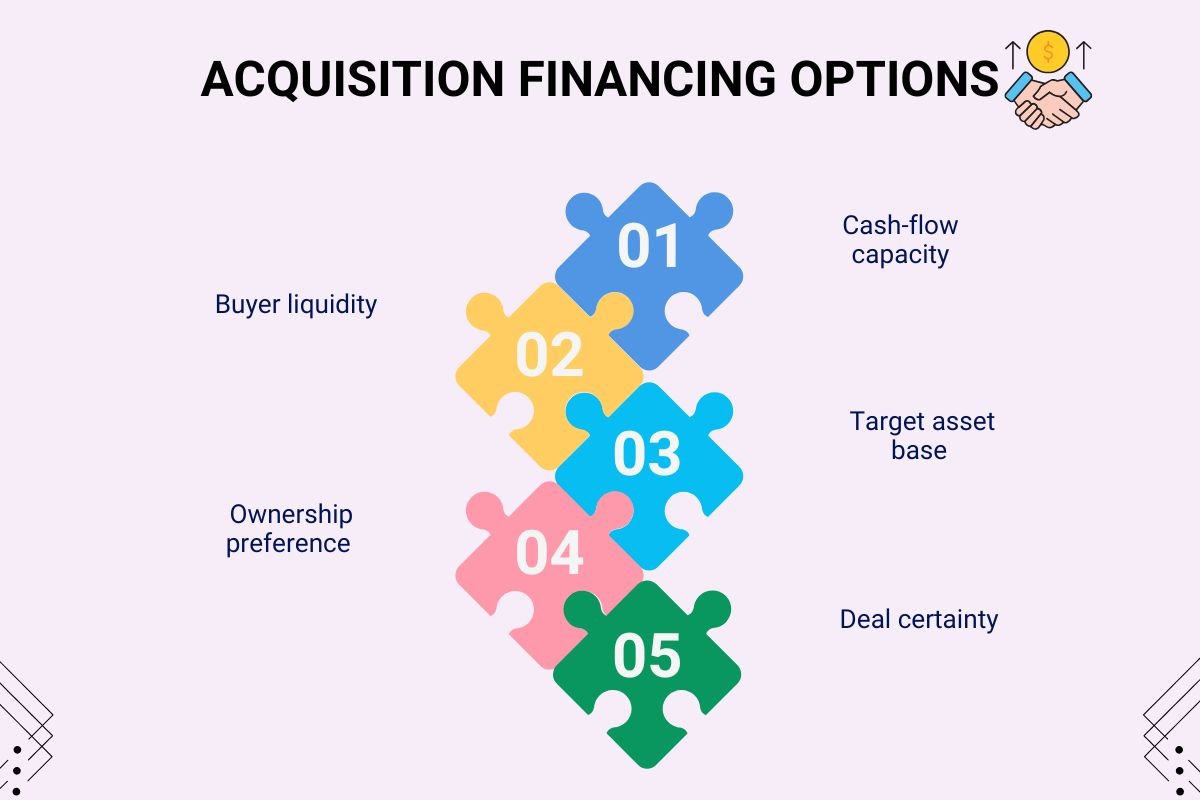
The right funding mix depends on more than the purchase price. Buyers must weigh cash flow, risk, control, and the seller’s needs. These five checks can help narrow the financing options for a business acquisition.
Five factors to check
1. Cash-flow capacity: Can the target cover loan payments and daily costs? Leave room for slow sales or late payments.
2. Buyer liquidity: How much cash can you invest without hurting your current business? Keep funds for emergencies and future growth.
3. Target asset base: Does the business own assets that lenders may accept as security? Check existing loans and claims first.
4. Ownership preference: Are you willing to share control with investors? Equity can ease debt pressure but reduce your stake.
5. Deal certainty: Does the seller need most funds upfront? If not, discuss deferred payments or an earn-out.
Which route should you examine?
| Buyer situation | Financing route to examine |
| Strong cash reserves | Buyer equity plus limited debt |
| Predictable target cash flow | Acquisition debt |
| Limited upfront capital | Seller financing or deferred payment |
| High growth, weak current cash flow | Equity or hybrid funding |
| Multiple funding constraints | Blended structure |
These options offer starting points, not fixed rules. A buyer should test each route against repayment needs and deal terms. The best structure funds the purchase without starving the business of cash.
What lenders and investors examine before funding an acquisition?

A strong deal needs more than an attractive price. Lenders and investors want proof that the business can support the funding. They also check whether the buyer can manage risks after closing.
Key checks include:
- Financial performance: Review past revenue, profit, operating cash flow, and debt.
- Cash needs: Check the working-capital cycle and the cash tied up in stock or unpaid bills.
- Customer mix: High reliance on one buyer can raise risk.
- Assets and liabilities: Check asset quality, existing loans, legal claims, and contingent liabilities.
- Buyer strength: Assess the buyer’s own funds, credit record, and financial health.
- Valuation: Compare the asking price with sustainable earnings and cash flow.
- Legal risks: Review permits, contracts, tax issues, and regulatory duties.
The Reserve Bank of India’s 2026 Commercial Banks (Credit Facilities) Directions set out specific acquisition-finance checks. These include combined buyer-target financials, leverage, equity contribution, and cash-flow certainty. Banks must also assess the deal’s value independently.
One key point matters: reported profit does not equal cash available for debt payments. Adjusted EBITDA measures earnings before interest, tax, depreciation, and amortisation, with agreed adjustments. Lenders still need to check actual cash flow and future cash needs.
Thorough due diligence in M&A helps buyers test these risks before they commit funds.
India-specific legal, tax and regulatory checks
Legal rules can change the cost, timing, and funding of an acquisition. Buyers should check these points before they commit capital.
- Companies Act: Check company approvals, share transfers, and board or shareholder consent where required.
- CCI approval: Some deals need Competition Commission of India approval before closing. Review the applicable merger-control rules and thresholds.
- SEBI rules: Listed-company deals may trigger disclosure, takeover, or open-offer duties.
- RBI and FEMA: Cross-border deals must meet foreign investment rules, pricing norms, and payment requirements.
- Stamp duty and tax: Deal form can affect stamp duty, tax exposure, and net proceeds to the seller.
The Companies Act, 2013, CCI combination rules, SEBI takeover regulations, and RBI foreign investment rules provide official guidance.
These checks can affect closing dates, cash needs, and the seller’s net proceeds. Buyers should confirm the rules that apply before they finalise funding.
Financing risks buyers should model before closing

A funding plan may work at closing but fail when sales fall. Buyers must test how the deal will handle lower cash flow and higher costs.
- Debt-service pressure: Check whether the business can meet loan payments during slow months.
- Interest-rate changes: Test how higher rates could raise repayment costs.
- Cash-flow gaps: Do not assume past earnings will continue. Lost customers or late payments can weaken repayment capacity.
- Refinancing risk: Check whether the buyer can repay or renew debt at maturity.
- Excessive cash use: Keep enough funds for daily needs and sudden costs.
- Seller-payment disputes: Set clear dates, targets, and rules for deferred payments.
- Integration costs: Budget for system changes, staff shifts, and process fixes.
These risks often link to post-merger integration challenges. If integration takes longer than planned, costs may rise while cash flow falls. Buyers should test a downside case before they commit.
A practical acquisition financing checklist
Use this checklist before you commit funds to an acquisition.
- Calculate the total funding needed.
- Separate the purchase price from deal costs.
- Check the target’s cash flow and debt capacity.
- Set the buyer’s equity contribution.
- Compare loan costs, terms, and repayment schedules.
- Discuss seller financing or deferred payments.
- Test cash flow under a downside case.
- Complete financial, legal, and commercial due diligence.
- Check tax rules and regulatory approvals.
- Keep enough cash for post-closing needs.
Final check: Can the acquired business repay its debt and fund daily operations?
Conclusion:
Financing options for a business acquisition are a deal-structure decision, not just a search for the cheapest loan. Buyers can use equity, bank debt, alternative credit, seller financing, or blended structures. The right mix depends on the target’s cash flow, the buyer’s financial capacity, and the terms of the deal. Legal, tax, and regulatory rules also shape the final choice. A sound funding plan must cover the purchase while protecting cash for daily operations after closing. This makes financing a key part of sound mergers and acquisitions planning.
Frequently asked questions
1. Can a business acquisition be financed entirely through debt?
Possibly, but approval depends on lender criteria, buyer strength, target cash flow, available security, and deal structure. Debt funding is never guaranteed.
2. What is seller financing in a business acquisition?
Seller financing lets the buyer pay part of the purchase price directly to the seller later. This reduces upfront funding needs and spreads payments over time.
3. What are the main financing options for a business acquisition?
The main financing options for a business acquisition include buyer equity, acquisition debt, equity investors, seller financing, deferred consideration, earn-outs, and blended structures.