


“Purpose is powerful. But when purpose meets business, it can become transformative.”
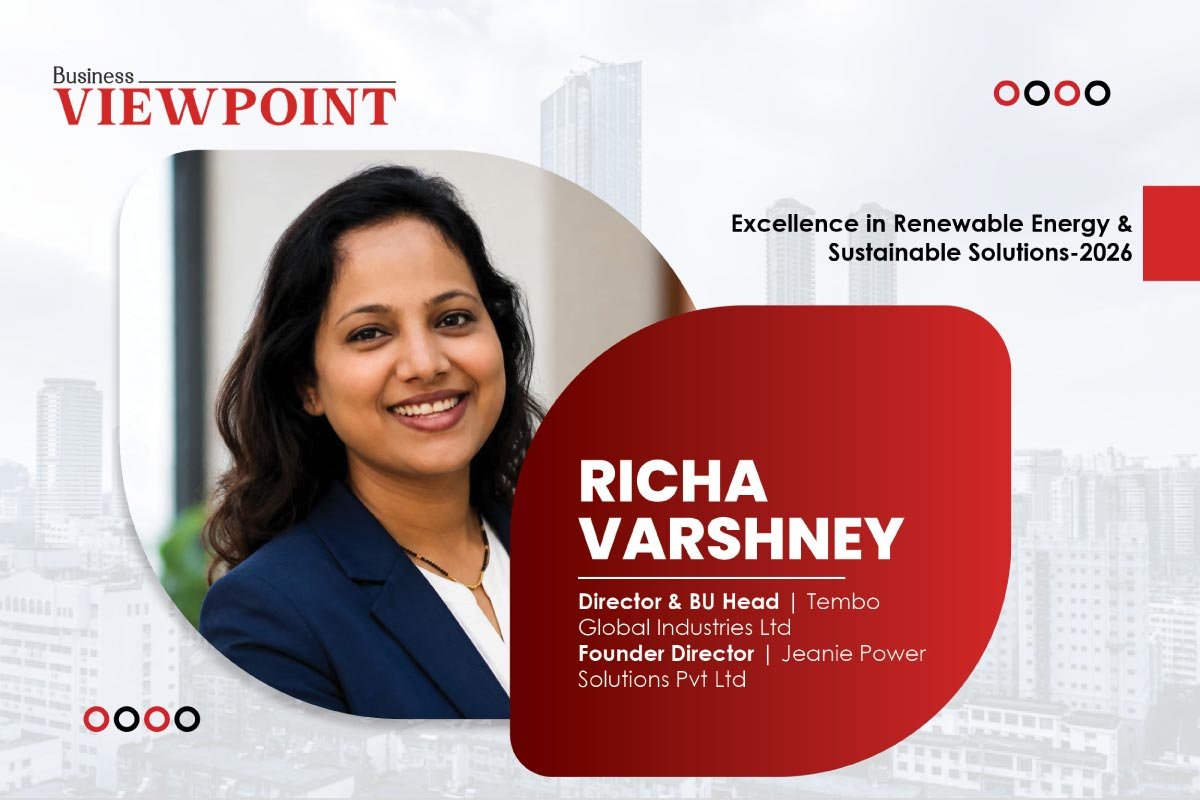
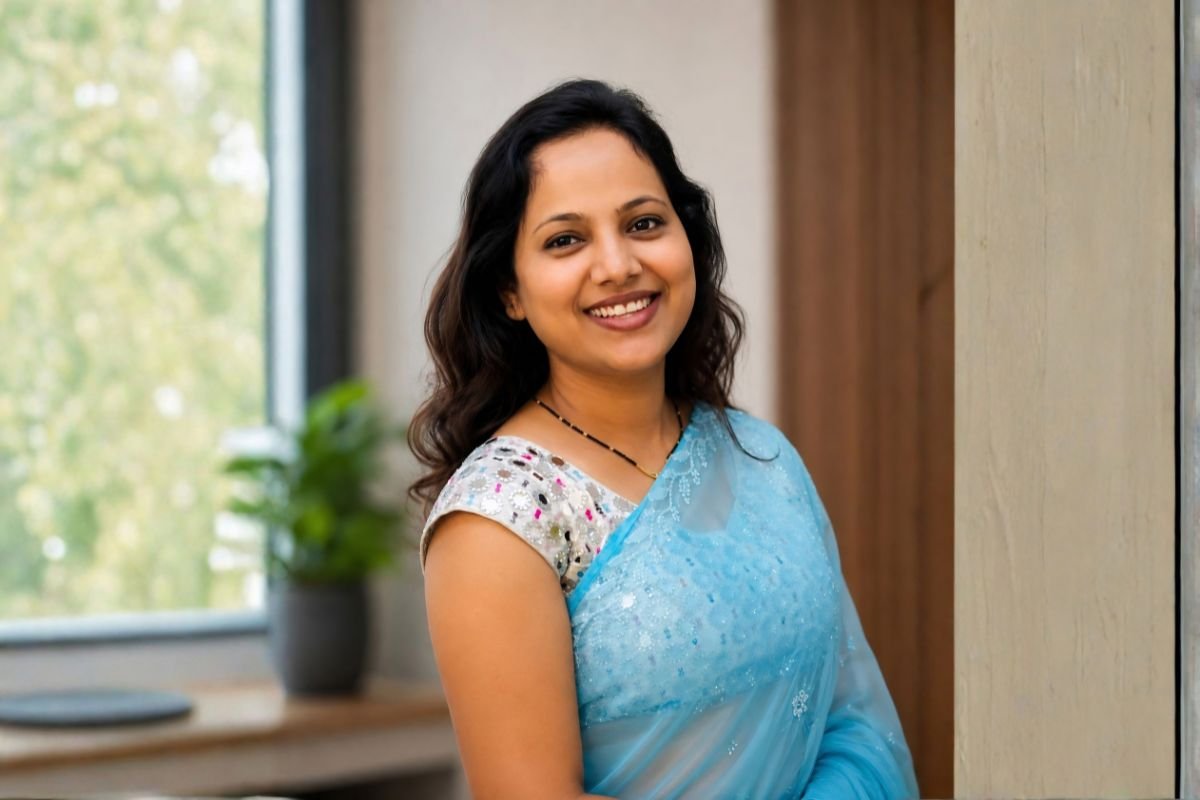
That idea sits at the heart of Richa Varshney’s leadership. As Director & BU Head at Tembo Global Industries Ltd and Founder Director of Jeanie Power Solutions Pvt Ltd, she is working to make sustainability not just responsible, but commercially viable.
Her journey from returning to India and choosing renewable energy to building Jeanie amid uncertainty reflects a willingness to build before the path is certain. Today, Richa brings that same mindset to renewable energy, technology, partnerships, and the larger question of how sustainable growth can create lasting business value.
When Sustainability Strengthens the Bottom Line
Renewable energy is often framed as an environmental responsibility, but Richa Varshney sees a larger business question: can the sustainable choice also be commercially sensible?
She believes the industry must challenge the assumption that sustainability automatically adds to business costs. Solutions that require customers to pay a premium simply for doing the “right thing” may attract committed adopters, but are unlikely to scale widely. The real opportunity comes when sustainability improves business economics rather than requiring compromise.
Recent developments and government initiatives are helping renewable energy move in that direction. Beyond replacing fossil fuels with cleaner electricity, it can reshape cost structures, reduce exposure to energy-price volatility, strengthen energy security, and provide greater long-term predictability for businesses planning sustained growth.
Richa Varshney believes businesses should not have to choose between sustainability and financial returns. The challenge is to make the sustainable choice financially attractive too, turning the energy transition from an obligation into a truly transformative business opportunity.
Seeing Sustainability from Both Sides of the Business
Richa’s leadership across Tembo Global Industries and Jeanie Power Solutions has given her two perspectives on making sustainability commercially viable.
At Tembo, she experiences it from within an established organization, where opportunities must stand up to scrutiny around scale, capital allocation, operational execution, and commercial viability. At Jeanie, she approaches it as an entrepreneur responsible for every aspect, from identifying a customer problem and creating enough value for someone to pay for it to building a model that can be replicated and scaled.
The contrast has sharpened her focus on the commercial fundamentals behind sustainability. In a large organization, it must compete for capital and management attention like any other investment. In a startup, customers determine whether a proposition can be both competitive and profitable.
Lower energy costs, greater price predictability, energy security, operational efficiency, and attractive returns therefore matter as much as the sustainability proposition itself.
As Richa Varshney puts it, “sustainability doesn’t scale because it is a good idea; it scales when it becomes a good business.” That principle shapes her approach to turning sustainability from a green initiative into a scalable business opportunity.
Closing the Gap Between Ambition and Execution
India has renewable-energy ambition, technology, and capital, but Richa sees the bigger challenge in turning that potential into bankable, executable projects delivered on predictable timelines. She identifies two closely linked gaps: financing readiness and infrastructure readiness.
From her experience, capital and financially viable projects are available; the difficulty lies in bringing the required pieces together without disrupting timelines. Before lenders commit, developers need land, connectivity, approvals, PPA visibility, security structures, and credible execution capability. Delays in these prerequisites increase carrying costs and financing risk.
Infrastructure must advance alongside generation capacity. Transmission connectivity, evacuation infrastructure, substations, roads, and other enabling systems need to move in sync. A technically and financially viable solar project cannot deliver its intended value if the grid is not ready to evacuate its power.
Richa’s first priority would be a stronger “project readiness” approach, where land, transmission, approvals, financing, and evacuation infrastructure progress in parallel rather than sequentially.
The next phase of renewable growth, she believes, is not simply about adding more megawatts. “It is about removing the friction between project award, financial closure, infrastructure readiness and actual commissioning.”
Testing Innovation Before Betting on It
Renewable energy is changing quickly, with new technologies constantly entering the market. Richa believes the challenge is distinguishing between technologies that are genuinely transformative and those simply receiving attention.
She evaluates emerging technologies through a few fundamentals: maturity, cost trajectory, reliability, scalability, and customer value. One question guides her assessment: does the technology solve a problem that conventional solutions cannot address efficiently?
Energy storage is a good example. Richa sees its potential to make renewable power more reliable and dispatchable. But potential alone does not justify investment. Performance, lifecycle economics, degradation, safety, bankability, and the ability to integrate at scale must also be proven.
Her approach is to start small, test benefits, and limit unnecessary risk. Yet waiting too long can mean missing the opportunity to build experience and gain an early advantage.
Richa Varshney therefore balances evidence with timing, building enough confidence to manage risk while moving early enough to learn. “I don’t think technology investment should be driven by the fear of missing out.” The greater risk, she believes, is investing heavily before the business case has matured.
Partnerships That Build Capability
Richa sees partnerships as essential to accelerating the energy transition because renewable energy is becoming more complex, with capabilities rarely sitting within a single organization.
That is particularly true in emerging areas such as Battery Energy Storage Systems (BESS), where technology, financing, execution, and operating expertise are developing rapidly. Bringing those capabilities together through the right partners can help the industry move faster while building expertise along the way.
Yet Richa Varshney believes the value of collaboration should extend beyond completing a project or signing a commercial agreement. “A transaction creates immediate value; a partnership creates capability,” she explains, distinguishing short-term outcomes from relationships that build capability over time.
A strategically valuable partnership, therefore, is one that combines complementary strengths, develops capabilities, and creates value that can extend beyond a single transaction. In a growing energy market, that depth of collaboration can become an important part of scaling new solutions.
Earning Influence Beyond the Title
Early in her career, Richa Varshney learned that a designation alone does not command respect. In the industrial and energy sector, she sometimes encountered colleagues or counterparts who were initially uncomfortable reporting to or working with a woman leader, making it clear that her authority could be questioned before her capabilities were understood.
Rather than confronting that resistance, Richa chose to “out-prepare” it. She built credibility by understanding the business, knowing the numbers, making consistent decisions, and delivering on her commitments.
Over time, performance became her strongest answer. The experience reshaped her understanding of leadership and showed her that influence does not require proving superiority. “You only need to prove that you can be trusted to lead.”
That principle continues to shape Richa’s leadership. Her focus is not on the authority attached to her position, but on the trust and respect earned through the way she works, decides, and follows through.
Leading When the Path Is Unclear
Jeanie Power Solutions taught Richa Varshney that leadership is tested most deeply when visibility is low, and others are looking to a leader for confidence. The COVID-19 pandemic became one of those defining moments. Funds were held up across projects, new opportunities became uncertain, and planning beyond the immediate future became difficult. At the same time, Richa was raising her daughter while her husband was serving the nation at the border and away from home.
The experience reshaped how she leads. She learned to remain steady without pretending that everything was under control, make decisions with incomplete information, manage downside risk, and continue moving despite uncertainty.
It also changed how she viewed setbacks. Rather than allowing difficult experiences to narrow her choices, Richa became more open to calculated risks, new opportunities, and unfamiliar territory.
“A setback should make you wiser, not smaller.”
That lesson continues to influence how she evaluates opportunities today. Immediate returns are no longer the only consideration. She also asks:
“What can we learn? What capability can we build? How resilient is the model? And could this take us somewhere others are not yet willing to go?”
The experience also changed her relationship with uncertainty. “I don’t expect to have every answer before making a decision anymore. I focus on what I can control, what I can learn, and what the next step needs to be.”
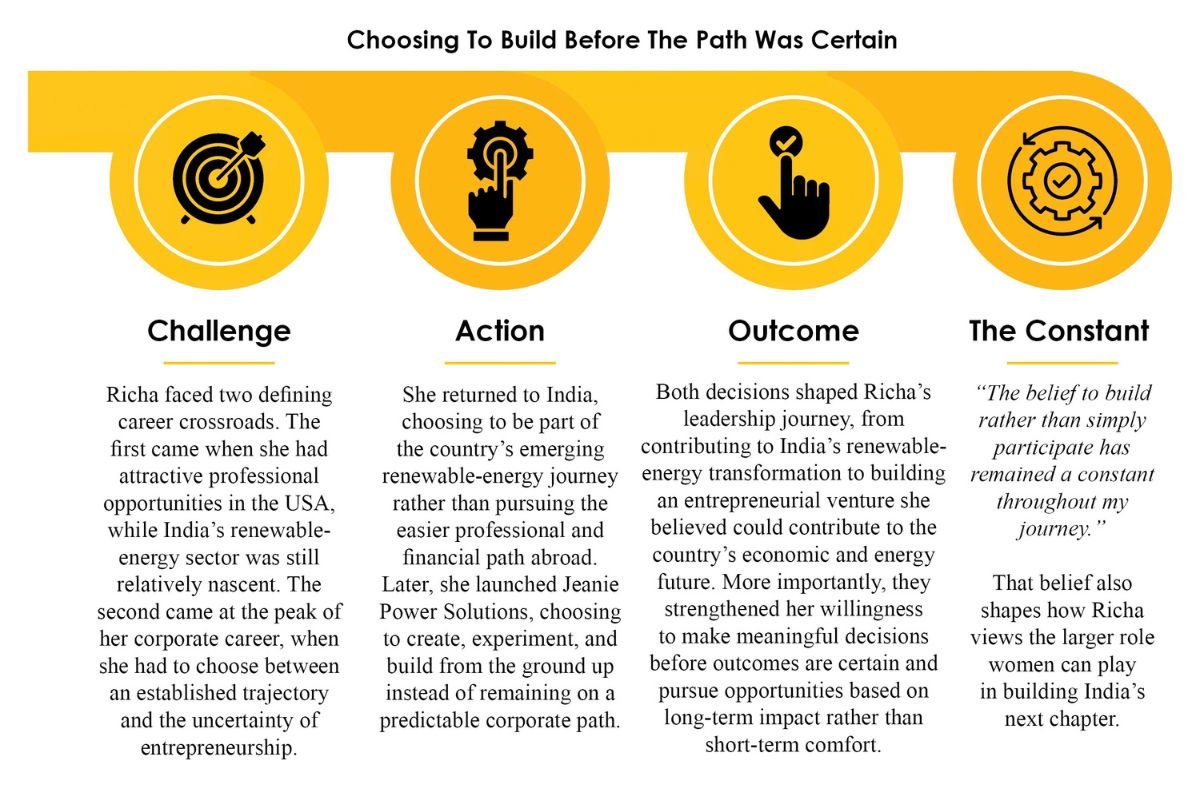
Choosing To Build Before The Path Was Certain
Challenge
Richa faced two defining career crossroads. The first came when she had attractive professional opportunities in the USA, while India’s renewable-energy sector was still relatively nascent. The second came at the peak of her corporate career, when she had to choose between an established trajectory and the uncertainty of entrepreneurship.
Action
She returned to India, choosing to be part of the country’s emerging renewable-energy journey rather than pursuing the easier professional and financial path abroad. Later, she launched Jeanie Power Solutions, choosing to create, experiment, and build from the ground up instead of remaining on a predictable corporate path.
Outcome
Both decisions shaped Richa Varshney’s leadership journey, from contributing to India’s renewable-energy transformation to building an entrepreneurial venture she believed could contribute to the country’s economic and energy future. More importantly, they strengthened her willingness to make meaningful decisions before outcomes are certain and pursue opportunities based on long-term impact rather than short-term comfort.
The Constant
“The belief to build rather than simply participate has remained a constant throughout my journey.”
That belief also shapes how Richa views the larger role women can play in building India’s next chapter.
Women Shaping the Next Chapter of India
Richa Varshney’s belief in building also extends to creating opportunities for other women to lead.
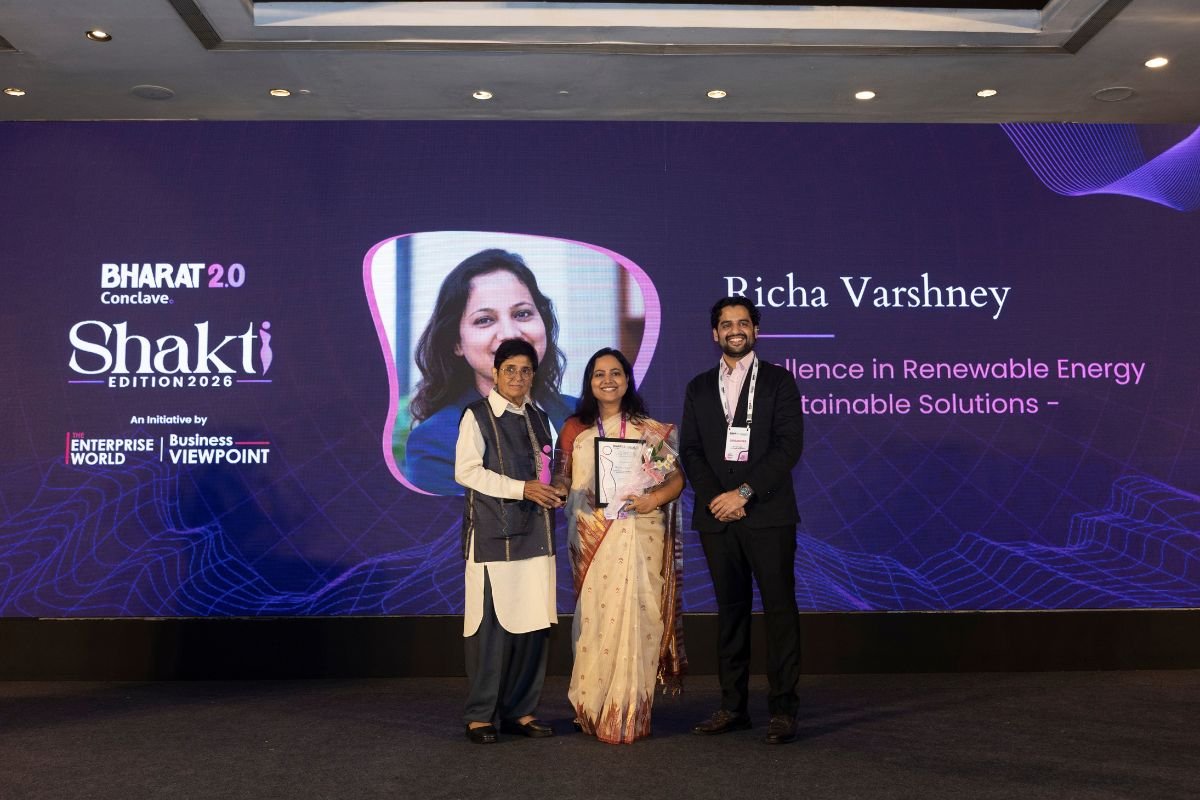
At the Bharat 2.0 Conclave | Shakti Edition, one conversation stayed with Richa long after the event: the role of women in shaping India’s vision of Viksit Bharat.
With women representing nearly half of the country’s population, she sees their participation as integral to realizing India’s broader aspirations. The discussion reinforced a belief that has become important to her: women should not simply have a place within India’s growth story; they should have a role in shaping its direction.
That perspective has strengthened Richa’s conviction that creating meaningful opportunities for women to lead, innovate, and take on new challenges is not only about individual advancement. It is also part of building a stronger and more inclusive Viksit Bharat.
As she reflects on the conversation, the message is clear: “Women should not just be participants in India’s growth story; they should help shape it.”
Three Words, One Leadership Mindset
Richa Varshney would sum up the spirit of the Shakti Edition in three words: Inspire, Challenge, and Transform.
The experience drew inspiration from the journeys of other women leaders while creating a sense of responsibility to encourage the next generation. It also challenged participants to look beyond conventional boundaries and question what they might achieve beyond familiar paths.
The final step was transformation, turning ideas and aspirations into meaningful action rather than allowing them to remain possibilities.
Together, the three words capture what Richa carried forward from the conclave: inspiration that motivates others, the courage to think beyond established boundaries, and the willingness to turn ambition into action.
That mindset also extends beyond personal leadership, shaping how Richa approaches growth, partnerships, and the opportunities she chooses to build.
Building Through Collaboration
Richa Varshney’s approach to growth remains rooted in collaboration. She and her teams are continuously exploring partnerships with established players and emerging technology companies to strengthen capabilities and expand their presence in renewable energy.
At Jeanie Power Solutions, this approach has already translated into larger projects with Tembo Global Industries. The relationship brings together the scale and capabilities of an established company with Richa’s entrepreneurial drive and commitment to sustainability.
Tembo’s experience in its Defence business has further reinforced the value of this model. The company has seen what strategic collaboration can unlock, and Richa is now carrying that approach into its Sustainability and Renewable Energy business.
The focus is not simply on adding partners. Richa looks for organizations with complementary strengths and opportunities where combined capabilities can create greater impact. The ambition is to work together to build “bigger, better and more impactful solutions.”
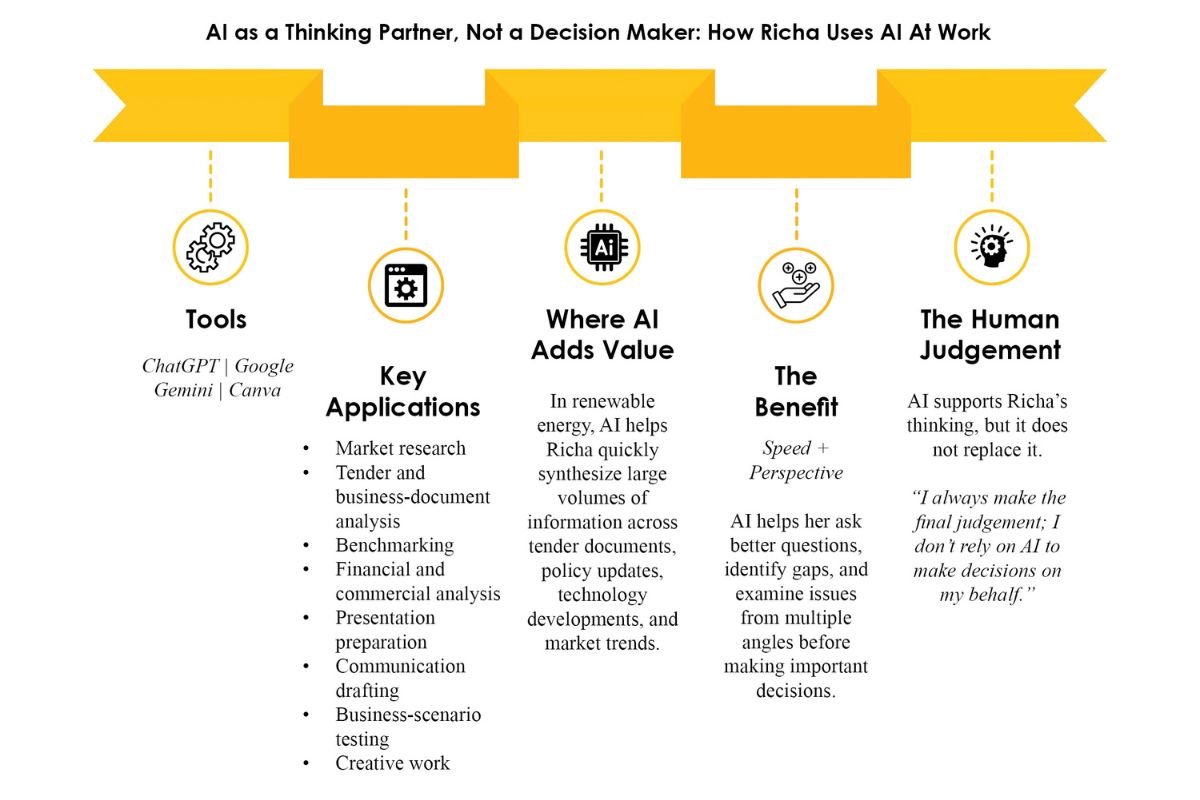
AI as a Thinking Partner, Not a Decision Maker: How Richa Uses AI At Work
Tools
ChatGPT | Google Gemini | Canva
Key Applications
- Market research
- Tender and business-document analysis
- Benchmarking
- Financial and commercial analysis
- Presentation preparation
- Communication drafting
- Business-scenario testing
- Creative work
Where AI Adds Value
In renewable energy, AI helps Richa Varshney quickly synthesize large volumes of information across tender documents, policy updates, technology developments, and market trends.
The Benefit
Speed + Perspective
AI helps her ask better questions, identify gaps, and examine issues from multiple angles before making important decisions.
The Human Judgement
AI supports Richa’s thinking, but it does not replace it.
“I always make the final judgement; I don’t rely on AI to make decisions on my behalf.”
Succes Code
I don’t think success comes from having a perfectly predictable journey. Most careers have setbacks, unexpected turns, and moments when an opportunity seems out of reach. What has helped me is staying open to learning, being willing to rethink a decision, and not letting one setback define the journey. Every challenge has taught me to adapt and keep moving forward. So I would say to anyone building a career or a business: don’t let one setback define your destination. Keep going, find another way, and stay open to where the journey can take you.