Government support for green businesses is not one single subsidy. Government incentives for green businesses can take many forms today. These include capital aid, production-linked incentives, and project finance. Grants, infrastructure support, and demand creation can also help. Tax measures and state-level benefits can further shape project costs.
The scale of support also reaches beyond power generation. Under its solar PLI scheme, MNRE awarded 39,600 MW of manufacturing capacity under Tranche II.
For a business owner, the right incentive can change project economics. Yet eligibility depends on activity, location, technology, and scheme rules. One support may fit a manufacturer, but not an EPC company.
That is why this guide looks beyond scheme names. We cover central schemes, state incentives, financing support, eligibility, and key checks before applying.
What counts as a government incentive for a green business?
Not every form of government support works like a subsidy. Government incentives for green businesses can lower costs, improve finance, or create demand.
A simple framework
- Capital subsidies: These cut part of the upfront project cost.
- Production incentives: These reward output, sales, or new capacity.
- Grants: These can fund R&D, pilots, or new green tech.
- Concessional finance: This can lower borrowing costs or ease access.
- Tax support: Tax rules can improve returns from eligible investments.
- Infrastructure support: This can ease access to land, grids, or approvals.
- Demand support: Policy can create buyers for green goods and power.
Incentive vs subsidy
Here’s the key difference: a subsidy usually cuts a direct cost. An incentive has a wider role and can change business economics.
For example, cheaper project finance gives support without handing out cash. A demand rule can also create sales without funding production. So, business owners should check the full support package, not just subsidy rates.
4 key areas of central government support for green businesses
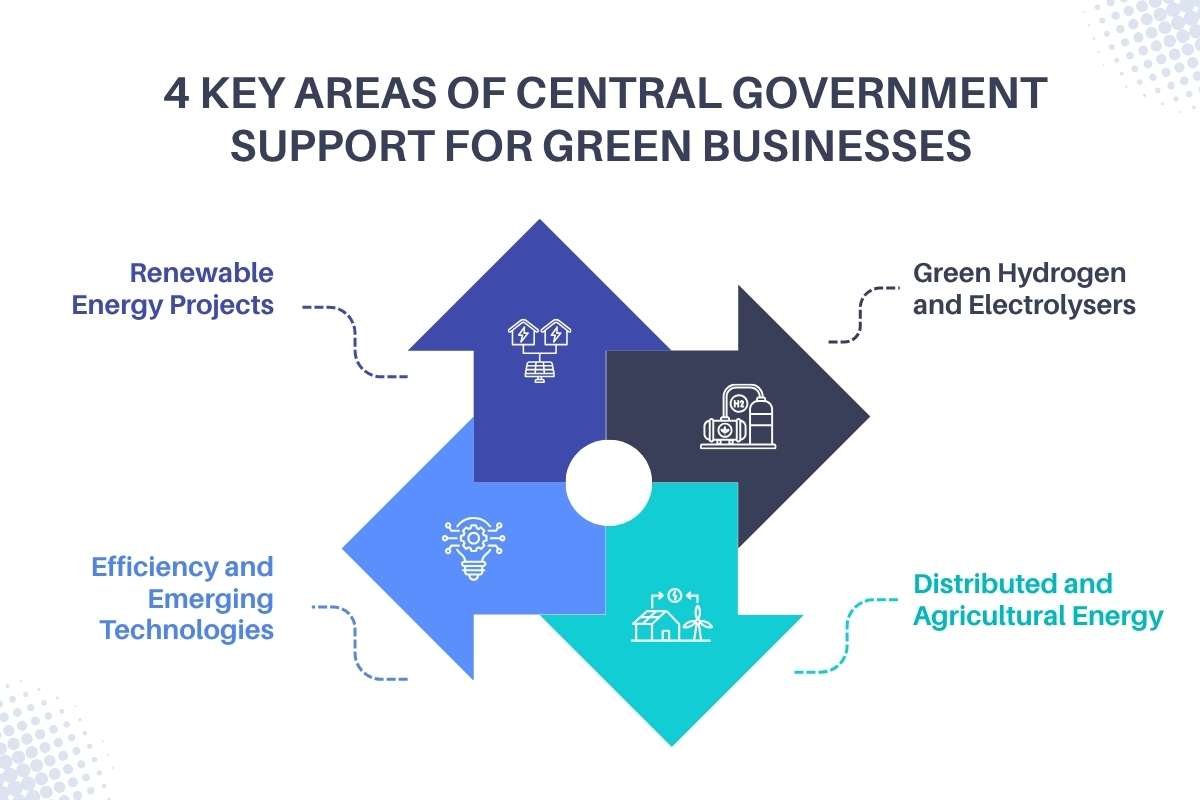
Central policy covers many parts of India’s green energy value chain. Government incentives for green businesses can support projects, production, equipment, or new technology.
1. Renewable Energy Projects
Solar, wind, small hydro, and bioenergy projects can access central support. The exact route depends on the project type and scheme rules. IREDA also offers project finance across these clean energy sectors.
2. Green hydrogen and electrolysers
Green hydrogen has a dedicated policy framework under the National Green Hydrogen Mission. Its SIGHT programme covers electrolyser manufacturing and green hydrogen production. The Mission also covers pilots, hydrogen hubs, R&D, testing, and related infrastructure.
3. Distributed and agricultural energy
PM-KUSUM creates space for developers, EPC providers, and equipment suppliers. Its components cover decentralised solar plants, solar pumps, and feeder solarisation. The scheme also lets eligible power producers sell output to DISCOMs.
4. Efficiency and emerging technologies
Support also reaches energy efficiency, waste-to-energy, biomass, CBG, and new technologies. IREDA lists financing for these areas, including battery storage and green hydrogen.
| Support Type | Business Segment | What It Supports | Implementing Agency |
|---|---|---|---|
| Production incentive | Green hydrogen | Hydrogen production | MNRE / designated agency |
| Manufacturing incentive | Electrolysers | Domestic manufacturing | MNRE / designated agency |
| Project support | Renewable energy | Eligible clean energy projects | Relevant central agency |
| Project finance | Clean energy | Debt and project costs | IREDA / financial institutions |
Always check the latest scheme guideline before applying. Rules, dates, and eligibility can change.
State-level incentives that can change the business case
Central support forms only one part of the incentive picture. Government incentives for green businesses can vary once a project enters a state policy framework.
A business should check these areas before choosing its site:
- Renewable-energy and green-hydrogen policies
- Electricity-duty and power-cost concessions
- Land and stamp-duty support
- Open-access and transmission rules
- Capital and manufacturing incentives
- Employment-linked support
- Local infrastructure and approvals
The same green business can face a different incentive structure by location. That makes state policy part of the feasibility study, not an afterthought.
Maharashtra, for example, has a dedicated Green Hydrogen Policy 2023. It covers hydrogen projects, renewable power, storage, and related systems. Gujarat also lists green hydrogen, electrolysers, renewable equipment, and battery storage among its green-energy thrust sectors.
So, compare the full project cost, not just the subsidy. Power charges, land costs, grid access, duties, and approval time can change the final business case.
Match the incentive to the green business model
The right question is not, “Which scheme is best?”
Ask instead, “Which incentive fits my revenue model?”
That shift can save time and improve your project plan. Government incentives for green businesses work differently across business models [T1]. Some reward output, while others support assets, research, or project finance.
| Green Business Type | Incentive Area to Investigate |
|---|---|
| Solar EPC | Project programmes, empanelment, and financing |
| Solar equipment manufacturing | Manufacturing incentives |
| Green hydrogen production | Production incentives |
| Electrolyser manufacturing | Manufacturing incentives |
| Bioenergy or CBG | Sector schemes and project finance |
| Energy-efficiency services | Efficiency programmes and financing |
| Waste-to-energy | Project and infrastructure support |
| Green-tech startup | Grants, R&D, and innovation support |
| Renewable-energy developer | Project finance and policy support |
IREDA’s financing portfolio spans solar, wind, hydro, and bioenergy. It also covers waste-to-energy, energy efficiency, CBG, and emerging technologies. (ireda.in)
So, start with your revenue model and cost base. Then map each cost to available support. This approach gives incentives a clear role in business planning.
What businesses must check before applying?

An announced incentive does not mean every green business qualifies. Government incentives for green businesses come with clear rules, limits, and process steps.
Before applying, check these seven points:
- Business activity: Does the scheme cover your exact business activity?
- Technology: Does your technology or equipment meet scheme rules?
- Project size: Does your project meet capacity limits or size rules?
- Location: Does the scheme cover your chosen state or project zone?
- Registration: Do you need specific registrations, licences, or approvals?
- Timeline: Did you apply before the required project milestone?
- Documentation: Can you provide complete financial and technical records?
Here’s another point many applicants miss. Eligibility does not equal payment.
The process often follows four stages:
Eligibility → Application → Approval → Disbursement
You may meet the rules but still need approval first. You may also need proof before the agency releases funds.
So, read the latest scheme guidelines before spending money. Check the official MNRE scheme pages, application rules, and implementing-agency notices. For green hydrogen, MNRE publishes separate scheme guidelines and related documents.
How to calculate the real value of an incentive?
A headline incentive can look large at first glance. Yet its real value depends on the full project cost. Government incentives need a wider cost check.
Use this simple framework:
Effective incentive value = Upfront support + financing benefit + recurring incentive + tax impact − compliance and application costs
Then check the details behind each number. Project size and capex can change the result. So can operating costs and financing rates. Incentive duration also matters for long-term planning.
Next, check any use conditions or performance targets. Some incentives may depend on output, investment, or other milestones. Repayment or clawback rules can also change the real benefit.
For example, a manufacturing incentive may offer a large headline amount. But the business may need to meet output or investment targets first.
Likewise, concessional finance may not count as a subsidy. Still, lower finance costs can improve project economics.
Where government support creates new green business opportunities?
Policy support can create demand far beyond the main project. Government incentives for green businesses can also strengthen the wider clean energy supply chain.
That creates room for EPC, equipment supply, and maintenance services. Testing, certification, and compliance work can grow alongside new projects. Energy management and digital monitoring can also gain demand.
The same shift can support project finance and hydrogen infrastructure. Recycling, skilled workers, and technical services can grow around these projects too.
The key point is simple: policy can create repeat demand, not just one-time sales. That matters when building green business models that scale. It also creates room for technology suppliers and solution providers across green energy solutions and technology [T1].
So, track where policy creates demand, not just where subsidies flow.
Government incentives do not remove business risk
Government support can improve project economics, but it cannot ensure demand. Government incentives for green businesses should strengthen a sound business model.
Before counting an incentive, check the market first. Study customer demand, power prices, and technology costs. Then assess land, grid access, and financing costs. Policy timelines and rule changes also need close attention.
Supply chains can affect costs and delivery dates too. Project execution can then decide whether the plan works. Heavy dependence on incentives can add another risk.
Here’s the contrarian point: an incentive should strengthen a business model, not become the business model.
A business that works only with one subsidy may face trouble later. Strong demand, sound costs, and good execution should lead the plan. Incentives should then add support to that foundation.
Conclusion:
Government incentives for green businesses can support many parts of a project. They can help with costs, finance, production, infrastructure, or demand. Yet the incentive alone should never drive the business plan.
Start with the fit between the incentive and your model.
Then assess:
Eligibility → incentive value → compliance → financing → market demand → long-term viability.
This approach helps you judge support in real business terms. It also helps you spot costs that a subsidy cannot cover. Remember that schemes and rules can change over time. Always check the latest official guidelines before making investment decisions.
Once the numbers make sense, policy support can add real value. From there, the wider Green Energy Business Opportunities in India [Pillar] become easier to assess.
Frequently Asked Questions
1. What are Government Incentives for Green Businesses?
They include subsidies, grants, finance support, tax measures, and policy help. Different schemes support different green activities and project needs.
2. Which government schemes support green businesses in India?
Schemes vary by sector, activity, technology, project size, and eligibility. Key areas include renewable energy, green hydrogen, energy efficiency, and waste-to-energy.
3. Does every green energy business qualify for a subsidy?
No. Government incentives for green businesses often require specific technology, documents, project sizes, and milestones.
4. Are green business incentives available from state governments?
Yes. State policies can add support beyond central government programmes. These may include power, land, tax, capital, and infrastructure incentives.
5. Does every green energy business qualify for a subsidy?
No. Government Incentives for Green Businesses often require specific technology, documents, project sizes, and milestones.
6. How can a business find current green energy incentives?
Check the latest notifications and guidelines from relevant ministries and agencies. Also review the latest policy documents from the state government where you plan to operate.