

A founder sits across the dinner table, explaining to his parents why the company shut down. Relatives ask what went wrong. Employees wait for final paychecks. Investors want a report, not sympathy. This scene has defined Indian business failure for decades: silence, a quiet exit, ambition folded away.
A year later, the same founder launches a new venture. Investors take his call again. Former employees ask to join him.
So has the shame really disappeared, or did one founder just get lucky?
Why failure became shameful?
Indian business decisions were rarely made in isolation. Scarcity meant few ventures could absorb a loss, so families treated risk itself as dangerous, not just failure. A stable job looked safer than any business idea, however promising, because it offered income without the threat of ruin.
Kailash Nadh’s early internet venture reached real international users while he was still in school. Even so, running a business at that stage clashed with the expectation that college came first, ahead of any entrepreneurial pursuit.
Rahul Rana connects this hesitation to schooling. Students learn to produce correct answers, not test ideas, so building a business feels foreign rather than natural by the time they reach adulthood.
Education, employment, and income became the accepted scorecard. A business that stumbled had no place on that scorecard, so Indian business failure carried weight far beyond the venture itself.
The cost of being wrong
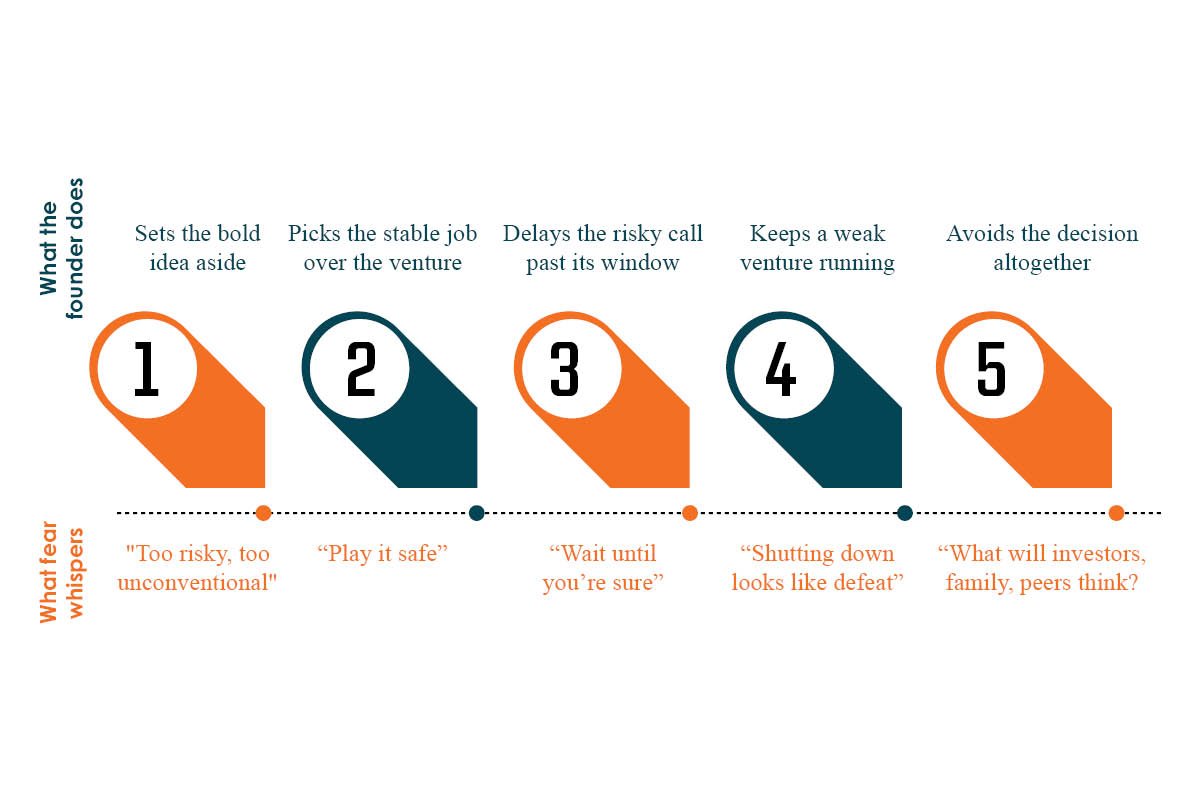
Fear rarely announces itself. It shows up quietly, in the decisions founders make before a product even ships.
| What fear whispers | What the founder does |
| “Too risky, too unconventional” | Sets the bold idea aside |
| “Play it safe” | Picks the stable job over the venture |
| “Wait until you’re sure” | Delays the risky call past its window |
| “Shutting down looks like defeat” | Keeps a weak venture running |
| “What will investors, family, peers think?” | Avoids the decision altogether |
Nadh’s story fits this pattern closely. Social pressure held back an idea with real merit, proving a venture can fail commercially while the product itself stays sound. Rahul Rana calls this analysis paralysis: founders waiting for certainty that never arrives.
Indian business failure carries this quiet weight, holding back good ideas before the market gets a chance to test them.
The old business attitude

In 2011, Vivek Wadhwa told Forbes something Indian entrepreneurs rarely admitted aloud: a failed venture back home left a mark a founder couldn’t shake off. He held up Silicon Valley as the opposite case, where founders discussed companies that hadn’t worked as openly as their current ventures, treating those setbacks as proof of hard lessons learned rather than a reason to hide. India, he said, ran on older rules, ones shaped by trust and obligation.
Indian business failure often meant customers left unpaid or commitments broken, and that record followed a founder’s name long after the company collapsed, closing doors that stayed shut for years.
Then and now sit far apart, yet one question remains open. Nobody disputes that the stigma existed. What’s uncertain is whether the culture behind it still sets the terms for founders today.
What changed in Indian startups?
A recent Mint report captures how India’s startup scene now treats setbacks differently than a decade ago.
- More shutdowns, less shock: Thousands of startups launch every year, so closures tied to funding gaps, weak market fit, or execution errors rarely make headlines anymore.
- Second attempts welcomed: Investors increasingly read a founder’s earlier shutdown as operating experience, not a warning sign.
- Relationships carry forward: Past investors, employees, and advisors often stay in a founder’s circle, so a new venture rarely starts from scratch.
- Closure becomes routine: With shutdowns and launches happening side by side, indian business failure looks less like an exception and more like a normal stage of building a company.
Together, these four shifts are the clearest evidence that attitudes are loosening.
The repeat founder test
What does society actually do with someone who has failed once?
The Beyond the Case conversation with Deepak Narayanan gives the sharpest answer yet. It describes an entrepreneur’s career as no longer ending after one shutdown, especially inside venture-backed companies. Communities once wary of entrepreneurship are warming to it, and professional management, along with newer capital sources, are replacing the old family-funded model.
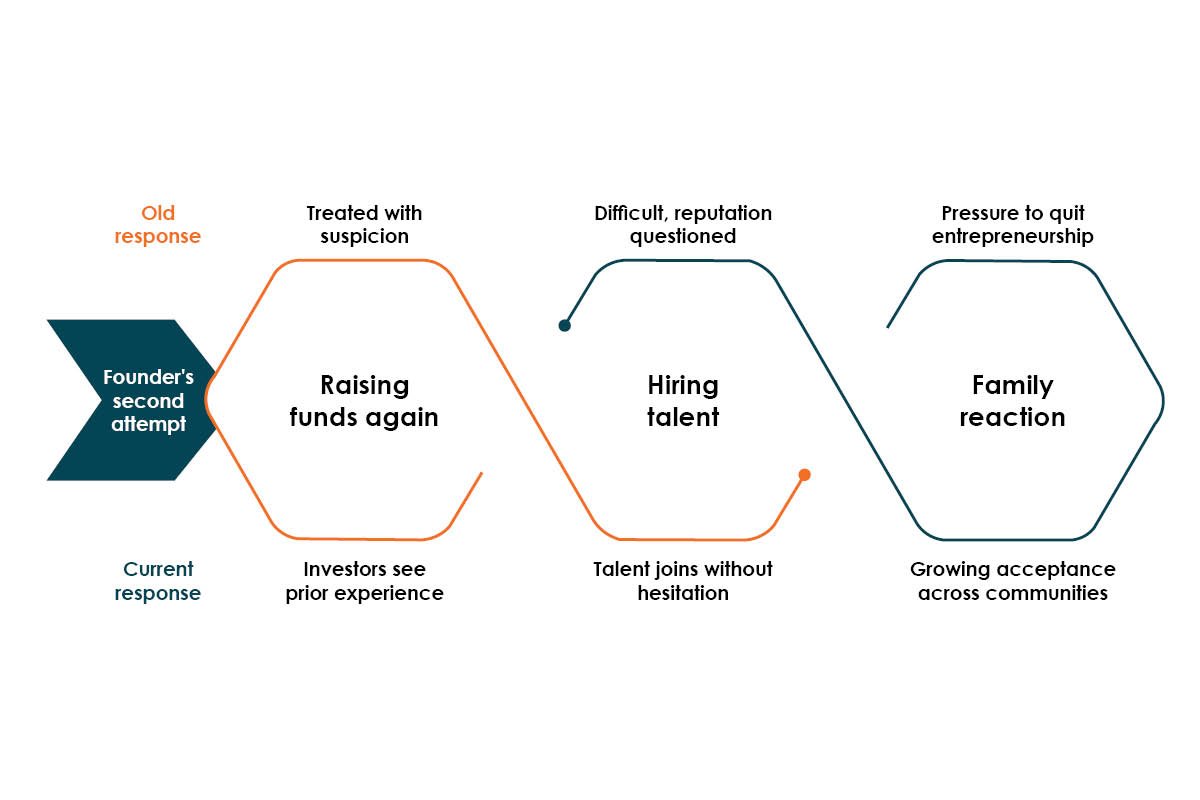
The real shift shows up in the second attempt.
| Founder’s second attempt | Old response | Current response |
| Raising funds again | Treated with suspicion | Investors see prior experience |
| Hiring talent | Difficult, reputation questioned | Talent joins without hesitation |
| Family reaction | Pressure to quit entrepreneurship | Growing acceptance across communities |
This pattern, seen across India’s startup circuit, is the clearest measure of Indian business failure and how it’s actually judged. The test was never the closure itself.
It was what came after it.
Has the stigma really disappeared?
The optimism has limits. Startup founders enjoy new acceptance, but indian business failure still carries weight elsewhere.
Reality check:
- Family businesses often treat a closed venture as personal shame, not a lesson.
- Public-sector banks stay wary of risk, favouring caution over second chances.
- Traditional companies rarely celebrate a founder’s comeback story.
The pattern is uneven, not universal. Openness has grown in pockets, while older institutions hold firm to old judgments.
Conclusion :
A shutdown in India no longer stays a permanent label. Shame once followed a closed venture for years; now it often ends where the next attempt begins. Startups show this shift clearly, though banks and family firms still hesitate. The verdict: stigma has not vanished, but its grip has loosened enough for second chances to become normal, not rare.