Indian businesses are moving fast. Cloud platforms, connected systems, digital payments, and AI tools now form the backbone of daily operations. Each addition brings real gains, and each one opens a fresh point that needs watching.
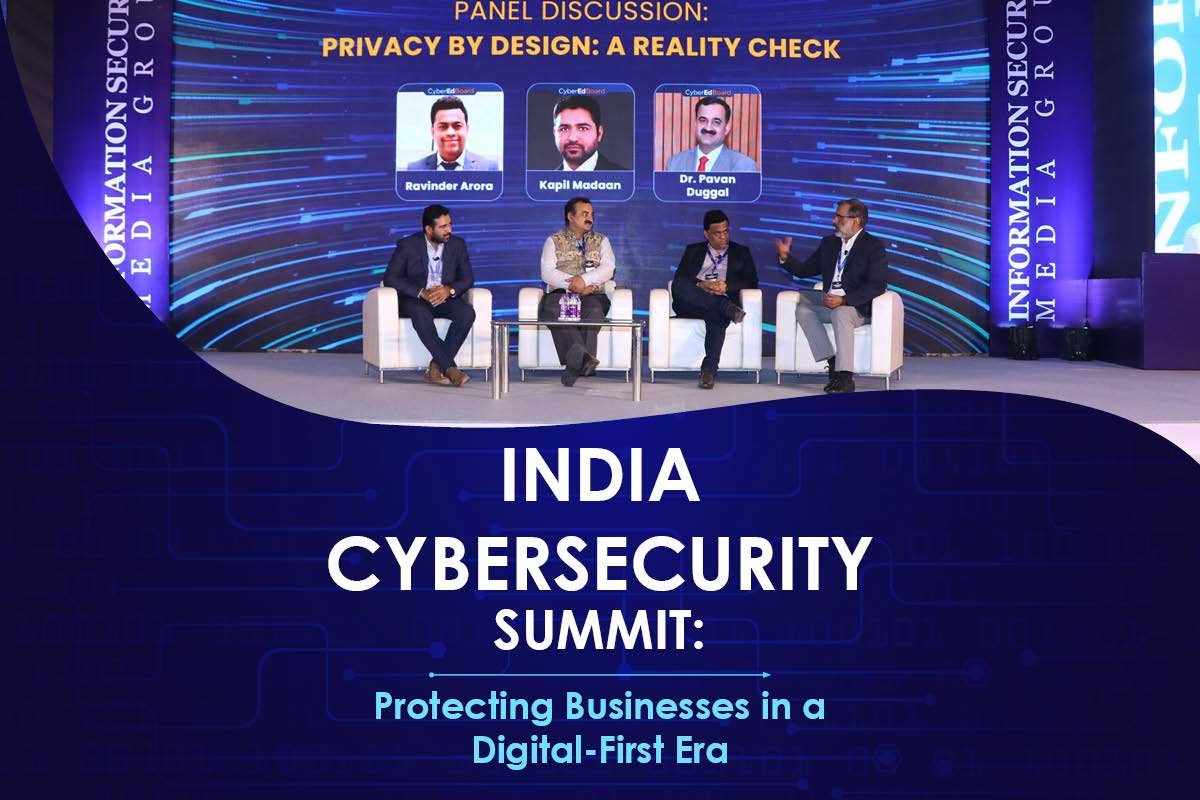
An India Cybersecurity Summit is where these two realities meet: business priorities on one side, security concerns on the other. This guide looks at what happens inside these gatherings, who attends, and when major editions have taken place.
Recent editions place heavier weight on cyber resilience, incident recovery, regulatory duty, and AI-related risk. CII’s 2026 summit, for instance, listed AI security, critical infrastructure, digital trust, supply-chain security, and cyber-risk measurement among its core themes.
Not one event, four roles: what the term actually covers
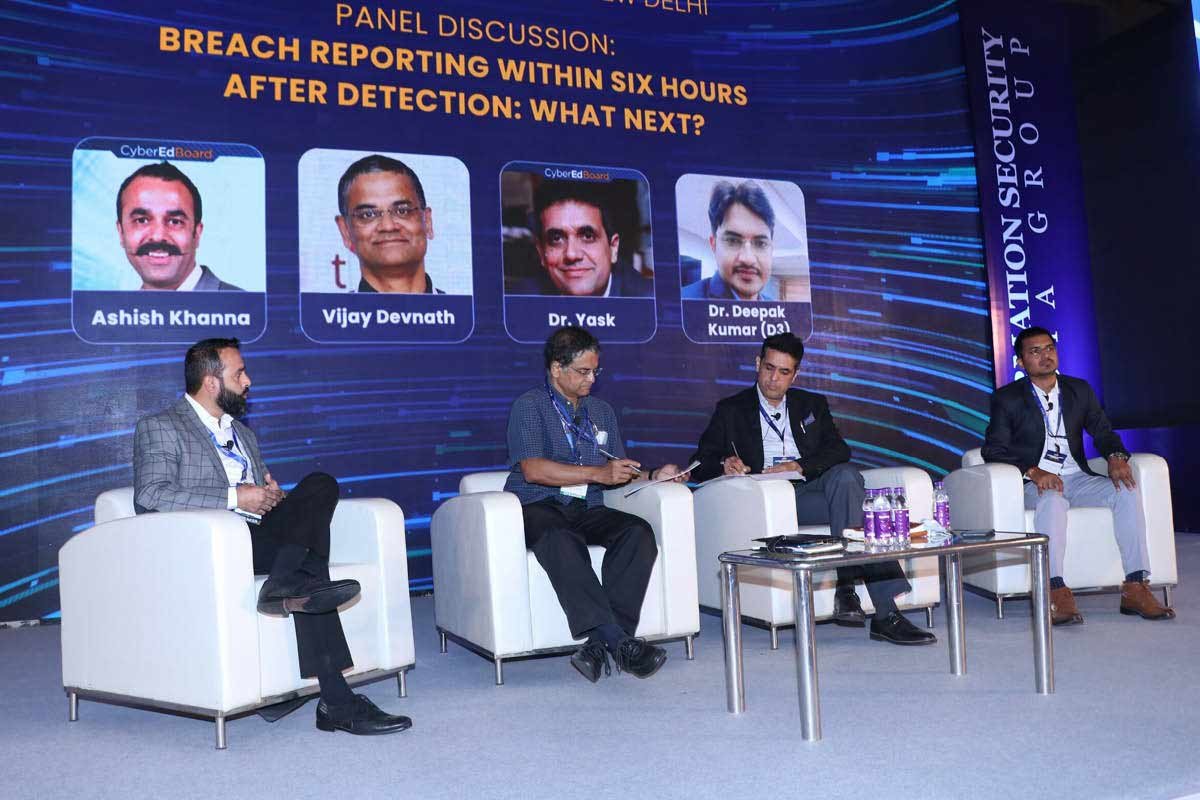
One phrase, four meanings.
- A knowledge forum. Security specialists, government representatives, technology companies, and business leaders sit together to discuss current threats.
- A decision-making room. The audience includes people who control security budgets, oversee compliance, and manage infrastructure risk.
- A practical learning space. Keynote talks, expert panels, workshops, and case discussions fill the schedule. IDC’s summit, for one, runs interactive formats including a cyber-crisis simulation.
- A business meeting point. Exhibitions, live demonstrations and private meetings let enterprises connect directly with security providers.
Put together, an India Cybersecurity Summit describes a type of industry gathering. It does not refer to one identical conference held under a single banner each year.
A day inside the summit: hour by hour
No two summit days look identical, but most follow a rhythm worth knowing before you arrive.
- 08:00 to 09:00 | Arrival and networking. Registration desks open, badges get handed out, and early conversations begin. The Cyber Revolution Summit lists this same registration and networking window before its formal opening.
- Morning | Keynotes and threat briefings. Speakers set the tone with national cyber risks, enterprise attacks, ransomware trends, and current security priorities.
- Midday | Panels and specialist conversations. Sessions turn to data protection, IT and OT security, identity management, cloud protection, cyber insurance, incident response, and critical infrastructure.
- Afternoon | Practical learning. Workshops, product demonstrations and case discussions take over. IDC’s crisis simulation puts participants in the middle of a live cyber incident, forcing real decisions under pressure.
- Closing hours | Meetings and networking. An India Cybersecurity Summit ends the way most productive days do: with direct conversations between peers, vendors, and future partners.
By the time the hall empties, most attendees have collected more contacts than notes.
The issues that keep returning to the agenda
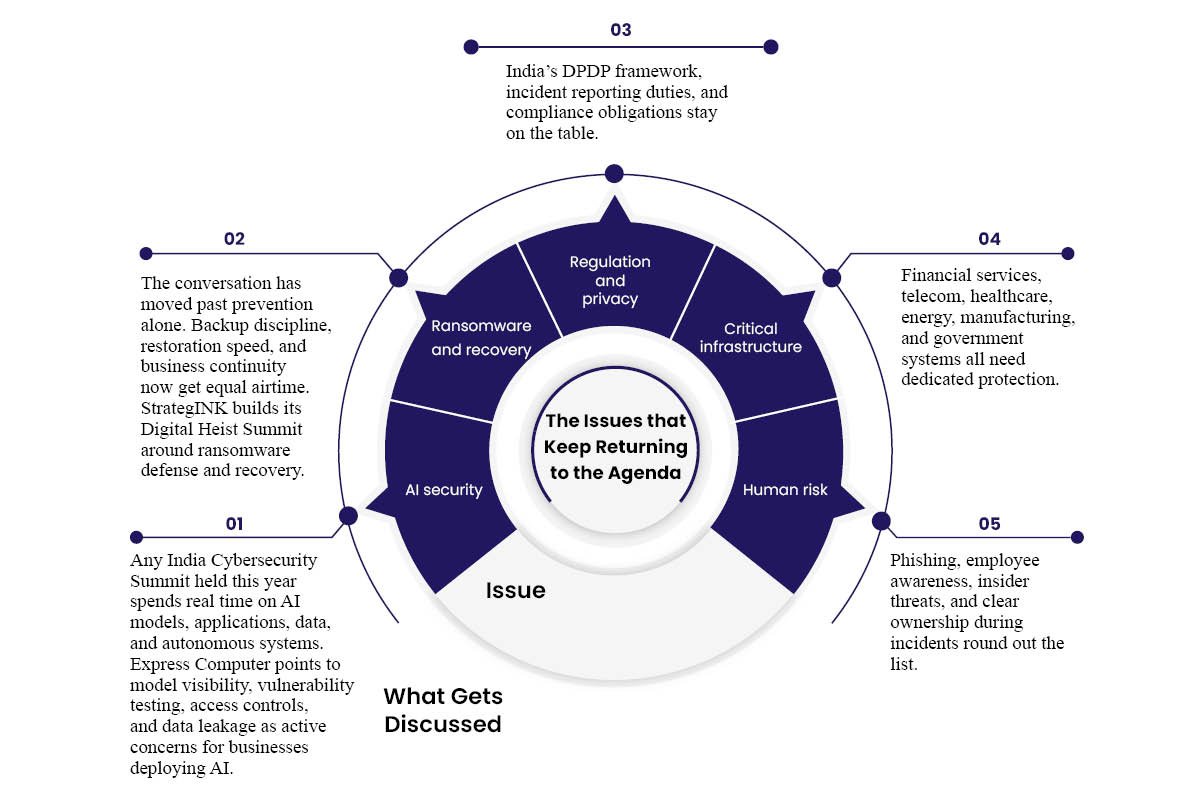
Five pressure points, every edition.
| Issue | What Gets Discussed | |
| 01 | AI security | Any India Cybersecurity Summit held this year spends real time on AI models, applications, data, and autonomous systems. Express Computer points to model visibility, vulnerability testing, access controls, and data leakage as active concerns for businesses deploying AI. |
| 02 | Ransomware and recovery | The conversation has moved past prevention alone. Backup discipline, restoration speed, and business continuity now get equal airtime. StrategINK builds its Digital Heist Summit around ransomware defense and recovery. |
| 03 | Regulation and privacy | India’s DPDP framework, incident reporting duties, and compliance obligations stay on the table. |
| 04 | Critical infrastructure | Financial services, telecom, healthcare, energy, manufacturing, and government systems all need dedicated protection. |
| 05 | Human risk | Phishing, employee awareness, insider threats, and clear ownership during incidents round out the list. |
When does it happen? A calendar, not a single date
Mark five dates, not one.
- July 3, 2026 | New Delhi: CII’s second Cybersecurity 360 Summit brings together 300+ delegates, 30+ speakers, and 10+ sessions.
- July 24, 2026 | New Delhi: Cyber Revolution Summit 2026 covers digital defense, human risk, ransomware resilience, cloud, and incident response.
- August 8, 2024 | New Delhi: ISMG’s Cybersecurity Summit focuses on cyber defense, AI, privacy, and DPDP compliance.
- December 2, 2025 | Sofitel BKC, Mumbai: StrategINK’s Digital Heist Summit centres on ransomware defense and recovery.
- 2026 | Pan-India: IDC’s IT Security Summit India builds its programme around securing AI-powered businesses.
No single date owns the term. An India Cybersecurity Summit happens several times a year, in different cities, under different names.
Badges in the room: who actually shows up
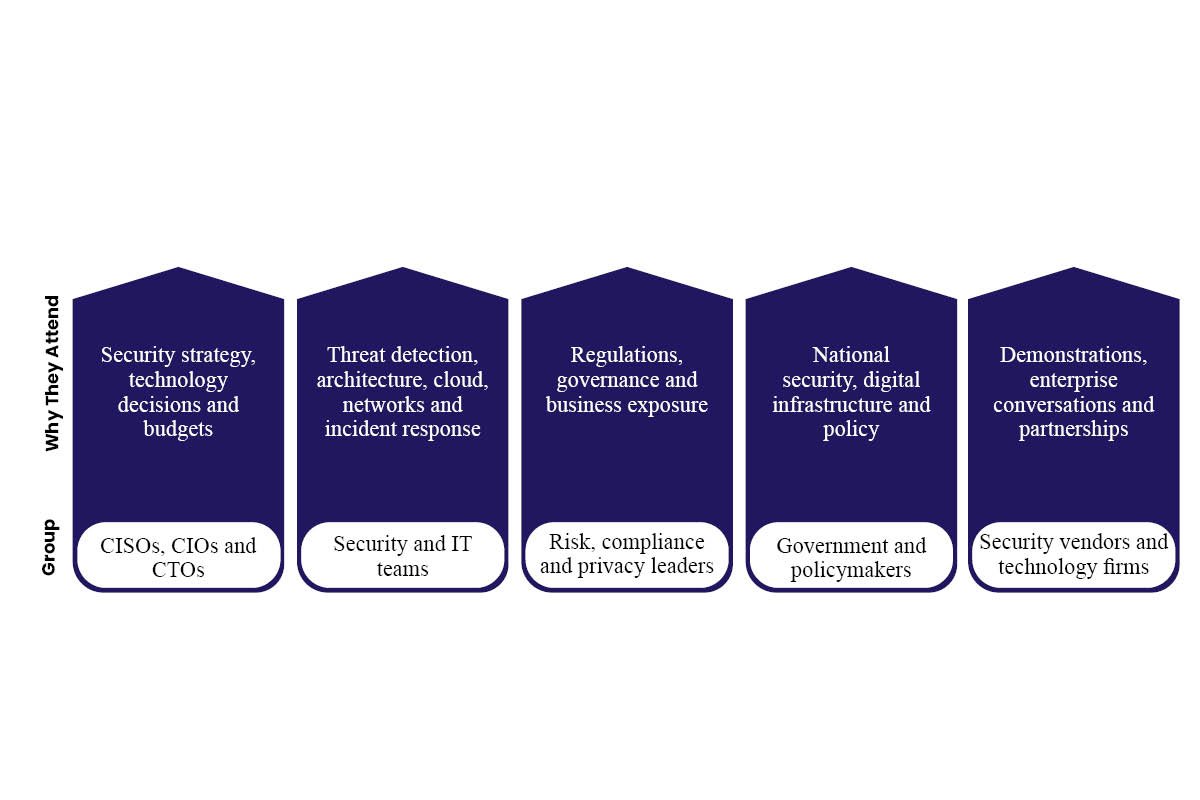
The room at a glance.
Walk into any India Cybersecurity Summit, and the badges tell a story of their own. Security leaders sit beside government officials, and vendors work the floor between sessions.
| Group | Why They Attend |
| CISOs, CIOs and CTOs | Security strategy, technology decisions and budgets |
| Security and IT teams | Threat detection, architecture, cloud, networks and incident response |
| Risk, compliance and privacy leaders | Regulations, governance and business exposure |
| Government and policymakers | National security, digital infrastructure and policy |
| Security vendors and technology firms | Demonstrations, enterprise conversations and partnerships |
The Cyber Revolution Summit draws CISOs, CTOs, CDOs, privacy heads and security architects. StrategINK pulls in compliance officers, data protection officers, policymakers and law-enforcement leaders.
Why should businesses pay attention?
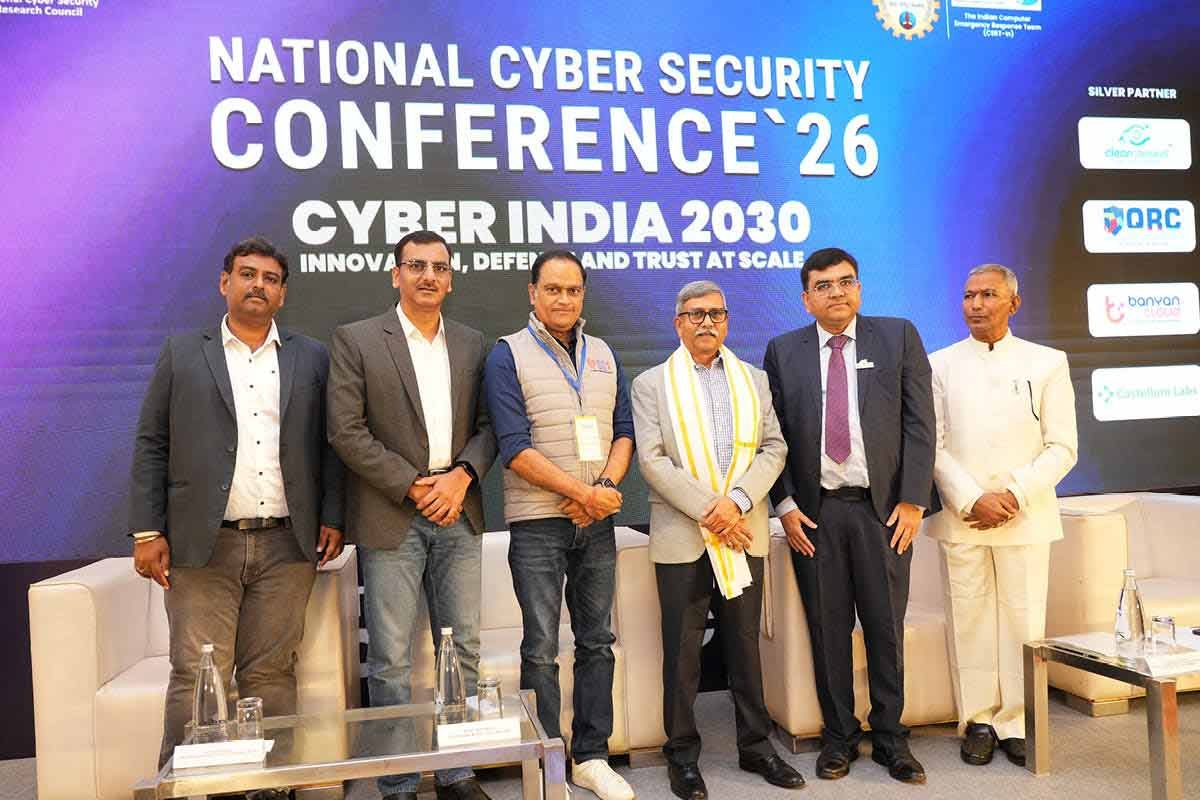
What attendees take home.
A day at an India Cybersecurity Summit rarely ends with just a badge and a bag of brochures.
- A clearer view of current attack methods
- Practical ideas for ransomware recovery
- Better understanding of privacy and compliance duties
- Peer perspectives on security budgets and business risk
- Exposure to security products and services
- Contacts among senior technology and security professionals
- Ideas for handling AI-related security concerns
- Lessons from real incidents and crisis exercises
IDC frames its summit around practical strategy, peer learning, and investment decisions. ISMG puts its weight behind education, panel discussions, and professional networking.
Closing: what the summit says about Indian business
Three takeaways, worth carrying past the closing session.
- Security is a business issue. A cyber incident can hit operations, customers, finances, and reputation in one stroke.
- Recovery matters more each year. The question has shifted from stopping every attack toward detecting it fast, containing it, and restoring operations quickly. Express Computer’s 2026 coverage makes this shift clear.
- The value sits in the conversation. Expert knowledge, practical examples, peer experience, and direct business discussion, all in one room, explain why attendance keeps rising.
Taken together, an India Cybersecurity Summit says something simple about Indian business: protection now sits next to profit on the agenda.