


A billion-dollar valuation can make a startup look like an instant success story. But what does that number actually tell us about the business?
Under the Valuation Microscope, we look beneath the headline figure and examine how a unicorn gets its price, what investors are really paying for, and which assumptions shape the number.
A Unicorn Valuation can reflect genuine confidence in future growth. It can also depend on funding terms, market sentiment, and expectations that have yet to become reality.
The goal is simple: understand what the billion-dollar figure represents before deciding what a unicorn is worth.
Behind the billion: what makes a startup a unicorn?
“Unicorn” is now a common term in the startup world. It refers to a privately held company valued at $1 billion or more.
The term was coined in 2013, when reaching that valuation was considered highly unusual. Since then, the number of unicorns has grown significantly.
But the billion-dollar label needs context. It comes from a funding round where investors purchase a stake at an agreed price. That transaction creates an implied value for the entire company.
The real question is what sits behind that figure. Looking at the calculation, deal terms, investor expectations, and business performance can reveal how closely the valuation matches the company’s underlying value.
Inside the number: how a unicorn gets its valuation
A funding round can put a price on a private startup without anyone buying the whole business.
Consider this: An investor puts $100 million into a company for a 10% stake. The deal implies a $1 billion post-money valuation. Yet, the investor has purchased only part of the company. The transaction price and the total company valuation are therefore two different figures.
What shapes the number? Investors may consider expected growth, market opportunity, future revenue, and valuations of similar companies. Financial methods can include revenue multiples, discounted cash flow analysis, and comparable transactions.
The takeaway: A Unicorn Valuation reflects the price established in a specific investment deal, alongside expectations about the company’s future. The headline figure needs that context before it can be treated as a measure of business value.
The valuation engine: why investors pay a premium
A startup can command a high valuation even when its current revenue or profit is modest. The reason often lies in what investors believe the business could become.
- Look at the potential: A large market, fast customer adoption, useful technology, and a strong chance of market leadership can raise expectations about future earnings.
- Then consider the funding race: When several investors compete for a stake, they may accept a higher price to secure the deal. A period of cheap money and abundant venture capital also gave investors greater capacity to back high-growth startups.
- The bigger picture: A high Unicorn Valuation can therefore reflect anticipated performance rather than present financial results. The price captures what investors expect the company to achieve in the years ahead.
The fine print: why every share is not equal
A Unicorn Valuation can look straightforward until you examine the rights attached to different shares.
- Start with preferred shares: Venture investors often receive protections that ordinary shareholders do not have. One example is a liquidation preference, which can give preferred investors priority when proceeds are distributed after a sale or other liquidity event.
- Then there are ratchets: These provisions can offer additional protection if a company later raises money at a lower valuation. Other investor protections can also affect how proceeds are divided.
- Why does this matter? A $1 billion valuation may reflect the price paid for preferred shares with valuable rights. Common shareholders may face different economic outcomes under the same company valuation.
- The fine print: The headline figure describes a funding transaction, but it does not necessarily show how much value each shareholder could ultimately receive.
Look under the hood: what the business produces

A funding round shows the price investors agreed to pay. The business tells us whether that price is supported by real performance.
- Start with the numbers. Revenue quality, customer retention, profit margins, unit economics, cash burn, and profitability offer a clearer view of the company’s financial health.
- Then question the growth. A rising user count may look impressive, but it says little about financial strength if customers leave quickly or acquisition costs remain high.
- Follow the cash. Heavy reliance on repeated fundraising can become a concern when fresh capital becomes harder to secure.
What matters most? It has greater substance when revenue, customer economics, and cash generation support the expectations attached to it.
The exit test: when does valuation become real?
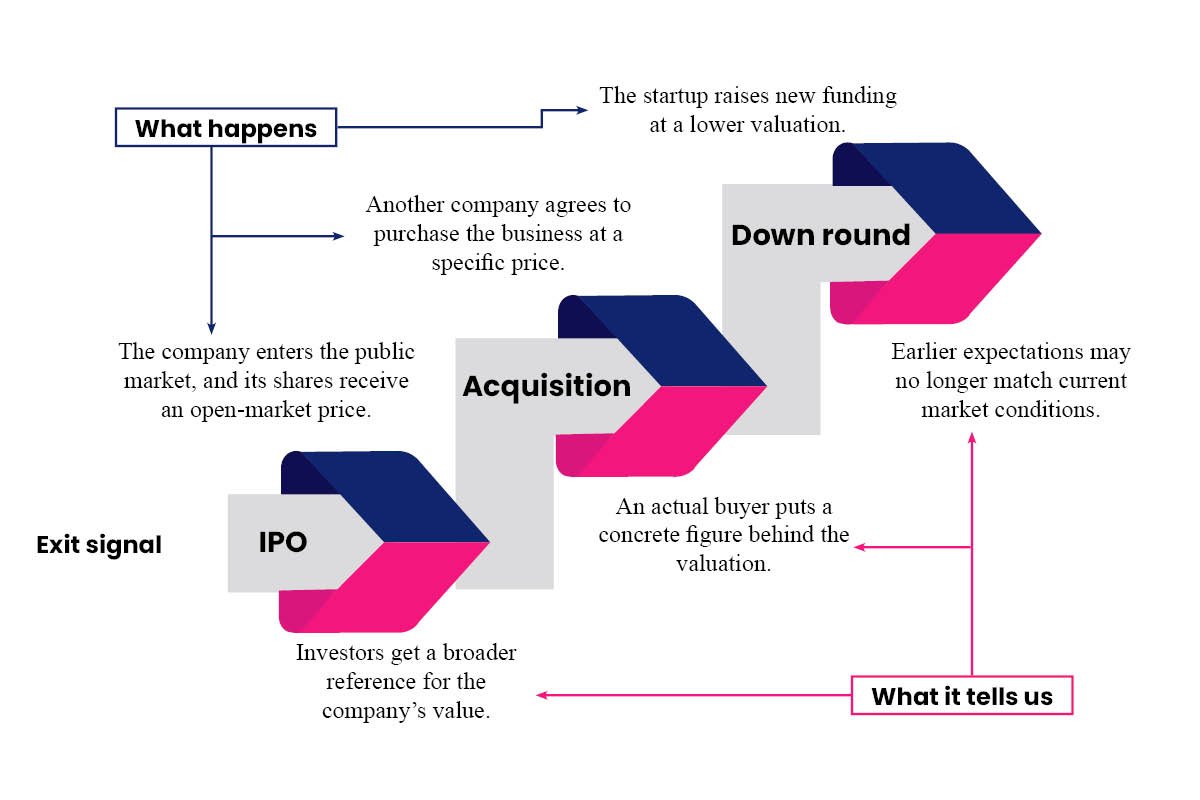
A private valuation faces its clearest test when investors can see what the company is actually worth in a real transaction.
| Exit signal | What happens | What it tells us |
| IPO | The company enters the public market, and its shares receive an open-market price. | Investors get a broader reference for the company’s value. |
| Acquisition | Another company agrees to purchase the business at a specific price. | An actual buyer puts a concrete figure behind the valuation. |
| Down round | The startup raises new funding at a lower valuation. | Earlier expectations may no longer match current market conditions. |
One more factor: A delayed exit can leave a startup dependent on additional funding to keep expanding. An IPO or acquisition gives the Unicorn Valuation a clearer test through realised value.
Why this format works: The table lets readers compare each outcome instantly, while the short paragraph underneath handles the broader point about delayed exits without repeating the same structure used in your other sections.
Beyond the billion: what makes a unicorn valuable?
A billion-dollar label says little without the business case behind it. So, what is a unicorn worth when you look beyond the headline?
Use this quick test:
- Demand: Are customers willing to pay and stay?
- Economics: Can the business generate healthy returns per customer?
- Potential: Is there a large market and room for profitable growth?
- Capital: How much funding will the company need?
- Leadership: Does management have the skills to execute its plans?
- Position: Does the company have a clear competitive advantage?
It becomes more credible when these factors support the assumptions behind the price.
The investor’s view: valuation reflects future expectations
Investors are often pricing what they believe a company could become, rather than simply measuring what it has already achieved.
That distinction matters. Potential value rests on expectations about future growth, earnings, and market position. Demonstrated value rests on results the business has already delivered.
Academic research on private startup valuations adds useful perspective to this gap between expectations and evidence. Citrin Cooperman likewise highlights the importance of examining the assumptions and methods behind technology startup valuations.
A high Unicorn Valuation therefore represents a view of the future, with varying levels of evidence supporting that view.
The final check: what should readers take away?
A Unicorn Valuation should be read as a financial estimate, not a final verdict on what a company is worth. It can reflect genuine expectations about future performance, while funding conditions, investor protections, growth assumptions, and private-market pricing can shape the headline figure.
Before accepting the number, ask:
- How was the valuation established?
- What rights do investors receive?
- What business performance supports the figure?
- How much cash does the company consume?
- Can it generate sustainable returns?
- Has an IPO, acquisition, or later funding round supported the earlier valuation?
These questions put the headline figure into context. A valuation tells you what investors believe the company is worth at a particular point. Value ultimately depends on what the business can deliver.