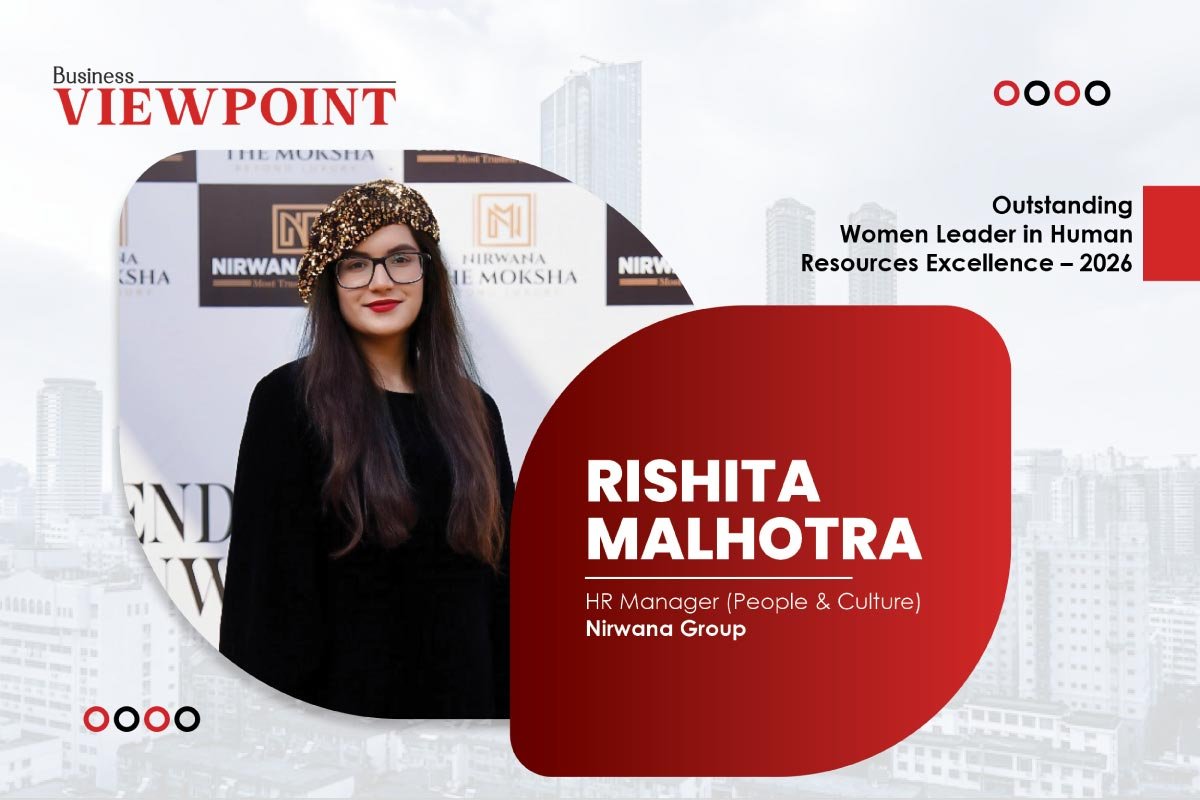


“In land development, technology may help us see further, but trust determines how far we can go. Our role is to combine both through disciplined processes that stand the test of time.”
Prachi Singh, Executive Director, Dharohar Land Corporation
In an industry shaped by changing regulations, growing customer expectations, and fast-moving digital integration, what truly sets a company apart often goes beyond land and infrastructure. It lies in credibility. Real estate development today calls for more than just execution. It requires foresight, ethical grounding, and a genuine commitment to building lasting relationships. As technology continues to change how projects are planned and delivered, trust remains the one constant that supports sustainable growth and long-term value.
Leading this balanced approach is Prachi Singh, Executive Director of Dharohar Land Corporation, who brings together strategic vision and principled leadership in her work. With a focus on disciplined processes and transparency, she has played a key role in guiding the company toward responsible land development while placing strong emphasis on client trust and operational integrity. Her leadership reflects a clear understanding that success in this field is not measured only by completed projects but by the confidence and credibility built along the way.
Built to Solve a Confidence Problem
Every industry runs on a kind of operating system. Some are built for efficiency, some for scale, and some continue running on old habits that no longer serve the people they were meant to. When Prachi entered India’s land investment sector after years of working in technology-driven environments abroad, she realised the real challenge wasn’t a lack of opportunity. India has always had plenty of that. The actual gap was information asymmetry, with too much reliance on trust and too little on verification, and too many decisions driven by instinct rather than structured processes.
As Prachi often puts it, “Dharohar Land Corporation was not created to sell land; it was created to solve a confidence problem.”
The company’s journey began with a simple question: “What would land investment look like if it were built with the same rigour as a modern technology company?” That question became the blueprint for everything Dharohar would go on to build.
The Architecture Beneath the Surface
In real estate, most people see the finished structure. Very few see the foundation beneath it. Prachi Singh believes the same holds true for land development. Many developers compete on visible factors such as price, location, incentives, or projected returns. While these matter, they are ultimately outcomes. The real differentiator lies in the invisible architecture that supports them, and at Dharohar Land Corporation, that invisible architecture is process.
It is a design principle. Every project undergoes a rigorous due diligence process covering title verification, encumbrance reviews, revenue record examination, zoning compliance, regulatory clearances, and environmental assessments before it is ever presented to an investor. Prachi compares it to an iceberg. The investor sees the opportunity above the surface, but beneath it sits an extensive body of research, verification, and risk evaluation that often goes unseen.
Dharohar also takes a deliberately long-term view of value creation. Markets move in cycles, headlines change, and speculative narratives come and go, but the company prefers to focus on fundamentals such as infrastructure connectivity, regulatory clarity, regional development potential, and demographic shifts that can support sustainable appreciation over time.
As Prachi explains, “A tree does not grow because someone predicts it will. It grows because the soil, roots, and environment are right.” Lasting value in land development works the same way. It comes from selecting the right fundamentals and allowing them to mature over time.
Ultimately, what sets Dharohar apart is that the company does not see itself merely as a developer of land. It sees itself as a custodian of investor confidence.
Sustainability From the First Decision
“Land is one of the few assets we borrow from the future before we truly own it.” This perspective, as Prachi Singh explains, shapes how Dharohar Land Corporation approaches development. Historically, real estate has often treated sustainability as a compliance requirement. Dharohar sees it instead as a value-preservation strategy, believing that the developments which thrive twenty years from now are unlikely to be the ones that ignored environmental realities today.
The company’s acquisition process includes environmental screening, regulatory reviews, and long-term land-use viability assessments before any investment decision is made. Dharohar actively avoids environmentally sensitive zones and prioritises locations that align with planned infrastructure and regional development frameworks.
As India’s urban landscape evolves, frameworks such as IGBC standards, GRIHA principles, integrated water management systems, climate-responsive planning, and resource-efficient infrastructure are becoming increasingly relevant. They offer a blueprint for developments that are not only commercially successful but also resilient.
As Prachi puts it, the future developer will not be judged solely by what they build, but by what they preserve while building it. For Dharohar, sustainability is not something added at the end of a project. It begins with the very first acquisition decision.
Trust as an Outcome, Not a Promise

Dharohar’s customer experience model is built on the idea that trust is an operational outcome, not a marketing promise. From the very first conversation with an investor, the company provides a structured legal brief covering title status, encumbrance history, land classification, and applicable approvals, well before any booking is processed.
Post-purchase, investors receive a complete documentation kit, a dedicated point of contact, and regular project updates. Buyers are never left to navigate land record systems on their own. Dharohar’s team supports them through mutation, demarcation, and registry processes at every step. This end-to-end engagement has significantly reduced post-sale disputes and contributed to steady referral-based growth, which now makes up a meaningful share of the company’s new investor pipeline.
Growth Built on Strong Foundations
As Dharohar Land Corporation expands its portfolio, the focus remains on locations where infrastructure, culture, policy, and economic growth come together to create long-term value. This includes spiritual and pilgrimage-led growth centres such as Varanasi, Ayodhya, Vrindavan, and Uttarakhand, heritage and tourism destinations across Rajasthan, globally connected coastal markets like Goa, and future-focused urban ecosystems such as the Dholera Special Investment Region.
That said, the company’s expansion philosophy is not driven by geography alone. Dharohar is equally focused on building partnerships that strengthen capability. Whether through collaborations with technology providers, planning experts, legal specialists, sustainability consultants, or infrastructure stakeholders, the goal remains the same: to build a stronger ecosystem around every project the company undertakes.
The Instrument Panel Approach
Technology has transformed almost every major industry over the past two decades, yet in land development, one of humanity’s oldest asset classes, many decisions are still made using methods that have changed very little over time. Dharohar Land Corporation saw that as an opportunity.
As Prachi Singh puts it, “For us, technology is the operating system that supports how we think, evaluate, and execute.” She often compares it to the instrument panel of an aircraft. It does not replace the pilot, but it gives the visibility needed to navigate uncertainty with greater confidence. The better the instruments, the better the decisions.
In project planning, the company uses data-driven evaluation frameworks to assess land parcels across multiple dimensions, including connectivity, infrastructure development, regulatory alignment, market potential, and future growth indicators.
On the customer side, Dharohar has implemented technology-enabled CRM systems and digital workflows that bring greater transparency to the investor journey. Whether it involves documentation, project updates, customer communication, or post-sales engagement, technology helps ensure that information flows efficiently and consistently.
Artificial intelligence is also becoming an increasingly valuable tool within the company’s ecosystem. From research synthesis and market intelligence to workflow automation and knowledge management, AI helps teams process information faster and make more informed decisions. As Prachi notes, its real advantage lies in helping the team ask better questions.
Three Trends Defining the Future of Land
India’s real estate landscape is being redrawn in real time. For decades, growth was concentrated around a handful of metropolitan centres. Today, entirely new investment geographies are emerging, driven by infrastructure, policy reforms, technology, and changing investor behaviour. As Prachi describes it, it feels less like watching a market evolve and more like watching a new map being drawn.
The first major trend is infrastructure-led value creation. Expressways, freight corridors, airports, industrial clusters, and smart city initiatives are reshaping the economic gravity of regions. History has shown that infrastructure does more than improve connectivity; it changes the destiny of locations. Roads do not merely connect places; they connect possibilities.
The second trend is the formalisation of land as an asset class. A decade ago, many land investments were driven largely by speculation. Today’s investors, particularly HNIs and experienced wealth creators, increasingly evaluate land through the lens of portfolio diversification, capital preservation, and long-term appreciation, seeking the same governance and transparency they would expect from any institutional-grade investment.
A third trend is the rise of technology-driven decision-making. Investors are no longer dependent solely on local information networks. Access to data, AI-powered research, digital documentation, GIS mapping, and real-time market intelligence is creating a far more informed buyer ecosystem, raising expectations and accountability across the industry. Alongside this is a growing emphasis on sustainable and compliant development.
Dharohar views these trends as a call to strengthen its research capabilities, deepen corridor-specific due diligence, use technology to support better decisions, and focus on locations backed by real infrastructure and policy momentum. Above all, the company continues to invest in governance-led processes that build confidence in an increasingly sophisticated market.
A Leadership Philosophy Built on L.A.N.D.

Real estate is often judged by what people can see: the plotted development, the infrastructure, and the rise in value over time. Prachi Singh believes the real work happens long before any of that becomes visible. It happens in the decisions nobody notices: the legal checks, the research, the governance systems, and the discipline to walk away from opportunities that do not meet the standard.
Her leadership philosophy rests on three pillars: technology, trust, and process. Technology helps separate signals from noise in an increasingly complex market. Trust builds the confidence needed for long-term investor relationships. Process ensures that quality is repeatable rather than accidental.
At Dharohar, these ideas come together in what the company calls its L.A.N.D. framework, standing for Legality, Acquisition, Nuance, and Decisions. Legality asks whether the foundation is sound. Acquisition asks whether the company is arriving at the right place at the right time. Nuance is a reminder that maps and master plans only tell half the story, with the rest unfolding on the ground. Decisions ensure that every investment can hold up not just against today’s market conditions but tomorrow’s uncertainties as well.
In many ways, Dharohar’s growth has come from building systems rather than chasing transactions. As Prachi puts it, the goal is not to predict the future but to prepare for it.
AI Across the Organisation
“AI’s greatest value is not generating answers. It’s expanding human capability.”
Prachi Singh, Executive Director, Dharohar Land Corporation
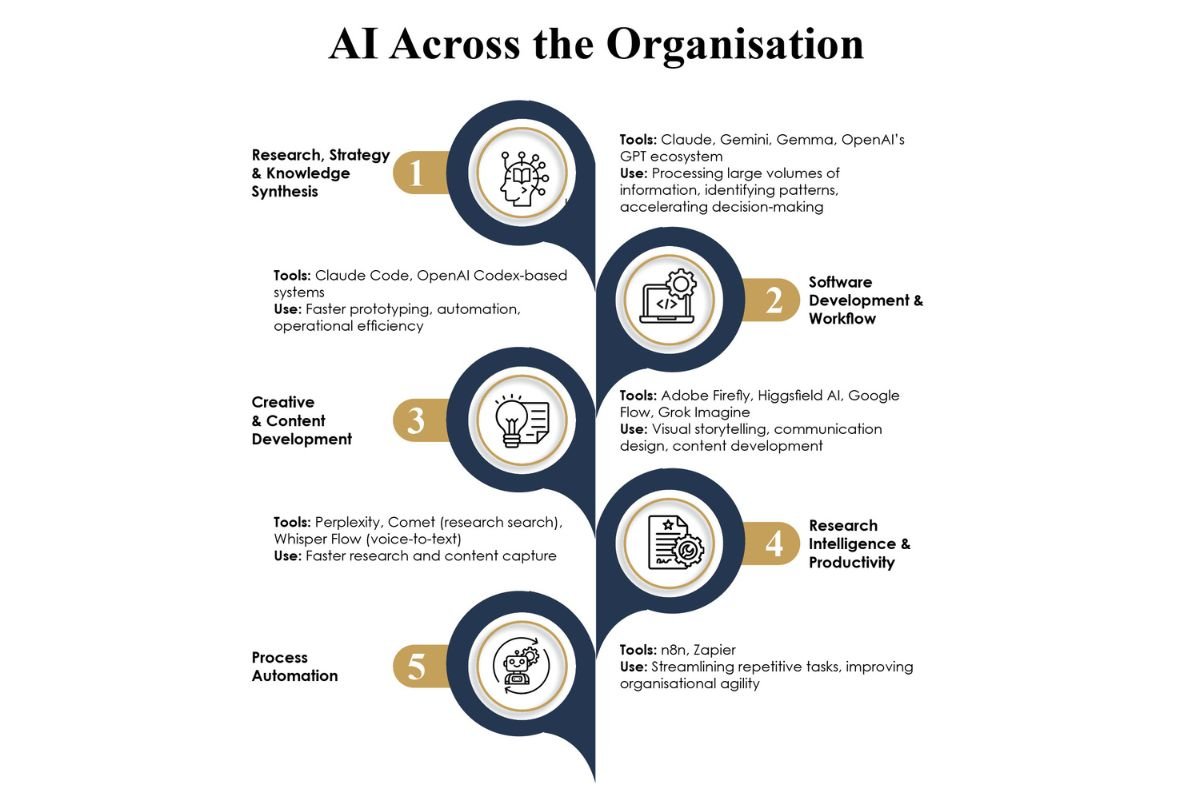
Research, Strategy & Knowledge Synthesis
- Tools: Claude, Gemini, Gemma, OpenAI’s GPT ecosystem
- Use: Processing large volumes of information, identifying patterns, accelerating decision-making
Software Development & Workflow
- Tools: Claude Code, OpenAI Codex-based systems
- Use: Faster prototyping, automation, operational efficiency
Creative & Content Development
- Tools: Adobe Firefly, Higgsfield AI, Google Flow, Grok Imagine
- Use: Visual storytelling, communication design, content development
Research Intelligence & Productivity
- Tools: Perplexity, Comet (research search), Whisper Flow (voice-to-text)
- Use: Faster research and content capture
Process Automation
- Tools: n8n, Zapier
- Use: Streamlining repetitive tasks, improving organisational agility
The Takeaway
AI’s greatest value is not generating answers. It is expanding human capability.
Growth at the Edge of Familiarity
“My greatest turning point wasn’t a single moment. It was learning that growth happens at the edge of familiarity.”
Early in her professional journey, Prachi Singh had the opportunity to work across diverse industries, functions, teams, and geographies. In the tech world, each role exposed her to a different way of solving problems, and looking back, she realises that every experience added a new lens through which to understand business.
Many professionals spend their careers digging deeper into a single well. Her journey encouraged her to explore multiple rivers instead. That diversity of exposure helped her connect ideas across disciplines and recognise patterns that might otherwise have gone unnoticed. Today, when she evaluates opportunities, builds teams, or makes strategic decisions, she draws on lessons from each of those experiences.
In many ways, her greatest turning point was not a moment at all. It was developing the willingness to step beyond the boundaries of a single profession and view every new challenge as an opportunity to grow.
Recognition and Media Coverage
Prachi Singh
- Featured in Femina Magazine, Power Women Leader 2026
Dharohar Land Corporation
- Emerging Developer of the Year 2026, awarded by Times of India
- Most Emerging Land Development Firm of the Year
- Best Integrated Township, Dharohar Estate
- Best Emerging Smart City Project, Expressway Retreat
The Success Code
One principle has consistently guided my journey: think beyond the transaction and focus on the legacy.
In business, as in life, sustainable success is rarely built overnight. It comes from making decisions that can withstand time, scrutiny, and changing circumstances. We believe land is more than an asset—it is a foundation for future generations. That belief shapes every decision we make, from acquisition and due diligence to investor relationships. When trust leads the process, and long-term value guides the vision, success becomes not just measurable but enduring.