



Every business reaches a stage where it must choose between expanding globally and growing in its home market.
This guide explains global expansion vs domestic growth strategies, including their benefits, risks, costs, timelines, and real-world examples to help you choose the right growth path.
Every business owner dreams of bigger sales, stronger profits, and a well-known brand. Then comes the million-dollar question. Should you conquer your home market first, or pack your bags and chase customers around the world?
It sounds exciting until reality arrives with different laws, cultures, currencies, and competitors.
At the same time, staying local may feel safe, but it can also limit growth if the market becomes crowded. That is why understanding global expansion vs domestic growth strategy matters more than ever.
The right decision can fuel years of success, while the wrong one can drain money, time, and confidence. Smart businesses do not chase every opportunity. They choose the opportunity that matches their goals.
Understanding global expansion vs domestic growth strategy
Before comparing both options, it helps to understand what they actually mean.
A global expansion vs domestic growth strategy compares two different ways a company can grow.
A global expansion strategy focuses on entering new international markets. Businesses may open overseas offices, partner with local distributors, launch country-specific websites, or sell products through international marketplaces.
A domestic growth strategy focuses on increasing market share within the existing country. Companies improve products, attract more local customers, expand into new cities, or increase customer loyalty.
Neither strategy is automatically better.
The right choice depends on factors such as available capital, business experience, customer demand, competition, regulations, and long-term goals.
Side-by-side comparison of global expansion vs domestic growth strategy
Many business owners assume international expansion always leads to faster growth. In reality, both approaches have unique advantages and challenges.
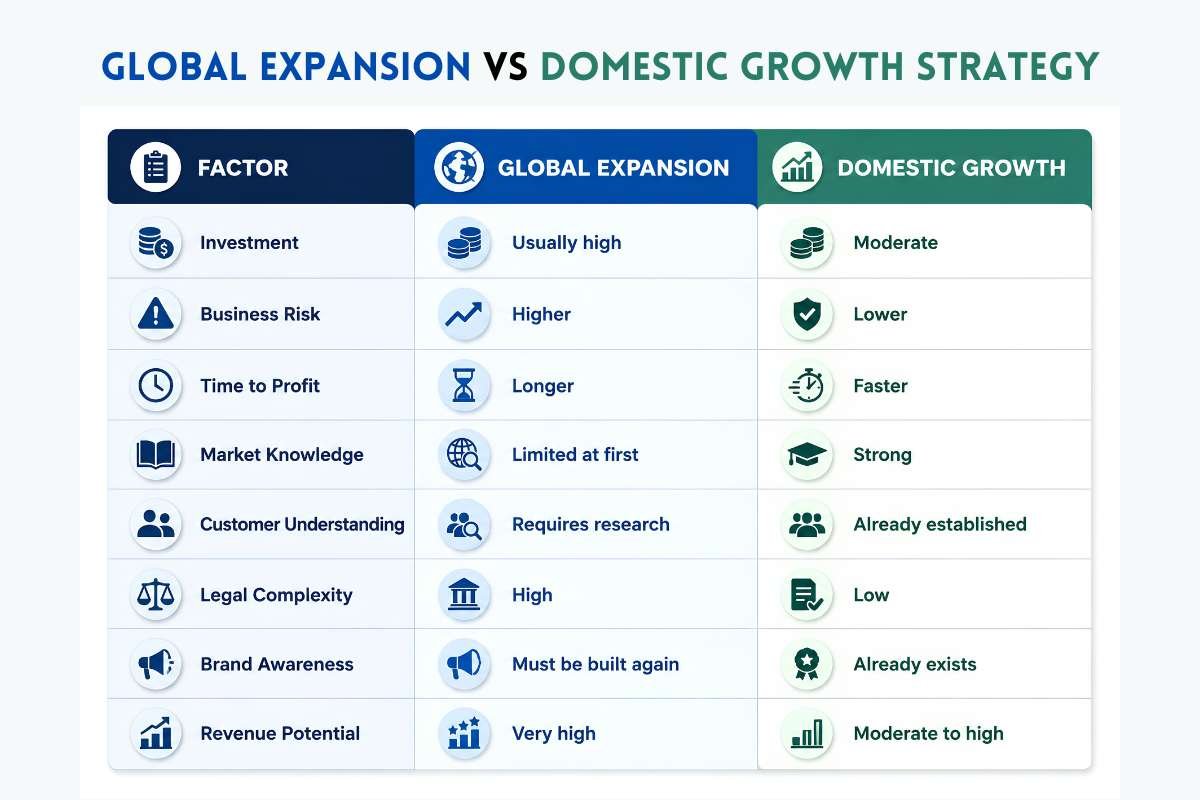
| Factor | Global Expansion | Domestic Growth |
| Investment | Usually high | Moderate |
| Business Risk | Higher | Lower |
| Time to Profit | Longer | Faster |
| Market Knowledge | Limited at first | Strong |
| Customer Understanding | Requires research | Already established |
| Legal Complexity | High | Low |
| Brand Awareness | Must be built again | Already exists |
| Revenue Potential | Very high | Moderate to high |
Looking at global expansion and domestic growth strategy this way makes it easier to see that the decision is about balance rather than ambition.
Capital requirements and financial commitment
Money is one of the biggest differences when comparing global expansion vs domestic growth strategy.
Expanding into another country often requires significant investment before earning meaningful revenue.
Businesses may need to pay for:
- Legal registrations
- Local licenses
- International marketing
- Product localization
- Currency management
- Distribution networks
- Local employees
- Warehousing
These costs can grow quickly.
Domestic growth usually costs less because the business already understands regulations, customer expectations, suppliers, and marketing channels.
Instead of building everything from scratch, companies improve what already works. This often results in faster returns and lower financial pressure.
Real world example: Starbucks expanded carefully
A good example is Starbucks.
Rather than entering every country at once, Starbucks carefully studied customer preferences before opening stores internationally. In China, for example, the company adapted store designs, menu offerings, and customer experiences to suit local culture instead of simply copying its U.S. model.
This approach reduced many expansion risks while helping the company build a strong international presence over time.
The lesson is simple.
International success requires more than opening new locations. It requires understanding local customers.
Risk profile: which strategy carries more uncertainty
Risk should never be ignored when evaluating a global expansion vs domestic growth strategy.
International growth introduces many uncertainties.
These include:
- Currency fluctuations
- Political changes
- Import restrictions
- Cultural differences
- New competitors
- Different tax systems
- Language barriers
Even successful products can fail if customer expectations differ across countries.
Domestic growth carries fewer unknowns.
Businesses already know:
- Customer buying habits
- Seasonal demand
- Competitor strengths
- Local regulations
- Marketing channels
That familiarity often reduces expensive mistakes.
However, domestic markets can eventually become saturated. Growth slows when nearly every potential customer already knows the brand.
This is why many mature companies eventually consider international expansion.
Case study: McDonald’s balanced both strategies
McDonald’s offers an excellent example of balancing global expansion vs domestic growth strategy.
The company first became one of the strongest restaurant brands in the United States. Only after building efficient operations did it expand globally.
Even today, McDonald’s adjusts its menus to match local tastes.
Customers in India see vegetarian options.
Customers in Japan enjoy unique seasonal products.
Customers in Europe often experience different café concepts.
This balance between global consistency and local adaptation has helped McDonald’s operate successfully across more than 100 countries.
Which businesses benefit most from domestic growth?

Many businesses actually achieve stronger long-term success by focusing on domestic expansion before entering international markets.
Domestic growth often works well for:
- Small businesses
- Family-owned companies
- Local service providers
- Regional retail chains
- Healthcare businesses
- Educational institutions
- Professional service firms
These businesses usually benefit from strengthening customer loyalty, improving operations, and building stable cash flow before expanding internationally.
Looking at global expansion vs domestic growth strategy, many experts recommend building a solid home-market foundation first because it creates financial stability and valuable operational experience.
Which businesses benefit most from global expansion?
After building a strong foundation, some businesses reach a point where local demand is no longer enough. This is where the global expansion vs domestic growth strategy becomes an important discussion. Companies that offer unique products, scalable services, or digital solutions often have the best chance of succeeding internationally.
Global expansion is usually a good fit for:
- Software and SaaS companies
- E-commerce brands
- Consumer electronics manufacturers
- Luxury brands
- Educational technology companies
- Healthcare technology firms
- Food and beverage brands with broad appeal
These businesses can often adapt their products to different markets without completely changing their business model.
For example, Netflix expanded from the United States into more than 190 countries by investing in local content rather than relying only on Hollywood productions. Popular shows such as Money Heist (Spain), Squid Game (South Korea), and Sacred Games (India) attracted millions of viewers worldwide. This strategy proved that understanding local audiences can create global success.
Timelines and return on investment
One of the biggest differences between global expansion and domestic growth strategies is the time required to see meaningful returns.
Domestic growth usually produces faster results because businesses already have:
- Brand recognition
- Existing customers
- Local supplier relationships
- Marketing data
- Customer trust
As a result, companies often see increased revenue within months after launching new products or expanding into nearby cities.
International expansion usually requires more patience.
Businesses need time to:
- Understand customer behavior
- Build brand awareness
- Hire local talent
- Establish partnerships
- Meet legal requirements
- Optimize logistics
Some companies wait several years before their overseas operations become consistently profitable.
According to the Organisation for Economic Co-operation and Development, successful international businesses often invest heavily during their early years before achieving sustainable long-term growth.
Which businesses tend to suit each path with a simple decision framework?

One of the most practical ways to approach global expansion vs domestic growth strategy is to look at the type of business you operate. Different business models benefit from different growth paths.
- A Simple Decision Framework
If you are unsure which path to choose, use this four-step framework.
Step 1: Check your cash position
Choose domestic growth if:
- Your budget is limited.
- You need faster returns.
- You want lower financial risk.
Consider global expansion if:
- You have strong cash reserves.
- You can invest for several years before seeing full returns.
Step 2: Measure market opportunity
Choose domestic growth if:
- Many customers in your country still do not know your brand.
- Your market share is relatively small.
Consider global expansion if:
- Your domestic market is becoming saturated.
- Growth has slowed significantly.
Step 3: Assess operational readiness
Choose domestic growth if:
- Your systems still need improvement.
- Customer support and logistics are under pressure.
Consider global expansion if:
- Your operations run smoothly.
- Your supply chain can handle additional demand.
Step 4: Evaluate product fit
Choose domestic growth if:
- Your product depends heavily on local culture or regulations.
Consider global expansion if:
- Your product solves a universal problem.
- Customers in other countries are already showing interest.
Conclusion
Every business has its own journey, so there is no single answer to the global expansion vs domestic growth strategy. Some companies achieve remarkable success by becoming market leaders at home, while others unlock new opportunities by entering international markets.
The smartest decision is not the biggest one; it is the one that matches your resources, customers, and long-term vision.
Growth should never be rushed. Build a strong foundation, evaluate opportunities carefully, and expand only when your business is truly ready for the next step.
FAQs
1. What is the difference between a global expansion and a domestic growth strategy?
Domestic growth focuses on growing within your home country, while global expansion targets customers in international markets.
The right choice depends on your business goals, budget, and growth opportunities.
2. Which is less risky, global expansion or domestic growth?
Domestic growth is usually less risky because businesses already know the local market and customers.
Global expansion involves more challenges but can bring higher long-term growth.v
3. When should a business expand internationally?
A business should expand internationally after building a strong position in its home market.
Stable finances, efficient operations, and market research are key before entering new countries.
Thank You for Reading!
See More
Indian Companies Expanding Globally Through Innovation and Smart Moves